



Content Curator
Ethylene is a gaseous plant hormone. It comes under the group of plant hormones called plant growth regulators (PGR). Ethylene is one of the most widely used PGRs in Agriculture. Structurally, it is a simple hydrocarbon, chemically represented as C2H4. Ethylene is unique among the Plant Growth Regulators as it can act as both Plant Growth Promoter and Plant Growth Inhibitor. Some of its major functions include promoting senescence and abscission in leaves and flowers, apical hook formation in dicot seedlings, and breaking of seed and bud dormancy.
| Table of Content |
Key Takeaways: Ethylene, C2H4, Plant Growth Regulators, senescence, abscission, seed dormancy, ethephon.
Ethylene Formula
[Click Here for Sample Questions]
Ethylene is a small, 2-carbon containing hydrocarbon. As it contains a double bond between the two carbon atoms, it is an unsaturated hydrocarbon compound. According to the IUPAC nomenclature, it’s chemical name is “Ethene”. At standard temperature and pressure, Ethylene exists as a colorless flammable gas, with a sweet odor.
Chemical Formula and Condensed Formula
Hydrocarbons are one of the simplest carbon compounds made of Carbon and Hydrogen atoms. Ethylene, or Ethene, belongs to the alkene family of hydrocarbons, with general formula CnH2n, where n represents the number of carbon atoms.
Now, Ethylene has two carbon atoms in it. It means that the corresponding number of Hydrogen atoms present in Ethylene would be 2x2 = 4.
Hence, the chemical formula of Ethylene becomes C2H4. This chemical formula of Ethylene is also called its condensed formula.
Structural Formula
In the structural formula, we represent the bonds between the atoms in the form of lines. The structural formula of Ethylene can be written as H2C=CH2.
This formula is expanded as
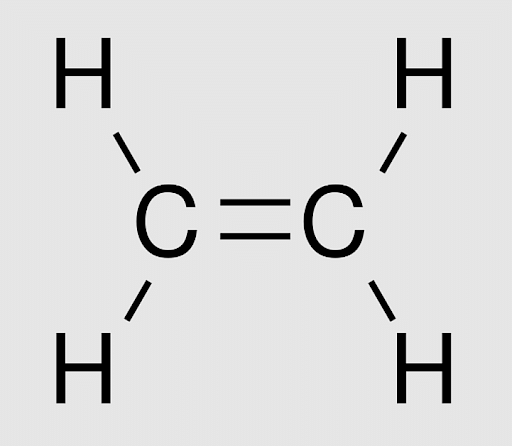
Ethylene Structural Formula
Ethylene Structure
[Click Here for Sample Questions]
Ethylene follows sp2 hybridisation. As a result, it is expected to have a bond angle of 120o, and geometry is Planar. Studies have shown that the exact bond angle between H-C-H in ethylene is 117.4o, which is very close to 120o. Due to the presence of four hydrogen atom bonds and carbon atoms known as double bonds, the ethylene molecule is rigid, and breaking the C=C structure requires very high energy. The bond length for the C-H bond is 108.7 ppm, and the bond length for C=C bond is 133.9 ppm. The exact structure of ethylene is drawn below.
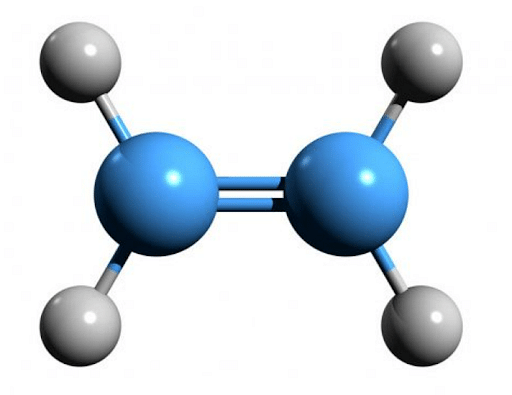
Ethylene Structure
Ethephon
[Click Here for Sample Questions]
Ethephon is the source of Ethylene in the plant body. During metabolism, the ethephon is converted into ethylene.
Plant Growth Regulators
[Click Here for Sample Questions]
The growth, development, and aging of all the parts of the plant are controlled by a large family of hormones. These hormones are called plant growth regulators. They are also called PGR in short. Fundamentally, Plant Growth Regulators are of two types: Plant Growth Promoters, and Plant Growth Inhibitors.
The Plant Growth Promoters support the growth and development of the plant bodies. Hence, they are usually associated with functions like cell division and enlargement, tropic growth, flowering, etc. Some of the common hormones that come under this category are Auxins and Cytokinin.
On the other hand, Plant Growth Inhibitors promote the aging process. The yellowing of leaves is a result of their activity. At the same time, they are involved in seed dormancy as well. Abscisic acid is a common PGR belonging to this group.
Apart from these two categories, there are some PGRs that can act as both promoters and inhibitors. Ethylene is one of those. However, it mostly acts as an inhibitor.
Functions of Ethylene as Plant Hormone
[Click Here for Sample Questions]
Ethylene is synthesized in large amounts inside ripening fruits and aging tissues. It is known to increase the rate of respiration during ripening. Apart from fruit ripening, it helps in breaking the dormancy, and hence plays a crucial role in seed germination. There are many other functions that Ethylene plays in a plant body.
Apical Hook Formation
Ethylene helps in activating the genes that are responsible for apical hook formation. Also, it helps in promoting auxin synthesis.
Senescence
The aging process in plants is called senescence. Ethylene helps in senescence of leaves and fruits.
Abscission
The detachment of dried plant parts from the plant body is called abscission. Ethylene promotes the abscission of dried leaves and fruits.
Ripening of Fruits
Ethylene is found in large amounts in the ripening fruits. It helps in increasing the respiration rate of the ripening fruits.
Breaking the Dormancy
Ethylene helps to break the dormancy in both seeds and buds. As a result, it plays a major role in initiating the germination process, and helps in sprouting of seeds to give rise to young plants from them.
Root Growth
Ethylene promotes growth of roots. It also helps in formation of root hairs.
Flowering
Ethylene is often used to initiate and trigger flowering. It is also a natural stimulator of flowering in many plants, like Mango.
Uses of Ethylene
[Click Here for Sample Questions]
In the agriculture industry. Ethylene is used for the following purposes:
- Ethylene is used to ripen the fruits for selling purpose.
- The agriculturists use Ethylene to increase female flowers in plants.
- The farmers apply ethylene to rhizomes and tubers to induce rapid sprouting.
- It is used to thin the outer coverings of tough fruits like walnuts and cotton.
Points to Remember
Some most crucial points about Ethylene.
- The chemical name of Ethylene is Ethene and its chemical formula is C2H4.
- Ethylene influences the horizontal growth of seedlings.
- Ethylene plays a crucial role in formation of ethical hooks in dicotyledonous seedlings.
- It plays a major role in promoting senescence and abscission.
- It is extremely crucial in ripening of fruits. It also helps in the respiratory climate during ripening.
- It breaks the dormancy of both buds and seeds.
Sample Questions
Ques. What is the IUPAC name of Ethylene? Explain its structure on the basis of hybridisation. (3 Marks)
Ans. The IUPAC name of Ethylene is Ethene. It is a part of the alkene family of hydrocarbons. It has a double bond between the two carbon atoms, and four hydrogen atoms are linked to the two carbon atoms, two hydrogens per one carbon.
In Ethylene, there is one sigma bond and one pi bond between the two carbon atoms, while hydrogen atoms are connected with sigma bonds. It follows sp2 hybridisation. Hence, it has a planar structure, and the angle between the H-C-H bond is 117.4o.
Ques. Why is Ethylene used by cucumber farmers? (2 Marks)
Ans. Ethylene helps to increase the number of female flowers in the cucumber plants. As the number of female flowers in a single plant increases, a greater number of fruits are produced from a single plant. Hence, it helps to increase the yield of the plants. As the yield increases, the profits of the farmers increase. For this reason, cucumber farmers use Ethylene.
Ques. During rice cultivation, which hormone helps the leaves to stay afloat above water? How? (3 Marks)
Ans. Ethylene plays a significant role in rice cultivation. During rice cultivation, the farmers irrigate the lands with a lot of water, as a result, the lower part of the plants sometimes get submerged. But, to protect the leaves from getting under the water, Ethylene helps to elongate the petioles of deep-water rice plants. So, the petioles become longer, and the leaves can easily get out and float above the water surface. It helps the leaves to stay healthy and keep conducting the photosynthesis process without any hindrance.
Ques. What is respiratory climatic? Which hormone is responsible for it? (2 Marks)
Ans. During the fruit ripening process, the ripening fruits respire faster. This phenomenon of increasing the rate of respiration during fruit ripening is called respiratory climatic. It is important to maintain the heat and growth level of ripening fruits. Ethylene is responsible for initiating this process. In this way, Ethylene plays a major role in ripening of fruits.
Ques. What is Ethephon? How is it related to Ethylene? (2 Marks)
Ans. Ethephon is a carbon compound that releases Ethylene inside the plant body. The aqueous solution of Ethephon is the most widely used source of Ethylene. It is because ethephon can quickly release ethylene upon metabolism. Its toxicity level is also very low.
Ques. Write three most prominent functions of Ethylene in the plant body. (3 Marks)
Ans. The three most prominent functions of Ethylene in the plant body are:
- Ripening of fruits: Ethylene helps in increasing the respiration rate of the ripening fruits, and reach the respiratory climatic.
- Breaking of dormancy: Ethylene plays a major role in initiating seed germination. It also helps in breaking the dormancy of buds.
- Initiation of flowering: Ethylene initiates flowering process by breaking bud dormancy.
Ques. “Ethylene fits both the groups” - Explain the statement. (3 Marks)
Ans. Ethylene can act as both plant growth promoter and inhibitor, as:
- It helps in senescence and abscission.
- It helps in breaking the bud and seed dormancy.
- At the same time, it also helps in growth and elongation of certain parts of plants.
Ques. Why do fruits kept in paper bags ripen faster? (2 Marks)
Ans. The fruit vendors often keep the fruits treated with Ethylene lamps inside the paper bags. It is because, when Ethylene is released, the paper bags do not allow the gas to escape. The higher concentration of Ethylene inside the paper bags helps in faster ripening of fruits.
Also Read:



Comments