



Content Curator
Factors of 28 are the numbers that can evenly divide the whole number 28. The factors of 28 are 1, 2, 4, 7, 14, and 28. On dividing the number 28 by any of its factors, the remainder will be equal to zero and the quotient will be a natural number.
- The sum of the factors of 28 is 56.
- The pair factors are a set of numbers that produces the original number on multiplication.
- The pair factors of 28 are (1, 28), (2, 14), and (4, 7).
- The prime factorization of 28 is written as 2 x 2 x 7.
- 2 and 7 are the two prime factors of 28.
- In order to determine the factors of 28, start by dividing it by the smallest prime number, i.e. 2. In case 2 is a factor of 28, then you can divide the result by 2 again, continuing until reaching a quotient of 1 or an odd prime number.
Read More: NCERT Solutions for Class 6 Maths Playing With Numbers
| Table of Content |
Key Terms: Factors of 28, Prime Factorization, Multiplication, Pair Factors, Prime Factors, Composite Number, Prime Number, Remainders, Number System
What are Factors?
[Click Here for Sample Questions]
Factors are the numbers which divide another number without leaving a remainder. Simply, factors, in math, are the numbers that can be multiplied together to get another number.
- For example, the factors of 42 are 1, 2, 3, 6, 7, 14, 21, and 42, because these numbers can be multiplied in various combinations to get 42.
- Factors can be either positive or negative. Also note that every number has at least two factors, which are, 1 and itself.
- The process of finding the factors of a number is known as Factorization.
Read More: LCM Formula
What are Factors of 28?
[Click Here for Sample Questions]
Factors of 28 are the natural numbers that divide 28 completely without leaving any remainder. Factors of 28 are pairs of those numbers whose product gives the value 28.
The number 28 is an even composite number that states that it has more than two factors. There are 6 factors of 28 which are 1, 2, 4, 7, 14, and 28.
| Factors of 28: 1, 2, 4, 7, 14, and 28 |
1 is the smallest factor of 28 while 28 itself is the biggest factor.
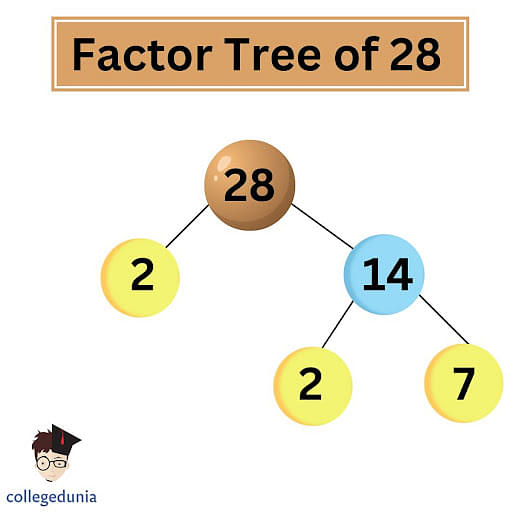
Factor Tree of 28
Read More:
Pair Factors of 28
[Click Here for Sample Questions]
The pair factors are a set of two numbers that give the value of the original number when multiplied by each other.
Positive Pair Factors of 28
The positive pair factors of 28 are (1, 28), (2, 14), and (4, 7).
| Factors | Pair Factors |
|---|---|
| 1 × 28 = 28 | (1, 28) |
| 2 × 14 = 28 | (2, 14) |
| 4 × 7 = 28 | (4, 7) |
Negative Pair Factors of 28
The negative pair factors of 28 are (-1, - 28), (- 2, - 14) and (- 4, - 7).
| Factors | Pair Factors |
|---|---|
| -1 × -28 = 28 | (-1, - 28) |
| - 2 × -14 = 28 | (- 2, - 14) |
| - 4 × -7 = 28 | (- 4, - 7) |
How to Calculate Factors of 28?
[Click Here for Sample Questions]
The following steps need to be followed in order to calculate the factors of the number 28:
- Step 1: The first step is to write down the number to be factored, i.e. 28
- Step 2: Now, take two numbers whose product gives 28. We will be taking here 2 and 14 as the numbers.
- Step 3: 2 is a prime number which means that it can only be factored as 1 and the number itself, i.e. 2.
- Step 4: However, 14 is not a prime number, so, it can be factored as 2 and 7, apart from 1 and the number itself.
- Step 5: 14 can be written as 14 = 7 × 2 × 1.
- Step 6: Now, we cannot factorize the numbers further which means that these are the only factors of 28.
Thus, the factors of 28 are 1, 2, 4, 7, 14, and 28.
Read Also: Difference Between Whole Numbers and Natural Numbers
Factors of 28 by Division Method
[Click Here for Sample Questions]
The factors of a number can be calculated by checking whether a given number is completely divisible by that particular number.
In the case of number 28, we can see that all the factors of 28 divide 28, evenly.
- 28 ÷ 1 = 28
- 28 ÷ 2 = 14
- 28 ÷ 4 = 7
- 28 ÷ 7 = 4
- 28 ÷ 14 = 2
- 28 ÷ 28 = 1

Factors of 28
If we try to divide 28 by any other natural number other than these factors, then the resulting quotient will be a fraction. For example, by dividing 28 by 3, we get,
28 ÷ 3 = 9.33.. (fraction)
So, 3 is not a factor of 28.
Prime Factorization of 28
[Click Here for Sample Questions]
28 is a composite number which means that it has prime factors. We can get the prime factors of 28 by performing the prime factorization of 28.
Step 1: Divide 28 with the smallest prime factor 2.
28 ÷ 2 = 14
Step 2: Now, divide 14 by 2 and continue the process.
14 ÷ 2 = 7
Step 3: If we divide 7 by 2, we will get the value in fractions, so, we will continue with the next prime factor 7.
7 ÷ 7 = 1
We received the number 1 at the end of the division process. It means we can not proceed further with the factorization process. The prime factorization of 28 is written as 2 × 2 × 7 or 22 x 7. 2 and 7 are the two prime factors of 28.
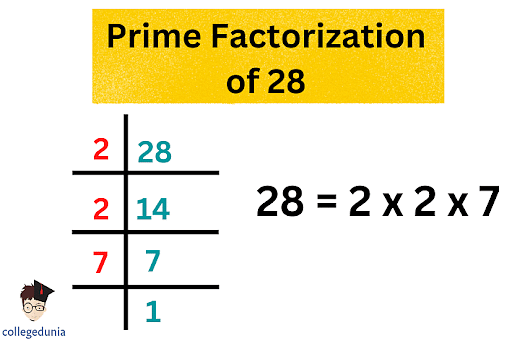
Prime Factorization of 28
Solved Examples on Factors of 28
[Click Here for Sample Questions]
Example 1: List the common factors of 28, 32, and 48.
Ans: All the factors of 28, 32, and 48 are as follows:
- Factors of 28: 1, 2, 4, 7, 14, 28
- Factors of 32: 1, 2, 4, 8, 16, 32
- Factors of 48: 1, 2, 3, 4, 6, 8, 12, 16, 24, 48
Thus, the common factors of 28, 32 and 48 are 1, 2 and 4.
Example 2: Mention the common factors of 28 and 56.
Ans: Writing down all the factors of 28 and 56,
- Factors of 28: 1, 2, 4, 7, 14, and 28.
- Factors of 56: 1, 2, 4, 7, 8, 14, 28, and 56.
Thus, there are 7 common factors of 28 and 56 which are 1, 2, 4, 7, 8, 14, and 28.
Factors in Math
[Click Here for Sample Questions]
Some examples of factors are:
Factors of 45
The factors of 45 are:
1, 3, 5, 9, 15, 45.
Factors of 30
The factors of 30 are:
1, 2, 3, 5, 6, 10, 15, 30.
The factors of a number are numbers dividing the given number completely and leaving no remainder.
Factors of 20
The factors of 20 are:
1, 2, 4, 5, 10, 20.
Factors of 60
The factors of 60 are:
1, 2, 3, 4, 5, 6, 10, 12, 15, 20, 30, and 60.
Factors of 36
The factors of 36 are:
1, 2, 3, 4, 6, 9, 12, 18, and 36.
Read More:
Things to Remember
- Factors of 28 are the numbers that divide 56 evenly leaving no remainder.
- There are 6 factors of 28 which are 1, 2, 4, 7, 14, and 28.
- The pair factors of 28 are those numbers that when multiplied in pairs give the number 28 as the product.
- (1, 28), (2, 14), and (4, 7) are the three pair factors of 28.
- The prime factors of 28 are 2 and 7 and the prime factorization of 28 is 2 x 2 x 7.
- The total sum of the factors of 28 is 56.
For Latest Updates on Upcoming Board Exams, Click Here: https://t.me/class_10_12_board_updates
Sample Questions
Ques. Christina has to distribute 28 food packets among 16 children. Calculate the extra number of packets she will require if they can't be distributed equally. (3 Marks)
Ans. In order to distribute the 28 food packets among 16 children equally, we need to divide 28 by 16,
28 ÷ 16 = 1.75
We can see that 28 is not entirely divisible by 16. So, the closest number to 28 which is completely divisible by 16 is 32.
Thus, Christina will require 4 more packets.
Ques. Farhan wants to count all the positive and negative factors of 28. Help him with the same. (2 Marks)
Ans. We know that the factors of 28 are those numbers that divide the number 28 completely leaving zero as the remainder.
The positive factors of 28 are 1, 2, 4, 7, 14, and 28 whereas the negative factors of 28 are -1, -2, -4, -7, -14, and -28.
Ques. Check whether 28 is a perfect number or not. (3 Marks)
Ans. Perfect numbers are those numbers whose factors excluding the number itself add up resulting in the same number. We know that the factors of 28 are 1, 2, 4, 7, 14, and 28. Adding up the factors of 28 excluding 28 gives:
1 + 2 + 4 + 7 + 14 = 28.
It can be seen that the sum of the factors of 28 (excluding 28) results in 28, thus, it is a perfect number.
Ques. Find out the greatest common factor of 28 and 26. (2 Marks)
Ans. The factors of 28 and 26 are as follows:
- Factors of 28: 1, 2, 4, 7, 14, 28
- Factors of 26: 1, 2, 13, 26
The common factors of 28 and 26 are 1 and 2. Thus, the greatest common factor of 28 and 26 is 2.
Ques. Which numbers are the prime factors of 28? (1 Mark)
Ans. Among all the factors of 28, there are only two prime numbers which are 2 and 7. Thus, the prime factors of 28 are 2, and 7.
Ques. List the Common Factors of 28 and 11. (2 Marks)
Ans. The factors of 28 and 11 are as follows:
- Factors of 28: 1, 2, 4, 7, 14, 28
- Factors of 11: 1, 11.
Thus, 28 and 11 have only one common factor which is 1. It implies that 28 and 11 are co-prime.
Ques. What is the total of all the Factors of 28? (2 Marks)
Ans. We know that the factors of 28 are 1, 2, 4, 7, 14, and 28. Adding up all these factors,
1 + 2 + 4 + 7 + 14 + 28 = 56
Thus, the sum of all the factors of 28 is 56.
Ques. Find the pair factors of 28 which on addition gives 16, subtraction gives 12, and division gives one of the factors of 28 which belongs to another pair. (3 Marks)
Ans. According to the question, the pair gives
- Addition of pair factors = 16,
- Subtraction of pair factors = 12.
- Division of pair factors = One factor belonging to another pair
As per the above conditions, the pair factor is (14, 2). 14 and 2 on addition give 16, subtraction gives 12, and division gives 7 which is another factor of 28 and is a part of another pair factor.
Ques. Mention the first 10 multiples of 28. (3 Marks)
Ans. The first 10 multiples of 28 are as follows:
- 28 × 1 = 28
- 28 × 2 = 56
- 28 × 3 = 84
- 28 × 4 = 112
- 28 × 5 = 140
- 28 × 6 = 168
- 28 × 7 =196
- 28 × 8 = 224
- 28 × 9 = 252
- 28 × 10 = 280
Thus, 28, 56, 84, 112, 140, 168, 196, 224, 252, and 280 are the first 10 multiples of 28.
Ques. How many multiples does 28 have? (1 Mark)
Ans. The number of multiples of any number is infinite which is that they are never-ending. 28 also have infinite multiples.
Ques. Demonstrate the Following: Prime factorisation of 284 × Prime factorisation of 456 = Prime factorisation of (284 × 456). (3 marks)
Ans. Prime factorisation of 284 = 2 × 2 × 71
Prime factorisation of 456 = 2 × 2 × 2 × 3 × 19
Therefore, it can be said that,
Prime factorisation of (283 × 456) = Prime Factorisation of 129504 = 2 × 2 × 2 × 2 × 2 × 3 × 19 × 71
Hence, it can be seen that: Prime factorisation of 284 × Prime factorisation of 456 = Prime factorisation of (284 × 456).
Read More:



Comments