



Education Journalist | Study Abroad Lead
Commutative Law deals with the arithmetic operations of addition and multiplication. Commutative Law is not used for the other two arithmetic operations, subtraction and division. If we define commutative, the term “Commutative” comes from the word “commute” which can be defined as moving around or travelling. The Commutative law or commutative property explains that if ‘a’ and ‘b’ are any two integers, the addition and multiplication of ‘a’ and ‘b’ produce the same result regardless of their position. We can symbolically represent it as: (a + b = b + a) and (a × b = b × a).
| Table of Contents |
Key Terms: Commutative Law, Arithmetic Operations, Addition, Multiplication, Associative Law, Subtraction, Division, Percentage
What is Commutative Law?
[Click Here for Sample Questions]
According to the commutative law, when two numbers are added or multiplied, the final value remains the same regardless of the position of the two numbers. In simpler terms, the sequence in which we add or multiply any two real numbers has no effect on the outcome. Therefore, if altering the order of the operands has no effect on the result of the arithmetic operation, that arithmetic operation is commutative.
If we consider that A and B are two real numbers, then, by this law;
- A + B = B + A
- A x B = B x A
For example, if 50 and 100 are the two integers, then;
50 + 100 = 100 + 50 = 150
50 x 100 = 100 x 50 = 5000
Read More: Multiplication and Division of Integers
Proof of Commutative Law
[Click Here for Sample Questions]
The commutative law of addition and multiplication has been proved below.
- Commutative Law of Addition
According to the commutative law of addition, if two numbers are added, then the result is equal to the addition of their interchanged position.
A + B = B + A
Examples:
- 1 + 2 = 2 + 1 = 3
- 4 + 5 = 5 + 4 = 9
- -3 + 6 = 6 + (-3) = 6 –
- 3 = 3
The commutative law is not applicable for subtraction because if the first number is negative and if we change the position, then the sign of the first number will get changed to positive, therefore;
(-A) - B = -A – B …… (1)
After changing the position of the first and second number, we get;
B – (-A) = B + A …. (2)
Hence, from equation 1 and 2, we can see that;
(-A) - B ≠ B - (-A)
For example: (-9) - 2 = -9 - 2 = -11 & 2 - (-9) = 2 + 9 = 11
Hence, -11 ≠ 11.

Commutative Law of Addition
Read More: Addition and Subtraction of Integers
- Commutative Law of Multiplication
According to this law, the result of the multiplication of two numbers stays the same, even if the positions of the numbers are interchanged.
Hence, A x B = B x A
Examples:
- 1 × 2 = 2 × 1 = 2
- 4 × 5 = 5 × 4 = 20
- -3 × 6 = 6 × (-3) = -18
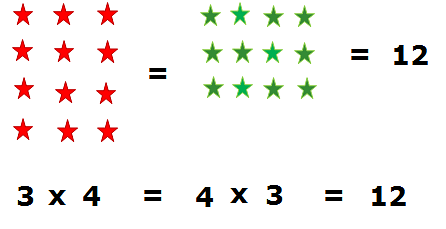
Commutative Law of Multiplication
Read More: Multiplication & Division
- Commutative Law in Percentages
When we calculate percentages, if we interchange or swap the order of the values, then
the answer does not change. Mathematically we can say;
A% of B = B% of A
Example:
20% of 50 = 50% of 20
Since,
20% of 50 = (20/100) x 50 = 10
50% of 20 = (50/100) x 20 = 10
Thus, the answer remains the same.
Read More: How to Calculate Percentage?
Things to Remember
- Commutative Law explains that the sequence in which we add or multiply any two real numbers has no effect on the outcome.
- When we add or multiply two numbers, the final value remains the same regardless of the position of the two numbers.
- Take A and B are two real numbers, then, by commutative law; A + B = B + A and A x B = B x A
- Commutative law is not applicable for subtraction because if the first number is negative and if we change the position, then the sign of the first number will get changed to positive.
- The commutative law does not apply to division because interchanging the values would give different results, a / b is not equal to b / a.
Sample Questions
Ques. State the difference between commutative property and associative property? (5 Marks)
Ans. The commutative property tells that the change in the order of numbers in an addition or multiplication operation does not change the sum or the product.
- For addition, the commutative property is: A + B = B + A.
- For multiplication, the commutative property is A × B = B × A.
Whereas, the associative property states that adding or multiplying two or more integers without grouping or combining them does not modify the sum or result.
- We represent the associative property of addition as: (A + B) + C = A + (B + C).
- The associative property of multiplication is (A × B) × C = A × (B × C).
Ques. Define Commutative law. (3 Marks)
Ans. According to the commutative law, when two numbers are added or multiplied, the final value remains the same regardless of the position of the two numbers. In simpler terms, the sequence in which we add or multiply any two real numbers has no effect on the outcome.
Ques. State an example of commutative law of addition? (1 Mark)
Ans. The example of commutative law of addition is: 40 + 10 = 10 + 40 = 50
Ques. Give an example of the commutative law of multiplication? (1 Mark)
Ans. The example of the commutative law of multiplication is: 2 x 5 = 5 x 2 = 10
Ques. Can we use Commutative Property for subtraction and division? (3 Marks)
Ans. We cannot use the commutative property for subtraction and division, it is because when we change the order of the numbers while doing subtraction and division do not produce the same result.
For instance, when we subtract ( 5 - 2) is equal to 3, whereas subtracting (3 - 5) is not equal to 3. Similarly, when 10 is divided by 2, it gives 5, whereas, when 2 is divided by 10, does not give 5. Thus, we can say the commutative property is not true for subtraction and division.
Ques. Give an example of commutative law in percentages. (3 Marks)
Ans. 10% of 50 = 50% of 10
Since,
10% of 50 can be written as (10/100) x 50 = 5
50% of 10 can be written as (50/100) x 10 = 5
Thus, we notice that the result remains the same.
Ques. Give an example of the commutative law of sets. (3 Marks)
Ans. Given A = {1, 2, 3} and B = {3, 4, 5, 6}
Let A ∪ B {1, 2, 3, 4, 5, 6} …….. (i)
Thus, B ∪ A {1, 2, 3, 4, 5, 6} ……… (ii)
From (i) and (ii), we get;
A ∪ B = B ∪ A
Now,
A intersection B is represented as A ∩ B = {3} ……. (iii)
B intersection A is represented as B ∩ A = {3} ……. (iv)
From (iii) and (iv), we get;
A ∩ B = B ∩ A
Thus, the commutative law for the union and intersection of two sets has been established.
Ques. Given, A = 25 & B = 20. Explain Commutative Law of Addition, Commutative Law of Multiplication and Commutative Law in Percentages with the same values of A and B. (3 Marks)
Ans. A) For Commutative Law of Addition: A = 25, B = 20
A + B = 25 + 20 = 45. Also, B + A = 20 + 25 = 45.
Hence, A + B = B + A
B) For Commutative Law of Multiplication: A = 25, B = 20
A x B = 25 x 20 = 500. Also, B x A = 20 x 25 = 500.
Hence, A x B = B x A
C) For Commutative Law of Percentages: A = 25, B = 20
A % of B = 25 % of 20 = 5
B % of A = 20 % of 25 = 5
Hence, A % of B = B % of A.
Check-Out:



Comments