



Education Content Expert
Factors of 42 are the whole numbers that can divide the number 42 completely. 42 is an even composite number which means that it has several factors apart from 1 and the number itself. There are 8 factors of 42 which are 1, 2, 3, 6, 7, 14, 21, and 42. The factors of 42 in pairs are (1, 42), (2, 21), (3, 14), and (6, 7). These pair factors would result in the number 42 on multiplication with each other. The prime factorization of 24 is 2 × 3 × 7, where 2, 3, and 7 are its prime factors.
Read More: NCERT Solutions for Class 6 Maths Playing With Numbers
| Table of Content |
Key Terms: Factors of 42, Prime Factors, Prime Factorization, Composite Number, Pair Factors, Factors, Natural Numbers, Division, Remainder
What are the Factors of 42?
[Click Here for Sample Questions]
Factors of 42 are the numbers that divide 42 exactly without leaving any remainder. Since 42 is a composite number, it has many factors. The factors of 42 are 1, 2, 3, 6, 7, 14, 21 and 42. 14, 21 and 42.
Factors of 42: 1, 2, 3, 6, 7, 14, 21, 42
Read More:
| Chapter-Related Topics | ||
|---|---|---|
| Greatest Common Divisor | Perfect Numbers | Relation Between HCF and LCM |
| HCF | Co Prime Numbers | Properties of LCM and HCF |
Pair Factors of 42
[Click Here for Sample Questions]
Pair factors of 42 are the numbers that on multiplication give the result as 42. There are four pair factors of 42 which are (1, 42), (2, 21), (3, 14), and (6, 7).
- 1 × 42 = 42
- 2 × 21 = 42
- 3 × 14 = 42
- 6 × 7 = 42
The pair factors of 42 can be positive as well as negative. As the product of two negative numbers is positive, thus, the factor pairs of 42 also include (-1,-42), (-2,-21), (-3,-14), and (-6,-7).
Positive Pair Factors of 42
The positive pair factors of 42 are:
| Positive Factors of 42 | Positive Pair Factors of 42 |
|---|---|
| 1 × 42 | (1, 42) |
| 2 × 21 | (2, 21) |
| 3 × 14 | (3, 14) |
| 6 × 7 | (6, 7) |
Negative Pair Factors of 42
The negative pair factors of 42 are:
| Negative Factors of 42 | Negative Pair Factors of 42 |
|---|---|
| -1 × -42 | (-1, -42) |
| -2 × -21 | (-2, -21) |
| -3 × -14 | (-3, -14) |
| -6 × -7 | (-6, -7) |
Factors of 42 By Division Method
[Click Here for Sample Questions]
We can check the factors of 42 by dividing it by various natural numbers.
The numbers which divide 42 exactly without leaving any remainder are the factors of 42 or vice-versa.
- 42 ÷ 1 = 42
- 42 ÷ 2 = 21
- 42 ÷ 3 = 14
- 42 ÷ 6 = 7
- 42 ÷ 7 = 6
- 42 ÷ 14 = 3
- 42 ÷ 21 = 2
- 42 ÷ 42 = 1
Thus, we can see that 1, 2, 3, 6, 7, 14, 21, and 42 are the factors of 42 as they divide the number 42 completely without leaving any remainder.
Any other number apart from these numbers would leave a remainder at the end, thus, they are not the factors of 42.
Prime Factorization of 42
[Click Here for Sample Questions]
42 is an even composite number. It has more than one prime factor. The prime factorization of 42 is explained below:
- Divide the number 42 with the smallest prime factor 2.
42 ÷ 2 = 21
- Check if 21 can be further divided by 2 or not.
21 ÷ 2 = 10.5
- Since 21 is not completely divisible by 2, we will proceed to the next prime number, which is 3. Dividing 21 by 3,
21 ÷ 3 = 7
- Now, on dividing 7 by 3, we will see that it is not completely divisible by 3. So, we will move to the net prime number 5.
21 ÷ 5 = 4.2
- Since it is also a decimal number, we will move to the next prime number 7.
7 ÷ 7 = 1
- On division, we get 1 at the end and we cannot proceed with the division method further.
Thus, the prime factorization of 42 is 2 × 3 × 7. There are three prime factors of 42 which are 2, 3, and 7.
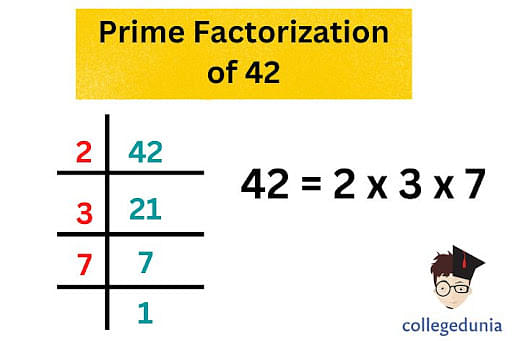
Prime Factorization of 42
Read More: Prime Number Formula
Factor Tree of 42
[Click Here for Sample Questions]
The factors of 42 can be described using the factor tree method also. The factor tree of 42 is as follows:

Factor Tree of 42
Solved Examples on Factors of 42
[Click Here for Sample Questions]
Example 1: List the common factors of 42 and 43.
Solution: First, we will list all the factors of 42 and 43,
- Factors of 42: 1, 2, 3, 6, 7, 14, 21 and 42
- Factors of 43: 1 and 43
It can be clearly seen that the common factor of 42 and 43 is 1.
Example 2: Mention the common factors of 42 and 44.
Solution: The factors of 42 and 44 are:
- Factors of 42: 1, 2, 3, 6, 7, 14, 21 and 42
- Factors of 44: 1, 2, 4, 11, 22, and 44
There are two common factors of 42 and 44 which are 1 and 2.
Read More:
| Related Topics | ||
|---|---|---|
| Cube and Cube Roots | Difference Between Whole Numbers and Natural Numbers | Multiplication and Division of Integers |
| Types of Numbers | Dividend | Quotient |
Things to Remember
- Factors of 42 are the numbers that divide 42 completely leaving the remainder as zero.
- The factors of 42 are 1, 2, 3, 6, 7, 14, 21, and 42.
- The factor pairs of 42 are (1, 42), (2, 21), (3,14), and (6,7).
- The prime factorization of 42 is 2 x 3 x 7.
- 2, 3, and 7 are the three prime factors of 42.
Sample Questions
Ques. What are the common factors of 42 and 41? (2 Marks)
Ans. Writing down the factors of 42 and 41,
- Factors of 42: 1, 2, 3, 6, 7, 14, 21 and 42.
- Factors of 41: 1 and 41.
There is only common factor of 42 and 41 which is 1.
Ques. What are the factor pairs of 42? (2 Marks)
Ans. Factor pairs of 42 are the pairs of two numbers that, when multiplied, give 42. So,
- 1 × 42 = 42
- 2 × 21 = 42
- 3 × 14 = 42
- 6 × 7 = 42
Thus, the factor pairs of 42 are (1,42), (2,21), (3,14), and (6,7).
Ques. List the prime factors of 42 and 60. (3 Marks)
Ans. Prime factors of a number are those numbers that are prime and divide the given number completely with zero remainders.
- The factors of 42 are 1, 2, 3, 6, 7, 14, 21, and 42 of which 2, 3, and 7 are the prime numbers.
- The factors of 60 are 1, 2, 3, 4, 5, 6, 10, 12, 15, 20, 30, and 60 of which 2, 3, and 5 are the prime numbers.
Ques. What are the factors of 42? (1 Mark)
Ans. The 10 factors of 42 are 1, 2, 3, 6, 7, 14, 21 and 42.
Ques. Write down the factors of 42 and 6. (2 Marks)
Ans. The factors of 42 and 6 are:
- Factors of 42 are 1, 2, 3, 6, 7, 14, 21, and 42.
- Factors of 6 are 1, 2, 3, and 6.
Ques. List the Common Factors of 42 and 70. (2 Marks)
Ans. First, we will write down all the factors of 42 and 70,
- Factors of 42: 1, 2, 3, 6, 7, 14, 21, and 42.
- Factors of 70: 1, 2, 5, 7, 10, 14, 35, and 70.
Thus, there are 4 common factors of 42 and 70 which are 1, 2, 7, and 14.
Ques. Name the least common factor and the greatest common factor of 42 and 90. (2 Marks)
Ans. As we know, Factors of 42 are 1, 2, 3, 6, 7, 14, 21, and 42 whereas the factors of 90 are 1, 2, 3, 5, 6, 9, 10, 15, 18, 30, 45, and 90.
The common factors of both 42 and 90 are 1, 2, 3, and 6, and we can see that the lowest common factor of 42 and 90 is 1. The greatest common factor of 42 and 90 thus 6.
Ques. Check whether 21 is a factor of 42 or not. (2 Marks)
Ans. In order to check whether 21 is a factor of 42 or not, we need to divide 42 by 21.
42 ÷ 21 = 2
We can see that 21 divides 42 completely leaving zero as the remainder. Thus, 21 is a factor of 42.
Ques. What is the prime factorization of 42? (1 Mark)
Ans. The prime factorization of 42 is given as 2 × 3 × 7.
Ques. Which number is the greatest factor of 42? (2 Marks)
Ans. Factors are usually smaller than the original number since they are a multiplication of numbers that result in the given number. However, a number itself is its greatest factor, so, the biggest factor for 42 is 42 itself. When 42 is divided by 42, it gives 1 which makes it its own factor.
Ques. What do you mean by factorization? (1 Mark)
Ans. Factorization refers to the process of breaking down a large number into smaller numbers such that when multiplied together, they return the original value.
Read More:



Comments