



Exams Prep Master
In humans, the female reproductive system is designed to produce female egg cells called ova and oocytes which are essential for the reproduction and to transport them to the exact fertilization site. Apart from this, the system also performs several functions such as, it receives sperms, provides the site for fertilization, implantation of the growing embryo and development of the foetus.
Read Also: How do Organisms Reproduce?
Female Reproductive System
[Click Here for Sample Questions]
The female reproductive system consists of two ovaries, two oviducts, the uterus, cervix, vagina, and the external genitalia, all of which are located in the pelvic area. These elements of the system, as well as a pair of mammary glands, are physically and functionally linked to support ovulation, fertilization, pregnancy, birth, and child care. The female reproductive system is designed to serve a variety of purposes. It produces ova, which are egg cells that are necessary for reproduction.
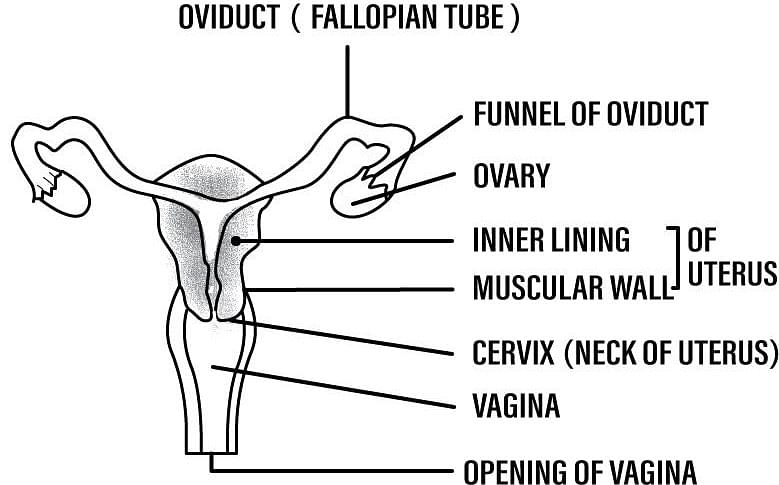
Female Reproductive System
The system is set up to convey the ova to the fertilization area. Along with the sperm, the egg fertilization takes place in the Fallopian tubes. The next step for fertilized eggs is to implant in the uterine walls and begin the phases of pregnancy. Aside from the tasks listed above, the female reproductive system is also involved in the creation of female sex hormones, which is necessary for the reproductive cycle to continue.
The video below explains this:
Female Reproductive System Detailed Video Explanation:
Ovaries

Ovary
The female gamete and several hormones are produced by the ovaries, which are the main female sex organs. These organs are located on both sides of the lower abdomen, one on each side. Each ovary is approximately 2 to 4 cm long and is attached to the uterus and pelvic wall via ligaments. The ovary is covered by a thin epithelium that encloses the ovarian stroma and is separated into two zones – the outer cortex and inner medulla. The cortex is made up of ovarian follicles at various stages of development. The basic unit of the female reproductive system is the ovarian follicle. The ampulla, isthmus, and infundibulum are the three anatomical regions that make up each oviduct.
Uterus
The uterus is also referred to as the womb. It is a female reproductive system muscled, inverted pear-shaped organ. The inner glandular layer, the middle thick layer, and the outer thin layer are the three layers that make up the uterus's walls. Ligaments linked to the pelvic wall maintain these three layers, which eventually open into the vagina from a small cervix. The birth canal is formed by the cervical canal and the vaginal canal. The vagina is a muscular tube that extends from the uterus's lower end to the outside.
Oviduct(Fallopian Tube)
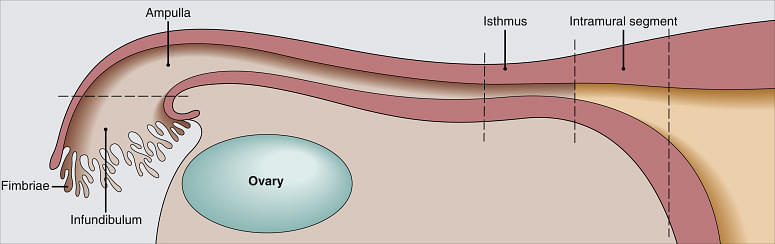
Oviduct(Fallopian Tube)
The fallopian tubes are a pair of muscular tubes and funnel-shaped structures that extend from the uterus's superior corners to the ovaries' edge. These tubes are encased in fimbriae, tiny projections that sweep over the ovaries, picking up released eggs and delivering them to the infundibulum for uterine supply. Cilia protect each fallopian tube and are responsible for transporting the ovum to the uterus.
Vagina
The vaginal tube connects the cervix to the external body and is made up of muscles and elastic. In sexual intercourse, it serves as a receptacle for the penis and transports sperm to the fallopian tubes and uterus. It also serves as a birth canal, allowing the fetus to be delivered during childbirth. The clitoris is a small finger-like structure that resides above the urethral opening at the top junction of the two labia minora. The hymen is a membrane that covers the vaginal entrance.
Read More:
| Related Topics: | |
|---|---|
| Sexual Reproduction | Heredity and Evolution |
| Heredity | Sex Determination |
Ovulation
[Click Here for Sample Questions]
The process of releasing eggs from the ovaries is known as ovulation. This occurs when the follicle has fully expanded and achieves its maximum size, accompanied with the collection of fluids within the follicle without a considerable increase in pressure. The stigma, or macula pellucida, appears as a little oval-shaped patch jutting outward as a clear cone area when the follicle grows out and later undergoes localized changes in color, integrity, and translucency. The maximal level of estrogen hormone release occurs just before ovulation. Ovulation happens at the stigma site after a rise of luteinizing hormone. This surge is required for ovulation to occur.
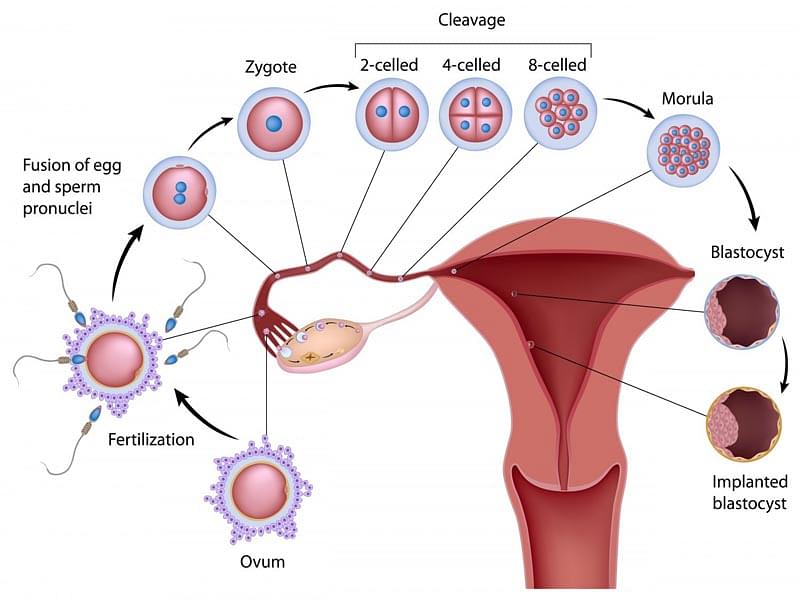
Ovulation
Ovulation is the release of the follicle from the ovum, which is enclosed by the corona radiata, by the release of follicular fluid. In the presence of spermatozoa, the cells of the corona radiata will separate later. At the time of ovulation in ruminants, the oocytes have already lost their corona. The ovum is picked up by the fimbriae, which are particularly active at the oviduct's end. If a fertilized ovum or zygote is cleaved and transported to the uterus for implantation. It degenerates in 24 hours if not fertilized.
Menstrual Cycle
[Click Here for Sample Questions]
After reaching adolescence, all females generate mature egg cells once a month during a process known as the menstrual cycle. An ovary releases a developed egg during this time, which goes to the uterus. If the egg is not fertilized in the uterus, the uterine lining sheds and a new cycle begins. A menstrual cycle lasts 28 days on average, but it can be as short as 21 days or as long as 35 days in certain women. The endocrine system is in charge of the entire menstrual cycle, and the hormones involved are FSH, LH, estrogen, and progesterone. The pituitary gland produces both FSH and LH hormones, while the ovaries generate estrogen and progesterone hormones.
There are many other variables that contribute to the disruption of the menstrual cycle, in addition to hormonal abnormalities. Diet, exercise, stress, and weight gain or loss are all factors that affect the menstrual cycle. At times, especially throughout puberty, the cycle may be erratic. Menstrual cycles occur every month from puberty until the age of 45 to 55, with the exception of pregnancy. Ovaries slow down hormone synthesis and mature egg release at the age of 55. The menstrual cycle eventually ceases, and the lady is no longer able to become pregnant.

Pregnancy
Following implantation, the placenta develops from maternal and fetal tissues, releasing human chorionic gonadotropin (HCG), which helps to keep the corpus luteum in the ovary at a healthy level until the placenta can produce its own progesterone and estrogen hormones.
Read More About Sexual and Asexual Reproduction
Hormones: Estrogen and Progesterone
[Click Here for Sample Questions]

Estrogen and progesterone hormones
Estrogen and progesterone hormones are produced by the ovaries that foster the development of reproductive organs by maintaining the proper uterine cycle and by developing female secondary sex characteristics. During menopause, usually between age 45 and 55, the uterine cycle stops, and the ovaries no longer produce estrogen and progesterone hormones.
Sample Questions
Ques. What causes the absence of menstrual periods during pregnancy or conception?(1 mark)
Ans. All of the events of the menstrual cycle stop during pregnancy, and there is no menstruation. Menstruation is only triggered when the expelled egg is not fertilized. However, because the released egg is fertilized during pregnancy, the uterus lining does not shed and instead feeds the fetus. However, uterine bleeding can occur during pregnancy for a variety of causes.
Ques. What role does the LH surge play during the menstrual cycle?(1 mark)
Ans. It causes the Graafian follicle to rupture and the ovum to be released into the fallopian tube.
Ques. How is a primary oocyte different from a secondary oocyte?(1 mark)
Ans. A diploid cell is the primary oocyte, while a haploid cell is the secondary oocyte. The primary oocyte is created in the fetal ovary when oogonia are in prophase-I of the meiotic division, whereas the secondary oocyte is created after meiosis – I division to create ova in females after puberty.
Ques. What are the different stages of the follicular phase of the menstrual cycle taking place in the ovary and uterus?(2 marks)
Ans. Primary follicles in the ovary mature into fully mature Graafian follicles during this period. The uterine endometrium regenerates at the same time through proliferation. Ovarian and pituitary hormone levels fluctuate, causing alterations in the uterus and ovaries. The release of FSH and LH gradually increases during this period, triggering the release and follicular development of estrogen by the developing follicles. Both LH and FSH reach their highest levels in the middle of the cycle. Graafian follicle rupture and ovulation are caused by the rapid release of LH at its greatest amount during the mid-cycle.
Previous Year’s Questions
Ques: What is the consequence of reckless female foeticide? (CBSE 2020)
Ans. Reckless female foeticide is the abortion of femal foetus with the help of illegal methods. The result of this can be abnormal men and women ratio. As the number of women decreases, there would be fewer women per 1000 men.
Ques: Which contraceptive method changes the hormonal balance of the human body? (CBSE 2020)
Ans. Hormonal methods involve pills, skin patches, vaginal rings and shots containing hormones like estrogen or progestin or may contain only progestin hormone. This hormone alters the reproductive hormone ratio in the human body that results in the absence or late ovulation or conception at the time when these contraceptives are administered.
Ques: List three techniques which are developed to prevent pregnancy, which one of these techniques is not meant for males? How does the use of these techniques have a direct affect on the health and prosperity of a family? (CBSE 2017)
Ans. There are several methods in order to prevent pregnancy, out of which three techniques are as follows:
- Barrier methods: These are physical methods to prevent pregnancy such as condoms, IUD and so on.
- Chemical methods: Contraceptive pills are the chemical hormones or substances in the form of pills that prevent pregnancy.
- Hormonal methods: There are hormonal injections which prevent pregnancy.
Hormonal methods are not meant for males.
All these methods help in preventing ovulation, implantation, fertilization and therefore, there is no pregnancy. These methods have been developed to maintain a specific number of people in the family by the family planning schemes. Moreover, this also helps in regulating the health condition of the female and the children.
Ques: Draw a diagram of a human female reproductive system and label the parts:
(a) which produces an egg
(b) where fertilization takes place. (CBSE 2019)
Ans. (a) Ovary produces an egg.
(b) Fertilization takes place in the fallopian tube or oviduct.

Ques: Write in brief the changes that take place in the fertilized egg (zygote) till the birth of a child in the human female reproductive system. What happens to the egg when it is not fertilized? (2012)
Ans. The egg gets fertilized in the oviduct. The fertilized egg, that is the zygote, gets implanted in the lining of the uterus and starts to divide. The uterus prepares itself every month to receive and nurture the growing embryo. The embryo receives nutrition from the mother's blood with the help of a special tissue called placenta. The development of a child inside its mother’s body takes approximately 9 months. On the completion of 9 months, the child takes birth as a result of rhythmic contractions of the muscles in the uterus. If the egg is not fertilized, the thick and nourishing lining of the uterus breaks and comes out through vagina as blood and mucous.
Ques: Draw a diagram of a human female reproductive and label the parts:
That produces egg
Where fusion of egg and sperm take place
Where zygote is implanted.
What happens to the human egg when it is not fertilized? (2012)
Ans.

If the egg is not fertilized, the thick and nourishing lining of the uterus breaks and comes out through vagina as blood and mucous.
Read More:
| Related Topics: | |
|---|---|
| Spore Formation | Chromosomal Theory of Inheritance |
| Regeneration | Tissue culture |
For Latest Updates on Upcoming Board Exams, Click Here: https://t.me/class_10_12_board_updates



Comments