



Content Writer
The concept of Rotational symmetry explains that when you rotate an object on its own axis, the shape of the object remains the same. Various figures are symmetrical when they are rotated 180 degrees or with some angles, clockwise or anticlockwise.
- Rotational symmetry is also known as radial symmetry.
- With this symmetry, the object remains the same even after partial rotation.
- The rotation of such figures is direct isometries, which means these figures preserve orientation.
- We know that the word symmetry is a combination of two words ‘sync + meter.
- This is why there should be at least two identical orders to have symmetry.
- We can find symmetry all around us, in nature, in architecture, and in art.
- It may be explored when we flip, slide or turn an object.
- There may be different types of symmetry, such as reflection, translational and rotational.
- Examples of rotational symmetry include shapes such as squares, circles, hexagons, etc.
Key Terms: Rotational Symmetry, Rotation, Order of Rotational Symmetry, Symmetry, Hexagon, Star, Reflection, Angle of Symmetry, Scalene Triangle, Center of Rotation, Circle, Squares
What is Rotational Symmetry?
[Click Here for Sample Questions]
The theory of Rotational Symmetry of shape states that an object looks the same when rotated on its axis. The geometrical shapes seem to appear as a symmetry when they are rotated clockwise, anticlockwise, or rotated with some angle such as 180°,360°, etc.
- Rotational Symmetry is a balanced and proportionate similarity found in two halves of an object.
- In this method, one-half is the mirror image of the other half.
- The shapes which are not symmetrical are referred to as asymmetrical.
- We may have heard of the term ‘symmetry’ in our day-to-day life.
- When the images are rotated around the origin, then they belong to a class of orthogonal group.
- However, a scalene triangle does not have symmetry if rotated as the shape is asymmetrical.
There are many shapes in the field of geometry that follow the concept of rotational symmetry, which are as follows:
Example of What is Rotational Symmetry?Example: We can understand Rotational Symmetry by taking some real-life examples from our surroundings.
|
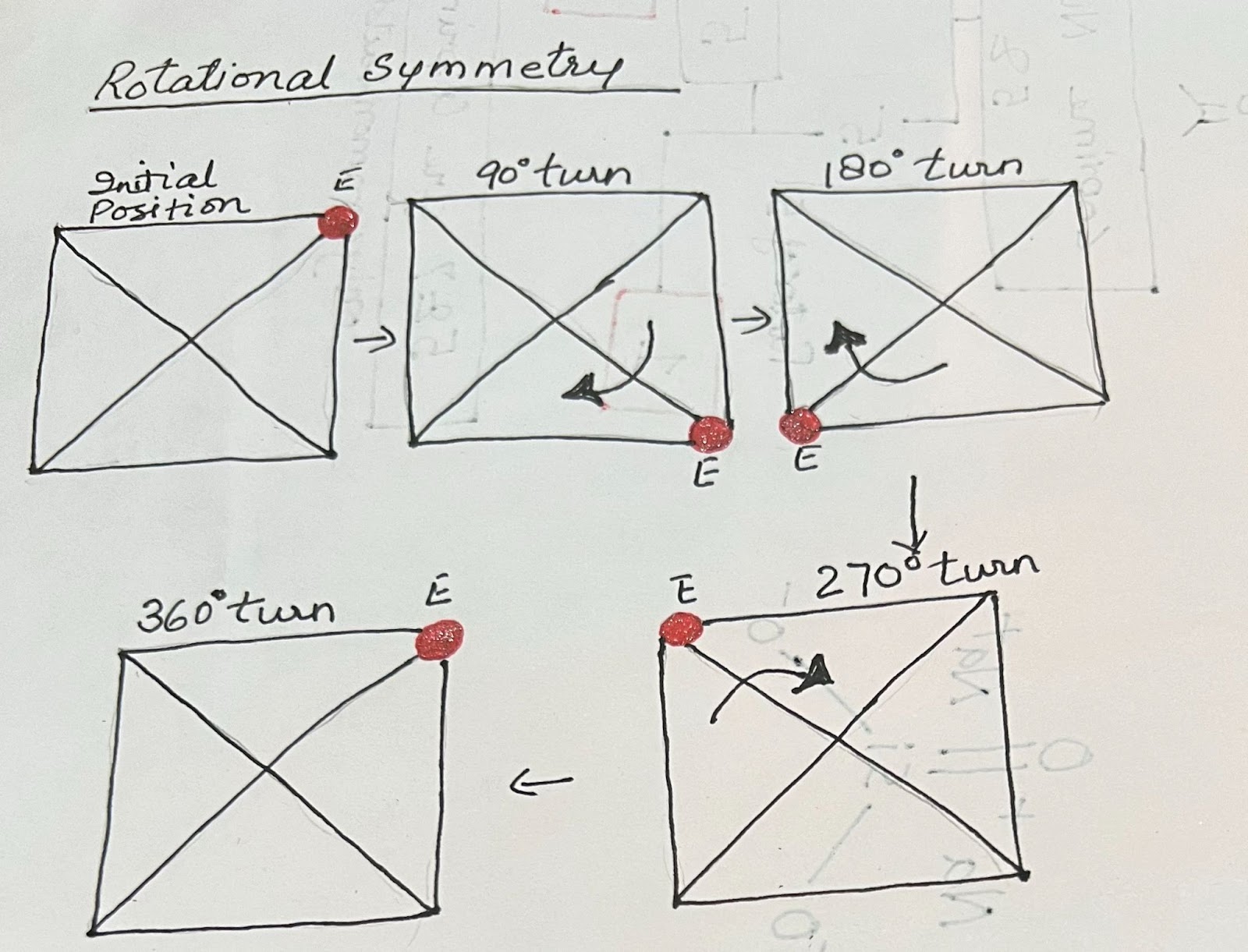
Rotational Symmetry
Also Read:
| Related Articles | ||
|---|---|---|
| Operations on Rational Numbers | Irrational Numbers | Differential Equation |
| Difference between Sequence and Series | Difference between power and exponent | Mensuration |
Center of Rotation
[Click Here for Sample Questions]
The center of rotation is defined as the rotation of an object around a fixed point. The object should follow the rotational symmetry. Rotation is done either clockwise or counterclockwise.
- The rotation is symmetry in m-dimensional Euclidean group.
- The rotated shape is identical to the origin.
Example of Center of RotationExample: If you are spinning the basketball on the tip of your finger, then the tip of your finger will be considered rotational symmetry. When an object has rotational symmetry, its center will also be its center of mass. |
Angle of Rotational Symmetry
[Click Here for Sample Questions]
The angle of rotational symmetry is defined as the smallest angle in which a shape is turned during rotation. After flipping, the shape of the object remains intact. When an object is rotated along rotational symmetry, then it will complete a rotation of 360 degrees.
Some of the angles of rotational symmetry include:
- When an object is rotated at an angle of 90 degrees, then it is called the quarter turn.
- When you rotate an object at an angle of 180 degrees, then it is called a half turn.
- When an object is rotated at an angle of 360 degrees, then it is called the complete turn.
Order of Rotational Symmetry
[Click Here for Sample Questions]
Order of rotational symmetry is the number of times any shape or an object is rotated. It still looks similar to us as it was before the rotation. The rotational symmetry order of a regular hexagon is equivalent to the number of sides a polygon has.
- We can find the order of symmetry by determining the smallest angle we can rotate any shape.
- It will look the same as the original figure.
- With respect to rotational symmetry, the center of any shape or object is the point around which rotation appears.
Various order of rotational symmetry are as follows:
- 80° = Order 2
- 120° = Order 3,
- 90° = Order 4.
Example of Order of Rotational SymmetryExample 1: As an example, a star can be rotated 5 times along its tip and looks similar each time. Therefore, the order of rotational symmetry of the star is 5. Example 2: Take the order of symmetry for regular hexagons. The order of the hexagon is 6 since it has 6 equal sides and is rotated with an angle of 60 degrees. |
Rotational Symmetry Letters
[Click Here for Sample Questions]
English alphabets consists of various letters that follow the properties of rotational symmetry. They maintain their symmetry even after rotation in clockwise and anticlockwise direction at 180 degrees.
- For your knowledge, there are many rotational symmetry letters in the English alphabet, including Z, H, S, N, and O.
Things to Remember
- The rotational symmetry includes the rotation of an object on its own axis, and the shape of the object looks the same.
- The order of rotational symmetry can be defined by the smallest angle we can rotate any shape so that it looks the same.
- When some alphabets are rotated 180 degrees clockwise or anticlockwise, the letters appear to be the same.
- The swastika symbol and roundabout symbol you have seen in your daily life exhibit the principle of rotational symmetry.
- It is a subgroup of the Euclidean group.
- The physical system will follow the angular momentum of the law.
Also Read:
Sample Questions
Ques. Differentiate between Reflective Symmetry and Rotational Symmetry? (3 marks)
Ans. Reflective symmetry refers to when a particular shape of the pattern is reflected in a line of symmetry. Thus, the reflected shape will be similar to the original, a similar size, and the same distance from the mirror line.
- Rotational Symmetry refers to when any shape or pattern rotates or turns around a central point and remains the same then it is said to have rotational symmetry.
- For instance, if we say that shape has rotational symmetry of order X.
- From this we know that the shape can be turned around a central point and still remains the same X times.
Ques. How do we state that a circle and trapezium have Rotational Symmetry? (3 marks)
Ans. Generally, a trapezium has one pair of parallel sides. Trapeziums have one line of symmetry. A trapezium like this is known as isosceles trapezium as it has two sides that are equally similar to isosceles triangles. The rotational symmetry of the trapezium is of order 1.
- The number of times a circle can be adjusted when experimenting with a rotation of 360 degrees is the order of rotational symmetry in terms of a circle.
- The rotational symmetry of such an order is infinite.
Ques. State the rational symmetry order for parallelogram, rhombus and circle? (1 mark)
Ans. The rational symmetry order for parallelogram is 2, for rhombus is 2 and for a circle is infinite.
Ques. State the order of rotational symmetry of a square and the angles of such rotation? (2 marks)
Ans. When a square is rotated by 90°, 180°, 270°, or by 360°. The shape of the square looks exactly similar to its original shape. So, we can say that the square has rotational symmetry of order 4.
Ques. State the order of rotational symmetry of a rhombus and the angles of such rotation? (2 marks)
Ans. When a square is rotated either by 180 or by 360. The shape of the rhombus looks exactly similar to its original shape. So, we can say that the rhombus has rotational symmetry of order 2.
Ques. What does a quarter, half, and complete turn indicate? (2 marks)
Ans. A quarter turn means a rotation of 90°. A half-turn indicates a rotation of 180°. A complete turn indicates a rotation of 360°
Ques. State the order of symmetry of, recycle logo, paper windmill, triangle, Swastik symbol and a roundabout road sign? (3 marks)
Ans. The order of symmetry of, recycle logo, paper windmill, triangle, Swastik symbol and a roundabout road sign are as follows:
- A recycle logo has an order of symmetry of 3.
- A paper windmill has an order of symmetry of 4.
- A triangle has an order of symmetry of 3.
- A Swastik symbol has an order of symmetry of 4.
- A roundabout road sign has an order of 3.
Ques. Anwer the following: (A) Mention the letters that show horizontal symmetry?
(B) Mention the letters that show horizontal and vertical symmetry? (2 marks)
Ans: (A) The letters that show horizontal symmetry include A, H, I, M, O, T, U, V, W, X, Y.
(B) The letters that show horizontal and vertical symmetry include H, I, O, and X.
Ques. What is the order of rotation and center of rotation of the following figures: (3 marks)
(a) Parallelogram
(b) Rhombus
(c) Circle
Ans. The order of rotation and center of rotation of the following figures are as follows:
| Figure | Order of Rotation | Centre of Rotation |
|---|---|---|
| Parallelogram | 2 | Intersection of diagonal |
| Rhombus | n | Intersection of diagonal |
| Circle | 2 | Intersection of diagonal |
Ques. What is the rotational anhle of parallelogram? (2 marks)
Ans. Rotationally symmetric shapes are those that revolve and are identical to the origin. Consequently, if the form remains true to its original look even after being rotated around the central point. Stated otherwise, the parallelogram has 180° rotational symmetry.
Ques. Mention all the figures that exhibit rotational symmetry are greater than one? (3 marks)
Ans. All the figures that exhibit the rotational symmetry greater than one are as follows:
- Square has axis of symmetry four which mean it has rotational symmetry equivalent to four.
- Rectangle has axis of symmetry two which mean it has rotational symmetry equivalent to two.
- Rhombus has axis of symmetry two which mean it has rotational symmetry equivalent to two
For Latest Updates on Upcoming Board Exams, Click Here: https://t.me/class_10_12_board_updates
Check-Out:



Comments