



Content Curator
Birds have a unique feature and ability to fly. To cope with the birds with these abilities, birds possess several physical features which are not only limited to the wings and feathers but these features are both lightweight and strong also.
Also Read: Fungus Life Cycle
| Table of Content |
Key Takeaways: Flight adaptations, morphological, anatomical, birds, fly
These adaptations are formed by eliminating and fusing some bones. The adaptations of flight for the birds are of two types namely morphological adaptations and anatomical adaptations.
Anatomical Adaptations
[Click Here for Sample Questions]
Certain anatomical adaptations in birds that help them to fly are:
Digestive System
The food which a bird eats gets digested rapidly because they have a high metabolism rate. Minimum waste which tends to be undigested is the reason for the rectum’s length. The birds also don’t have a gallbladder which helps in minimising the weight of the bird.
Warm-Blooded
The temperature of a bird does not vary as per the environment and always remains high (40-46 degrees Celsius) which helps them to fly at high altitudes and regions.
Flight Muscles
The muscles of birds are all developed well and control the wings' action for flying. These muscles are 1/6th of that of the whole bird which is striated. While the other muscles help the muscles on the wings in functioning. The wing muscles are relatively large.
Excretory System
The birds do not even have a urinary bladder which in turn minimises the body weight. The nitrogenous waste is converted to uric acid or urates which are toxic-less. Water is efficiently absorbed with the help of uriniferous tubules.
Also Read:
Respiratory System
Birds possess a slightly different respiratory system which is designed for the rapid oxidation of food and liberating more energy. Due to the high metabolism rate, oxygen is required in a large amount by the body. The lungs help in this which are present between the internal organs and takes the entire space.
Light and Rigid Endoskeleton
Teeth are not present in birds and also they have thin skull bones. They have hollow bones which contain air sacs. To increase the strength or rigidity, they also have additional plastering. They also don’t have bone marrow and have fused bones. There is a fusion in the thoracic vertebrae just the last one doesn’t have a fusion. It is an important factor in the wings' action which strikes the air.
Reproductive Organs
Birds only have a single ovary that is functional on the female bird’s left side. The reproductive organs are also lightweight.
Sense Organs
Muscular coordination in birds is due to the cerebellum which is developed in the brain. Voluntary movements are because of the cerebrum. The optic lobes are also inflated.
Circulatory System
The birds have a four-chambered heart which helps them in having an efficient circulatory system. The double circulations help in separating the oxygenated and deoxygenated blood.
Also Check:
Morphological Adaptations
[Click Here for Sample Questions]
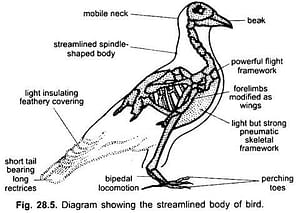
The morphological adaptations in birds are of several kinds. These include:
Perching
The toes of a bird come around the twig when it sits on the branch of any tree which is called perching. They can also sleep while sitting on the tree without falling.
Short Tail
The short tail of a bird acts as a rudder during the flight as it helps in lifting, counterbalancing, and steering.
Bipedal Locomotion
The part that helps the body in landing and take-off is the anterior part of a bird. For the locomotion which takes place on land, the hindlimbs come to a rescue that also can support the full weight of a bird’s body.
Compact Body
Birds possess a dorsally strong, compact, and ventrally heavy body which helps them in maintaining equilibrium. The other features that help them are the centrally placed heavy muscles, thorax attached wings, and the organs which are lighter in weight such as lungs and sacs.
Also Read:
Mobile Neck and Head
The bird possesses a long, flexible neck that helps in smooth head movement. They also have a beak that is horny so that they can pick the food like grains and insects during feeding.
Forelimbs modified into wings
The only organ that is responsible for flight in a bird is the forelimbs that are transformed into the wings. The wings have a framework of bones, feathers, muscles, blood vessels, and nerves. It has a large surface area which helps them in supporting the bird.
Body Contour
The spindle-shaped body of a bird helps it for less air resistance which helps them during flight time. It also aids them so that they become efficient at flying and also conserves energy.
Body Covered with Feathers
They have backward-directed, smooth, closely fitted feathers which help their body to be streamlined. It also helps them reduce the friction during the flying time. It protects them from the environmental temperature effects and lightens the weight of their body. To strike the sir, they have a larger surface area. The buoyancy is also enhanced by the feathers. They also aid the bird in insulation which helps them in preventing the heat loss from the body which further helps them in the low temperatures and at the higher altitudes.
Also Check More:
Points to Remember
[Click Here for Sample Questions]
Following are some important points:
- Birds can fly and have two different kinds of flight adaptations that include anatomical adaptations and morphological adaptations.
- Birds have hollow bones which make them lightweight and support them in flying and tend to be warm-blooded animals and their temperature does not change concerning the environment.
- Birds can lift, steer, and counterbalance due to their short tail and they can sleep without falling off while sitting on a branch of the tree due to perching.
- Birds have only one organ that is the reason for them to fly is the forelimbs that are converted to wings.
- Birds neither have teeth nor a gallbladder.
Read Also: Cockroach Life Cycle
Sample Questions
Ques: Explain the different adaptations in birds. (2 Marks)
Ans: There are different kinds of adaptations that are available in birds because the bird’s body is adapted to fly. They have a streamlined body and have bones that are hollowed to make them lightweight. Wing movement is regulated by the light chest muscles. The capability of being warm-blooded to maintain the body temperature. The high metabolism rate keeps them warm. They do not consist of teeth. Perching helps them bend their toes while sitting on a tree. These adaptations help them in flying and other activities.
Ques: In what manner does the beak of a bird help it? (3 Marks)
Ans: Like all other body parts, the beak of a bird also has a particular function. It helps the bird in finding food to survive. The other functions of a beak include defending themselves from becoming prey, mating, feeding their young ones, feeding themselves, maintaining the body temperature, making nests, and grooming their feathers. Every bird has a different kind of beak. Like the ones who are predators have a sharp, strong, and hooked beak to catch their prey. To pick small grains, a sparrow has a small beak while a hummingbird has a long, slender beak to suck the nectar from flowers.
Ques: Why is it not possible for a human to fly? (2 Marks)
Ans: The birds have hollow bones which make them lightweight to fly which is not present in humans. Humans are heavyweight. Also, the birds have a balance between the size of the body and the strength of wingspan and wing muscle. In the case of humans, the ratio of strength to size is different. Humans do not have a streamlined body and also do not possess feathers that could help them in flying.
Ques: In what manner is the skeleton of a bird helpful in flying? (3 Marks)
Ans: The skeleton of a bird is strong to help them in landing and take-off. It is because the skeleton of the bird is very light. They have hollow bones and fewer bones as compared to terrestrial vertebrates. The breast bones in the birds are changed to help them to hold the flight muscles that help in the wings movements like moving the wings in the upward and downward direction. The hind limbs bones help them in the perching and walking purposes. The forelimbs are converted into wings for flying. The bones of the shoulder are strong enough for support.
Ques: Name the different kinds of structural adaptations in birds. (3 Marks)
Ans: There are two kinds of adaptations in birds according to the structure namely anatomical adaptations and morphological adaptations. The anatomical adaptations include flight muscles, light, and rigid endoskeleton, digestive system, respiratory system, excretory system, circulatory system, and warm-blooded. While the morphological adaptation includes a compact body, body contour, body covered with feathers, mobile neck and head, forelimbs modified into wings, short tails, bipedal locomotion, and perching. Both of these adaptations are important for a bird to survive.
Ques: In what manner does the feather of a bird help them in flying? (2 Marks)
Ans: Feathers of a bird are waterproof, give insulation, and help in lowering the bird’s body weight so that the bird becomes airborne. The breast muscles of a bird are strong and help them in flapping their wings. The wings have a specific shape that has the capability of moving in the air for the plane flight. The feathers also help in adding body buoyancy to a bird and prevent heat loss.
Ques: State the average temperature of a bird? (2 Marks)
Ans: A bird normally possesses a high body temperature as it is a warm-blooded animal. The average body temperature of a bird is around 40â—¦-46â—¦ C. Birds tend to have a higher metabolism than humans which helps them in keeping themselves hot during the winter season. To keep themselves warm, and to maintain this temperature, birds need to find dependable food chains which are always not possible. Hence, they choose to migraine.
Read More:



Comments