



Content Writer
Heisenberg Uncertainty stated that it is impossible to simultaneously measure a particle's position and momentum with arbitrarily high accuracy. Werner Heisenberg, a German physicist, presented this idea in 1927. The science of extremely small measurements is known as quantum mechanics. The results of measurements in macro and microphysics can have a wide range of effects. A key idea in quantum mechanics is the Heisenberg uncertainty principle or uncertainty principle. Additionally, the sum of these two measurements' uncertainty has a minimal value. As a result, there is a minimum for the sum of the energy and temporal uncertainty. It results from the wave characteristics built into the quantum mechanical explanation of nature.
Read more: Types of waves
| Table of Content |
KeyTerms: Planck constant, Momentum, Kinetic energy, potential energy, subatomic particles,
Heisenberg Uncertainty Principle
[Click Here for Sample Questions]
According to the uncertainty principle, it is impossible to precisely identify a particle's position and momentum at the same time. Position and momentum always produce a result that is greater than h/4. The Heisenberg Uncertainty Principle's formula is as follows:
Δ x Δp ≥ h/4 π
Where,
h is the Planck’s constant ( 6.62607004 × 10⁻³⁴ m2 kg / s)
Δp is the uncertainty in momentum
Δx is the uncertainty in position
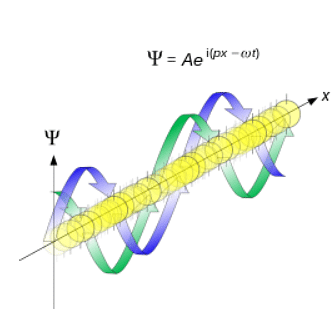
Heisenberg Uncertainty Principle
Uncertainty is a fundamental aspect of nature. Thus, concluded that it is difficult to accurately and simultaneously determine a particle's position and momentum. Therefore, the ideas of exact position and exact velocity alone are meaningless.
Normal scientific experience won't give any indication of this principle. It is because it is simple to gauge both an object's position and its velocity. This is because the uncertainty this principle implies for common objects is too small to be observed.
As a result, the product of the position and velocity uncertainty is equal to or larger than h, a very, very small physical quantity. Therefore, only extremely small amounts of atoms and subatomic particles will be affected by this product of uncertainty.
Read more:
| Relevant Concepts | ||
|---|---|---|
| Visible light | Electron Affinity | Structure of atom |
| Wave function | Mass and momentum | Angular velocity formula |
Derivation of the Heisenberg Uncertainty Principle
[Click Here for Sample Questions]
In this theory, x is regarded as an error in the measurement of location, whereas p is regarded as a mistake in the measurement of momentum. As a result of this idea, we can write:
Δ X × Δ p ≥ h/4π
Momentum p = mv can also be written as
Δ X × Δ mv ≥ h/4π
A more significant inaccuracy in the measurement of the other variable is automatically revealed by an accurate measurement of position or momentum.
Now, apply Heisenberg’s Principle to an electron in an orbit of an atom, with h = 6.626 ×
where h = 6.626 × 10⁻³⁴ Js and m= 9.11 ×10⁻³¹Kg,
∆x × ∆v ≥ 6.626 × 10⁻³⁴/4×3.14×9.11×10-31
= 10-4 m2 s-1.
Only microscopic particles with dual natures are affected by Heisenberg's Principle; a macroscopic particle with a minute wave nature is not.
Example of the Heisenberg Uncertainty Principle
[Click Here for Sample Questions]
Both microscopic matter and electromagnetic radiation display a dual nature of mass/ momentum and wave nature. Position and velocity/momentum can both be calculated simultaneously for macroscopic particles.
For example, if the location and speed of a moving car can be correctly determined at the same time. However, it won't be able to fix the position and measure the particle's velocity/momentum at the same time for microscopic particles.
With naked eyes cannot be seen very small particles, such as electrons with a mass of 9.91 × 10⁻³¹kg.
- The electron is light when a beam of light with a high intensity collides with it; this illumination helps to establish in identifying the electron's position.
- Collisions between intensified light sources contribute to increasing the electron's momentum and cause it to depart from its starting place.
- As a result, the particle's velocity and/or momentum would have altered from their initial values when the position was fixed.
- Thus, even if the particle's position is precise, there will be a velocity or momentum inaccuracy, or vice versa.
- In contrast, precise momentum measurement will cause a position shift.
Things To Remember
- As stated by Heisenberg Uncertainty Principle An electron's position and momentum cannot be defined clearly at the same time.
- An electron in an atom has a mass of 9.91 × 10⁻³¹Kg.
- Only minuscule particles with dual natures are subject to Heisenberg's principle; a macroscopic particle with minimal wave nature is not.
- Every particle is believed to have a wave character, and particle detection is most likely to occur where waveforms are most pronounced.
- According to Heisenberg's uncertainty principle, particles that display both particle and wave characteristics are uncertain.
Sample Questions
Ques. Why is it Impossible to Measure Both Position and Momentum Simultaneously? (2 marks)
Ans. To determine an electron's precise location, Heisenberg's uncertainty principle is applied. Photons are required to be collided with a particle and then return to the measuring equipment to identify its precise location. Because photons have a set amount of momentum, following a collision, this momentum is transferred to the electron, increasing its momentum. After that, there will be more ambiguity in the precise position of the electrons if we measure them.
Ques. The uncertainty in the momentum of a ball traveling at speed of 20ms−1is1×10-6 of its momentum. Calculate the uncertainty in the position. The mass of the ball is given as 0.5 kg. (5 marks)
Ans. Known parameters in the problem are as follows,
Velocity,v=20ms-1
Mass, m = 0.5 kg,
Plank’s Constant, h has a value of 6.626×10⁻³⁴ Js
And, uncertainty in momentum is,
Δp=p×1×10⁻⁶, for momentum p.
As we know,
Momentum,p=m×v
So, p=0.5×20
i.e. p=10Kgms−1
Now, Δp=p×1× 10⁻⁵
i.e. Δp=10×1× 10-5 .
Δp=1× 10⁻⁵
Now, Heisenberg Uncertainty principle formula is:
Δx×Δp≥h/4π
i.e., Δx≥h/4π×Δp
Δx≥6.626×10-34×3.14×10-5
Δx≥0.527×10⁻²⁹ m
Therefore, uncertainty in position will be 0.527× 10⁻²⁹ m.
Ques. If the position of the electron is measured within an accuracy of + 0.002 nm, calculate the uncertainty in the momentum of the electron. Suppose the momentum of the electron is h / 4 pm × 0.05 nm. Is there any problem in defining this value? (3 marks)
Ans. ΔX = 2×10-12m
ΔX × ΔmV ≥ h/4π
6.625 × 10⁻³⁴ / 4 × 3.14
2.64 × 10⁻²³ Kg m s-1
Ques. A Microscope Using Photons is Employed to Detect the Position of Electrons in an Atom within a Distance of 0.2 Angstrom. What is the Uncertainty in the Velocity of the Electron Located in this Way? (3 marks)
Ans. We know that, Δv ≥ h/4πmd
Now, put the values in the above equation:
Δv ≥ 6.626 ×10-4 × 3.14 × 9.1 × 10-31 × 0.2 A × 10° m/A
Δv ≥ 2897144.651 m/s, this value is the uncertainty in the velocity of the electron.
Ques. Why is Heisenberg's uncertainty principle important? (2 marks)
Ans. One of the most well-known (and certainly most poorly understood) concepts in physics is the uncertainty principle. It reveals that there is fuzziness in nature and a fundamental limit to our understanding of quantum particle behavior and, consequently, the tiniest scales of nature.
Ques. How is Heisenberg's uncertainty principle true? (2 marks)
Ans. The Heisenberg Uncertainty Principle is the cornerstone of quantum mechanics. The concept essentially asserts that there is a limit to how much one can understand about a quantum system. For instance, one can learn less about a particle's momentum the more precisely one knows about its position, and vice versa.
Ques. How do you explain uncertainty? (2 marks)
Ans. Simply said, uncertainty is the absence of certainty or sureness in an occurrence. Uncertainty in accounting is the inability to forecast outcomes or consequences due to a lack of knowledge or a basis on which to base such predictions.
Ques. What is uncertainty for example? (2 marks)
Ans. Epistemic scenarios with incomplete or ambiguous knowledge are referred to as uncertain. It applies to physical measurements that have previously been performed, to the unknown, and projections of future events. In partially observable or stochastic circumstances, as well as from ignorance, complacency, or both, uncertainty can develop.
Ques. Why do we calculate uncertainty? (2 marks)
Ans. The ability to compare multiple measurement results of the same part or of any other of the same values, taken from different instrument manufacturers or collected at separate locations, is the primary practical benefit of quantifying measurement uncertainty.
Check out:



Comments