



Education Journalist | Study Abroad Lead
Visible light waves are a kind of electromagnetic wave. Electromagnetic waves include microwaves, X-rays, infrared radiation, and ultraviolet radiation. Visible waves are the ones that can be seen as the colors of the rainbow. Every color of the rainbow has a different wavelength and frequency. Violet color has the shortest wavelength while the red color has the longest one. When all the waves of different colors come together, all the wavelengths and frequencies are combined, they merge and form the white light. When this white light is passed through the prism, the light is broken and split into all colors of the spectrum of visible light through dispersion. Electromagnetic radiation can be transmitted as particles or waves at different wavelengths and frequencies. All of these wavelengths together comprise the electromagnetic spectrum. The visible part of the electromagnetic spectrum is divided into seven colors having increasing orders of frequency and energy and decreasing levels of wavelength. In this article, we will learn more about visible light, colors, temperature, and the electromagnetic spectrum.
| Table of Content |
Key Takeaways: Visible light, Electromagnetic waves, Color, Temperature, Radio waves, Microwaves, Rainbow, Spectral colors, X-rays, Infrared radiation, Ultraviolet radiation, Wavelength
What is the Visible Light Spectrum?
[Click Here for Sample Questions]
The part of the electromagnetic spectrum that is visible to the human eye is referred to as the spectrum of visible light or the visible light spectrum. It ranges from infrared radiation to ultraviolet radiation that has a frequency of about 4 x 10¹⁴ to about 8 x 10¹⁴ cycles per second. The range has wavelengths from 2.9 x 10⁻⁵ inches or 740 nanometers to 380 nanometers.
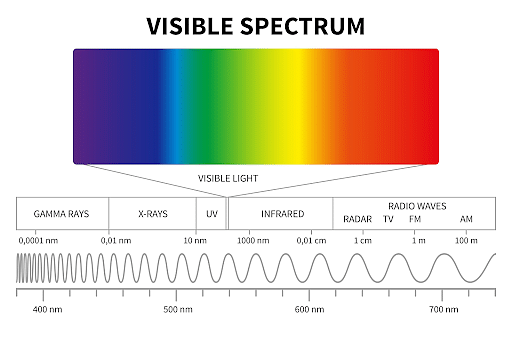
Visible Spectrum
We can observe wavelengths from the range of 380 nm to 740 nm. The wide range of the wavelengths of varying electromagnetic radiations is known as the electromagnetic spectrum. This spectrum is further divided into 7 regions in the decreasing order of their wavelength and increasing order of their frequency. These 7 regions are:
- Radio waves
- Microwaves
- Infrared light
- Visible light
- Ultraviolet radiation (UV)
- X-rays
- Gamma rays
Color
[Click Here for Sample Questions]
A very important feature of visible light is the color of that particular radiation. Color is an artifact of the human eye as well as an inherent property of light. Our eyes have cones that are specialized cells that help us see color. These cones are the receivers of the human eye which are tuned to particular wavelengths of the specific band of the electromagnetic spectrum. Colors having just one wavelength are referred to as spectral or pure colors.
Light that is at the lower end of the visible spectrum has a long wavelength that is about 740 nm. This light is observed as red, with green in the middle, and the violet color is present at the upper end of the visible light spectrum which has a wavelength of about 380 nm.

Colors of Visible Light
As the age of a person increases, the transparency for shorter wavelengths of the electromagnetic spectrum such as the blue light decreases.
| Color | Wavelength | Frequency | Photon Energy |
|---|---|---|---|
| Violet | 380 nm - 450 nm | 680 - 790 THz | 2.95 - 3.19 eV |
| Indigo | 450 nm - 485 nm | 620 - 680 THz | 2.64 - 2.75 eV |
| Blue | 485 nm - 500 nm | 600 - 620 THz | 2.48 - 2.52 eV |
| Green | 500 nm - 565 nm | 530 - 600 THz | 2.25 - 2.34 eV |
| Yellow | 565 nm - 590 nm | 510 - 530 THz | 2.10 - 2.17 eV |
| Orange | 590 nm - 625 nm | 480 - 510 THz | 2.00 - 2.10 eV |
| Red | 625 nm - 740 nm | 405 - 480 THz | 1.65 - 2.00 eV |
Also read: Human Eye and the Colourful World
Color and Temperature
[Click Here for Sample Questions]
As heat is applied to an object, it gets hotter as the temperature rises, energy is radiated. It is dominated by radiations of shorter wavelengths.
For example, as a blowtorch turns hotter, it turns from blue to red.
The Sun has a temperature of 5500°C and it produces yellow light. If the surface of the sun was cooler, having a temperature of about 3300°C, it would have a reddish appearance.
If the sun was hotter than this, at about 12000° C, it would appear bluish.

Temperature of the visible light spectrum
Spectral Colors
[Click Here for Sample Questions]
Spectral colors are known as rainbow colors. We can understand spectral color as a color made up of a single wavelength of the visible part of the electromagnetic spectrum. It is not made up of a mixture of colors. Some examples of spectrals that are formed of a single frequency are green, orange, and red color.

Spectral Colors
Colors that are produced by a single wavelength (monochromatic light) of the visible light are known as pure spectral colors. The electromagnetic spectrum is continuous and it has no clearly defined boundaries between one color and another.
Examples of visible light
[Click Here for Sample Questions]
Visible light spectrum is the most important part of the electromagnetic spectrum for us. Some of these examples include
- Light naturally produced by the sun
- Light bulbs
- Fluorescent tubes
- Neon lights
- LED Bulbs
Also read: Transmission, Absorption, and Reflection of Light
Importance of visible light
[Click Here for Sample Questions]
Life is possible on Earth due to our ability to see things due to light.
- Light has been used since the beginning to determine our biological cycle of sleeping and waking.
- Light is also used in many therapy devices to treat winter depression.
- Our eyes can not process images without visible lights.
- Visible light is also used for medical surgery.
- It is also used in electronic devices such as mobile phones, TV, computer, electric bulbs, etc.
Things to Remember
- Visible waves are the ones that can be seen as the colors of the rainbow.
- When all the waves of different colors come together, all the wavelengths and frequencies are combined, they merge and form the white light.
- The visible part of the electromagnetic spectrum is divided into seven colors having increasing orders of frequency and energy and decreasing levels of wavelength.
- As heat is applied to an object, it gets hotter as the temperature rises, energy is radiated.
- Our eyes have cones that are specialized cells that help us see color.
- Spectral colors are the colors made up of a single wavelength of the visible part of the electromagnetic spectrum.
- Our eyes can not process images without visible lights.
Also Read:
Sample Questions
Ques. Write a short note on light rays or visible light. (5 marks)
Ans. The most common kind of electromagnetic wave is the light wave.
- In terms of wavelength, it ranges from 4 x 10¹⁴ Hz to 7 x 10⁴ Hz.
- Everything around us is visible to us due to the presence of light rays.
- The radiation received from the sun is a form of visible light.
- Most of the insects are able to see ultraviolet rays too along with the visible light as they have compound eyes.
- Snakes are able to see even the infrared rays.
Ques. How does white light split into a rainbow? (3 marks)
Ans. Most of the light that we interact with daily is in the form of white light. White light consists of the wavelength of all ranges. When white light is passed through a prism, various wavelengths bend at varying angles as a result of optical refraction. The light we see as a result is split, showing the visible light color spectrum. A Rainbow is formed as a result of this. The airborne particles of water or water droplets in the air act as a refractive medium. The order of wavelengths or colors of the rainbow can be remembered through the mnemonic "VIBGYOR" or "Roy G Biv". It stands for red, orange, yellow, green, blue, indigo, and violet.
Ques. Write a short note on electromagnetic waves. (5 marks)
Ans. The waves that have the ability to travel through a vacuum are known as electromagnetic waves. While mechanical waves require a medium to travel and transport their energy, electromagnetic waves, on the other hand, have the ability to travel and transport their energy through the vacuum.
- Electromagnetic waves are produced as a result of a vibrating electric charge.
- It has both a magnetic as well as an electric component.
- They have a large number of frequencies.
- The continuous range of these large frequencies of electromagnetic waves is known as the electromagnetic spectrum.
- Some of the examples of electromagnetic waves are radio waves, infrared radiation, gamma rays, etc.
Ques. Explain the uses of various components of the electromagnetic spectrum. (5 marks)
Ans. The uses of various components of the electromagnetic spectrum are:
- Radio waves: A radio captures radio waves transmitted by the radio stations. These waves are also emitted by the stars and gases present in space and are mainly used for mobile or TV communication.
- Microwave: These waves are a kind of radiation emitted by microwaves that helps in the process of cooking. Astronomers also make use of microwaves to understand or find out the structure of stars or galaxies that are nearby.
- Infrared: These radiations are mainly used in night vision goggles. These kinds of devices help in reading and capturing the infrared light that is emitted by objects with heat such as our skin. In space also, infrared radiation helps in mapping out interstellar dust.
- X-rays: These radiations have a wide range of applications. From being used in the medical field to take a picture of our teeth or bones, to being used in the airports to see through the bags, they are used in many instances. In astronomy also, X-rays are emitted by the hot gases present in the universe.
- Gamma rays: These radiations are widely used in the medical field. To see inside our bodies, Gamma-ray imaging is widely done. An interesting fact to note here is that the universe is the biggest gamma-ray generator.
- Ultraviolet: The main source of ultraviolet radiation is the sun. These radiations are harmful as they can cause tanning of skin or even skin burns. Hot materials present in space also emit ultraviolet radiation.
- Visible light: The range of wavelengths that can be detected by our human eye is known as visible light. Some of the sources of visible light are stars, sun, light bulbs, etc.
Ques. List down some sources of visible light. (5 marks)
Ans. The ability of our eyes to view colors is affected by various types of lights. Some of the sources of visible light are:
- Sun: The main source of light on Earth is the sun. The sun produces radiation across the electromagnetic spectrum from X-rays with extremely high energy to long-wavelength radio waves and every wavelength in between. The majority of this emission is produced in the visible part of the spectrum.
- Fluorescent: It is an ultraviolet light of a short wavelength that leads to a phosphor coating in the inside of the lamp causing it to glow. The light spectrum of fluorescent light ranges from 480 nm to around 570 nm. When mixed with other types of light, fluorescent lights produce a light that is somewhere closer to the sunlight.
- Incandescent Light Bulbs: The light produced by these bulbs is an electric light wherein a wire filament is heated to a high temperature that eventually glows with incandescence or visible light. The output generated is more towards the red end of the visible spectrum, thus producing a warm output.
- Halogen: When a tungsten filament is sufficiently heated to emit light, visible light is produced. The light output is increased using a halogen gas.
- LED (Light-emitting diode): LED is a two-lead semiconductor source of light. It emits visible light when it is activated. Herein, an electric current is passed through a microchip that further illuminates the tiny light sources that are known as LEDs and as a result, visible light is produced.
Ques. What are the various colors of the visible light? (5 marks)
Ans. The various colors of the visible light are:
- Violet Light: Present at the end of the spectrum of visible light, violet color is present between the indigo color & the invisible ultraviolet light. The wavelength of violet light is around 400 nm. Of all the visible colors of light, violet light has the shortest wavelength.
- Indigo: The visible indigo light has a wavelength of about 445 nm. The objects that reflect indigo color and absorb the rest of the visible light colors appear indigo to us.
- Blue: The frequency of blue visible light ranges from 606 to 668 THz while its wavelength ranges from 450 to 495 nm.
- Green: The frequency of green visible light ranges from 526 to 606 THz while its wavelength ranges from 495 to 570 nanometers. When objects reflect green-colored light, they appear to be green in color.
- Yellow light: The wavelengths of yellow light range from 570 to 590 nm while its frequencies range between 508 and 526 THz.
- Orange: The frequency of green visible light ranges from 484 to 508 THz while its wavelength ranges from 590 to 620 nanometers.
- Red: The wavelengths of red light range from 620 to 700 nm while its frequencies range between 400 and 484 THz.
When an object reflects light of a particular color while absorbing the rest of the colors, it appears as the color it has reflected.
Ques. Write a short note on the wavelengths of visible light. (3 marks)
Ans. Electromagnetic waves are grouped in various classes as per the frequency. A visible light spectrum is a group of electromagnetic waves that have a particular frequency range amongst the overall electromagnetic spectrum. Now, we know that the frequency and wavelength are related to one another as they are inversely proportional. A short-wavelength means a higher frequency while a longer wavelength means a low frequency.
The visible spectrum of light ranges in wavelength from 400 nm to approximately 700 nm. In terms of frequency, these wavelengths correspond to a range of about 750 THz to 429 THz.
Ques. State some properties of visible light. (5 marks)
Ans. Visible light refers to the light that is visible to the human eye.
- If the spectrum of visible light is passed through a prism, a rainbow is formed as a result that displays all the colors of the spectrum.
- These colors range from red, having a small wavelength of just 700 nm to orange, yellow, green, blue, and lastly violet that has an even smaller wavelength of 380 nm.
- Dark absorption lines are also present in the visible light spectrum. These lines act as indicators for missing wavelengths. These patterns are studied by scientists to understand the formation and makeup of the stars, as the missing wavelengths correspond to specific elements.
- Visible light exists in nature both as a particle as well as a wave.
- When it is passed through a denser material such as human eyes or air, visible light slows down.
- Unlike radio waves, visible light can not pass through any of the opaque walls.
For Latest Updates on Upcoming Board Exams, Click Here: https://t.me/class_10_12_board_updates
Check-Out:



Comments