




The ICAR AIEEA PG syllabus is divided into 20 subject groups, including Agronomy, Plant Sciences, Horticulture, Forestry, Agricultural Engineering, Animal Sciences, and Biotechnology, etc. Questions are based on the graduation-level curriculum approved by ICAR and are aligned with the candidate’s selected subject group.
The exam has 2 units; Unit I is common across the 20 exams and covers topics such as crop production, Indian soils, NPK, plant physiology, biochemistry, rural development, and agricultural research institutions.
Unit 2 varies by the subject chosen by the student from the group of 20 subjects. Some of the popular subjects are Plant Sciences, Horticulture, Physical Science, and Soil Science, etc.
| Check Out: ICAR AIEEA Official Syllabus 2027 |
- The ICAR AIEEA PG exam is a computer-based test containing 120 multiple-choice questions worth a total of 480 marks with a duration of 2 hours.
- Plant Sciences: The syllabus covers genetics, plant breeding, plant pathology, microbiology, seed science, and plant genetic resources.
- Horticulture: Key areas include fruit science, vegetable science, floriculture, landscaping, post-harvest management, plantation crops, spices and medicinal plants.
- Physical Science/Soil Science: Important topics include soil physics, soil chemistry, clay minerals, soil fertility, problem soils, agricultural chemicals and environmental science.
- Agricultural Chemistry: Candidates need to study chemical analysis, pH, buffers, atomic structure, organic chemistry, pesticides and laboratory instruments such as spectrophotometers and flame photometers.
- Soil Science: Focus areas include soil formation, texture, density, porosity, Stokes’ Law, CEC, AEC, and the reclamation of saline, sodic, and acidic soils.
Related Links:
- ICAR AIEEA PG 2027: Exam on 4 July, Admit Card Out, Syllabus, Pattern and Cutoff
- ICAR AIEEA PG 2026 Question Paper: Download Answer Key with Solution PDF
Key Summary
- The ICAR AIEEA PG syllabus is organized into 20 major subject groups, and candidates are tested only on the group matching their undergraduate specialization.
- The ICAR AIEEA PG exam is a 120-question, 480-mark Computer-Based Test conducted in English only, with +4 for every correct answer and -1 for every incorrect answer.
- Every stream under the ICAR PG syllabus carries a mandatory Unit-I (General Agriculture) component, alongside stream-specific Core Disciplinary Units.
- Recent revisions to the ICAR AIEEA syllabus have added significant weightage to frontier technologies like AI, GIS, Remote Sensing, CRISPR/Cas9, and climate-resilient farming, across nearly every subject group.
ICAR AIEEA PG Syllabus 2027: Overview
Unlike general aptitude postgraduate exams, the ICAR AIEEA PG syllabus evaluates candidates across 20 distinct subject groups.
Preparation for the ICAR AIEEA PG exam must be strictly tailored to a candidate's specific undergraduate major (e.g., Agronomy, Plant Biotechnology, or Horticulture) rather than a broad, generic science syllabus.
- The ICAR AIEEA PG syllabus is based on the ICAR-approved 5th Deans' Committee recommendations.
- The 4-year Bachelor's degree requirement generally excludes candidates with traditional 3-year B.Sc. degrees in subjects such as Botany or Zoology, depending on the eligibility criteria of the chosen programme.
- Since the ICAR PG exam is conducted by NTA on behalf of ICAR, the syllabus is standardised at the national level for eligible agricultural programmes.
| Parameter | Details |
|---|---|
| Conducting Body | National Testing Agency (NTA) on behalf of the Indian Council of Agricultural Research (ICAR) |
| Exam Name | All India Entrance Examination for Admission - Post Graduate (AIEEA PG) |
| Courses Covered | Master's degree programmes (M.Sc., M.Tech., M.F.Sc., M.V.Sc., MBA, etc.) in Agriculture and Allied Sciences |
| Total Marks | 480 marks (+4 for each correct answer, -1 for each incorrect answer) |
| Total Questions | 120 questions (Multiple Choice Questions) |
| Language | English only (the UG level exam offers English and Hindi, but the PG level under the ICAR AIEEA PG syllabus is conducted in English) |
| Subjects | Divided into 20 major subject groups including Agronomy, Plant Sciences, Horticulture, Forestry, Agricultural Engineering, Animal Sciences, and Biotechnology |
| Syllabus Level | Graduation Level (based on the Bachelor's degree curriculum approved by ICAR) |
| Exam Frequency | Conducted once a year |
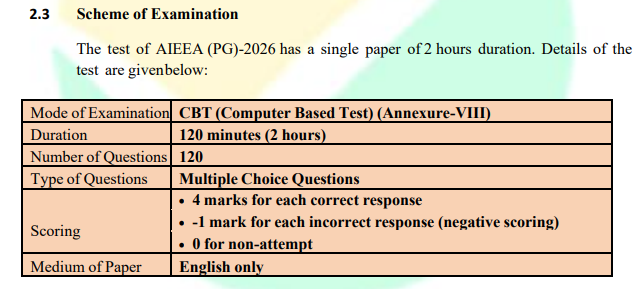
Source: ICAR AIEEA Information Brochure 2026
Ques. What is the ICAR AIEEA PG syllabus based on?
Ans. The ICAR AIEEA PG syllabus is based on the ICAR-approved 5th Deans' Committee (or latest) recommendations for undergraduate agricultural programmes, tested at graduation level.
Ques. Is the NTA ICAR PG exam conducted in Hindi as well?
Ans. No. Unlike the UG-level exam, the ICAR PG exam at the postgraduate level under the ICAR AIEEA PG syllabus is conducted in English only.
ICAR AIEEA PG Syllabus: What's New?
The ICAR AIEEA PG syllabus has gradually shifted from traditional agriculture concepts to technology-driven, climate-focused, and interdisciplinary topics. Key changes include:
- Modern Technology: AI, Machine Learning, GIS, Remote Sensing, drones, GPS, and precision farming are increasingly covered.
- Climate & Sustainability: More focus on natural farming, climate-resilient agriculture, carbon sequestration, conservation agriculture, bio-pesticides, and biological nitrogen fixation.
- Biotechnology & Bioinformatics: Topics such as genomics, proteomics, CRISPR/Cas9, molecular markers, gene silencing, and bioinformatics have gained importance.
- Agribusiness & IPR: The syllabus now covers agricultural IPR, WTO provisions, PPV&FR, and modern agribusiness and value-chain management.
| Phase | Major Changes |
|---|---|
| Pre-2019 | Mostly offline exams with state-level curriculum variations and greater focus on traditional concepts. |
| 2019–2025 | NTA introduced the CBT format and greater national-level standardisation of the ICAR PG syllabus. |
| 2026/2027 | Greater emphasis on analytical questions, technology, sustainability, biotechnology, and interdisciplinary applications. |
Ques. Has the ICAR AIEEA PG syllabus changed recently?
Ans. Yes. The ICAR AIEEA PG syllabus has steadily shifted from recall-based, state-specific curricula toward a nationally standardized, technology-heavy structure that now includes AI, GIS, CRISPR/Cas9, and climate-resilient farming concepts.
Also Check:
ICAR AIEEA PG Syllabus 2027: Subject-Wise Breakdown
The ICAR AIEEA PG exam has 20 major subject groups, with the number of applicants varying across streams based on student interest, seat availability, and career opportunities.
Below is the detailed ICAR AIEEA syllabus for the most sought-after subject groups.
ICAR AIEEA Agronomy Syllabus 2027
A total of 120 questions are asked in the exam across the 9 syllabus units:
- Core Agronomy Units: Unit II (Principles of Agronomy) and Unit III (Field Crops Production) together account for nearly 35% of the overall score. Candidates should focus on crop varieties, sowing practices, crop management, and agricultural meteorology.
- Soil & Fertility: Unit VI (Soil Fertility) and Unit VIII (Problem Soils) require practice with numerical problems, including nutrient requirements and fertilizer dose calculations. These units also cover soil nutrients, fertilizers, and the management of saline, sodic, and acidic soils.
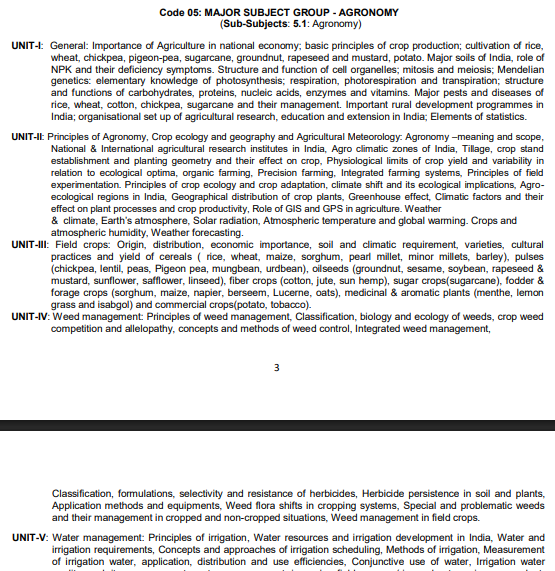
Source: ICAR AIEEA Official Syllabus 2026
| Unit | ICAR AIEEA PG Agronomy Syllabus Topics | Expected Weightage(Approx. Questions) |
|---|---|---|
| Unit I: General Agriculture | Macroeconomics, crop husbandry, soil nutrition, plant physiology, genetics, plant protection, and agricultural extension systems | 10–12 Questions |
| Unit II: Principles of Agronomy & Meteorology | History and principles of agronomy, agro-climatology, tillage, ecological limits, organic farming, and precision farming | 15–17 Questions(~13–15% of paper) |
| Unit III: Field Crops Production | Cultivation practices, varieties, and economic importance of Kharif and Rabi crops, including cereals, pulses, oilseeds, cash crops, and forages | 25–28 Questions(~20–23% of paper) |
| Unit IV: Weed Management | Weed biology, ecological interference, allelopathy, and weed control methods, including chemical herbicides | 10–12 Questions(~8–10% of paper) |
| Unit V: Water Management | Irrigation systems, soil-plant-water relationships, water-use efficiency, and micro-irrigation systems | 10–12 Questions(~8–10% of paper) |
| Unit VI: Soil Fertility | Essential plant nutrients, fertilizers and their chemistry, Integrated Nutrient Management (INM), and soil fertility management | 15–17 Questions(~13–15% of paper) |
| Unit VII: Dryland Agronomy | Drought classification, moisture conservation, rainfed agriculture, and contingent crop planning | 8–10 Questions(~6–8% of paper) |
| Unit VIII: Problem Soils | Characteristics, management, and reclamation of saline, sodic, and acidic soils | 8–10 Questions(~6–8% of paper) |
| Unit IX: Sustainable Land Use | Cropping systems, crop rotation, Conservation Agriculture, and sustainable land-use practices | 8–10 Questions(~6–8% of paper) |
ICAR AIEEA Plant Sciences Syllabus 2027
The ICAR AIEEA PG Plant Sciences exam is one of the most competitive streams under the NTA ICAR PG exam. It covers five specific postgraduate disciplines: Genetics & Plant Breeding, Plant Pathology, Agricultural Microbiology, Seed Science & Technology, and Plant Genetic Resources.
- Unit III contributes nearly two-thirds of your marks under this part of the ICAR AIEEA PG syllabus. Selection depends heavily on mastering Genetics, Plant Breeding, and Plant Pathology.
- Master Advanced Formats: Prepare for statement-assertion pairs and matching grids (e.g., diseases and causative agents, certification tags).
- Recommended Resources: Standard references include works by Phundan Singh, P.D. Sharma, and Ratan Lal Agrawal.
| Unit | Unit Topics | Weightage |
|---|---|---|
| Unit I: General Agriculture | Crop production principles, major field and horticultural crops, Indian soils, NPK roles and deficiency symptoms, package of practices, and economic contributions | 10–12 Qs |
| Unit II: Elementary Plant Sciences | Cell organelles, cell division, Mendelian genetics, basic crop physiology, biochemistry, meiotic prophase I, Mendelian exceptions, and photosynthetic pathways | 15–20 Qs |
| Unit III: Core Plant Sciences | Microbiology, plant pathology, genetics, heredity, protein synthesis, seed testing protocols, operon models, fungal disease life cycles, and seed isolation distances | 75–80 Qs |
| Unit IV: Applied Sciences & Extension | Bio-fuels, composting, rural development programmes, ICAR and SAU organisational structures, KVK networks, and composting phases | 8–10 Qs |
ICAR AIEEA Horticulture Syllabus 2027
The ICAR AIEEA PG Horticulture exam has five specific postgraduate disciplines: Vegetable Science (Olericulture), Fruit Science (Pomology), Post-Harvest Management, Floriculture & Landscaping, and Plantation, Spices, Medicinal & Aromatic Crops.
- Pomology & Olericulture: Fruit and vegetable science together account for nearly 50% of the performance in this part of the ICAR AIEEA PG syllabus. Focus on botanical names, chromosome numbers, plant families, centres of origin, edible parts, and pollination methods.
- Rootstocks & Varieties: Prepare important and newly released varieties, along with important rootstocks such as M9 and MM106 in apple and Fyfe and Olour variants in mango.
- Physiological Disorders: Study common disorders and their causes, such as Black Tip in mango, Bitter Pit in apple, Whiptail in cauliflower, and Blossom End Rot in tomato.
- Post-Harvest Management: Focus on maturity indicators, ethylene production, controlled-atmosphere storage, cold-chain requirements, and fruit and vegetable processing methods.
| Section / Unit | Syllabus Topics & Subjects Covered | Expected Weightage |
|---|---|---|
| Unit I: General Agriculture & Allied Sciences |
| 12–15 Questions |
| Unit II: Pomology (Fruit Science) |
| 25–30 Questions |
| Unit III: Olericulture (Vegetable Science) |
| 25–30 Questions |
| Unit IV: Floriculture & Landscape Architecture |
| 12–15 Questions |
| Unit V: Post-Harvest Technology & Management |
| 12–15 Questions |
| Unit VI: Plantation, Spices, Medicinal & Aromatic Crops |
| 10–12 Questions |
ICAR AIEEA Physical Science / Soil Science Syllabus 2027
The ICAR AIEEA PG Physical Science / Soil Science exam encompasses multiple critical sub-subjects: Soil Science & Agricultural Chemistry, Agricultural Meteorology, Agricultural Physics, Agricultural Chemicals, Environmental Science, and Organic Farming.
- Units III & IV: Together, these units cover over 70% of the paper. Focus on clay minerals, soil properties such as bulk density, particle density and porosity, and Stokes’ Law calculations.
- Problem Soil Reclamation: Prepare gypsum and lime requirement calculations, chemical reactions, and Exchangeable Sodium Percentage (ESP).
- Soil Analysis Instruments: Focus on the working principles of Flame Photometers for Na and K estimation and Spectrophotometers for phosphorus estimation.
| Unit | Core Subjects & Brief Syllabus Topics | Expected Weightage |
|---|---|---|
| Unit I: General Agriculture | Agriculture and crop production basics; nutrient and water management in major crops; cell structure, plant physiology and biochemistry; rural development programmes, extension setup and ICAR strategies. | 10–12 Questions |
| Unit II: Applied Chemistry & Agro-Chemicals | Volumetric, gravimetric and complexometric analysis; periodic classification; laboratory instruments such as spectrophotometer, flame photometer and chromatography; atomic structure, pH, buffers and solubility; basic organic chemistry; chemical and botanical pesticides. | 20–25 Questions |
| Unit III: Pedology, Soil Physics & Soil Chemistry | Rocks, minerals and soil formation; soil texture, density, porosity, aeration and Stokes' Law; clay minerals, CEC, AEC and exchangeable ions; acid, saline, sodic and acid sulphate soils; waterlogged soil conditions. | 40–45 Questions |
| Unit IV: Soil Fertility, Biology & Modern Tech | Essential nutrients, mobility and deficiency symptoms; soil fertility and testing; organic matter, C:N ratio, mineralization and immobilization; soil microorganisms and BNF; soil survey, land classification, Remote Sensing, GIS, GPS, pollution and soil conservation. | 40–45 Questions |
ICAR AIEEA Social Sciences Syllabus 2027
The ICAR AIEEA PG Social Sciences (Subject Code 06) syllabus mainly covers Agricultural Economics, Agricultural Extension Education, and Agricultural Statistics.
- Unit II: Focus on the three stages of production, especially conditions such as MP = AP and MP = 0. Also prepare farm budgeting concepts, Net Farm Income, BCR, IRR, and the Green, Blue, and Amber Boxes under WTO.
- Unit III: Study important extension programme timelines and founders, Rogers’ adopter categories (2.5%, 13.5%, 34%, 34%, and 16%), and communication models such as Berlo’s SMCR and Leagans’ model.
- Unit IV: Understand the basic use of t-test, z-test, and Chi-square test for different types of statistical problems.
| Unit / Domain | Core Subjects & Brief Syllabus Topics | Expected Weightage |
|---|---|---|
| Unit I: General Agriculture | Agriculture and crop production basics; soil science, NPK and deficiency symptoms; cell structure, plant physiology and biochemistry; ICAR, SAUs and major rural development programmes. | 10–12 Questions |
| Unit II: Agricultural Economics | Microeconomics: consumer behaviour, demand, elasticity, production, costs and market structures; macroeconomics: GDP, money, banking and inflation; agricultural finance and credit agencies; production economics, farm management and budgeting; agricultural marketing, WTO, GATT and IPR. | 50–55 Questions |
| Unit III: Agricultural Extension Education | Extension concepts and evolution in India; rural development programmes; communication, adoption and diffusion; extension teaching methods and ICT tools; programme planning, monitoring and evaluation; training institutions; rural sociology, psychology, motivation and leadership. | 45–50 Questions |
| Unit IV: Agricultural Statistics | Mean, Median, Mode and measures of dispersion; correlation and regression; probability and normal distribution; t-test, z-test, F-test and Chi-square test; basic experimental designs such as CRD and RBD. | 8–10 Questions |
Ques. Which subject group carries the highest number of streams under the ICAR AIEEA PG syllabus?
Ans. Horticulture and Social Sciences are among the most subject-dense groups within the ICAR AIEEA PG syllabus, each combining multiple postgraduate disciplines under one subject code.
Also Check:
ICAR AIEEA PG 2026 Question Paper with Solution PDF
| ICAR AIEEA PG Paper | Question Paper PDF | Solution PDF |
|---|---|---|
| ICAR AIEEA PG Agri Business Management Question Paper 2026 | Download PDF | Check Solutions |
| ICAR AIEEA PG Agricultural Engineering and Technology Question Paper 2026 | Download PDF | Check Solutions |
| ICAR AIEEA PG Agronomy Question Paper 2026 | Download PDF | Check Solutions |
| ICAR AIEEA PG Animal Biotechnology Question Paper 2026 | Download PDF | Check Solutions |
| ICAR AIEEA PG Animal Sciences Question Paper 2026 | Download PDF | Check Solutions |
| ICAR AIEEA PG Community Science Question Paper 2026 | Download PDF | Check Solutions |
| ICAR AIEEA PG Dairy Science Question Paper 2026 | Download PDF | Check Solutions |
| ICAR AIEEA PG Dairy Technology Question Paper 2026 | Download PDF | Check Solutions |
| ICAR AIEEA PG Entomology and Nematology Question Paper 2026 | Download PDF | Check Solutions |
| ICAR AIEEA PG Fisheries Sciences Question Paper 2026 | Download PDF | Check Solutions |
| ICAR AIEEA PG Food Science Technology Question Paper 2026 | Download PDF | Check Solutions |
| ICAR AIEEA PG Forestry Agroforestry Silviculture Question Paper 2026 | Download PDF | Check Solutions |
| ICAR AIEEA PG Horticulture Question Paper 2026 | Download PDF | Check Solutions |
| ICAR AIEEA PG Physical Sciences Question Paper 2026 | Download PDF | Check Solutions |
| ICAR AIEEA PG Plant Biotechnology Question Paper 2026 | Download PDF | Check Solutions |
| ICAR AIEEA PG Plant Sciences Question Paper 2026 | Download PDF | Check Solutions |
| ICAR AIEEA PG Social Sciences Question Paper 2026 | Download PDF | Check Solutions |
| ICAR AIEEA PG Statistical Science Question Paper 2026 | Download PDF | Check Solutions |
| ICAR AIEEA PG Veterinary Science Question Paper 2026 | Download PDF | Check Solutions |
| ICAR AIEEA PG Water Science and Technology Question Paper 2026 | Download PDF | Check Solutions |
ICAR AIEEA PG Exam Pattern 2027
The ICAR AIEEA PG 2027 exam pattern is a national-level framework conducted by the National Testing Agency (NTA). It mainly tests candidates on their undergraduate-level subject knowledge and concepts, as prescribed in the ICAR AIEEA PG syllabus.
The 120 questions are based on the candidate’s selected Major Subject Group, covering one of the 20 subject areas such as Agronomy, Plant Biotechnology, Social Sciences, and others.
- Unit I: General Agriculture: This is a common section covering basic topics such as crop statistics, Indian soils, rural development schemes, and agricultural economics.
- Units II Onwards: Core Subject: These units focus on technical, graduation-level topics related to the candidate’s chosen subject or specialization.
| Particular / Parameter | Official Specification |
|---|---|
| Mode of Examination | Computer-Based Test (CBT) |
| Total Number of Questions | 120 Questions |
| Maximum Marks | 480 Marks |
| Duration of Exam | 2 Hours (120 Minutes) |
| Medium of Paper | English only |
| Question Format Types |
|
| Marking Scheme |
|
Ques. How many questions are asked under the ICAR AIEEA PG syllabus?
Ans. The ICAR AIEEA PG exam consists of 120 questions worth 480 marks, split between the mandatory General Agriculture unit and the candidate's chosen Core Disciplinary Stream.
Also Check:
Best Books for ICAR AIEEA PG Syllabus 2027
Choosing the right books can help ICAR AIEEA PG aspirants build concepts and practice subject-specific questions effectively.
- Use the main books for concepts: Start with the recommended books for your subject group to build a strong foundation in core topics.
- Use reference books for practice: Refer to advanced books for MCQs, revision, and exam-oriented practice, especially for topics requiring deeper preparation.
General Agriculture for ICAR Exam by Muniraj Singh Rathore is the ultimate book to prepare for the General Agriculture part of the ICAR AIEEA exam.
- Dedicate the first 45 minutes of your daily study routine to Unit-I (General Agriculture) using the recommended book, and stay updated on active central schemes (like PM-KISAN, PM-FBY) and the latest crop production estimates.
| Subject Group | Main Book (Concepts & Foundations) | Reference Book (Advanced & Practice) |
|---|---|---|
| Agronomy (Code 05) | Principles of Agronomy by T. Yellamanda Reddy & G.H. Sankara Reddi | Agronomy at a Glance by P.L. Maliwal |
| Plant Sciences (Code 02) | Elements of Genetics & Plant Breeding Principles by Phundan Singh | Plant Pathology by P.D. Sharma (or Objective Plant Sciences by J.P. Singh) |
| Horticulture (Code 08) | Basic Horticulture by Jitendra Singh | Essence of Horticulture by A.R. Karunakaran |
| Physical Science (Code 03) | Introductory Soil Science by D.K. Das | Glimpses of Soil Science by J. Jhavar |
| Social Sciences (Code 06) | Agricultural Economics by S. Subba Reddy & P. Raghu Ram | Extension Education by A. Adivi Reddy |
Ques. Which book should I start with for the ICAR AIEEA PG syllabus?
Ans. Regardless of your chosen stream, start with a General Agriculture reference such as Muniraj Singh Rathore's book to cover the mandatory Unit-I before moving to stream-specific texts.
Also Check:
ICAR AIEEA PG Syllabus 2027: Preparation Tips
A balanced study plan can help candidates cover concepts thoroughly while also improving speed and accuracy.
- Follow the 70-30 approach: Spend 70% of your study time on core chapters, concepts, derivations, and reactions from the main book, and 30% on reference books for advanced practice and mock questions.
- Practice matching questions: Use reference books to practise matching botanical varieties, certification terms, and complex definitions within a 1-minute time limit.
| Subject | Preparation Tips |
|---|---|
| Agronomy |
|
| Horticulture |
|
| Physical Science / Soil Science |
|
| Social Sciences |
|
ICAR AIEEA PG Syllabus FAQs
Ques. What is the ICAR AIEEA PG syllabus for 2027?
Ans. The ICAR AIEEA PG syllabus 2027 covers 20 major subject groups at graduation level, with each stream carrying a mandatory Unit-I (General Agriculture) component and multiple stream-specific Core Disciplinary Units, tested across 120 questions worth 480 marks.
Ques. How is the ICAR AIEEA PG exam different from the ICAR AIEEA UG exam?
Ans. The ICAR PG exam is conducted only in English, tests graduation-level subject depth across 20 specialized streams, and follows a +4/-1 marking scheme, whereas the UG-level exam is offered in English and Hindi and tests a broader, less specialized syllabus.
Ques. Where can I find the detailed ICAR-PG syllabus for my subject group?
Ans. The detailed ICAR-PG syllabus for each of the 20 subject groups, including unit-wise weightages, is published as part of the official ICAR AIEEA PG information bulletin; candidates should cross-check unit weightages using previous years' patterns as covered in this article.
Ques. Is the ICAR AIEEA syllabus the same every year?
Ans. No. While the core structure of the ICAR AIEEA syllabus remains stable, ICAR periodically updates unit content — most recently adding frontier technology topics like AI, GIS, Remote Sensing, and CRISPR/Cas9 across several subject groups.
Ques. Which subject groups are covered under the ICAR syllabus for Plant Sciences?
Ans. The icar syllabus for Plant Sciences (Code 02) covers Genetics & Plant Breeding, Plant Pathology, Agricultural Microbiology, Seed Science & Technology, and Plant Genetic Resources, with Unit III (Core Plant Sciences) alone accounting for nearly 65% of the paper.
Ques. Does the NTA ICAR PG exam have negative marking?
Ans. Yes. Under the ICAR AIEEA PG syllabus and exam pattern, candidates receive +4 marks for every correct answer and lose -1 mark for every incorrect answer, with no penalty for unattempted questions.



Comments