



Content Curator
Imbibition is the absorption of water by some solid colloidal particles of an adsorbent, making it tremendously expand in volume without forming a solution. These solid colloidal particles or adsorbents increase their volume after retaining a certain amount of liquid which is sometimes referred to as imbibants and the liquid being adsorbed is known as imbibate.
| Table of Content |
Key Takeaways- Imbibant, Imbibate, Water Potential, Diffusion, Adsorption.
Imbibition
[Click Here for Sample Questions]
Have you noticed why the seeds soaked in water swell and the wooden doors and windows in the rainy seasons become heavier? The answer to this question is imbibition. In this process, the hydrophilic solid particles of seeds and wooden doors adsorb some water and increase its volume therefore in this case the seeds and wooden doors can be called imbibants and the water as imbibate.
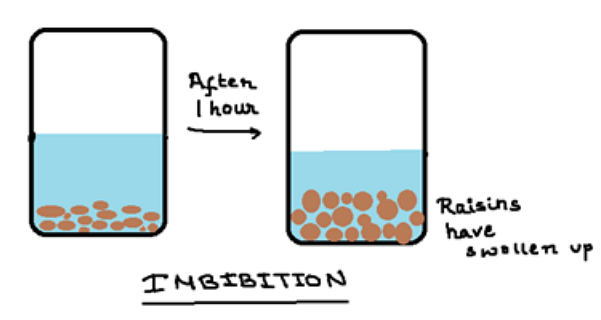
Imbibition of Raisins
Different solids have different capacities of imbibing water and this capacity depends upon their hydrophilic ability. For example, if we compare the imbibing capacities of protein, starch, and cellulose, protein will adsorb more amount of water than starch and cellulose because of being more hydrophilic in nature.
Read More:
Characteristics of Imbibition
[Click Here for Sample Questions]
- Water Potential: The water potential gradient between the imbibant and imbibate is established because the imbibants have a negative value for water potential on the other hand the water potential of pure water is considered to be zero. Due to this, when a dry seed comes in contact with water the water rapidly diffuses into the seed, in other words, the liquid diffuses from higher water potential to lower water potential.
- The Heat of Wetting: Energy is released in the form of heat during the process of imbibition.
- Increase in Pressure and Volume: As the liquid diffuses inside the imbibant it swells up or it increases its volume which in turn increases the overall pressure in the imbibant. This pressure is known as imbibition Pressure and is responsible for various phenomena like the cracking of seeds and rocks.

Seed Imbibition
Also Read: Xylem Vs Phloem
Factors Affecting Imbibition
[Click Here for Sample Questions]
- Temperature: The rate of imbibition increases with an increase in temperature.
- Pressure: The rate of imbibition increases with an increase in pressure.
- PH value
- Hydrophilic Capacity of the imbibate to attract a water molecule.
- The affinity between the imbibant and imbibate.
Also Read
Condition Necessary for Imbibition
[Click Here for Sample Questions]
Following are the three necessary conditions to achieve imbibition
- A water potential gradient between imbibate and imbibant.
- Moderate to high temperature.
- Force of attraction between imbibate and imbibant.
Read More:
Significance of Imbibition
[Click Here for Sample Questions]
- Imbibition provides necessary hydration to seeds.
- It is considered to be the first step in the germination of seeds and water adsorption.
- Imbibition facilitates water absorption in the roots of plants.
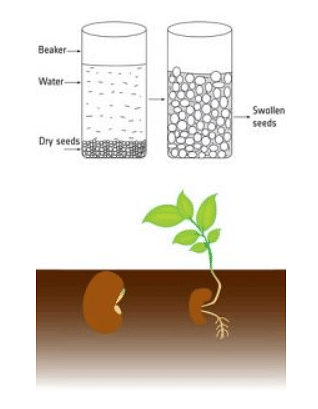
Imbibition of Seeds
- It is because of imbibition that the water reaches the ovule and then further ripens it into seeds.
- Due to an increase in imbibition pressure inside the seeds it eventually breaks down and the seedling manages to reach above the soil.
Also Read: Asexual Reproduction
Things to Remember
[Click Here for Sample Questions]
- Imbibition is the absorption of water by some solid colloidal particles of an adsorbent, making it tremendously expand in volume without forming a solution.
- Different solids have different capacities of imbibing water and this capacity depends upon their hydrophilic ability.
- The water potential of pure water is zero.
- The water potential of imbibant is negative.
- Imbibition pressure has a very high magnitude.
- Imbibition provides necessary hydration to seeds.
Read More:
Sample Questions
Ques. What do you mean by imbibition? (2 marks)
Ans. Imbibition is the absorption of water by some solid colloidal particles of an adsorbent making it tremendously expand in volume without forming a solution. These solid colloidal particles or adsorbents increase their volume after retaining a certain amount of liquid which is sometimes referred to as imbibants and the liquid being adsorbed is known as imbibate.
Example- swelling of seeds when soaked in water.
Wooden doors become heavier in the rainy season.
Ques. What is the difference between diffusion and imbibition? (3 marks)
Ans. Diffusion - It is the movement of solid, liquid, or gaseous ions from high concentration to lower concentration.
It is irreversible in nature and can only occur on living surfaces.
On contrary to this
Imbibition is the movement of liquid from higher to lower water potential.
It is reversible in nature and occurs in both living and dead surfaces.
Ques. What is the basic difference between Imbibition and Osmosis? (2 marks)
Ans. The basic difference between imbibition and osmosis is that imbibition is the adsorption of water by solid surfaces and osmosis usually refers to the general movement of water across high to low concentrations.
Ques. How is Imbibition important for plants? (3 marks)
Ans. Imbibition plays a crucial role in the life of plants because of the following points:
- It is because of imbibition that the water reaches the ovule and then further ripens it into seeds.
- Due to an increase in imbibition pressure inside the seeds it eventually breaks down and the seedling manages to reach above the soil.
- It provides necessary hydration to seeds and keeps them moist.
- It is considered to be the first step in the germination of seeds and water adsorption.
- It facilitates water absorption in the roots of plants.
Ques. What do you mean by water potential and water potential gradient? (2 marks)
Ans. Water potential is the difference in the potential energy of water molecules to move from one area to another due to differences in their pressure. Water potential on the other hand is the difference between the potential energies of two liquids. For example, when a dry seed comes in contact with water the water rapidly diffuses into seed, in other words, the liquid diffuses from higher water potential to lower water potential.
Ques. Mention some important factors affecting imbibition. (3 marks)
Ans. Factors affecting Imbibition are as follows
Temperature - The rate of imbibition increases with an increase in temperature.
Pressure - The rate of imbibition increases with an increase in pressure.
PH value of the medium.
Hydrophilic Capacity of the imbibate to attract a water molecule.
The affinity between the imbibant and imbibate.
Force of attraction between imbibant and imbibate.
Ques. Explain Features of Imbibition. (3 marks)
Ans. Water potential - The water potential gradient between the imbibant and imbibate is established because the imbibants have a negative value for water potential on the other hand the water potential of pure water is considered to be zero. Due to this when a dry seed comes in contact with water the water rapidly diffuses into the seed, in other words, the liquid diffuses from higher water potential to lower water potential.
- The heat of Wetting- Energy is released in the form of heat during the process of imbibition.
- Increase in Pressure and volume- As the liquid diffuses inside the imbibant it swells up or it increases its volume which in turn increases the overall pressure in the imbibant. This pressure is known as imbibition Pressure, it is very high in magnitude. For example, it requires atleast 1000atm pressure to break down the seed and help it reach above the ground. This pressure is being generated through imbibition.
Ques. List some important conditions necessarily required for imbibition. (3 marks)
Ans. Following are the three necessary conditions to achieve imbibition
- i) A water potential gradient between imbibate and imbibant, the more the difference in potential of two liquids more rapidly the water molecules will move.
- ii) Moderate to high temperature as an increase in temperature or warm climate accelerates the rate of imbibition.
iii) Force of attraction between imbibate and imbibant, the stronger the force of attraction between water and solid particles, the higher will be the rate of adsorption.
Read More:



Comments