



Content Writer
Initial velocity is the velocity before the object accelerates. When an object is set in motion, it changes its position and displacement according to its speed and time. The time taken by an object to change its position in a specific displacement or specific direction is called Velocity. Hence, velocity can be calculated as Displacement/Time and thus SI unit of velocity will be meter per second(m/s) The object in motion is associated with various factors like displacement, distance, time, and velocity. If an object is in acceleration or deceleration, two velocities are generated, Initial velocity and Final Velocity.
Read more: Angular speed
| Table of Content |
KeyTerms: Initial Velocity, Acceleration, Rotation, Displacement, Time, Law of constant acceleration
What is Initial Velocity?
[Click Here for Sample Questions]
Motion is described as something that changes the position of the object. Examples like a moving car, a ball hitting an object, and running.
Velocity is the displacement of an object in a particular direction. An example of the earth’s rotation around the sun, is the speed of a car moving in the north direction Hence the force on the object causes it to accelerate.

Earth rotating around the sun
Initial velocity is the velocity that is defined as velocity before the object begins to accelerate. It is represented as the letter ‘u’.Whereas, the final velocity is the velocity that is defined as when an object has reached its maximum acceleration. It is represented as the letter ‘v’. The speed or the acceleration in which an object rotates or moves is represented as the letter ‘a.
What Is Uniform Acceleration?
[Click Here for Sample Questions]
If the object in motion is increasing its velocity concerning equal intervals of time, then that acceleration is called Uniform Acceleration. Example-a ball rolling down a slope. There are three equations of this acceleration which are also called Laws of Constant Acceleration.
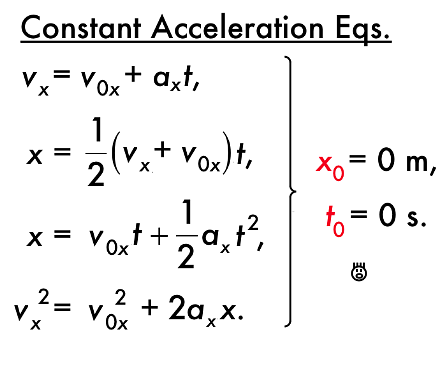
Laws of constant acceleration
Read more:
| Relevant Concepts | ||
|---|---|---|
| Angular motion | Frequency distribution table | Radio waves |
| Relative frequency | Resonance | Ripple factor |
Formulas for Initial Velocity
[Click Here for Sample Questions]
Let us look at some of the initial velocity formulas related to different terms and aspects.
- If Time, velocity, and acceleration are provided to us, then one can calculate Initial Velocity with help of the formula:-
| u = v – at |
where, v=final velocity, a=acceleration and t=time taken
- Distance, acceleration, and velocity are given to us, then one can calculate Initial Velocity with the help of the formula:
| u2 = v2 – 2as |
where, s=distance,a=acceleration and v=final velocity
- Distance, acceleration, and time are known, then one can calculate Initial Velocity with the help of the formula:
| u = s/t – at/2 |
where s=distance, a=acceleration and t=time taken
Things to Remember
- Initial velocity is the velocity that is defined as velocity before the object begins to accelerate. It is represented as the letter ‘u’
- Final velocity is the velocity that is defined as when an object has reached its maximum acceleration. It is represented as the letter ‘v’.
- If the object in motion, is increasing its velocity concerning equal intervals of time, then that acceleration is called as Uniform Acceleration
- The key is to always understand what is given to us and consider different aspects of velocity such as displacement, time, and acceleration.
Sample Questions
Ques. Raj travels a distance of 200 meters with a velocity of 50 meters per second, and the acceleration throughout his journey was 7 meters per second square. Find the initial velocity of Raj. (5 marks)
Ans. Here s= 200 m, v= 50 m/s, a= 7 m/s2
As S, V, and A are known to us
Apply formula:
u2 = v2 + 2as
Inserting the values in the formula
u2= 100 + 2(7)(200)
u2 = 100+2800 = 2900
Hence u = 53.85 m/s.
Ques. A bus is moving at a speed of 0.50 ms2 for the 50s. It starts taking up speed and the velocity of the bus reaches 30 m/s. What is the initial velocity of the bus? (5 marks)
Ans. Here v=30,t=50 and a=0.50
As v, a,t are known
calculate, the initial velocity using the formula:-
u =v – at
Inserting the values in the formula
u = 30 – (0.50) ×(50)
u = 30 – 25
u = 5 m/s
Therefore, the initial velocity of the bus was 5 m/s
Ques. A boat sails 1000 meters in 10s and has an acceleration of 10 m/s2. What is the initial velocity of the boat? (5 marks)
Ans. Here s=1000,a=10 and t=10
As s, a,t are known
calculate initial velocity using the formula:-
u=s/t-at/2
Inserting the values in the formula
u=1000/10-(10*10)/2
u=100-50
u=50 m/s
Therefore, the initial velocity of the boat was 50 m/s
Ques. A Bus is traveling in a ghat but when the bus moves to a plain area, the driver accelerates the bus to 0.30 m/s2 for the 40s. Then the velocity of the bus changes to 60m/s. What is the initial velocity of the bus? (5 marks)
Ans. Here t = 40s, a =0.30m/s2,v =60 m/s
As t, a,v are known
calculate initial velocity using the formula:-
u = v – at
Inserting the values in the formula,
u = 60 – (0.30) × (40)
u = 60 – 12
u = 48 m/s
u = 48m/s
Ques. A car covers 1.6km in 20 seconds and has an acceleration of 0.50 m/s2. What is the initial velocity of the car? (5 marks)
Ans. Here given to us: s = 1.6km = 1.6 × 1000 = 1600m, t = 20s, a = 0.50m/s2
As t, a,v are known
calculate initial velocity using the formula
u = s/t – at/2
Inserting the values in the formula
u = 1600/20 – (0.50 × 20)/2
u = 80 – 5
u = 75 m/s.
Ques. A bike is moving through traffic at a moderate speed. Once traffic got cleared, the bike accelerated at 0.50 m/s2 for the 80s. After gaining acceleration, the velocity of the bike is 100m/s. What is the initial velocity of the bike? (5 marks)
Ans. Given: t = 80s, a = 0.50 m/s2, v = 100 m/s
As t, a,v are known
calculate initial velocity using the formula
u = v – at
Inserting the values in the formula,
u = 100 – (0.50)×(80)
u = 100 – 40
u = 60 m/s
Ques. If the final velocity is 20 meters per second, and the acceleration is 5 meters per second, the time taken is 6 seconds. What was the initial velocity of that person? (5 marks)
Ans. Given v= 20 m/s, a= 5 m/s2, t=6 s
As t, a,v are known
calculate initial velocity using the formula
u= v + at
Inserting the values in the formula,
u= 20+5(6)
u= 50m/s.
Hence the initial velocity of that person was 4 m/s.
Ques. A person throws a stone in the air.. The stone moves up to a maximum point, then reverses and falls to the ground. The final velocity of the stone is -12.7 m/s, taking it to be the negative direction. The time from when the stone leaves the person's hand to when it hits the ground is 4s. What was the initial velocity of the stone? Acceleration due to gravity is g = -9.8 m/s2 (5 marks)
Ans. Considering time, acceleration and final velocity,
find initial velocity using the formula
u = v - at
(-12.7)-(-9.8)*4
(-12.7 m/s) + 39.2
u = 26.5 m/s
The initial velocity of the stone was 26.5 m/s
Ques. A ship sails 10000 meters in the 30s and has an acceleration of 20 m/s2. What is the initial velocity of the ship? (5 marks)
Ans. Here s=10000,a=20 and t=30
As s, a, t are known
calculate initial velocity using the formula:-
u=s/t-at/2
Inserting the values in the formula
u=10000/30-(20*30)/2
u=333.33-300
u=33.3 m/s
Therefore, the initial velocity of the boat was 33.3m/s
Ques. Rahul travels on a bike a distance of 500 meters with a velocity of 60 meters per second, and the acceleration throughout his journey was 8 meters per second square. Find the initial velocity of his bike. (5 marks)
Ans. Here s= 500 m, v= 60 m/s, a= 8 m/s2
As S, V, and A are known
use the formula:
u2=v2+2as
Inserting the values in the formula
u = 1200 + 2(8)(500)
u = 1200+8000 = 9200
Hence u = 95.91 m/s
Check out:



Comments