



Education Journalist | Study Abroad Lead
We, the humans being the part of this vast ecosystem, consume food to live, be active and perform our daily activities. Each animal that is a part of this food cycle must consume something to live and continue in the ecosystem. An environment is nothing but everything that surrounds us and affects us. Every creature including plants searches for food in its environment. From the minutest bacteria to giant Blue Whale everyone depends on each other to complete the food chain. The bacteria are found everywhere around us which is the reason for biodegradation, feeding on the dead organisms to live and hence completing the food chain. In this article, we will have a look at the interdependence of plants and animals.
| Table of Content |
Key takeaways: plants, producers, animals, consumers, photosynthesis, food chain, ecosystem, environment, balance in nature.
Plants as Producers
[Click Here for Sample Questions]
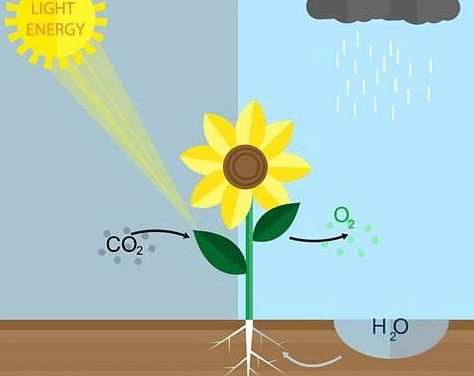
All the green plants make their food as well as prepare food for the animals and human beings. Hence, they are called producers. To prepare the food, they use the energy from the sunlight along with water and the carbon dioxide present in the environment. This process of preparation of food by the leaves in the plants is called Photosynthesis.
Plants as producers
The green leaves are responsible for the preparation of food by the process called photosynthesis. Leaves are generally green in color due to the presence of chlorophyll in them. Every leaf which is green in color can prepare food by taking the carbon dioxide which enters through the stomata, water from the soil which contain dissolved minerals like phosphorous and nitrogen, and sunlight from the sun rays as shown in the above diagram.
6CO2 + 6H2O → C6H12O6 + 6O2 + 6H2O
(Carbon dioxide) (Water) (Glucose) (Oxygen) (Water)
The produced glucose in the above reaction is prepared into different materials which are considered as the consumable food from the plants. The oxygen is evolved out of the leaves through stomata. In this way, the plants are used as oxygen generators.
Animals as consumers
[Click Here for Sample Questions]
As animals cannot make their food, they depend on the plants for their food, so they are called consumers. Animals including humans, get their energy from the food they eat. Some animals eat plants and plant products. Some animals eat the flesh and milk of these plant-eating animals. Thus, all the animals depend on plants directly or indirectly for their food requirement. Based on eating habits, animals are divided into the following:
Herbivores – they eat only plants or plant products. (Buffalo, cow, deer, giraffe)
carnivores – They feed on other animals. (Crocodile, tiger, snake)
Omnivores – they eat both plants and the flesh of other animals. (Dog, monkey, pig)

Herbivores, Carnivores, and Omnivores
Forests are considered as the traditional and natural ecosystem in the world. The plants are producers and generate food for animals and human beings. The food provided by the plants in the forests and the animals contribute to the spreading of fruits and seeds which increase the plant diversity and result in more food for the animals. The main difference between the plants and the animals is that the animals show locomotives, but plants will show stimuli to various phenomena like phototropism, geotropism, and so on.
Interdependence of plants and animals
[Click Here for Sample Questions]
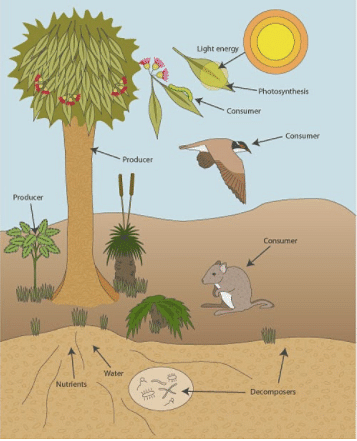
This interdependence of plants and animals can be observed in various aspects of the ecosystem. Plants and animals help to maintain the balance of oxygen and carbon dioxide in the environment by the exchange of gases. Plants give out oxygen. This oxygen is needed by animals for breathing or for the respiration process.
- Firstly, the animals depend on the plants for oxygen which is essential for humans for breathing. Plants give out the oxygen from the stomata present on the leaves after the photosynthesis process. That oxygen will help the human body to generate the energy required for the body. Animals give out carbon dioxide, which is needed by plants for photosynthesis.
- Secondly, the food requirement for animals is majorly fulfilled by the plants. Sometimes besides the plants, the animals also act as a source for the other animals like carnivores and omnivores. Plants convert the energy-giving elements into different forms like fruits, vegetables, flowers, roots, stems, etc. which can be consumed by the animals further digested, and converted into energy. Every edible material consumed by the animals must be produced directly or indirectly by the plants.
- Thirdly, medicinal plants like Garlic, ginger, lemon, eucalyptus, neem plant, aloe vera, penicillin, chinchona (quinine is extracted) are used highly for the preparation of the medicines. Almost all plant parts have a medicinal behavior which when observed to be useful to the animals and synthesized in larger amounts and use for curing certain diseases and problems.
- The animals directly or indirectly help the plants in the dispersion and reproduction process through the pollination of the seeds to farther areas. Generally, some of the plants have pollen grains in their flowers, when a bee comes to the flower for its food (generally honey) then the pollen grains stick to the bee’s body and falls at some other places and hence a plant of the same kind grows at that place and hence enhancing the reproduction process. Many animals use the borrows of the tree stems for shelter and the humans make most of the furniture with the wood which is obtained from the plant’s stem.
Interdependence of plants and animals
Food chain
[Click Here for Sample Questions]
Food chain describes the feeding relationship between plants and animals in the ecosystem. The food chain is a chain of organisms that shows that each organism in the chain depends on the lower organism for its food. A food chain shows how nutrients and energy are passed from one living organism to the other. The food chain begins with plants and ends with animals.
A simple food chain could start with grass, which is eaten by rabbits, the rabbits are eaten by the foxes, the foxes are eaten by the lions, the lions when become old eventually die, their dead body will be slowly eaten by the scavengers which feed on the dead organisms and decomposers like bacteria and fungi present in the soil, and converts into nitrogenous nutrients which will be used by the plants for the preparation of the food and converts them in the form of vegetables and fruits.

Food Chain
Read about: Bioderadable and Non Biodegradable Substances
Balance in Nature
[Click Here for Sample Questions]
The balance is maintained by the food chain in the ecosystem. The ecosystems are organized in a state of balance where one species coexist with the other species and also with the environment. Ecological imbalances occur when a natural or man-made cause disturbs the natural balance of an ecosystem.
Some of the natural causes for disturbance of ecosystem are:
- Floods.
- Volcanic eruptions.
- Drought.
- Cyclone.
- Tsunami.
Some of the man-made causes are:
- Introduction of a new species.
- Deforestation.
- Forest fire.
- Pollution.
- Overhunting species.
Things to remember
[Click Here for Sample Questions]
- Plants and animals are highly interdependent on each other.
- Plants paved the way for the living of animals by giving food to the animals.
- Animals also assisted in pollinating plants and providing carbon dioxide, which uses plants for energy.
- Plants make food by taking in carbon dioxide from the air and giving off oxygen into the air.
- Animals in turn breathe in that oxygen to survive, plants add oxygen to the atmospheric air. Without plants, which replace the oxygen in the air that animals would die.
- Forests are the best ecosystem in the world, all living organisms are dependent on each other for their continued existence.
Also read:
Sample Questions
Ques. How are plants and animals are interdependent on each other? (5 marks)
Ans. Plants and animals are interdependent on each other for many reasons some of them are listed below:
- Respiration: plants and animals are interrelated for maintaining the level of co2 and o2 in the atmosphere. Plants make food by taking in carbon dioxide from the air and giving off oxygen into the air. Animals in turn breathe in that oxygen to survive, plants add oxygen to the atmospheric air. Without plants, which replace the oxygen in the air that animals would die. Hence the plants and animals maintain the ratio of gases in the atmosphere.
- Food production and consumption: Food that is generated in the world is by green plants. The food requirement is majorly fulfilled by the plants. Sometimes besides the plants, the animals also acted as a source of the other animals like carnivores and omnivores. Plants convert the energy-giving elements into different forms like fruits, vegetables, flowers, roots, stems, etc, which can be consumed by the animals further digested, and converted into energy.
- Medicinal use: Medicinal plants like Garlic, ginger, lemon, eucalyptus, neem plant, aloe vera, penicillin, chinchona (quinine is extracted) are used highly for the preparation of the medicines. Almost all plant parts have a medicinal behavior.
- Other uses: Most of the furniture is generated from the stems of large trees and many spices which give a good taste to the food we eat are provided by the plants. After the death of a certain animal, they are decomposed by the decomposers and transfer the nutrients to the soil which in turn will help the plant to make the food.
Ques. Explain any one of the food chains present in the ecosystem? (5 marks)
Ans. Food chain can be defined as the linear sequence of organisms where one organism is consumed by the other for food is known as the food chain. Fundamentally, the food chain is a sequence of organisms where there is a huge transfer of matter and energy, which transforms from one place to the other in the ecosystem.
Food webs are the combinations of many food chains. Several interconnections can be observed in a food chain which when connected in a tree structure will result in a food web.
Consider a food chain in a grassland. The food chain is described with the arrows as shown below. Here grass is the producer of the food by the process of photosynthesis and serves the primary consumers like grasshoppers and then the grasshopper will be prey for the predators like frogs. The frogs were generally eaten by carnivorous animals like the snake. Thereby, if the snake dies with any external effects, then eagles or bacteria will feed on the dead organisms hence completing a food chain.
Grass —> Grasshopper —> Frog —> Snake —> Eagle.
Ques. Where can we find the humans in the food chain? (2 marks)
Ans. Humans are at the top of the food chain as we eat different types of plants and animals and are not consistently eaten by other animals. Human beings are generally intelligent so as to prevent the danger from the other organisms to feed on them when alive.
Ques. What is the difference between a food chain and a food web? (3 marks)
Ans. Food chain is a sequence of organisms where there is a huge transfer of matter and energy, which transforms from one place to the other in the ecosystem.
Food web is the combination of many food chains. Several interconnections can be observed in a food chain which when connected in a tree structure will result in a food web.
The food chain is a small part of the food web.
Ques. Why is the interdependence of plants and animals important? (3 marks)
Ans. This interdependency of plants and animals is very important in the environment. The balance in the ecosystem is maintained by their interdependence. This will lead to the flow of energy and matter throughout the food chain.
Each and every living being in the world directly or indirectly depend on each other. Otherwise, the entire living culture will damage and hence leads to the death of the complete organisms.
Ques. How Do Animals Differ from Plants? (3 marks)
Ans. The main difference is the way of life. Although both the plants and animals are composed of eukaryotic cells, they have completely different systems for the generation of energy which is important for the life processes.
Plants are autotropic and they make their own food besides some parasite plants also depend on the plants for the food requirements. Plants excrete through transpiration and humans have various ways of excretion.
Ques. Explain how honeybees help in the reproduction of plants? (3 marks)
Ans. The pollen grains contain the male gametes which when carried to the carpel of the flower, will result in the formation of a zygote. This transference is called pollination. Many animals will be a part of this transference. Brightly colored flowers or sweetly scented flowers have many insect visitors like bees, butterflies, wasps, etc and they will transmit the pollen grains to the other flower and hence a zygote will be formed which on further growth will turn into a fruit.
Birds are the larger pollinating agents in the silk, cotton plants which generally have larger flowers.
Ques. Give the classification of the animals as consumers? (3 marks)
Ans. On the basis of eating habits, animals are divided into the following categories:
- Herbivores – they eat only plants or plant products. (Buffalo, cow, deer, giraffe)
- Carnivores – they feed on other animals. (Crocodile, tiger, snake)
- Omnivores – they eat both plants and the flesh of other animals. (Dog, monkey, pig).



Comments