




The IPMAT Exam Pattern 2027 is expected to be different for IIM Indore and IIM Rohtak, although both exams will be conducted in CBT mode for 120 minutes. The IPMAT Exam 2027 Marking Scheme awards 4 marks for each correct response and deducts 1 mark for each wrong response.
- There is no negative marking for short answer questions section at IPMAT Indore exam 2027.
- For IPMAT Indore exam 2027, there will be 90 questions for 360 marks while for IPMAT Rohtak exam 2027 there will be 120 questions for 480 marks.
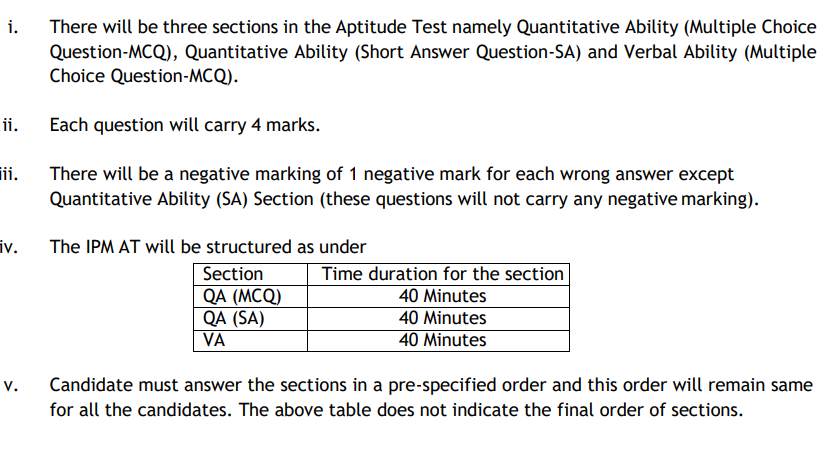
- IPMAT Indore exam is expected to follow three 40 minute sectional timers across QA MCQ, QA Short Answer and Verbal Ability.
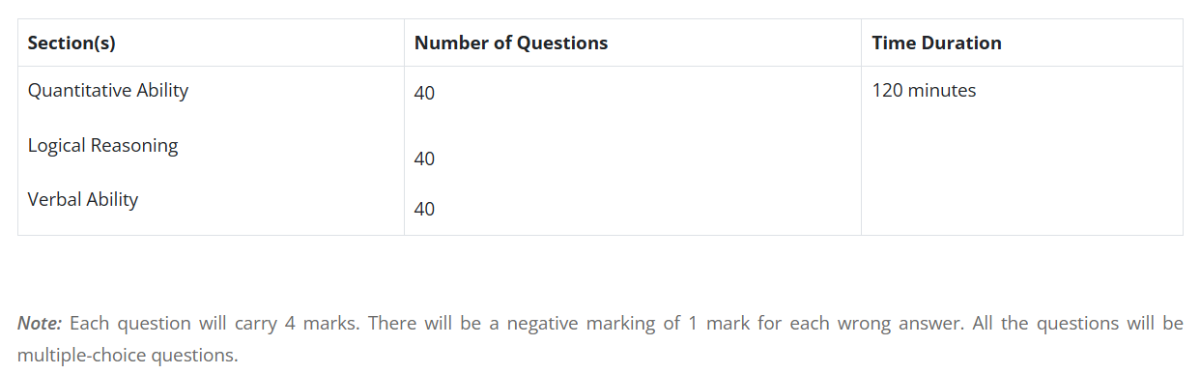
- In IPMAT Rohtak exam, there will be Quantitative Ability, Logical Reasoning and Verbal Ability sections with 40 questions each with no sectional timing.
- Verbal Ability section is the most important section in IPMAT Indore where there will be 45 questions carrying 180 marks.
Related Links:
- IPMAT Syllabus: Section-Wise Topics, Topic Wise Weightage and PDF Download
- IPMAT Previous Year Question Paper, Download PDF, Paper Pattern
- IIM Indore: Admission, Fees, Courses, Cutoff, Ranking, Placements
- IIM Rohtak: Admission, Fees, Courses, Cutoff, Ranking, Placement
Key Summary
- QA-MCQ has remained the toughest section in IPMAT Indore while Logical Reasoning is usually the easiest in IPMAT Rohtak.
- Verbal Ability contributes 50% of the IPMAT Indore paper making it the highest weightage section.
- Geometry, Algebra, Arithmetic and Reading Comprehension are among the most important topics for IPMAT 2027.
- Taking full length practice tests according to the IPMAT exam pattern increases the speed and accuracy of solving questions.
- Solving IPMAT previous year papers helps candidates understand recurring question types and difficulty trends.
IPMAT Exam Pattern 2027 Highlights
IPMAT (Integrated Programme in Management Aptitude Test) is conducted separately by IIM Indore and IIM Rohtak. The patterns for 2027 are expected to follow recent trends (subject to official confirmation).
| Feature | IPMAT Indore 2027 | IPMAT Rohtak 2027 |
|---|---|---|
| Conducting Body | IIM Indore | IIM Rohtak |
| Mode of Exam | Computer-Based Test (CBT) | Computer-Based Test (CBT) |
| Total Duration | 120 minutes | 120 minutes |
| Total Questions | 90 | 120 |
| Total Marks | 360 | 480 |
| Number of Sections | 3 | 3 |
| Sectional Time Limit | Yes (40 minutes per section) | No (flexible time management) |
| Question Types | MCQ + Short Answer (SA/TITA) | MCQ only |
| Marking Scheme |
|
|
| Sections & Questions |
|
|
| Key Difference | Includes Short Answer questions; strict sectional timing; no dedicated LR section | Includes Logical Reasoning; no Short Answer; more questions |
Also Check: IPMAT 2026 Question Paper (Available), Download Answer Key with Solutions PDF
Expected Section-wise Distribution in IPMAT Exam Pattern 2027
In IPMAT Indore, negative marking applies only to MCQs, while Short Answer questions have no negative marking; whereas in IPMAT Rohtak, negative marking applies to all MCQ questions.
- Both IPMAT Indore and IPMAT Rohtak examinations are conducted in the English language.
- Unattempted questions will be awarded zero marks in IPMAT Indore and IPMAT Rohtak exams.
- The candidates are advised to refer to the official website of IIM Indore and IIM Rohtak to know the pattern of IPMAT 2027.
IPMAT Indore Exam Pattern 2027
IPMAT Indore 2027 is expected to have a 40-minute sectional time limit, with no option to switch between sections.
- Short Answer (SA) questions in IPMAT Indore do not carry any negative marking.
| Section | Question Type | No. of Questions | Time |
|---|---|---|---|
| Quantitative Ability (SA) | Short Answer | 15 | 40 min |
| Quantitative Ability (MCQ) | Multiple Choice | 30 | 40 min |
| Verbal Ability (MCQ) | Multiple Choice | 45 | 40 min |
| Total | - | 90 | 120 min |
Source: IIM Indore Official
IPMAT Rohtak Exam Pattern 2027
In the IPMAT Rohtak Exam all questions are MCQ type and candidates can move freely between sections as there is no strict sectional lock like IPMAT Indore exam.
| Section | Question Type | No. of Questions | Time |
|---|---|---|---|
| Quantitative Ability | MCQ | 40 | 120 min |
| Logical Reasoning | MCQ | 40 | |
| Verbal Ability | Multiple MCQ | 40 | |
| Total | - | 120 |
Source: IIM Rohtak Official
Also Check: IPMAT 2025 Question Paper (Available), Download Answer Key with Solutions PDF
Ques. What is the difficulty level of IPMAT 2026?
Ans. IPMAT 2026 was Moderate overall. Quantitative Ability (MCQ) was the toughest section, while Quantitative Ability (SA) was Moderate and Verbal Ability was Easy to Moderate.
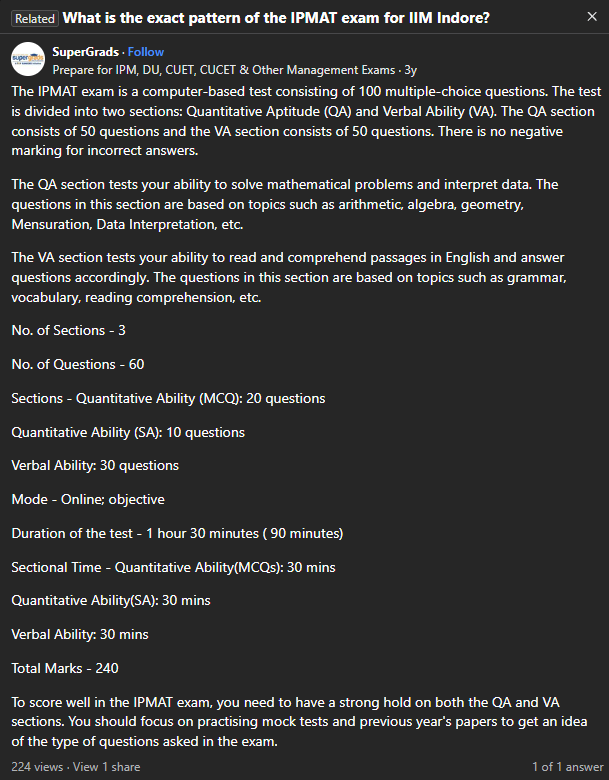
According to a Quora discussion, IPMAT Indore is conducted as a 90-minute CBT with three sections and sectional time limits. The discussion also recommended regular mock tests and previous year papers with Arithmetic, Algebra, Reading Comprehension and Vocabulary identified as key preparation areas.
Source: Quora
IPMAT Exam Marking Scheme 2027
In IPMAT Indore exam, +4 marks is awarded for every correct answer and 1 marks deducted for incorrect answers while Short Answer questions have no negative marking.
- IPMAT Rohtak applies +4 for correct and –1 for incorrect MCQs across Quantitative Ability, Logical Reasoning and Verbal Ability.
IPMAT Indore Exam Marking Scheme
| Section | Question Type | Correct Answer | Incorrect Answer | Unattempted |
|---|---|---|---|---|
| Quantitative Ability (SA) | Short Answer | +4 | 0 | 0 |
| Quantitative Ability (MCQ) | Multiple Choice | +4 | –1 | 0 |
| Verbal Ability (MCQ) | Multiple Choice | +4 | –1 | 0 |
Source: IIM Indore Official
IPMAT Rohtak Exam Marking Scheme
| Section | Question Type | Correct Answer | Incorrect Answer | Unattempted |
|---|---|---|---|---|
| Quantitative Ability | MCQ | +4 | –1 | 0 |
| Logical Reasoning | MCQ | +4 | –1 | 0 |
| Verbal Ability (MCQ) | MCQ | +4 | –1 | 0 |
Source: IIM Rohtak Official
Also Check: IPMAT vs CAT for IIM Indore: Age Limit and Class 12 Eligibility
Ques. What is the marking scheme for IPMAT 2026?
Ans. In IPMAT 2026, candidates received +4 marks for every correct answer. MCQ sections had a -1 negative marking for each incorrect answer, while Short Answer (SA) questions had no negative marking. Unattempted questions received 0 marks.
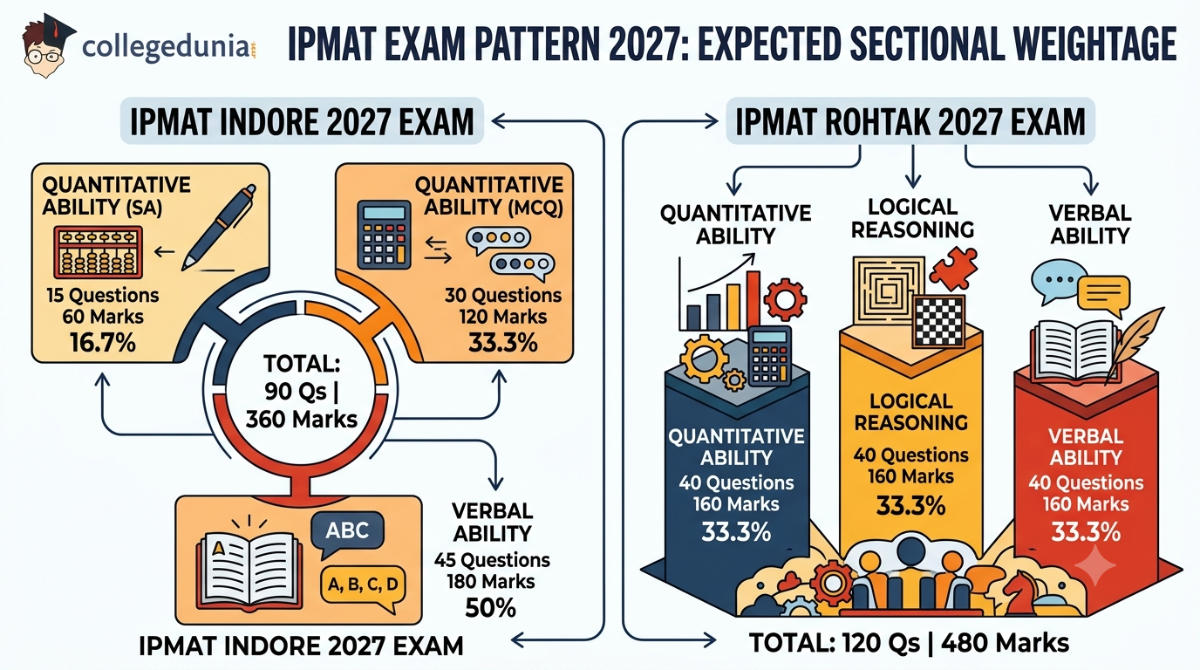
IPMAT Exam Pattern 2027 Sectional Weightage (Expected)
Verbal Ability contributes 50% of the IPMAT Indore paper with 45 questions and 180 marks.
- All three sections in IPMAT Rohtak have 33.3% weightage, with 40 questions and 160 marks each.
IPMAT Indore Exam 2027 Sectional Weightage
| Section | Number of Questions | Marks | Weightage (%) |
|---|---|---|---|
| Quantitative Ability (SA) | 15 | 60 | 16.7% |
| Quantitative Ability (MCQ) | 30 | 120 | 33.3% |
| Verbal Ability (MCQ) | 45 | 180 | 50% |
| Total | 90 | 360 | 100% |
IPMAT Rohtak Exam 2027 Sectional Weightage
| Section | Number of Questions | Marks | Weightage (%) |
|---|---|---|---|
| Quantitative Ability | 40 | 160 | 33.3% |
| Logical Reasoning | 40 | 160 | 33.3% |
| Verbal Ability | 40 | 160 | 33.3% |
| Total | 120 | 480 | 100% |
Also Check: Best Books for IPMAT Preparation, Check Important study material here
Ques. Is IPMAT as tough as CAT?
Ans. No. CAT is generally considered more difficult than IPMAT because it has a higher competition level and tests advanced aptitude suitable for postgraduate management admissions. IPMAT is designed for candidates seeking admission to integrated management programmes after Class 12.
Expected Topic-wise Sectional Weightage in IPMAT Exam Pattern 2027
IPMAT Indore 2027 may include 6–7 Geometry & Mensuration questions in Quantitative Ability MCQ and 12–15 Reading Comprehension questions in Verbal Ability.
- IPMAT Rohtak 2027 may include 15–20 Arithmetic questions in Quantitative Ability and 8–10 Seating Arrangement questions in Logical Reasoning.
IPMAT Indore Exam 2027
| Section | Topic | Expected Questions | Approx. Weightage |
|---|---|---|---|
| Quantitative Ability (MCQ) – 30 Questions | Geometry & Mensuration | 6–7 | 20–23% |
| Algebra (Equations, Inequalities, Functions) | 5–7 | 17–23% | |
| Arithmetic (%, P&L, Ratio, TSD, Work etc.) | 4–6 | 13–20% | |
| Logarithms & Surds | 2–3 | 7–10% | |
| Progressions (AP/GP) | 2–3 | 7–10% | |
| P&C + Probability | 2–3 | 7–10% | |
| Number System | 1–2 | 3–7% | |
| Matrices & Determinants | 1–2 | 3–7% | |
| Data Interpretation / Sets | 3–5 | 10–17% | |
| Quantitative Ability (Short Answer) – 15 Questions | Algebra (Equations, Functions, Modulus, Logs) | 4–6 | 27–40% |
| Arithmetic | 2–4 | 13–27% | |
| Geometry / Mensuration | 1–3 | 7–20% | |
| Progressions / Sequences | 1–2 | 7–13% | |
| P&C / Probability / Sets | 1–2 | 7–13% | |
| Matrices / Number System / DI | 1–3 | 7–20% | |
| Verbal Ability (MCQ) – 45 Questions | Reading Comprehension | 12–15 | 27–33% |
| Vocabulary (Synonyms, Antonyms, Idioms, Phrases) | 8–12 | 18–27% | |
| Grammar / Sentence Correction | 5–7 | 11–16% | |
| Para Jumbles | 4–6 | 9–13% | |
| Para Completion / Fillers | 4–6 | 9–13% | |
| Sentence Completion / Error Spotting | 4–6 | 9–13% |
IPMAT Rohtak Exam 2027
| Section | Topic | Expected Questions | Approx. Weightage |
|---|---|---|---|
| Quantitative Ability – 40 Questions | Arithmetic | 15–20 | 38–50% |
| Modern Math (P&C, Probability, Sets) | 6–8 | 15–20% | |
| Algebra | 4–6 | 10–15% | |
| Geometry & Mensuration | 3–5 | 8–13% | |
| Number System | 3–4 | 8–10% | |
| Data Interpretation | 4–6 | 10–15% | |
| Logical Reasoning – 40 Questions | Seating Arrangements (Linear/Circular) | 8–10 | 20–25% |
| Coding-Decoding + Series | 4–6 | 10–15% | |
| Blood Relations + Directions | 4–6 | 10–15% | |
| Data Sufficiency / Puzzles | 4–6 | 10–15% | |
| Syllogisms / Critical Reasoning | 3–5 | 8–13% | |
| Clocks, Calendars, Odd One Out | 4–6 | 10–15% | |
| Miscellaneous (Dice, Visual etc.) | 3–5 | 8–13% | |
| Verbal Ability – 40 Questions | Vocabulary (Synonyms, Antonyms, Idioms) | 10–14 | 25–35% |
| Reading Comprehension | 10–12 | 25–30% | |
| Sentence Correction / Grammar | 8–11 | 20–28% | |
| Para Jumbles | 4–5 | 10–13% | |
| Fillers / Para Completion | 3–5 | 8–13% |
Note: These are expected ranges based on recent trends. Focus more on high-weightage areas (Arithmetic + Algebra for Quant, RC + Vocabulary for Verbal) while covering the full syllabus. Official papers may show minor variations.
Also Check: IPMAT Exam Preparation Tips for Class 12 Students
Ques. What are the most important topics for IPMAT?
Ans. The most important topics for IPMAT 2027 are Arithmetic, Algebra, Number System, Geometry, Modern Mathematics, Reading Comprehension, Grammar, Vocabulary, and Para Jumbles. These topics consistently carry high weightage in recent IPMAT examinations.
IPMAT Exam 2027 Difficulty Level (Previous Year Trend Analysis)
IPMAT Indore remained Moderate or tougher in 5 of the last 6 years, with the 2023 paper rated Difficult.
- IPMAT Rohtak was Easy to Moderate in 2025 and 2026 after reaching its highest difficulty level in 2023.
| Year | IPMAT Indore Overall | IPMAT Rohtak Overall |
|---|---|---|
| 2026 | Moderate to Difficult | Easy to Moderate |
| 2025 | Moderate | Easy to Moderate |
| 2024 | Moderate | Moderate |
| 2023 | Difficult | Tough |
| 2022 | Moderate | Moderate |
| 2021 | Easy to Moderate | Easy to Moderate |
IPMAT Indore Exam Section-wise Difficulty
QA-MCQ has remained the most difficult section in IPMAT Indore with questions from Geometry, Algebra, Higher Mathematics and Data Interpretation.
- QA-SA section is generally considered a high scoring section because it has no negative marking.
- Verbal Ability has consistently been one of the most scoring sections in recent IPMAT Indore examinations.
- Quantitative Ability has become more challenging in recent years, resulting in a gradual decline in sectional cutoffs.
| Section | 2026 | 2025 | 2024 | Trend for 2027 (Expected) |
|---|---|---|---|---|
| QA (Short Answer) | Easy to Moderate | Easy to Moderate | Easy to Moderate | Easy to Moderate |
| QA (MCQ) | Moderate to Difficult / Very Difficult | Moderate to Difficult | Moderate to Difficult | Moderate to Difficult (toughest section) |
| Verbal Ability | Easy to Moderate | Easy to Moderate | Easy to Moderate | Easy to Moderate |
| Overall | Moderate to Difficult | Moderate | Moderate | Moderate to Difficult |
IPMAT Rohtak Exam Section-wise Difficulty
IPMAT Rohtak has generally been easier than IPMAT Indore in recent admission cycles.
- Arithmetic contributes a major share of Quantitative Ability questions and is often the most scoring area.
- Logical Reasoning has consistently been one of the easiest and highest-scoring sections.
- Verbal Ability can be slightly more challenging because of vocabulary-based questions.
- IPMAT Rohtak cutoffs vary every year and may increase significantly when the overall paper is easier.
| Section | 2026 | 2025 | 2024 | Trend for 2027 (Expected) |
|---|---|---|---|---|
| Quantitative Ability | Easy | Easy to Moderate | Easy to Moderate | Easy to Moderate |
| Logical Reasoning | Easy | Easy to Moderate | Easy to Moderate | Easy to Moderate |
| Verbal Ability | Easy to Moderate | Easy to Moderate | Easy to Moderate | Easy to Moderate |
| Overall | Moderate to Difficult | Easy to Moderate | Easy to Moderate | Easy to Moderate |
Also Check: IPMAT Exam: Eligibility, Syllabus, Exam Pattern, Cutoff and Marks vs Rank
Ques. Do PYQs repeat in IPMAT?
Ans. No. Exact questions rarely repeat in IPMAT, but question types, concepts, and topic patterns are repeated across years. Solving previous year question papers (PYQs) helps candidates understand the exam pattern and frequently tested concepts.
How to Prepare Based on IPMAT Exam Pattern
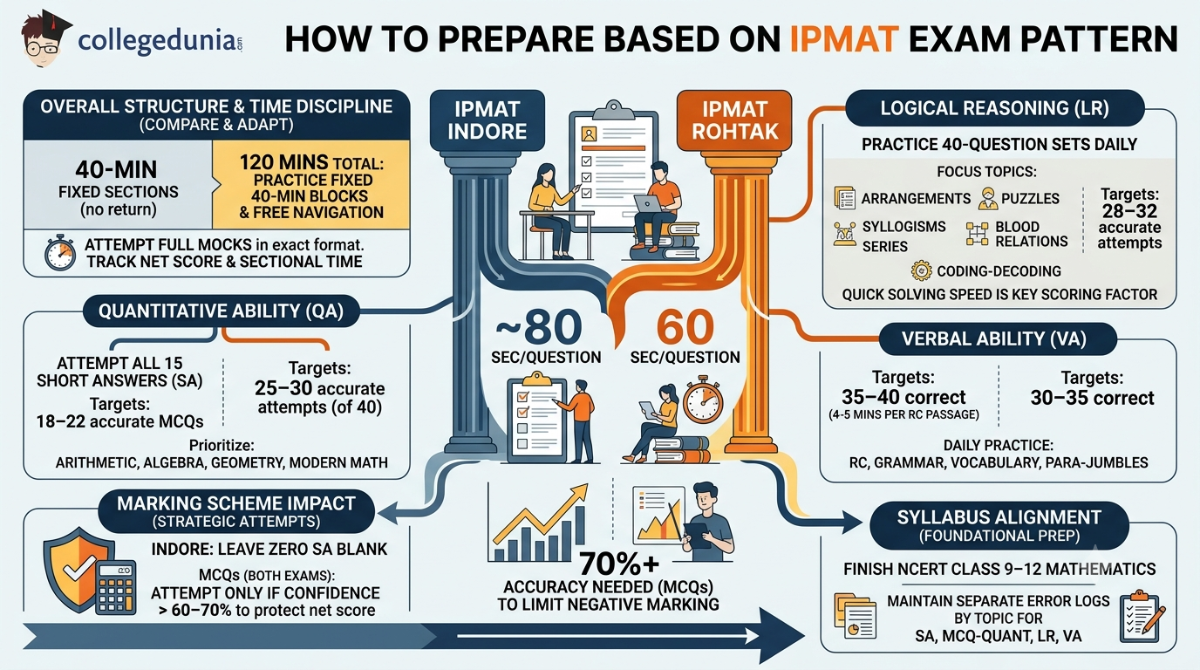
IPMAT Indore allows about 80 seconds per question while IPMAT Rohtak provides 60 seconds per question.
- Maintaining at least 70% accuracy in MCQ sections helps reduce the impact of negative marking.
- Strong accuracy in Short Answer (SA) questions is a key scoring factor in IPMAT Indore.
- Quick Logical Reasoning solving speed plays an important role in improving scores in IPMAT Rohtak.
| Aspect of Exam Pattern | Preparation Strategy |
|---|---|
| Overall Structure | Attempt full mocks matching each exam’s exact format. For Indore lock sections at 40 min and for Rohtak practise both fixed 40 min blocks and free navigation. Track net score and time per section after every mock. |
| Quantitative Ability | Indore: attempt all 15 SA questions; target 18–22 accurate MCQs.Rohtak: aim for 25–30 accurate attempts out of 40. Prioritise Arithmetic, Algebra, Geometry and Modern Math across both. |
| Logical Reasoning | Practise 40-question LR sets daily. Focus on Arrangements, Puzzles, Syllogisms, Series, Blood Relations and Coding-Decoding. Target 28–32 accurate attempts. |
| Verbal Ability | Indore: target 35–40 correct; spend 4–5 min per RC passage.Rohtak: target 30–35 correct. Daily practice split across RC, Grammar, Vocabulary and Para-jumbles. |
| Marking Scheme Impact | Leave zero SA questions blank in Indore. In all MCQ sections (both exams) attempt only when confidence exceeds 60–70% to protect net score. |
| Sectional Time Discipline | Indore: train under strict 40-min timers with no section return.Rohtak: practise both rigid 40-min blocks and free time allocation across 120 minutes. |
| Syllabus Alignment | Finish Class 9–12 NCERT Mathematics first. Maintain separate error logs for SA, MCQ-Quant, LR and VA showing frequency of mistakes by topic. |
Also Check: IPMAT: Is 200 Marks a Safe Score for IIM Indore PI Shortlist?
Ques. Is 150 a good score in IPMAT?
Ans. It depends on the category. A score of 150 is not considered sufficient for General, EWS, and NC-OBC candidates, but it can be competitive for SC, ST, and PwD candidates, subject to sectional cutoffs and the admission process.
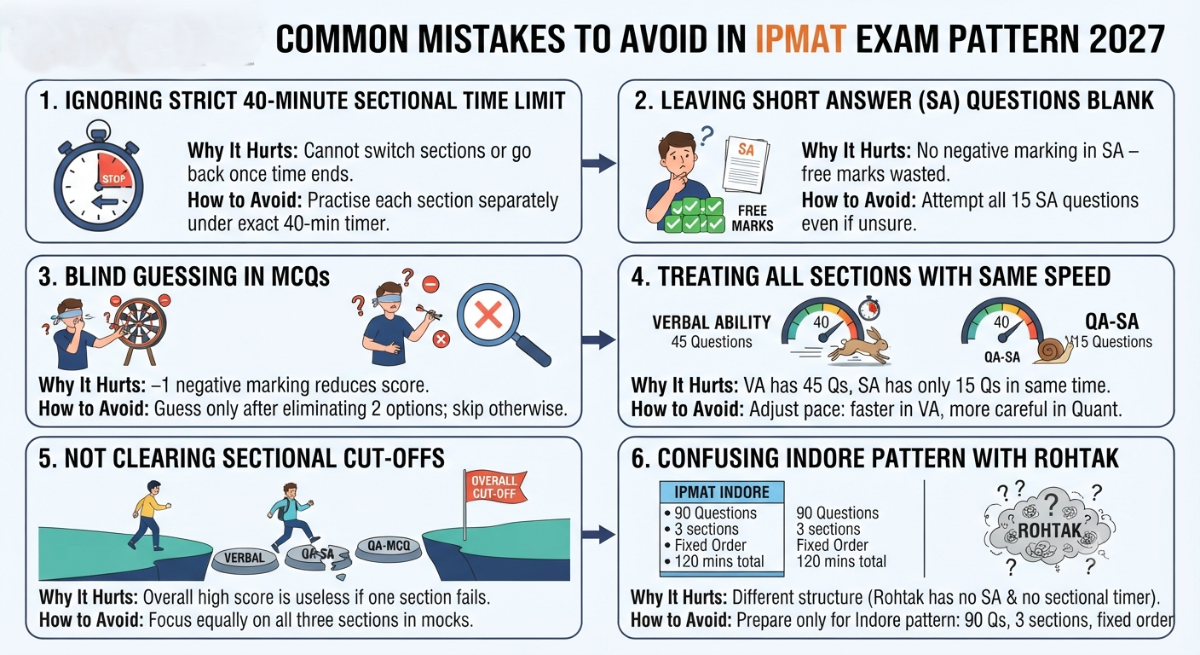
Common Mistakes to Avoid in IPMAT Exam Pattern 2027
The 40-minute sectional timer in IPMAT Indore does not allow candidates to return to a previous section after time expires.
- Leaving Short Answer (SA) questions unattempted in IPMAT Indore can reduce the overall score as they carry no negative marking.
- Random guessing in MCQ sections may lower the score because every incorrect answer attracts –1 negative marking.
- Candidates should manage time according to the section as Verbal Ability has 45 questions while QA-SA has only 15.
- Clearing every sectional cutoff is essential in IPMAT Indore as a high overall score alone is not enough.
- Candidates should prepare separately for IPMAT Indore and IPMAT Rohtak as both examinations follow different patterns.
| Mistake | Why It Hurts | How to Avoid |
|---|---|---|
| Ignoring strict 40-minute sectional time limit | Cannot switch sections or go back once time ends | Practise each section separately under exact 40-min timer |
| Leaving Short Answer (SA) questions blank | No negative marking in SA – free marks wasted | Attempt all 15 SA questions even if unsure |
| Blind guessing in MCQs | –1 negative marking reduces score | Guess only after eliminating 2 options; skip otherwise |
| Treating all sections with same speed | VA has 45 Qs, SA has only 15 Qs in same time | Adjust pace: faster in VA, more careful in Quant |
| Not clearing sectional cut-offs | Overall high score is useless if one section fails | Focus equally on all three sections in mocks |
| Confusing Indore pattern with Rohtak | Different structure (Rohtak has no SA & no sectional timer) | Prepare only for Indore pattern: 90 Qs, 3 sections, fixed order |
Also Check: Why Choose IPMAT? Benefits of a 5-Year IIM Program
Ques. Is IPMAT Indore difficult?
Ans. Yes. IPMAT Indore is generally considered moderate to difficult due to its high competition, sectional time limits, and challenging Quantitative Ability section. In recent years, Quantitative Ability (MCQ) has consistently been the toughest section of the exam.
IPMAT Exam Pattern 2027: Frequently Asked Questions (FAQs)
Ques. How to prepare for IPMAT 2027?
Ans. Candidates should complete the IPMAT 2027 syllabus, practise topic-wise questions, solve previous year papers, attempt regular mock tests, and analyse mistakes. Consistent revision and strong preparation in Quantitative Ability and Verbal Ability are essential.
Ques. Is 150 a good score in IPMAT?
Ans. A score of 150 is generally considered average in IPMAT. It may be competitive for some reserved categories, but General category candidates usually require a higher score for a stronger chance of selection.
Ques. Is IPMAT easy or tough?
Ans. IPMAT is generally considered moderate to difficult because of its high competition, sectional time limits, and challenging Quantitative Ability section. Candidates with consistent preparation and mock test practice can achieve a competitive score.
Ques. Can I clear IPMAT without Maths?
Ans. Yes. Candidates from non-Maths backgrounds are eligible for IPMAT and many have successfully cleared the exam. However, strong preparation in Quantitative Ability is essential, as it is one of the most challenging sections in IPMAT Indore.
Ques. Can I prepare for IPMAT without coaching?
Ans. Yes. Candidates can prepare for IPMAT without coaching by following a structured study plan, completing the syllabus, solving previous year papers, attempting regular mock tests, and revising consistently. Self-study with the right resources can be sufficient for a competitive score.



Comments