



Content Curator
Jellyfish are jelly-like creatures with long trailing tentacles that are found on shores.
- These bell-shaped organisms have tentacles that consist of poisonous venom.
- They are marine invertebrates with around 200 species that fall under Scyphozoa and the phylum Cnidaria.
- They don't have brains or a heart and emit light in the dark.
- The size of a jellyfish can range from 2 cm to 40 cm, with some bigger ones that reach 6 feet.
- The lifespan of a jellyfish can vary from a few hours to several years.
| Table of Content |
Key Terms: Jellyfish, Jellyfish life cycle, Jellyfish lifespan, Egg, Larvae, Medusa, Marine invertebrates, Asexual reproduction
Jellyfish
[Click Here for Sample Questions]
Jellyfish are found in every ocean of the planet starting from the freezing waters to the warm regions.
- These are bell or umbrella-shaped marine animals with tentacles coming out of the base of their body like trails.
- They are fast-growing creatures that have been known to inhabit the waters for millions of years.
- The lifespan of a jellyfish depends on its type.
- For example, the medusa jellyfish lives up to a few months, some jellyfish live till 2-3 years, and some live for a few decades.
- Carnivorous Turritopsis dohrnii, known as the immortal jellyfish, can potentially live forever.

Also check:
| Related Concepts | ||
|---|---|---|
| Termite Life Cycle | Difference between Autosomes and Allosomes | Meiosis Cell Division |
| Vermiculture | Apomixis | Invertebrates |
Lifecycle of a Jellyfish
[Click Here for Sample Questions]
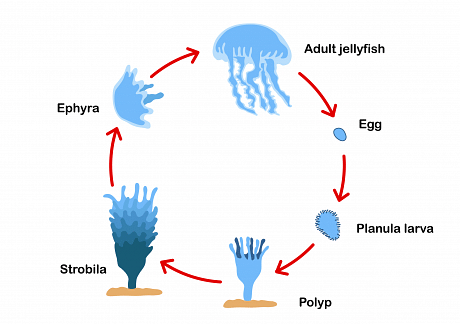
Jellyfish are creatures that reproduce sexually using reproductive organs called gonads. The various stages of the lifecycle of a jellyfish are given below.
Stage 1: The Egg
It begins with the male and female jellyfish mating at dusk.
- In this process of spawning, a lot of sperm and eggs are released into the ocean.
- These fertilized eggs keep drifting freely in the ocean waters.
- Some eggs are even protected by the jellyfish, like the moon jellies.
- They do so in order to make them survive the upcoming stages of life.
Stage 2: Planula Larvae
The fertilized egg grows into a spore known as the planula.
- This planula constitutes the ability to move around freely.
- The structure of a planula is oval-shaped like a flatworm.
- It's covered with tiny hairs called cilia, lined all over the body.
- After floating in the water for some time, it starts to swim downwards.
- Here it settles on the surface where it develops into a polyp.
- The planula is known to grow on till the point it becomes eligible to plant itself or attach itself to a surface.
Stage 3: Polyp (Scyphistoma)
A jellyfish has the ability to stay in the polyp stage for years.
- They wait for the period in which they reach their maturity and become most suitable to spawn.
- The structure of a polyp is cylindrical and often resembles corals.
- The bottom of a polyp is flat and disc-like.
- This surface helps it attach to different underlying surfaces.
- A mouth is present on top with tentacles surrounding it.
- In this stage, the polyp's digestive system is efficiently working which is why they keep on feeding.
- They start reproducing asexually and elongate themselves, thereby encouraging more polyps to come together.
- This is known as scyphistoma. It is at the end of this stage they enter the medusa lifecycle.
Stage 4: Medusa
The newly formed segment of polyp is known as an “ephyra”.
- Ephyrae are independent living organisms and feed for growth.
- They are the size of a few millimeters.
- This stage comes just before the jellyfish reaches its adult stage.
- The lobes of this ephyra are not fully developed but serve the function of pushing the food towards its mouth.
- Ephyrae can also be called immature medusa.
- As they approach their maturity, they start to develop tentacles and arms.
- This adult and fully grown stage of a jellyfish is known as “Medusa”.
- Medusas are different depending upon each species.
Also check:
| Related Concepts | ||
|---|---|---|
| Artificial Pollination | Difference Between Active and Passive Transport | Biotechnology Agriculture |
| What is Triple Fusion? | Nuclear Membrane | Hepatic Portal System |
Things to Remember
- Jellyfish fall under the Animalia kingdom and are commonly found in the depths of ocean waters as well as the surface.
- They are umbrella-like creatures with tentacles.
- The average size of a jellyfish is 3 feet.
- Some are even known to grow to 6 feet and weigh about 20-400 g.
- There are almost 200 species of jellyfish known according to studies.
- The four primary life stages of jellyfish are egg, planula larvae, polyp, and medusa.
- They become fully mature upon reaching the final stage.
Sample Questions
Ques. Is jellyfish harmful to humans? (1 Mark)
Ans. Several types of jellyfish are quite harmless to humans. Others can produce severe pain and a full-body (systemic) reaction.
Ques. Do jellyfish have blood? (1 Mark)
Ans. No, jellyfish do not have blood. Instead of blood, jellyfish depend on a process called diffusion to transport nutrients and oxygen throughout their bodies.
Ques. Name the various life stages of a jellyfish. (2 Marks)
Ans. A jellyfish goes through four different life stages before it finally becomes mature. These life cycles are as follows,
- Egg
Planula larvae
Polyp (Scyphistoma)
Medusa
Ques. In what stage of its life cycle is a jellyfish that is not floating freely or swimming? (1 Mark)
Ans. In the polyp stage of its life cycle, a jellyfish is not floating freely or swimming.
Ques. What is the lifespan of a jellyfish? (1 Mark)
Ans. The lifespan of a jellyfish can vary from a few hours to several years.
Ques. What do I do if a jellyfish stings me? (3 Marks)
Ans. Treatment of a jellyfish bite usually depends on the type you have been stung by. It also depends upon the severity of the pain. Immediate first aid is recommended for such cases.
- All the visible tentacles must be pulled out with tweezers without disturbing or scraping the skin.
- The affected area of the skin must be immersed in hot water for 20-45 minutes. The temperature of the water must be between 43-45.
It should be kept in mind that rubbing the affected area with a towel and rinsing the area with human urine, seawater, or alcohol is strictly advised against.
Ques. How does a jellyfish sting? (2 Marks)
Ans. Jellyfish have long tentacles with numerous stinging cells called cnidoblasts. These cnidoblasts house nematocysts, which contain microscopic threads. When a jellyfish encounters prey or a threat, pressure triggers the nematocysts to discharge the stinging threads, injecting venom to paralyze or capture the target.
Ques. Where can I find jellyfish? (2 Marks)
Ans. Jellyfish can be found in the oceans in all parts of the world. From torrid to polar regions, and the surface to deep waters, they are present everywhere. While they are commonly found in seawater, fresh waters also witness their presence. It is popularly known that jellyfish are found in the ocean’s “twilight zone”. Research is yet to be done on this subject.
Ques. Where was the first jellyfish found? (2 Marks)
Ans. According to surveys and research, the presence of the first jellyfish in the world was found in the form of fossils in the rocks in Utah, US. It is almost as old as 500 million years. It is considered to be the first jellyfish ever found.
Ques. Define the polyp stage of a jellyfish. (3 Marks)
Ans. In the polyp stage of a jellyfish, the cylindrical-shaped jellyfish attaches itself easily to other surfaces because of its flat base. It has a mouth at the top which is surrounded by tentacles. The polyp is independent and feeds from all the surfaces it can. When it becomes capable of reproducing asexually, more polyps join and form groups. These coral-looking structures enter the Medusa life cycle at the end of this stage.
For the Latest Updates on Upcoming Board Exams, Click Here: https://t.me/class_10_12_board_updates
Also Read:
| Class 11 Biology Study Guides | ||
|---|---|---|
| Biology Study Notes | NCERT Solutions for Class 11 Biology | NCERT Class 11 Biology Book |



Comments