



Content Curator
Linear Equations In One Variable are equations with a homogenous variable of degree 1, i.e., one variable. The variable is represented by alphabets and the most common alphabet is ‘x’. There is only one solution to this variable. Linear equations are widely used in mathematics and real-life to simplify and calculate age-related problems, speed, distance and time. The equations are also used to solve problems in geometry, finance etc.
Read Also: Pair of Linear equation in two variables formula
| Table of Content |
Key Takeaways: Linear Equation In One Variable, Standard Form, Variables, Constants.
What is Linear Equation in One Variable?
[Click Here for Sample Questions]
Linear Equations in one variable can be defined as the equations with only one variable and a unique solution for that variable. An equation can have more solutions depending upon the number of variables. For example, a linear equation with two variables has two solutions. Examples of linear equations are:
- 4 + x = 5 (here x can only have a value of 1)
- 2x - 3 = 10
- 5/2x = 10
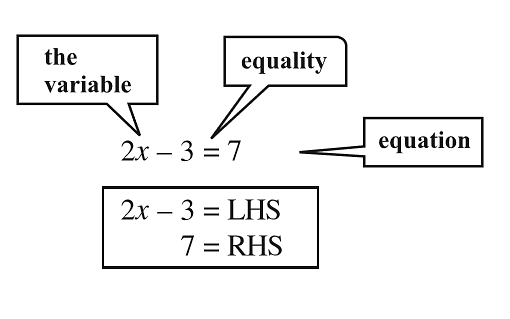
Linear equation in one variable
Check Important Questions for Pair of Linear equation in two variables
Standard Form of Linear Equation in One Variable
[Click Here for Sample Questions]
The standard form of linear equations in one variable is
ax + b = 0
where, ‘a’ and ‘b’ are integers and a≠0, b≠0.
This means that any equation which has one variable in any form can be reduced to this standard form.
Steps for Solving Linear Equation in One Variable
[Click Here for Sample Questions]
The steps for solving linear equations in one variable are as follows:
Step 1: Keep the variable terms on one side of the equation and constant on the other side. This can be done by adding, subtracting, multiplying or dividing numbers.
Step 2: Simplify the numbers using the same method. You may need to take LCM in this step.
Step 3: Isolate the variable by transposing the coefficient to another side of the equation.
Step 4: Simplify this side of the equation. This number will be the value of the variable.
Step 5: If you will put this value in the place of the variable, L.H.S. will be equal to R.H.S., satisfying the equality of the equation.
Check Also: Linear equation in two variables
Examples of Linear Equation in One Variable
[Click Here for Sample Questions]
To get a clearer understanding of this concept, the example is provided below:
Solve the equation: 4x + 9 = -3x + 20
Step 1: Transpose all the variables on one side of the equation and consonants on another side. By transpose, we mean to shift the variables and consonants from one side of the equation to the other side of the equation. By this method, the operation on the operand will get reversed.
In the equation, 4x + 9 = -3x + 20, we transpose -3x from the right-hand side to the left-hand side of the equality, the operation gets reversed and the equation becomes:
4x + 3x + 9 = 20
Step 2: Now, transpose all the constant terms on the other side of the equation::
7x + 9 = 20
7x = 20 - 9
7x = 11
Step 3: Isolate the variable and transpose 7 to the other side of the equation:
x = 11/7
Now, substitute x = 11/7 in the equation 4x + 9 = -3x + 20, we will get 107/7= 107/7, thereby satisfying L.H.S. = R.H.S. and giving us the required solution.
Read More: Linear Equations in Two Variable
Things to Remember
[Click Here for Sample Questions]
- Linear equations in one variable have practical uses in our day to day lives and students must know how to solve them.
- The standard form of linear equation in one variable is: ax + b = 0.
where, ‘a’ and ‘b’ are integers and a≠0, b≠0.
- One should solve these equations in such a way that the variable and the consonants are segregated to opposite sides of the equation.
- The segregation helps in finding the value of the variable, which will be a unique solution.
Sample Questions
Ques: Find the value of x, 7x + 10 = 59. (2 marks)
Ans: 7x + 10 = 59
7x = 59 - 10
7x = 49
x = 49/7
x = 7
Ques: Solve 15x - 12 = 3. (2 marks)
Ans: 15x - 12 = 3
15x = 3 + 12 (transposing 12 to R.H.S)
15x = 15
x = 15/15 = 1
Ques: Verify that x = ¾ , is the solution of the linear equation 8x + 16 = 5x + 20. (2 marks)
Ans: 8x + 16 = 5x + 20
8x - 5x = 20 - 16
3x = 4
X = 4/3
Or
Putting the value of x = 4/3 in the above equation directly,we get
8(4/3) + 16 = 5(4/3) + 20
32/3 + 16 = 20/3 + 20
(32 + 48)/3 = (20 + 60)/3
80/3 = 80/3
L.H.S. = R.H.S. Hence proved.
Ques: Find the value of y: 4/7 + y = 3/7 (2 marks)
Ans: 4/7 + y = 3/7
y = 3/7 - 4/7 (transposing 4/7 to R.H.S.)
y = -1/7
Ques: What should be added to twice the rational number (-4/5) to get 5/4? (2 marks)
Ans: Twice the rational number (-4/5) is 2 × (-4/5)= (-8/5)
Let the number to be added be x
The equation formed will be:
x + (-8/5) = 5/4
x = 5/4 - (-8/5)
x = 5/4 + 8/5
x = (25 + 32)/20
x = 57/20
Thus 57/20 should be added to twice the rational number (-4/5) to get 5/4.
Ques: The present age of Aman’s father is three times the present age of Aman. After 5 years, their ages will add to 70 years. Find the present age of Aman and his father. (3 marks)
Ans: Let Aman’s present age be x.
And Aman’s father’s age be 3x
| Aman | Father | Sum | |
|---|---|---|---|
| Present age | x | 3x | |
| 5 years later | x +5 | 3x + 5 | 4x + 10 |
As it is given that 5 years later, their ages will add to 70 years, therefore
4x + 10 = 70
4x = 70 - 10
4x = 60
x = 60/4, i.e., 15
Hence, x = 15.
Aman’s present age is 15 years and Aman’s father’s age is 3x, i.e., 45 years.
Ques: The difference between two whole numbers is 60. The ratio of the two numbers is 2 : 5. Write the two numbers. (3 marks)
Ans: Since the ratio of two numbers is 2:5,
Let the first number be 2x and the second number be 5x.
Therefore the ratio of the numbers is 2x:5x
Difference between 2x and 5x is 60,
5x-2x = 60
3x = 60
x = 60/3 = 20
The two numbers are 5x and 2x. Therefore 5(20) = 100 and 2(20) = 40.
Ques: The base of an isosceles triangle is 4 cm. The perimeter of the triangle is 13 cm. What is the length of the remaining equal sides? (3 marks)
Ans: Since it is an isosceles triangle, the other two sides are equal.
If one side is x, then the sum of two sides will be x + x = 2x.
The perimeter of the triangle is 13 cm.
4 + 2x = 13
2x = 13 - 4
2x = 9
x = 9/2 = 4.5 cm
Hence, the length of the remaining sides of the triangle is 4.5 cm.



Comments