



Content Curator
Linear pair of Angles are angles which are adjacent to each other and are formed by two intersecting lines. The linear pair should form 180 degrees and their non-common side must form a straight line. The adjacent angles are the ones that must have a common vertex so in a linear pair as well there should be a common vertex, for example, a ladder when placed against the wall forms a linear pair of angles with the ground. The sum of a linear pair of angles is always 180 degrees and such angles are also known as supplementary angles.
Read Also: Types of Angles
| Table of Content |
Linear Pair of Angles
[Click Here for Sample Questions]
Linear pair of angles is a straight angle where the angle between the two lines forms 180 degrees. A straight angle in simple language is a straight line as straight lines always form an angle of 180 degrees.
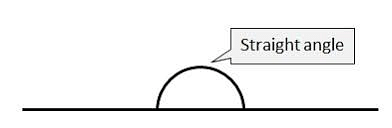
Figure 1.1
Consider a line segment AB forming a straight angle at point C. There is a Ray CD coming out of the line segment AB. Here angle ACD and angle DCB form a linear pair of angles. See figure 1.2.
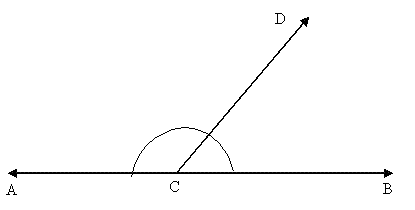
Figure 1.2
In Figure 1.2 ∠ACD +∠DCB =180 degrees and their non-common side AC and CB forms a straight line and they have a common vertex CD so, angle ACD and DCB are linear pair whereas in the case of adjacent angles the non-common side is on the different side of the common side but the addition of the angles may or may not be 180 degrees. Some real-life examples of a Linear pair of Angles are slices of pizza, a ladder placed against the wall forms a linear pair of angles with the ground. This linear pair of angles has given birth to axioms related to it.
Check Important Notes for Division Line Segments
Axiom 1
[Click Here for Sample Questions]
If a ray stands on a line, then the sum of two adjacent angles formed is 180 degrees. When the sum of two adjacent angles is 180 degrees, then they are called linear pairs of angles.
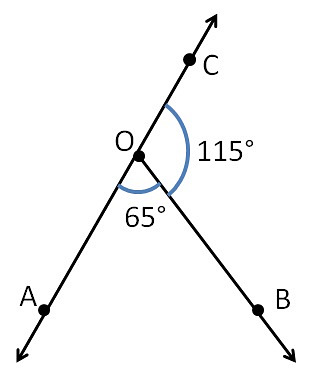
Figure 1.3
In figure 1.3, Ray OB is standing on AC, Angle COB and BOA are adjacent to each other and they form a linear pair and their sum is 180 degrees. The converse of the said axiom is also true and can be said as the axiom stated below.
Also Read: Construction of Copy of Line Segments
Axiom 2
[Click Here for Sample Questions]
If two angles form a linear pair then the uncommon arm of the said linear pair forms a straight line. In figure 1.3 it is evident that while forming an adjacent angle the linear pair or the uncommon arm forms a straight line or 180 degrees.
Figure 1.3 is an apt example for the given axiom but there are times when adjacent angles may not form a straight line.
Things to Remember
[Click Here for Sample Questions]
- The sum of two angles in a linear pair is always 180 degrees.
- Linear pairs of angles always form a straight line.
- All linear pairs of angles are adjacent angles but all adjacent angles are not linear pairs.
- Linear pairs of angles are also called supplementary angles
- Straight line forms 180 degrees of angle.
Read More: Parallel Perpendicular Axes Theorem
Sample Questions
Ques: If one of the angles forming a linear pair is a right angle, then what can you say about its other angle? (2 marks)
Ans: Let one of the angles forming a linear pair be 'a' and the other be 'b'.
Given that ∠a = 90° and we already know that linear pairs of angles are supplementary ⇒ ∠a + ∠b = 180°.
⇒ 90° + ∠b = 180°
⇒ ∠b = 180° - 90°
⇒ ∠b = 90°
Therefore, in a linear pair of angles, if one of the angles is a right angle then another angle is also a right angle.
Ques: If two angles forming a linear pair are in the ratio of 4:5, then find the measure of each of the angles. (2 marks)
Ans: Let the two angles be 4y and 5y.
We know that linear pairs of angles are supplementary ⇒ 4y + 5y = 180°.
9y = 180°
y = 180/9
y = 20
Therefore, the two angles are: 4y = 4 × 20 = 80° and 5y = 5 × 20 = 100°.
Ques: If two angles forming a linear pair are in ratio 2:3, then find the measure of each angle. (2 marks)
Ans: Let the two angles be 2y and 3y, we know that 2y+3y =180º.
5y = 180
y = 36, so therefore two angles are 2y = 2 x 36 = 72º and 3y = 3 x 36 = 108º.
Ques: What could be the linear pair of the angle 60 degrees? (2 marks)
Ans: Linear pair of angle =180 degrees so one angle is 60º
Other angles of the pair will be 180 – 60 = 120º.
Therefore other angle is 120º.
Ques: What could be the linear pair of angles 37 degrees? (2 marks)
Ans: Linear pair of angle =180º, so one angle of the pair is 37º
Other angle will be180-37=143º.
Therefore another angle of the linear pair is 143º.
Ques: In the given figure, if POQ is a straight line and ∠POC = ∠COQ, then show that ∠POC = 90°. (2 marks)

Ans: Since ray OC stands on line PQ. So, by linear pair axiom, ∠POC + ∠COQ = 180°. But ∠POC = ∠COQ (given).
⇒ ∠POC + ∠POC = 180°
⇒ 2∠POC = 180°
⇒ ∠POC = 180°/2 = 90°
⇒ ∠POC = 90°.
Ques: Identify the linear pair of angles from the given options. (2 marks)
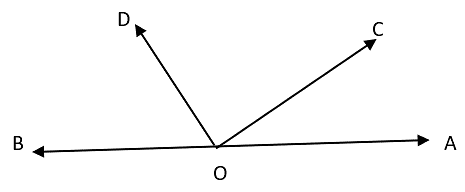
Ans:
- ∠AOB and ∠AOC
- ∠AOC and ∠COD
- ∠AOC and ∠COB
- ∠AOD and ∠DOB
Explanation: Two adjacent angles form a linear pair of angles if their non-common arms are two opposite rays.
In the given figure, there are two linear pairs:
- ∠AOC and ∠COB and
- ∠AOD and ∠DOB.
Ques: Find the value of k if ∠POQ and ∠POR form a linear pair. (2 marks)

a) 20°
b) 120°
c) 40°
d) 50°
Ans: Linear pair of angle =180 degrees
7k + 2k = 180º
⇒ 9k = 180º,
⇒ k = 20º
Now 7k ⇒ 7 x 20 ⇒ 140º and 2k ⇒ 2 x 20 ⇒ 40º,
Linear pairs are 140º and 40º.
Ques: Find the value of ∠BOD if ∠AOD : ∠AOC=4:5. (2 marks)

Ans: ∠AOC and ∠AOD form a linear pair of angles, ∠AOC + ∠AOD = 180°.
Also, ∠AOD: ∠AOC = 4:5,
∠AOC + ∠AOD = 180
⇒ ∠AOC + (4/5) ∠AOC = 180
⇒ 9∠AOC = 180 * 5
⇒ ∠AOC = 100°
Now, ∠BOD = ∠AOC (Vertically opposite angles)
⇒ ∠BOD = 100°.



Comments