



Content Writer
Interior Angles of a Polygon is an angle formed between two adjacent sides of the vertices. It is an angle that is formed inside a shape. There are two ways of forming internal angles of a polygon, including when parallel lines are cut by traversal, and the other is inside a polygon.
- An angle is formed when two straight, unparallel lines extend up to a certain point where they intersect or at a common endpoint.
- It is measured in terms of degrees or radians.
- A polygon, on the other hand, is a two-dimensional closed geometric figure with a length, a width, sides and vertices.
- A polygon’s angles, sides and vertices lie on the same plane; therefore, it is a plane geometric figure.
- Interior Angles of a Polygon are equivalent to the number of sides in a closed figure.
- In the case of a regular polygon, the values of interior angles are equal to each other.
Read More: Frequency Polygons
Key Terms: Polygon, Interior Angle, Exterior Angle, Triangles, Quadrilaterals, Pentagons, Regular & Irregular Polygons, Degree
What is the Interior Angle of a Polygon?
[Click Here for Sample Questions]
Interior Angles of a Polygon are formed when two adjacent sides of a polygon intersect at a common point, also called the vertex. Then, the angle formed between the two lines and at the vertex is known as the interior angle of a polygon.
- It is also known as an internal angle.
- Each polygon has only one internal angle per vertex.
- If the value of the interior angles of a polygon is less than 180 degrees, then such a polygon is called a convex polygon.
- Interior Angles of a Polygon can be categorised into two types, namely Regular Polygon and Irregular Polygon.
- Naturally, this angle is formed inside the geometric plane.
- Therefore, this angle is an interior part of the polygon.

Interior Angles of a Polygon
As we can see, the angles formed are known as the interior angles.
Interior Angles of a Polygon
Now, if we notice, the number of interior angles in a polygon is always going to be equal to the number of sides of the polygon. Therefore if a polygon has three sides (such as a triangle), it will have three angles, and if a polygon has five sides (as shown in the above figure), it will inherently have five angles, and so on.
Read More: Quadrilateral Angle Sum Property
Sum of Interior Angles of a Polygon
[Click Here for Sample Questions]
The sum of the interior angles of a polygon is defined as the summation of all the angles formed in the interior part of a polygon. The sum of the interior angles of different polygons will have different values.
- The value of a particular polygon is always equal to a constant, irrespective of whether the polygon is a regular polygon or an irregular polygon.
- The sum of all interior angles of a polygon with ‘n’ number of sides can be calculated by the formula, [(n-2) x 180]°.
Regular Polygon
[Click Here for Sample Questions]
Regular polygon is a polygon which has all its sides of equal length and all its interior angles of equal measure. Therefore, a polygon which has equal sides and angles is known as a regular polygon. Examples of regular polygons include the Equilateral Triangle, Square, A Regular Pentagon, etc.
- In a regular polygon, all interior angles are equal to each other.
- For example, in a square, each interior angle is of a measure of 90°, and all sides are equal to each other.
- The measure of each interior angle of a regular polygon is equal to the sum of the interior angles of the regular polygon divided by the number of sides of the polygon.
- The measure of each interior angle of a regular polygon is congruent to the other.
- This can be put as,
Measure of each interior angle of a regular polygon = Sum of Interior angles of the regular polygon / Number of sides of the polygon
Sum of Interior Angles of a Regular Polygon
The table below showcases the number of interior angles and their respective sum of interior angles in the case of a regular polygon, which are as follows:
| Polygon | No. of Sides | Measure of each angle (in degrees) | Sum of all interior angles (in degrees) |
|---|---|---|---|
| Triangle | 3 | 60 | 180 |
| Quadrilateral | 4 | 90 | 360 |
| Pentagon | 5 | 108 | 540 |
| Hexagon | 6 | 120 | 720 |
| Heptagon/ Septagon | 7 | 128.57 | 900 |
| Octagon | 8 | 135 | 1080 |
| Nonagon | 9 | 140 | 1260 |
| Decagon | 10 | 144 | 1440 |
Read More: Area of Rectangle
Irregular Polygon
[Click Here for Sample Questions]
Contrary to Regular Polygons, an irregular polygon is a polygon which does not have all its sides of the same length and not all its angles of equal measure.
- Therefore, a polygon which does not necessarily have equal sides and angles is known as an irregular polygon.
- A classic example of an irregular polygon is the Right-Angled Triangle.
- A scalene triangle is another example of an irregular polygon, as all its sides are unequal in length.
Sum of Interior Angles of an Irregular Polygon
The table below showcases the number of interior angles and their respective sum of interior angles in the case of a irregular polygon, which are as follows:
| Polygon | No. of Sides | Sum of Interior Angles (in degrees) |
|---|---|---|
| Triangle | 3 | 180 |
| Quadrilateral | 4 | 360 |
| Pentagon | 5 | 540 |
| Hexagon | 6 | 720 |
| Heptagon/ Septagon | 7 | 900 |
| Octagon | 8 | 1080 |
| Nonagon | 9 | 1260 |
| Decagon | 10 | 1440 |
As evident from the above tables, we can conclude that the sum of interior angles of a polygon with the same number of sides, irrespective of whether it is a regular polygon or an irregular polygon, is always the same. Although, the measure of each interior angle is different.
Read More: Geometry Formula
Interior Angles of Different Polygons
[Click Here for Sample Questions]
The interior angles of different polygons are as follows:
Interior Angles of a Triangle
A triangle is a polygon with three edges, three vertices and three angles. It is a shape in geometry which is taken as the base for all other shapes and polygons for calculating the sum of their interior angles.
- Triangles can be classified into three types based on the measure of their sides and the interior angles.
- But regardless of the type of triangle, the sum of the interior angles of all triangles is always equal to 180°.
- Take the example of a regular triangle (also called an equilateral triangle).
- In this case, the measure of each angle will be (180° / 3) = 60°.
- The sum of all interior angles of an equilateral triangle is (60°+ 60°+ 60°)= 180 degrees.
- The result will be the same for acute-angled or obtuse-angled triangles.
Interior Angles of a Quadrilateral
A quadrilateral is a four-sided closed figure or shape with four edges, four corners and, therefore, four angles. Some forms of quadrilaterals are square, rectangle, parallelogram, rhombus, trapezium, kite, etc.
- All quadrilaterals have a common feature, that is, all of them have four sides and four angles.
- Another common property of all quadrilaterals is that the sum of all the interior angles of each quadrilateral is equal to 360°
- In the case of a regular quadrilateral, the measure of each interior angle is equal to 360°/4 = 90°.
Interior Angles of a Pentagon
A pentagon is a closed polygon with five sides and, therefore, five angles. It can be formed by joining three triangles together. Thus, the sum of interior angles of a pentagon will be equal to the sum of interior angles of three triangles, which is equal to three times 180 degrees, that is, 540 degrees.
- The measure of each angle of a regular pentagon is equal to 540 degrees divided by 5, that is 108 degrees.
- Note: The sum of the interior angles of a polygon can be calculated as,
Number of triangles formed inside the polygon x 180 degrees
Read More: Pythagoras Theorem
Interior Angles of a Polygon Formula
[Click Here for Sample Questions]
Interior Angles of a Polygon are formed when two adjacent sides of a polygon intersect at a common point. These angles are formed inside a polygon. The interior angles can be calculated in three ways:Formula-1
If n is the number of sides of a polygon, then the required formula is as follows:
Interior Angles of a Polygon = [(180° n) - 360°]n,
where n= the number of sides of the polygon
Formula-2
When the exterior angle of a regular polygon is given, there
Interior Angles of a Polygon = 180° – Exterior angle of a polygon
Formula-3
In case the sum of the interior angles of the polygon is given, then the interior angle can be calculated by the formula: Sum of the interior angles of the polygon divided by the number of sides of the given polygon, or,
Interior Angles of a Polygon = Sum of the interior angles of the polygon / number of sides of the polygon
Read More: Nature of Roots of Quadratic Equation
Interior Angles of a Polygon: Theorem
[Click Here for Sample Questions]
According to the Interior Angles of a Polygon theorem, for a polygon with ‘n’ number of sides, the sum of the interior angles is equal to (2n – 4) × 90°.
To Prove: The sum of the interior angles is equal to (2n – 4) times 90 degrees.
Proof- ABCDE is a polygon with n number of sides.
- For “n” number of sides in a polygon, the polygon forms “n” triangles.
- We know that the sum of the interior angles of a triangle is equal to 180 degrees. Therefore, the sum of the interior angles of n triangles = n × 180 degrees.
- Thus, we can say that, Sum of interior angles + Sum of the angles at point O = 2n × 90 degrees.
- But, the sum of the angles at the point O is equal to 360°.
- This implies, the sum of interior angles + 360°= 2n × 90 degrees.
- Therefore, the sum of the interior angles = (2n × 90 degrees) – 360 degrees.
- Therefore, the sum of “n” interior angles is (2n – 4) × 90 degrees [by simplifying the equation]
Therefore, the measure of each interior angle of a regular polygon is [(2n – 4) × 90°] / n.
Read More: Quadrilateral Angle Sum Property
Exterior Angles
[Click Here for Sample Questions]
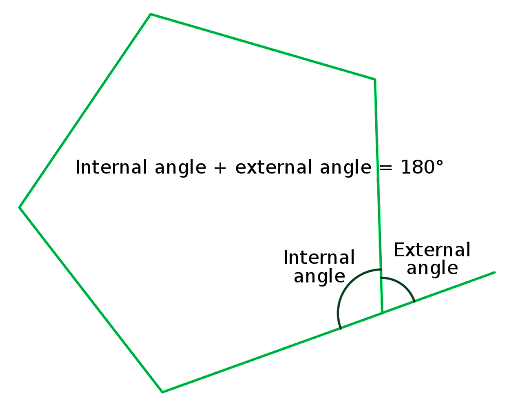
Exterior angles are the angles that are formed at the vertices of a polygon but on the outside. These angles lie on the outer surface of the polygon. Exterior angles are formed when one side of the polygon intersects with the extension of the other side of the polygon.
- The sum of the interior angle of the side of the polygon and the adjacent exterior angle to it is 180 degrees as they lie on a linear plane.
- Hence, the exterior angles of a polygon form a linear pair.
- The sum of the total exterior angles is 360 degrees.
- Thus, exterior angles can be calculated by the formula, that is, Exterior angle = 360 degrees / n.
Where n is the number of sides of the polygon.
Also Read:
Things to Remember
- No. of Interior Angles of a Polygon is always equal to the number of sides of the polygon.
- Polygons can be categorized into two types- a regular polygon and an irregular polygon.
- The sum of all interior angles of a polygon is always equal to a constant.
- The sum of all interior angles of a polygon with ‘n’ number of sides can be calculated by the formula, [(n-2) x 180]°
- Measure of each interior angle of a regular Polygon = sum of Interior angles of the regular polygon / number of sides of the polygon
- The sum of interior angles of a polygon with the same number of sides, irrespective of whether it is a regular polygon or an irregular polygon, is always the same.
- The exterior angle of a polygon is equal to 360 degrees divided by the number of sides of the polygon.
Sample Questions
Ques. Define exterior angles. How can we calculate the exterior angles of a polygon? (2 marks)
Ans. Exterior angles are the angles that are formed at the vertices of a polygon but on the outside. These angles lie on the outer surface of the polygon. We can calculate exterior angles by following the formula; that is, the exterior angle is equal to 360 degrees divided by the number of sides of the polygon.
Ques. What is a regular polygon? Give examples of some regular polygons. (2 marks)
Ans. A regular polygon is a polygon which has all its sides of equal length and all its interior angles of equal measure. Examples of regular polygons include Equilateral Triangles, Square, Regular Pentagon, etc.
Ques. What is an irregular polygon? Give examples of the same. (2 marks)
Ans. An irregular polygon is a polygon which does not have all its sides of the same length and not all its angles of equal measure. An example of an irregular polygon is the Right-Angled Triangle.
Ques. If each interior angle of a given polygon is equal to 108 degrees, then how many sides does this regular polygon have? (3 marks)
Ans. Each interior angle = 108 degrees
- We know that,
- Interior angle + Exterior angle = 180°
- Exterior angle = 180°-108°
- Therefore, the exterior angle is 72 degrees.
- The formula to find the number of sides of a regular polygon is as follows:
- Number of Sides of a Regular Polygon = 360° / Magnitude of each exterior angle
- Therefore, the number of sides = 360° / 72° = 5 sides
- Hence, the polygon has 5 sides.
Ques. What is the sum of interior angles of a 7-sided polygon? (2 marks)
Ans. Number of sides, n = 7
- Sum of interior angles of a polygon = [(n – 2) x 180]°
- (7 – 2) x 180° = 5 x 180° = 900 degrees.
Ques.What is the value of the interior angle of a regular nonagon? (2 marks)
Ans. A regular nonagon has nine sides and nine angles.
Therefore, n = 9
- Since, we know that, the sum of interior angles of nonagon, is;
- Sum of interior angles of a polygon = (9 – 2) x 180° = 7 x 180° = 1260°
- A regular nonagon has all its interior angles equal in measure.
- Therefore, measure of each interior angle = 1260°/ 9 = 140°.
Ques. Calculate the sum of the interior angles of a kite. (1 mark)
Ans. Since a kite is a quadrilateral, therefore, the sum of interior angles of a kite will be 360 degrees.
Ques. Find the number of sides of a regular polygon whose each exterior angle has a measure of 45°. (2 marks)
Ans. Sum of all exterior angles = 360°
- Measure of each exterior angle = 45°
- Therefore, the number of exterior angles = 360 / 45 = 8
The polygon has 8 sides.
Ques. The exterior angles of a pentagon are (m + 5)°, (2m + 3)°, (3m + 2)°, (4m + 1)° and (5m + 4)° respectively. Find the measure of each angle. (3 marks)
Ans. Sum of all exterior angles of a pentagon = 360°
- So, (m + 5)° + (2m + 3)° + (3m + 2)° + (4m + 1)° + (5m + 4)° = 360°
- m + 5 + 2m + 3 + 3m + 2 + 4m + 1 + 5m + 4 = 360°
- 15m + 15 = 360°
- 15m = 360 - 15°
- 15m = 345°
- m = 345/15
- m = 23°
Now, we can find the measure of each angle
- First angle, m + 5° = 23° + 5° = 28°
- Second angle, 2m + 3° = 46° + 3° = 49°
- Third angle, 3m + 2° = 69° + 2° = 71°
- Fourth angle, 4m + 1° = 92° + 1° = 93°
- Fifth angle, 5m + 4° = 115° + 4° = 119°
Ques. Is it possible to have a regular polygon whose each exterior angle is 50°? (2 marks)
Ans. The measure of each exterior angle of a polygon = 360/n
- So, 360 / n = 50°
- n = 7.2
No, we cannot have a regular polygon with each exterior angle 50°.
Ques. Find the measure of each interior angle of a regular polygon having 10 sides and 15 sides (2 marks)
Ans. Each exterior angle = 360/n (n = no. of sides of polygon)
- Exterior angle = 360 / 10 = 36°
- Each interior angle = 180 - 36 = 144°
- Exterior angle = 360 / 15 = 24°
- Each interior angle = 180 - 24 = 156°
Ques. The sum of the interior angles of a polygon is equal to 540°. Find the number of sides for that polygon. (3 marks)
Ans. Sum of the interior angles of a polygon (S) = 1540°.
- According to the formula, sum of the interior angles of a polygon (S) = (n-2) x 180°.
- 540° = (n – 2) x 180°.
- 540° / 180° = n – 2
- 3 = n – 2
- 3 + 2 = n
- n = 5.
Ques. In a triangle, the values of three angles are 60°, 50° and x, the sum of the interior angles of a triangle is equal to 180°. What is the value of “x”. (3 marks)
Ans. Measurements of the three angles in a triangle are : 60°, 50° and x.
- the sum of the interior angles of a triangle = 180°.
- Sum of the interior angles of a triangle is
- 60° + 50° + x = 180°
- 180° – (60° + 50°) = x.
- 180° – 110° = 70°.
- The value of “x” is 70°.
Ques. What is the sum of interior angles of a 9-sided polygon. (2 marks)
Ans. Given,
- Number of sides, n = 9
- Since the value of a particular polygon is always equal to a constant, irrespective of the polygon.
- The sum of all interior angles of a polygon with ‘n’ number of sides is calculated by the formula [ ( n – 2 ) x 180°].
- Therefore, sum of interior angles = (9 – 2) x 180° = 7 x 180° = 1260°.
- So our required answer is 1260 degrees.
Check Out:



Comments