



Content Curator
Membrane is the outermost layer of a cell. It is a lipid bilayer with proteins embedded in it. The electron microscope was the only approach to find the comprehensive and viable design of the membrane. Apart from providing a barrier between the external environment and inside of a cell, a cell membrane performs several other important functions including transport of molecules and cell signalling.
| Table of Content |
Key Takeaways: Proteins, Cell membrane, Lipid Bilayer, Cholesterol, Carbohydrate, Fluid Mosaic Model, Circumferential Protein, Intrinsic Proteins
Structure of Cell Membrane
[Click Here for Sample Questions]
The structure of the cell membrane is mainly composed of a phospholipid bilayer and proteins. There are three main components of the cell membrane:
Phospholipids
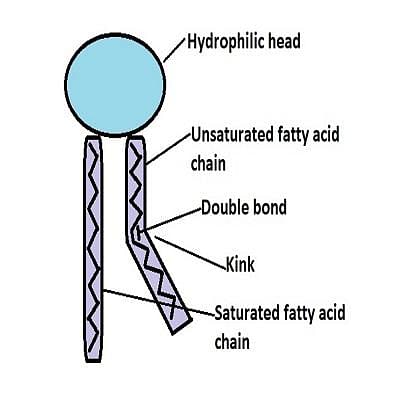
Head and tails are the two main parts of phospholipids. The head part is attracted by water and this is a phosphate molecule also called hydrophilic end. The tail part consists of two tails made up of fatty acid. The tail part repels water and thus is also known as the hydrophobic end. The cell membrane makes the assembly of phospholipids into two layers because of hydrophobic and hydrophilic properties. The head part faces the aqueous or water part and the two tails hide from the water because they are hydrophobic.
Cholesterol
Cholesterol is an important component of the cell membrane which helps in managing the molecule's entrance and exit through a cell. Cholesterols are steroids present between the phospholipids layers and help prevent stiffness of the membrane by maintaining a gap between the two layers. It also decreases membrane permeability for some water-soluble molecules.
Proteins
Different types of protein are found embedded in the cell membrane. It helps the membrane to construct a 3D-shape. Proteins work as a signal between the cell‘s exterior and inmost wall. Proteins behave like an iceberg in the lipid ocean that can switch their place. The proteins found in the membrane are divided into two categories:
- Circumferential Proteins- Circumferential proteins exist on the two sides of the membrane, inner or outer wall of the cell. The leading function of circumferential proteins is to transfer the molecules into the membrane. Molecules signalling is also the function of the circumferential Proteins.
- Intrinsic Proteins- Intrinsic proteins are found embedded in the lipid bilayer of the cell membrane. They act as carrier proteins and enzymes. They facilitate the transport of certain molecules across the cell, for example, transport of water molecules through aquaporins.

Read Also:
Function of Cell Membrane
[Click Here for Sample Questions]
Cell membranes are important for normalising the functioning of all the cells in the human body. The main functions of the cell membrane are as follows:
- Cell membrane protects the cell from the exterior surroundings.
- It maintains the delivery of food and wastes, like it delivers the nutrients into the cell and throws the toxic and wastes out of the cell.
- Cell membrane gives support to the cell and maintains a firm shape of the cell.
- The quasi fluid property of the membrane is helpful in the development of cells, cell division, secretion etc.
- The leading function of the cell membrane is to transfer the molecules in and out of the cell. This allows the control of an enclosed chemical environment – important to maintain ion gradients.
- It acts as a permeable barrier between the cells and intracellular compartments.
Fluid Mosaic Model
[Click Here for Sample Questions]
The Fluid Mosaic Model is the most popular model for the detailed structure of cell membranes. Singer and Nicolson in 1972 suggested this model. Several constituents like proteins, cholesterol, phospholipids, and carbohydrates are the leading aspects of the fluid mosaic model.
The fluid mosaic model suggests a bunch of different molecules that are spread over the cell membrane. The microscopic view of the cell membrane is just like a pattern of different types of molecules put together and this is called mosaic pattern. The molecules move continuously in two directions, in fluid, it looks like icebergs floating in the ocean.

Read Also:
Fluidity of Cell Membrane
[Click Here for Sample Questions]
The fluid mosaic model also accounts for the fluidity of the cell membrane. The main factors that affect the membrane’s fluidity are:
- Temperature - Temperature affects the membrane fluidity because when the temperature is low, phospholipids come closer together and when the temperature is high, then they move farther apart.
- Cholesterol- The cholesterol molecules are randomly dispersed across the phospholipid bilayer, and it helps to maintain the bilayer fluidity in different climatic conditions. Cholesterol helps in holding the phospholipids together so that they don’t disperse too far. Without cholesterol, the phospholipids will start to separate from each other and it will leave large gaps.
- Fatty acids- Fatty acids are stored in the phospholipid tails. Fatty acids are of two types: saturated fatty acids and unsaturated fatty acids. Saturated fatty acids are the chain of carbon atoms and a single bond between them. Unsaturated fats are chains of carbon atoms but it has double bonds which tightly packs the chain. Saturated fatty acids provide rigidity to the membrane and unsaturated fatty acids maintain fluidity of the membrane.
Things to Remember
[Click Here for Sample Questions]
- The cell membrane is very flexible to switch shape as per the requirement.
- In the electron microscope, the cell membrane pops up as a trilamellar (three layers) structure.
- Signal reception, movement conduction, cell division, sexual reproduction, etc. are the leading functions of the cell membrane.
- The leading characteristic of the cell membrane is that it is metabolically active.
- The Fluid Mosaic Model accounts for the structure and fluidity of the cell membrane.
Sample Questions
Ques. What is a cell membrane? (2 Marks)
Ans. Cell membrane is the outermost boundary of the cell. It is also known as the lipid bilayer. The head part of the lipid faces towards the centre and the tail part of the lipid faces towards the boundary.
Ques. Explain the prime role of the cell membrane. (3 Marks)
Ans. The prime role of the cell membrane is to give full safety to the cell from outer surroundings. There are two functions of the cell membrane:
- It behaves like a barrier that prohibits constituents of the cell in and unwanted substances out.
- It works like a gate that allows essential nutrients into the cell and dispersal of waste products out of the cell.
Ques. Are cell membranes and plasma membranes the same? (1 Mark)
Ans. Yes, cell membrane is also called plasma membrane. It is an armour of the cell which protects it from outer surroundings.
Ques. Explain the difference between intrinsic protein and circumferential protein. (2 Marks)
Ans. Intrinsic proteins are those proteins which are found embedded in the lipid bilayer of the cell membrane, whereas circumferential proteins lie on the exterior wall of the membrane.
Ques. How many types of shapes cells can take? (3 Marks)
Ans. Cells can take any shape depending upon the kind of cell. Cell membrane helps the cell in maintaining its shape. Generally, cells are round, elongated or spherical. Some of the cells are long and pointed on both ends and some are of spindle-shape.
Ques. Who invented the fluid mosaic model? (2 Marks)
Ans. Singer and Nicolson in 1972 invented the fluid mosaic model. This model defines that the membranes are made up of lipids, proteins and carbohydrates. The fluid mosaic model, apart from membrane structure, also accounts for the fluidity of the membrane.
Ques. Define the structure and function of the cell membrane. (2 Marks)
Ans. The cell membrane is made up of a phospholipid bilayer with integrated proteins and the function of a cell membrane is to protect the cell from outside surroundings. It also controls the movement of substances across the cell membrane.
Ques. Which type of materials can enter a cell membrane easily? (3 Marks)
Ans. Gases like oxygen and carbon dioxide can enter into the membranes rapidly.
Small polar molecules like water, ethanol and small hydrophobic molecules also enter the membrane easily but they move slowly.
Read Also:



Comments