



Content Curator
Lipids are the general names given to a set of fat-soluble chemicals present in plant and animal tissues. They are the structural and functional building elements of living cells. Even though fats have become associated with lipids, triglycerides are a subgroup of lipids. Adipose tissue, also known as a fat depot, is a loose connective tissue made up of adipocytes that are found in human bodies. This fat-rich tissue is found beneath the skin, surrounding internal organs, bone marrow, and breast tissue, and is made up of around 80% fat. This tissue's primary function is to store energy in the form of lipids.
| Table of Content |
Key Takeaways: Lipids, Fats, Tissue, Fatty Acid, Nutrients
Fats
[Click Here for Sample Questions]
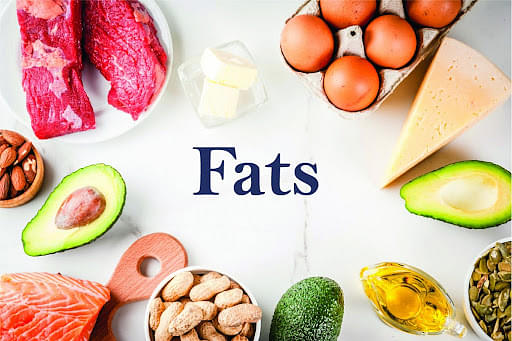
Fat is a term used in nutrition, biology, and chemistry to describe any ester of fatty acids or a combination of such compounds, most typically those found in living creatures or food. Even though fats have become associated with lipids, triglycerides are a subgroup of lipids. Animals' principal energy stores are fats, which are fatty acid esters of glycerol. The energy depots are utilized to store energy that the body may require during a period of fasting. In general, fats are soluble in organic solvents but not in water. At room temperature, fats may be found in both solid and liquid states; the solid-state is referred to as fats, while the liquid state is referred to as fat at the liquid state. In a medical or biological context, the term 'lipid' refers to fat in both liquid and solid form.
Fats
Saturated and unsaturated fats are the two types of fats. Unsaturated fat is classified into two types: cis fats and trans fats. Lard, fish oil, butter/ghee, whale blubber, peanut, soya bean, sunflower, sesame, coconut, and olive oils, as well as cocoa butter and margarine, are all edible fats. These fats are beneficial in moderation, but in excess, they can cause an individual to gain too much weight and become obese.
Lipids
[Click Here for Sample Questions]
Lipids and fats are both essential components of the human body. They belong to the third group of macronutrients required for human nutrition. With everyone these days attempting to lose weight, these essential nutrients have begun to be reduced, which isn't necessarily a healthy thing. These nutrients serve as an energy source in the body, allowing it to carry out its regular duties.
Chemical Structure of Lipids
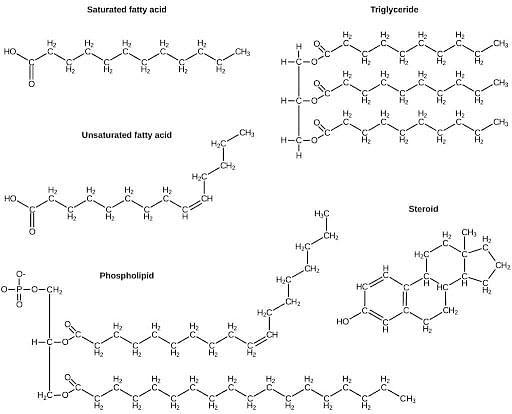
Lipids are the general names given to a set of fat-soluble chemicals present in plant and animal tissues. Fats, phospholipids, sphingomyelins, waxes, and sterols are all types of lipids. Lipids are a complex molecule that contains carbon, hydrogen, and oxygen, as well as nitrogen and sulfur, as well as other minor components. About vitamins A, D, E, and K, lipids play a significant role in the creation of the cellular membrane, energy storage, cellular signaling, and other minor nutritional activities. They are the structural and functional building elements of living cells.
Also Read:
| Related Articles | ||
|---|---|---|
| Lysosomal Storage Disease | Life Processes | |
| Nutrition in Human Beings | Excretion | |
Difference Between Fats and Lipids
[Click Here for Sample Questions]
Fats have a different chemical structure and physical characteristics than other lipids, and they play a vital role in chemical and metabolic operations. Lipases, which are generated in the pancreas, are responsible for breaking down fats and lipids in the human body.
| FATS | LIPID |
|---|---|
| Fats are an oily material present throughout the body, including under the skin and surrounding organs. | Lipids are a kind of organic molecule that is soluble in organic solvents but insoluble in water. |
| Fats are a form of Lipids | Lipids are a large collection of macromolecules present in the body of animals. |
| Saturated and trans fats are two different kinds of fats. | Lipids are divided into three categories: triglycerides, phospholipids, and steroids. |
| Fats are a type of solid material. | Lipids come in a variety of forms, some of which are solids and others which are liquids. |
| Fats are utilized as a source of energy. | Lipids are both structural and energetic molecules in the human body. |
Points to Remember
- Lipids are a broad category of chemicals that are mostly nonpolar. They're hydrocarbons with a lot of nonpolar carbon-carbon or carbon-hydrogen bonds in them. Non-polar molecules are hydrophobic (meaning they are afraid of water) and insoluble.
- Lipids are a diverse category of biological molecules that include fats/oils, waxes, phospholipids, and sterols. They serve a variety of activities in the body and cells.
- The fat molecule is made up of two primary components: glycerol and fatty acids. Fat / Oil is a subclass of lipids.
- Glycerol is a three-carbon, five-hydrogen, and three-hydroxyl (OH) group chemical molecule (alcohol).
Also Read:
| Related Articles | ||
|---|---|---|
| Nutrients | Visceral Fat | |
| Test for Fats | Lipids | |
Sample Questions
Ques 1. What are lipids? What role do lipids play in our bodies? (5 marks)
Ans: Lipids are chemical substances made up of fatty acids or fatty acid derivatives that are water insoluble but soluble in organic solvents. Natural oils, steroids, and waxes, for example.
Lipids serve a critical function in our bodies which are as follows:
- They are a component of the cell membrane's structure.
- They aid in the production of hormones and provide energy to our bodies.
- They aid in appropriate meal digestion and absorption and give a nutritious element of our diet.
- They play a vital function in signalling as well.
Ques 2. Give some instances of the many types of lipids there are in our body? (4 marks)
Ans: Water does not dissolve lipids; therefore, they can exist as simple fatty acids. A carboxyl group is connected to an R-group, which can be methyl, ethyl, or a larger number of -CH2 groups in a fatty acid.For example, there are 20 atoms of carbon which includes carboxyl carbon in Arachidonic acid whereas 16 carbon atoms in palmitic acid, including the carboxyl carbon. Unsaturated or saturated fatty acids might be present. Trihydroxy propane, often known as glycerol, is another lipid.
Several lipids include fatty acids and glycerol, and the fatty acids are esterified with glycerol to form diglycerides, triglycerides, and monoglycerides, which are classified as oils or fats based on their melting points. Phosphorylated organic substance and phosphorus are only present in a few other lipids, which are phospholipids found in the cell membrane. Lecithin is a good example.
Ques 3: What are carbohydrate's primary functions? (3 marks)
Ans: Carbohydrates serve the following purposes:
- Controlling blood glucose levels.
- It has a role in fat metabolism and helps to keep you out of ketosis.
- Provide the body and neurological system with energy and sustenance.
- Fibre, starch, and sugars are some of the basic components of food.
- They are the principal energy source.
- As a result, it's engaged in the conversion of starch to glucose and proteins, which provides energy for metabolism.
Ques 4. What are the different types of carbohydrates? (2 mark)
Ans: Monosaccharides, disaccharides, oligosaccharides, and polysaccharides are the four main categories of carbohydrates. Despite the fact that there are alternative categorization criteria, this is the most often used.
Ques 5. What are lipid rafts, and what do they do? (2 mark)
Ans: Lipid rafts are regions of the cell membrane that have high cholesterol and glycosphingolipid concentrations. Although the presence of lipid rafts has not been shown definitively, many experts believe they do exist and may play a role in membrane fluidity, cell-to-cell communication, and viral infection.
Ques 6. What is the role of fat in our body? (3 marks)
Ans: Fats, like the other two primary macronutrients carbohydrates and proteins, are a source of energy in the human diet. The membranes that encircle our cells physically divide the interior from the outside of the cell and control chemical transit in and out. The majority of them are made up of phospholipids, triglycerides, and cholesterol. The body creates and utilises a sterol/lipid molecule as a structural component in cells. Fat assists in the absorption of fat-soluble vitamins A, D, E, and K in the gut by acting as a transporter. Adequate intake of these micronutrients requires sufficient consumption of fatty foods containing these vitamins.
Ques 7. What's the Difference Between Fatty Acids and Lipids? (3 marks)
Ans: Fatty acids are part of a larger family of chemicals known as lipids. There are two types of fatty acids, saturated and unsaturated. Carbon-carbon double bonds do not exist in saturated fatty acids, but they do exist in unsaturated fatty acids. Long chains of hydrocarbons having a carboxylic acid group at one end are referred to as fatty acids. Lipids are polymers of fatty acids with a nonpolar hydrocarbon chain and a small polar oxygen group, while lipids are polymers of fatty acids with a nonpolar hydrocarbon chain and a small polar oxygen group.
Ques 8. What is fatty acid? (2 marks)
Ans: Fatty acids are the building blocks of fat in both our body and our meals. The body breaks down lipids into fatty acids during digestion, which may subsequently be taken into the bloodstream. Fatty acid molecules are commonly linked in groups of three to create a molecule known as a triglyceride.
Ques 9. Do lipids mix in water? (2 marks)
Ans: Lipids are nonpolar molecules, meaning they have no charged ends. They are not soluble in water because they are nonpolar whereas water is polar. Therefore, there is no link or sharing of electrons between the lipids and water molecules. The lipids just float on the surface of the water, not mixing in.
Check-Out:



Comments