



Education Journalist | Study Abroad Lead
Metalloids are those chemical elements whose physical and chemical properties fall in between the metal and non-metal categories. The six most well-known metalloids are boron, germanium, silicon, antimony, arsenic, and tellurium. Metalloids have a metallic appearance, but they are usually brittle and have poor conductors of electricity. These elements are usually non-metals chemically. The majority of their physical and chemical properties are intermediate in nature. Metalloids are typically too brittle to be used in structural applications and this article discusses Metalloids and their compounds are used in alloys, flame-retardants, catalysts, optical storage, glasses, pyrotechnics, electronics, and semiconductors.
| Table of Content |
Key Terms: Metalloids, Metals, Nonmetals, Catalysts, Alloys, Germanium, Silicon, Antimony, Arsenic, Conductors, Elements, Electronegativity, Ionization
What are Metalloids?
[Click Here for Sample Questions]
Metalloids are a group of elements that display the properties of both metals and non-metals and are found in the periodic table of elements along the zigzag line that distinguishes metals from non-metals. The zig-zag line is drawn from between boron and aluminium to the border between polonium and astatine.
The following elements are classified as metalloids:
- Boron (B)
- Silicon (Si)
- Germanium (Ge)
- Arsenic (As)
- Antimony (Sb)
- Tellurium (Te)
- Polonium (Po)
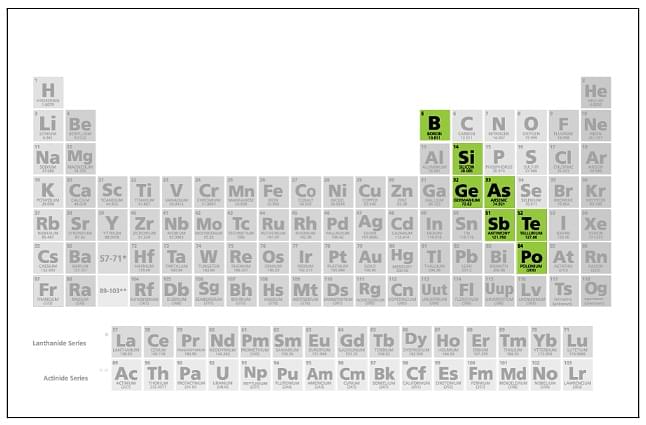
Position of Metalloids in Modern Periodic Table
Properties of Metalloids
[Click Here for Sample Questions]
Metalloids have a similar appearance to metals but behave similarly to nonmetals. Physically, they are brittle, lustrous solids at room temperature with intermediate to good electrical conductivity and a semiconductor or semimetal electronic band structure. Metalloids typically look like metals but often behave like non-metals.
- Metalloids are brittle, somewhat lustrous materials that are usually solid at room temperature.
- The electrical conductivity of these elements is usually intermediate to strong.
- Metalloids have electronic band structures that are similar to those of semimetals or semiconductors.
- These elements have intermediate ionization energies and electronegativity values and act chemically as non-metals (albeit in a weak way).
- Metalloids have the ability to form amphoteric or weakly acidic oxides, and they can also form metallic alloys.
- Metalloids have many other physical and chemical properties that are, in essence, intermediate.
Also Read:
General Applications of Metalloids
[Click Here for Sample Questions]
Metalloids and metalloid compounds are widely used as alloys (or as a component of alloy production), biological agents (which can be nutritional, toxicological, and medicinal), flame-retardants, catalysts, glasses and optical storage media. Optoelectronics, semiconductors, pyrotechnics, and electronics are all known to use metalloids.
When it comes to the lighter metalloids, alloys formed when transition metals are combined are extremely well represented. Boron can combine with other metals to form intermetallic compounds. If the value of n is greater than 2, this element can also form alloys with these MnB composition metals. In fact, Ferro boron (a 15 per cent boron compound) is widely used to inject boron into steel.
Nickel-boron alloys are also used as ingredients in welding alloys and case hardening compositions in the engineering industry. Aluminium and iron silicon alloys are widely used in the construction and automotive industries. Germanium is known to form a variety of alloys, particularly with coinage metals.
Medical Applications of Metalloids
[Click Here for Sample Questions]
Each of the six metalloid elements is known to be either toxic or have medicinal and nutritional properties. Antimony and arsenic compounds, for example, are known to be particularly toxic. On the other hand, Boron, arsenic, and silicon are vital trace elements. Boron, arsenic, silicon, and antimony are four elements with numerous medical applications.
The remaining two elements (germanium and tellurium) are well-known for their medicinal potential. Boron is also used in herbicides, insecticides, and other pesticides. In the form of boric acid, this element is an active trace element with antiseptic, antiviral, and antifungal properties.
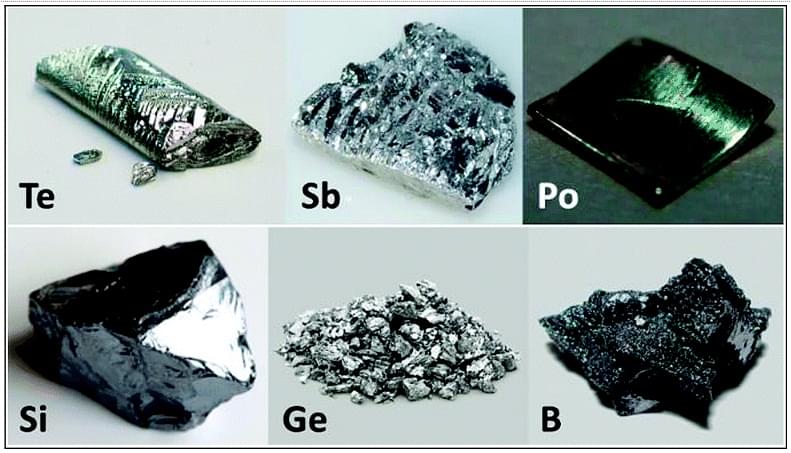
Metalloids
Read More: Physical Properties of Metals and Non-Metals
Uses of Metalloids
[Click Here for Sample Questions]
The detailed uses of the metalloids are mentioned below:
Boron (B)
- Boron is used in fireworks because it has the property of turning green when burned.
- Considered to be one of the most dangerous metalloids around.
- It can be used as a cleaning agent and comes in the form of boric acid.
- Boron can be used as a semi-natural pest control agent in small amounts.
Silicon (Si)
- Silicon, as a semiconductor, is used in computer chips.
- Silicon in silicones can be used as a waterproof sealant on roofs and around water pipes.
Germanium (Ge)
Fluorescent lamps and infrared detectors contain germanium, which is used in the semiconductor industry to improve conductive properties.
Arsenic (As)
- When mixed with gallium, arsenic can be used as a semiconductor and is used in LEDs.
- Arsenic can be used as an insecticide and for the preservation of wood.
- Lead alloys used in the manufacturing of bullets use Arsenic.
Antimony (Sb)
- Antimony is used in paints and ceramic enamels.
- It was also used as a cosmetic in ancient times by Egyptians.
Tellurium (Te)
- Tellurium is used as an additive for creating alloys.
- It is also used in the making of ceramics and cast iron to prevent thermal shocks.
Polonium (Po)
There is no use for Polonium as it is the rarest element and is highly radioactive and toxic in nature.
Read More: Magnetic Properties of Transition Elements & Applications
Things to Remember
[Click Here for Sample Questions]
- Metalloids have both metal and nonmetal properties. Metalloids are solids that appear to be metallic under normal conditions, but they are brittle and usually form alloys with metals. In many forms, they do not conduct heat or electricity very well.
- Silicon is the most abundant metalloid in the Earth's crust and the second most abundant element overall (oxygen is the most abundant). Tellurium is the least abundant natural metalloid.
- In the electronics industry, metalloids are extremely valuable. Silicon is used to make chips in phones and computers, for example.
- Arsenic and polonium are metalloids that are extremely toxic.
- Antimony and tellurium are primarily used to improve the properties of metal alloys.
Sample Questions
Ques. What exactly does the term "metalloid" mean? (3 Marks)
Ans. A metalloid is a chemical compound with both metallic and nonmetallic properties. Metalloids separate elements with clear metallic properties from elements with clear non-metallic properties in the periodic table, forming a jagged region. They are also known as semi-metals because their properties are halfway between those of metals and nonmetals. Boron, Silicon, Germanium, and other elements are examples.
Ques. How are metalloids recognized? (3 Marks)
Ans. The most straightforward way to determine whether an unknown element is a metalloid is to look for metal and non-metal characteristics. If both are present, the given element is almost certainly a metalloid element. Metalloids are elements at or near the edges that lack a clear preponderance of either metallic or nonmetallic properties.
Ques. Is it possible to classify mercury as a metalloid? (3 Marks)
Ans. Mercury, on the other hand, is not a metalloid. Because mercury has a valency of 1 or 2, it must be classified as a metal. This is due to the fact that this element conducts both electricity and heat very well. Mercury is known as a "Transition Metal" because of its ductility, malleability, and ability to conduct heat and electricity.
Ques. Which metalloid is an excellent electrical conductor? (3 Marks)
Ans. Metalloids are unique in that they possess both metal and non-metal properties. When boron reacts with sodium, it behaves like a nonmetal, but when it reacts with fluorine, it behaves like a metal. Most metals have a distinctive lustre and are excellent heat and electricity conductors. Semiconductors are metalloids that can conduct electricity at higher temperatures. A semiconductor is something like silicon.
Ques. What are metalloids, and what elements do they consist of? (3 Marks)
Ans. Metalloids are elements that are found in the periodic table's step-like line between metals and nonmetals. Antimony (Sb), germanium (Ge), silicon (Si), arsenic (As), tellurium (Te), polonium (Po), boron (B), and astatine (As) are the elements that make up astatine (At). Carbon, aluminium, selenium, polonium, and astatine are five of the less commonly classified elements.
Ques. What are the applications for metalloids? (5 Marks)
Ans. Metalloids are typically too brittle to be used in structural applications.
-
Alloys, biological agents, catalysts,flame-retardants, glasses, optical storage and optoelectronics, pyrotechnics, semiconductors, and electronics all use them or their derivatives.
- Arsenic and antimony compounds are particularly poisonous, while boron, silicon, and possibly arsenic are necessary trace elements.
- Medical applications exist for boron, silicon, arsenic, and antimony, and germanium and tellurium are thought to have potential.
Ques. What are the Metalloids elements? (3 Marks)
Ans. The elements that are metalloids are as follows:
- Boron
- Silicon
- Germanium
- Arsenic
- Antimony
- Tellurium
- Polonium (usually recognized, sometimes considered a metal)
- Astatine (sometimes recognized, otherwise seen as a halogen)
Ques. Why did metalloids call semimetals? (3 Marks)
Ans. Semimetals are an element (such as arsenic) with poor metallic properties and a lack of malleability. Metalloids are a special class of elements that combine metal and nonmetal properties. Because of the shared properties of these elements along the dividing line between metals and nonmetals, they're also known as semimetals.
Ques. Why are metalloids are unique? (5 Marks)
Ans. The reasons why metalloids are unique are as follows:
- Metalloids are unique in that they possess both metal and non-metal properties.
- When boron reacts with sodium, it behaves like a nonmetal, but when it reacts with fluorine, it behaves like a metal.
- Silicon has a metallic lustre, but it is a brittle and a poor conductor.
- Most metals have a distinctive lustre and are excellent heat and electricity conductors.
- Metalloids have a metallic lustre but are poor heat and electricity conductors.
- Nonmetals have a dull appearance and are poor heat and electricity conductors.
Check-Out:



Comments