



Content Writer
Livermorium is a synthetic chemical element with atomic number 116 and the symbol Lv on the periodic table. It is known to be a highly radioactive element, which is not generally found naturally in the earth's crust, but it can be created in the laboratory.
- Livermorium was discovered by the Lawrence Livermore National Laboratory and the Joint Nuclear Research Institute.
- The element is formerly known as Ununhexium, symbol: Uuh.
- It is a super-heavy synthetic element first produced in 2000 by the Joint Institute for Nuclear Research (JINR) in Dubna, Russia.
- This is a p-block transactinide element which belongs to the 7th period of the periodic table.
- Livermorium has properties similar to its lighter homologues, like oxygen, sulfur, selenium, and polonium.
Key Terms: Livermorium, Atomic number, Chemical element, Periodic table, Radioactive element, Earth’s crust, Ununhexium, Synthetic element, Neutrons, Protons, Atoms, Elements
What is Livermorium?
[Click Here for Sample Questions]
Livermorium is a chemical element that has an atomic number of 116. It is considered highly radioactive, and it was discovered by Lawrence Livermore National Laboratory and Joint Institute of Nuclear Research.
- Livermorium is the heaviest chalcogen, which is placed in group 16 and period 7.
- The IUPAC rejected the name moscovium for the element in favour of the recognition of the Lawrence Livermore laboratory.
- They gave credit to the JINR group for it's discovery,
Being the heaviest member of Group 16 of the Periodic Table, Livermorium would likely display similar chemical properties to other members of this group; it shows the closest resemblance to its closest neighbour, polonium.
- To date, very few Livermorium atoms have been produced.
- This prevents a thorough study of the properties of the element and the development of practical applications for it.
The detail about is tabulated below:
| Compound | Value |
|---|---|
| Symbol of Livermorium | Lv |
| Atomic Mass | 293 |
| Atomic Number | 116 |
| Discovered by | Joint Institute for Nuclear Research and Lawrence Livermore National Laboratory |
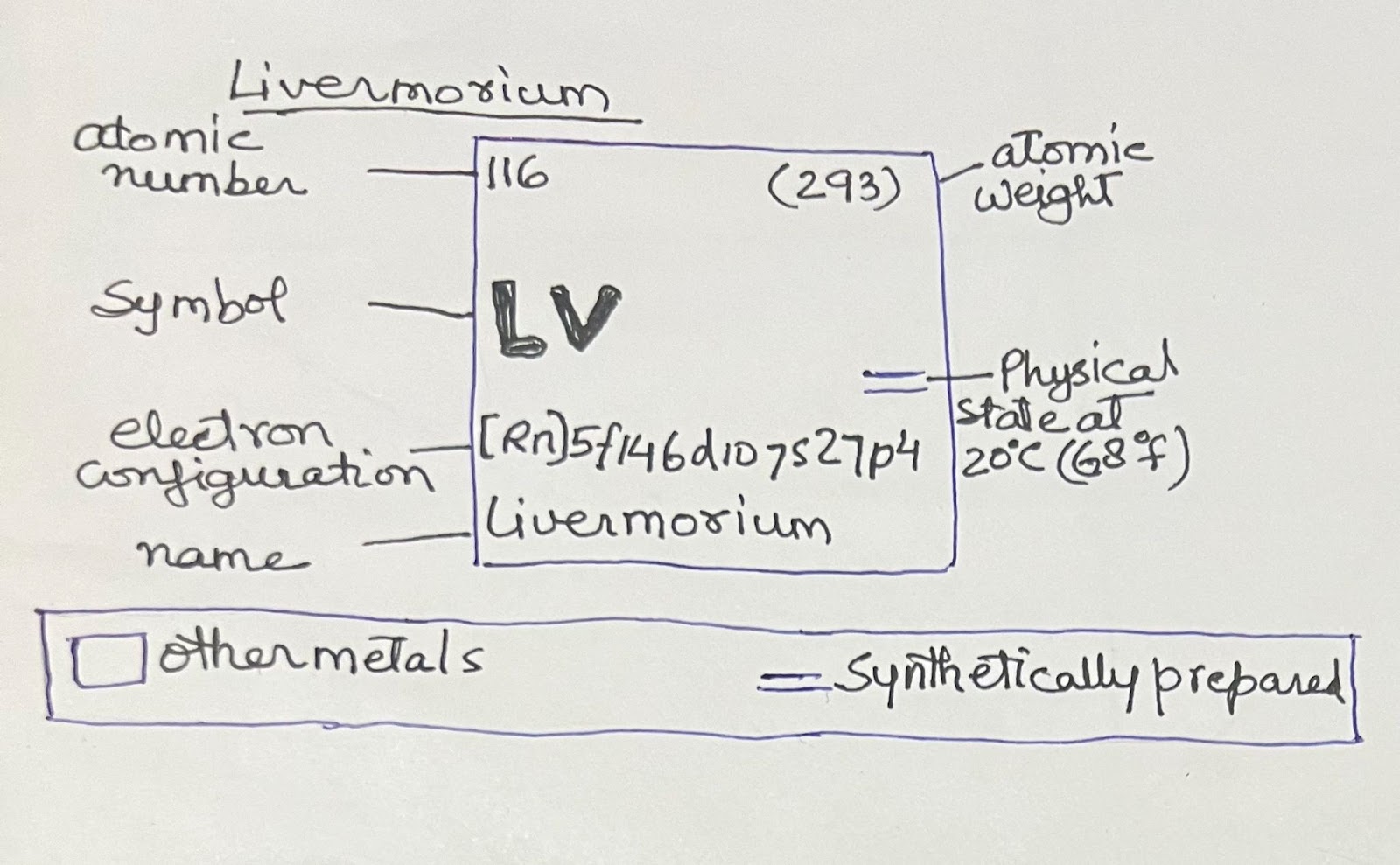
Livermorium
Also Read:
Discovery of Livermorium
[Click Here for Sample Questions]
Like the other various superheavy elements that exist, livermorium does not exist on Earth, which makes it extremely problematic to synthesize. Scientists have tried to do this by breaking Ca atoms with forty-eight neutrons into Cm atoms with 248 neutrons.
- Theoretically, the resulting atom would have 116 protons and 296 neutrons.
- The extra neutrons would make moving apart easier for the protons, keeping the nucleus long for precious milliseconds.
Scientists first tried it in 1977, then tried it again and again as bigger colliders and larger detectors became available. In 2000, Russian researchers at the Joint Institute for Nuclear Analysis in Dubna, Russia, finally succeeded.
- They detected an atom of component 116.
- They decided to call it "livermorium", formerly the Lawrence Livermore National Laboratory in the USA.
- They had provided the essential material for the invention of the element.
Properties of Livermorium
[Click Here for Sample Questions]
The properties of Livermorium are as follows:
Physical Properties of Livermorium
The physical properties of Livermorium are as follows:
- In the periodic table, livermorium is placed within the transactinide part p block.
- It is a member of the seventh period and is placed in the 16th group.
- Four isotopes with atomic mass numbers 290, 291, and 293 have been identified.
- All the isotopes of livermorium are radioactive in nature.
- The electron configuration of the element is [Rn] 5f146d107s27p4.
- Its electronic shell structure is [2, 8, 18, 32, 32, 18, 6].
- The longest-lived atom is livermorium 293, which has a half-life of just about sixty milliseconds.
- The oxidation states of Lv is predicted to be -2, +2, +4.
- Livermorium has a predicted melting and boiling point of 637–780 K and 1035–1135 K.
The physical properties of Livermorium are tabulated below:
Chemical Properties of Livermorium
The chemical properties of livermorium are as follows:
- The covalent radius of livermorium is 175 pm.
- It is known to be the fourth member of the 7p series of chemical atomicity.
- Though it's the smallest amount on paper of the 7p elements, its chemistry is expected to be quite the same as that of polonium.
The oxidation state of +4 state resembles that of sulfur. Atomic number 34, atomic number 52, and atomic number 84 undergo a modification instability of reduction of sulfur (IV) and selenium (IV) being the foremost stable state for tellurium (IV), all oxidizing to polonium (IV).
- The oxidation number of the +6 group is thought for all chalcogens except elements that cannot expand their octet.
- It is one of the strongest oxidants among the chemical elements.
- Element is restricted to at most +2 state, indicated in OF2 fluoride.

Uses of Livermorium
[Click Here for Sample Questions]
Since livermorium was discovered in the laboratory it is not found in nature as it contains only a few atoms. The element can decay rapidly after its formation.
- Currently, it has no commercial uses except in research.
- Livermorium is used in the field of research to understand the properties of compounds.
- The research gave insights into superheavy atoms.
Livermorium Effects
[Click Here for Sample Questions]
Livermorium lies in the range of stability, which is targeted by copernicium (element 112) and flerovium (element 114). However, the known isotopes of elements do not have enough neutrons to find them on the Isle of Stability.
- They'll be seen approaching the island because the heavier isotopes are sometimes the most sturdy.
The effects of livermorium on the environment and human beings cannot be taken into consideration as it has an extremely short half-life.
- The amount of production of atoms of the compound is also less.
Things to Remember
- Livermorium is understood to be an artificial hot metal with atomic number 116.
- It has been solely created in minute amounts.
- The element is generated by colliding 248Cm with 48Ca.
- It has four isotopes with known half-lives, with mass numbers from 290 to 293.
- The most stable isotope is 293Lv, with a half-life of approximately 61 milliseconds.
- Earth's crustal abundance of livermorium: zero solar system abundance: parts per trillion by weight, parts per trillion in moles
Also Read:
Sample Questions
Que: Explain: (A) What is the name of the element with the symbol Lv?
(B) List the following elements in order according to their atomic number: sulfur, livermorium, and oxygen? (2 marks)
Ans: (A) Livermorium is the name of the element with the symbol Lv
(B) Oxygen, Sulfur, and Livermorium.
Que: Explain: (A) Which element names and atomic numbers are correct?
Selenium 34, Oxygen 7, Livermorium 116, Sulfur, 10
(B) Which element in the Periodic Table has the highest atomic number and highest atomic mass of all known elements? (2 marks)
Ans: (A) Selenium 34, Livermorium 116 are correct element and atomic numbers.
(B) Livermorium is the element in the Periodic Table has the highest atomic number and highest atomic mass of all known elements.
Que: What are the isotopes of livermorium? (2 marks)
Ans: Livermorium has four isotopes with known half-lives, with mass numbers from 290 to 293. The longest-lived atom is livermorium 293 with a half-life of just about sixty milliseconds. It is expected to possess characteristics similar to its lighter counterparts such as oxygen, tellurium, and sulfur.
Que: Why is Livermorium harmful? (2 marks)
Ans: Livermorium is known to be harmful due to its radioactivity. The effects of livermorium on the environment and human beings cannot be taken into consideration as it has an extremely short half-life. The amount of production of atoms of the compound is also less.
Que: Who discovered Livermorium? (2 marks)
Ans: Scientists at Dubna, Russia with Scientists from Lawrence Livermore National Laboratory discovered Livermorium. In 2000, Russian researchers at the Joint Institute for Nuclear Analysis in Dubna, Russia, finally succeeded. They detected an atom of component 116. They decided to call it "livermorium", formerly the Lawrence Livermore National Laboratory in the USA, which had provided the essential material for the invention of the element.
Que: Describe livermorium as a metal? (1 mark)
Ans: Livermorium may be an artificial element with the symbol Lv and its number is 116. It's a very hot element that was created solely within the laboratory and has not been discovered in nature.
Ques: What is the uses of livermorium? (2 marks)
Ans: Since livermorium was discovered in the laboratory it is not found in nature as it contains only a few atoms. The element can decay rapidly after its formation. Currently, it has no commercial uses except in research.
Ques: What are the physical properties of livermorium? (3 marks)
Ans: The physical properties of livermorium are as follows:
- In the periodic table, livermorium is placed within the transactinide part p block, which is a member of the seventh period and is placed in the 16th group.
- Four isotopes with atomic mass number 290, 291 ,293 have been identified and all of them are highly radioactive.
- The longest-lived atom is livermorium 293 with a half-life of just about sixty milliseconds.
- Livermorium is expected to possess characteristics similar to its lighter counterparts such as oxygen, tellurium, and sulfur.
- It is known to be harmful due to its radioactivity.
Ques: Explain: (A) Why is element 116 called livermorium?
(B) Is livermorium the heaviest element? (2 marks)
Ans: (A) In 2000, Russian researchers at the Joint Institute for Nuclear Analysis in Dubna, Russia, finally succeeded. They detected an atom of component 116. They decided to call it "livermorium"
(B) Yes, livermorium is the heaviest element
Ques: Explain the oxidation state of livermorium? (3 marks)
Ans: The +6 group is one of the strongest oxidants among the chemical elements and is assumed to be the oxidation number for all chalcogens, with the exception of elements that are unable to expand their octet. element is thus limited to a maximum +2 state, as seen in fluoride OF2. The +4 state is believed to exist for sulfur, atomic numbers 34, 52, and 84. These atomic numbers are oxidizing to polonium (IV) and are undergoing a modification instability of reduction of sulfur (IV) and selenium (IV). Tellurium (IV) is the most stable state.
Ques: What are the chemical properties of livermorium? (3 marks)
Ans: The chemical properties of livermorium are as follows:
- Livermorium has a covalent radius of 175 pm.
- It is recognized as the fourth chemical atomicity in the 7p series.
- Despite being the least amount of the seven p elements on paper, its chemistry is predicted to be quite similar to that of polonium.
For Latest Updates on Upcoming Board Exams, Click Here: https://t.me/class_10_12_board_updates
Check-Out:



Comments