


NCERT Solutions for Class 10 Maths Chapter 3 Exercise 3.1

Jasmine Grover logo

Jasmine Grover

Education Journalist | Study Abroad Lead

NCERT Solutions for Class 10 Maths Chapter 3 Pair of Linear Equations in Two Variables Exercise 3.1 is provided in this article. Class 10 Maths Chapter 3 Exercise 3.1 has 3 questions regarding the representation of the given form of equations algebraically or graph of the linear equations.

Download PDF: NCERT Solutions for Class 10 Maths Chapter 3 Exercise 3.1

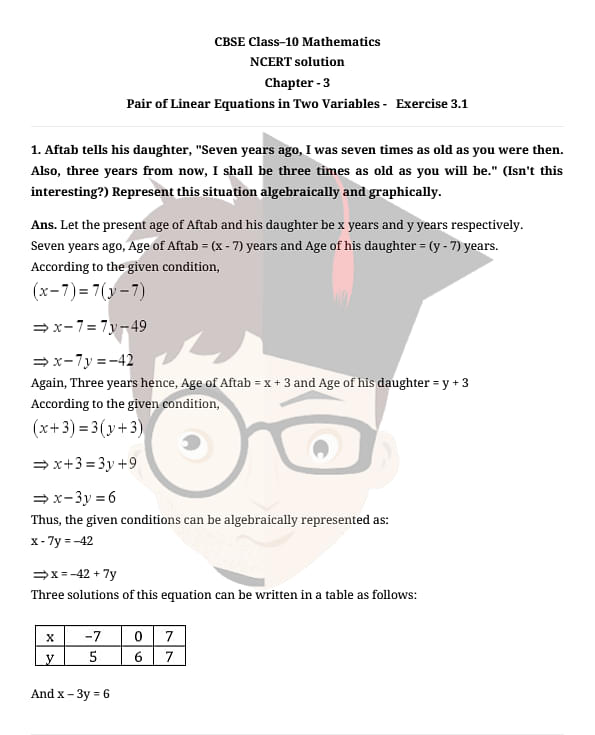
Check out the solutions of Class 10 Maths NCERT solutions chapter 3 Pair of Linear Equations in Two Variables Exercise 3.1
Read More: NCERT Solutions For Class 10 Maths Pair of Linear Equations in Two Variables

Check out other exercise solutions of Class 10 Maths Chapter 3

Class 10 Chapter 3 Topics:

CBSE Class 10 Maths Study Guides:

CBSE X Related Questions

  • 1.
    A bag contains 25 balls. Some of them are yellow and others are green. One ball is drawn at random. If probability of getting a green ball is $3/5$, then find the number of yellow balls.


      • 2.
        An arc of length $2.2\text{ cm}$ subtends an angle $\theta$ at the centre of the circle with radius $2.8\text{ cm}$. The value of $\theta$ is

          • $50^\circ$
          • $60^\circ$
          • $45^\circ$
          • $30^\circ$

        • 3.
          Two water taps together can fill a tank in $8\frac{8}{9}$ hours. The tap of larger diameter takes 4 hours less than the smaller one to fill the tank separately. Find the time in which each tap can separately fill the tank.


            • 4.
              In the given figure, $AB \parallel DE$ and $AC \parallel DF$. Show that $\Delta ABC \sim \Delta DEF$. If $BC = 10\text{ cm}$, $EB = CF = 5\text{ cm}$ and $AB = 7\text{ cm}$, then find the length $DE$.


                • 5.
                  Prove that $14 - 2\sqrt{3}$ is an irrational number, given that $\sqrt{3}$ is irrational.


                    • 6.
                      A chord of a circle, of radius 14 cm, subtends an angle of $60^\circ$ at the centre. Find the area of the smaller sector and perimeter of the smaller segment.

                        Comments


                        No Comments To Show
