


NCERT Solutions for class 11 Biology Chapter 2 : Biological Classification

NCERT Solutions for Class 11 Biology Chapter 2 Biological Classification are provided in the article below. It includes all the important definitions, concepts, and methodologies that will be really beneficial for the students appearing for CBSE Class 11 Exam 2022-23. The important topics that are included in this chapter are:

Expected no. of Questions: 1-2 questions of around 3-4 marks.

Download PDF: NCERT Solutions for Class 11 Biology Chapter 2 Biological Classification


NCERT Solutions for Class 11 Biology Chapter 2
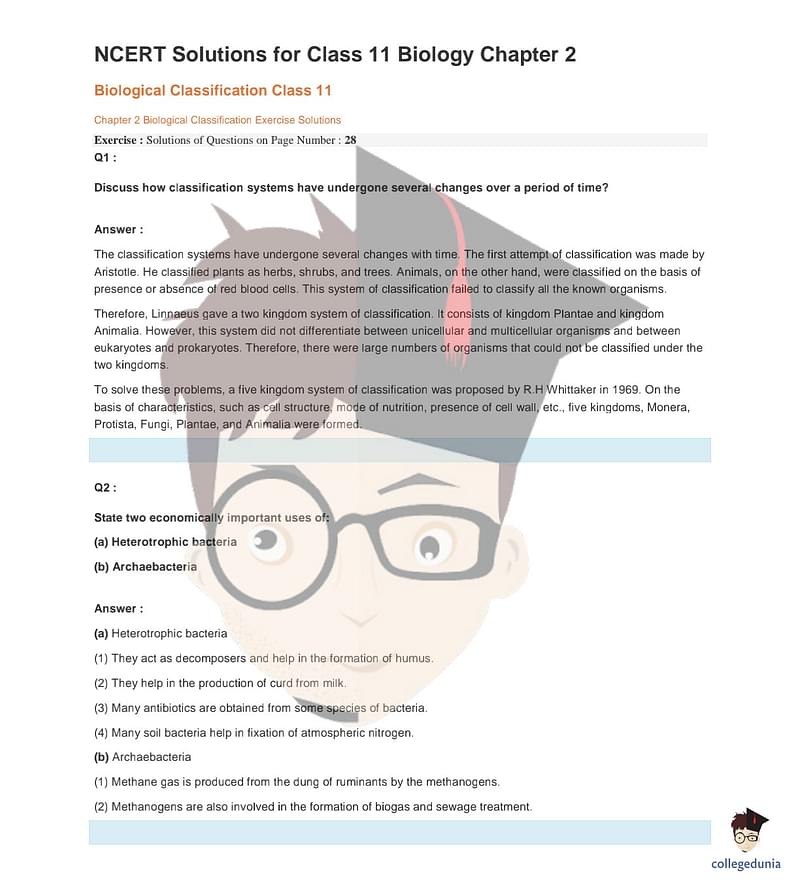
NCERT SolutionsNCERT SolutionsNCERT SolutionsNCERT SolutionsNCERT SolutionsNCERT Solutions

Class 11 Biology Chapter 2 Biological Classification: Important Topics

Biological classification is the process of identifying traits in living organisms and arranging them according to their characteristics. The study of living organism classification helps to study the common features of the group, only one or two species from each categorized category should be studied. It helps in the identification of new organisms.

  • Five Kingdom Classification

The five-kingdom classification was not the initial result of the classification of living organisms. Carolus Linnaeus was the first person to come up with a two-kingdom classification, which included only the kingdom Plantae and kingdom Animalia. Living things are divided into five kingdoms: animal, plant, fungi, protist and monera

Chapter Related Links:

Kingdom Monera Kingdom Protista Kingdom Fungi
Kingdom Plantae Kingdom Animalia Ascomycetes
Deuteromycetes Mumps Bacteriophage

CBSE Class 11 Biology Study Guides:

CBSE CLASS XII Related Questions

  • 1.
    "Early and accurate diagnosis of diseases is vital in medical technology."
    Name the conventional methods of diagnosis and their disadvantages.
    Which three diagnostic techniques have been developed through Biotechnology ? Explain how each one helps in detecting diseases.


      • 2.
        Explain any two basic principles/core techniques on which biotechnology is based.
        Describe any three key tools used in Recombinant DNA technology.


          • 3.
            What is the carrying capacity of a species in a habitat?
            Explain the growth curve that takes this capacity into account.


              • 4.
                Cow dung and water are mixed and fed into a biogas plant to allow digestion of biowastes. The person performing this process says that there is no need to provide an inoculum.
                Do you agree with him? Justify your answer.
                What happens to the biowaste inside the digester ?
                (c) Name the useful by-products obtained from this process and mention how they are used.


                  • 5.
                    In vitro fertilization (IVF) is a popular method these days that is helping childless couples to bear a child.
                    Write the different steps that are carried out in this technique.
                    Would you consider gamete intra fallopian transfer as a type of IVF? Justify your answer.


                      • 6.
                        Work out the crosses between:
                        Normal female and Haemophilic male
                        Carrier female and Normal male
                        (III) Carrier female and Haemophilic male
                        Write the conclusions you draw from these crosses. Comment on the type of inheritance of the disease.
                        (Use: $X$ - Normal, $X^h$ - Haemophilic)

                          CBSE CLASS XII Previous Year Papers

                          Comments


                          No Comments To Show
