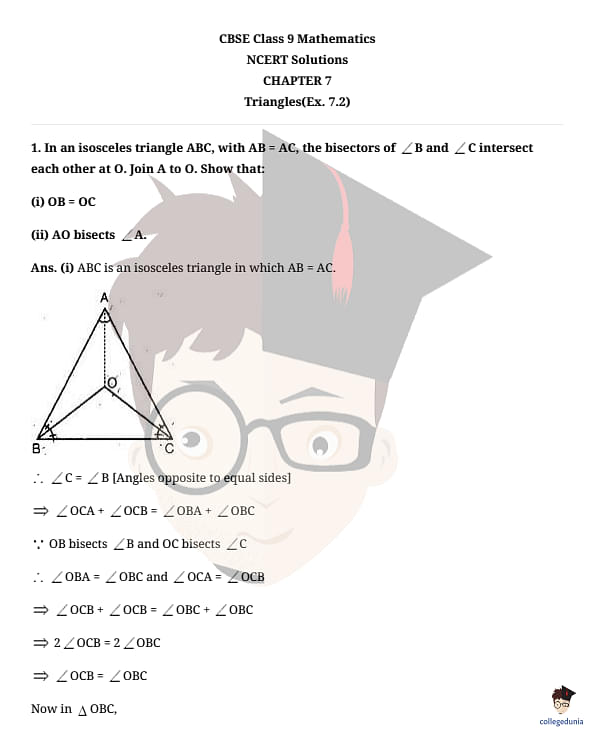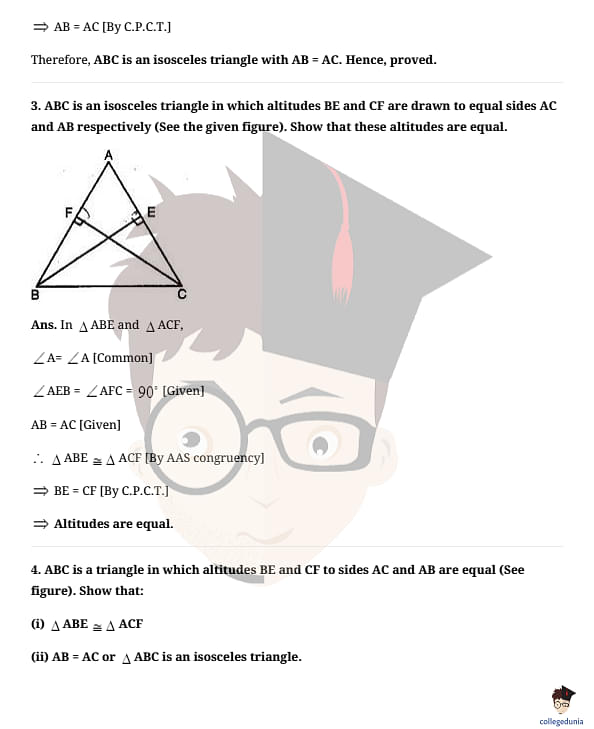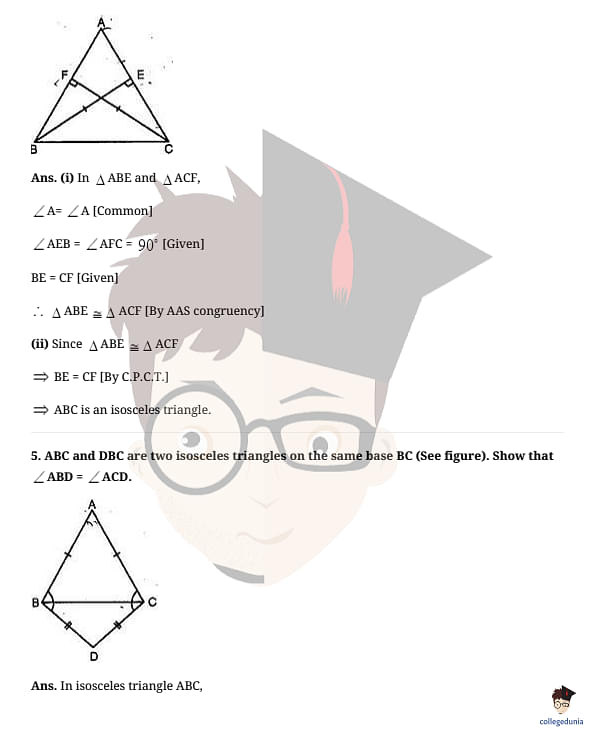

NCERT Solutions for Class 9 Maths Chapter 7 Triangles Exercise 7.2 Solutions

CBSE X Related Questions

  • 1.
    The graph of a quadratic polynomial f(x) passes through (5,0), (0, -1) and (-2, 0). The two factors of the polynomial are

      • \((x + 2), (x - 5)\)
      • \((x + 5), (x - 2)\)
      • \((x + 1), (x - 5)\)
      • \((x - 1), (x + 2)\)

    • 2.
      If \(PQ\) and \(PR\) are tangents to the circle with centre \(O\) and radius \(4 \text{ cm}\) such that \(\angle QPR = 90^{\circ}\), then the length \(OP\) is

        • \(4 \text{ cm}\)
        • \(4\sqrt{2} \text{ cm}\)
        • \(8 \text{ cm}\)
        • \(2\sqrt{2} \text{ cm}\)

      • 3.
        It is given that \(\triangle ABC \sim \triangle EDF\). Which of the following is not true?

          • \(\frac{\text{Perimeter of } \triangle ABC}{\text{Perimeter of } \triangle EDF} = \frac{AB}{ED}\)
          • \(\frac{AB}{ED} = \frac{AC}{EF}\)
          • \(\angle A = \angle D, \angle C = \angle F\)
          • \(\frac{AB + BC}{AC} = \frac{ED + DF}{EF}\)

        • 4.
          Which of the following graphs represents a polynomial with both zeroes being positive?


          • 5.
            If the zeroes of the polynomial \(p(x) = 2x^2 - 7x + 6\) are \(\alpha\) and \(\beta\), then the value of \(\frac{1}{\alpha} + \frac{1}{\beta}\) is

              • \(\frac{7}{2}\)
              • \(\frac{6}{7}\)
              • \(\frac{-7}{6}\)
              • \(\frac{7}{6}\)

            • 6.
              For an acute angle \(\theta\), if \(\sin \theta = \frac{1}{9}\), then value of \(\frac{9 \csc \theta + 1}{9 \csc \theta - 1}\) is

                • \(0\)
                • \(\frac{80}{81}\)
                • \(1\)
                • \(\frac{82}{80}\)

              Comments


              No Comments To Show