



Content Curator
Similar figures have the same shape as each other, and their corresponding angles are equal. Their corresponding sides also have lengths in the same ratio. This ratio is termed the scale factor. Similar figures are denoted with this symbol: ~. Similar figures aren’t the same as congruent figures. Congruent figures are those that have the exact same shape, angles, and lengths.
| Table of Content |
Key Takeaways: Scale factor, congruent figures, similar figures
What are Similar Figures?
[Click Here for Sample Questions]
In geometry, similar figures have the same shape as each other but they have different lengths. Their corresponding lengths are in the same ratio, and their corresponding angles are equal. Here’s an example of similar figures:
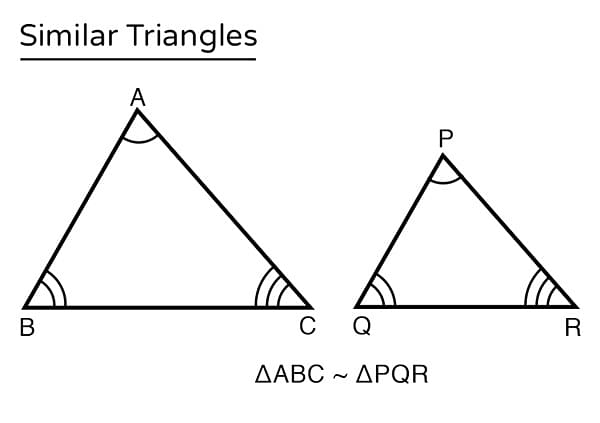
Similar Triangles
Since these two triangles are similar, they can be represented in the following manner:
\(\Delta\)ABC ~ \(\Delta\)DEF
The two triangles above are similar. The corresponding sides are:
- AC and DF
- AB and DE
- CB and FE
The ratios of the lengths of these corresponding sides are all the same:
- AC and DF; 10:15 = 2:3
- AB and DE; 6:9 = 2:3
- CB and FE; 8:12 = 2:3
This ratio will stay the same no matter how much the lengths change, given that the corresponding angles stay the same. It’s also called the scale factor.
The corresponding sides of the bigger triangle are longer than those of the smaller triangle by a scale factor of 3/2 or 1.5.
The relationship between the sides and angles of the above two triangles can be represented in the following way:
AC/DF = AB/DE = CB/FE
∠A = ∠D, ∠B = ∠E, ∠C =∠F
Also Read:
| Related Articles | ||
|---|---|---|
| Triangles | Triangle Important Question | Similarities of Triangles |
| Direction of a vector formula | Adjacency Matrix | Cross Product |
Finding Length, Area, & Volume of Similar Figures
[Click Here for Previous Year Questions]
Length, area, and volume of similar figures can be calculated using the scale factor. In order to find corresponding lengths, areas, and volumes, you just have to use the following rules:
- To find the length of a side, multiply or divide the length of the corresponding side by the scale factor.
- To find the area of a figure or a face, multiply the area of the corresponding figure or face by square of the scale factor (scale factor)2
- To find the volume of a figure, multiply the volume of its similar figure by the cube of the scale factor (scale factor)3
These rules are summarized below:
| Measure | Multiplier or Divider |
|---|---|
| Length | (scale factor) |
| Area | (scale factor)2 |
| Volume | (scale factor)3 |
Examples of Similar Figures
[Click Here for Sample Questions]
Here are 2 examples of similar figures, with the smaller ones inside the bigger ones:
- In both these diagrams, you can see that even though their sides have different lengths, all of their corresponding angles are equal.
- You can identify similar figures by checking if all their corresponding angles are equal.
Things to Remember
- Similar figures have the same shape with equal corresponding angles.
- Their sides have lengths in proportion to their corresponding sides.
- The ratio of two corresponding sides of similar figures is called scale factor.
- Scale factor can be used to calculate the length of other sides of similar figures, their area, and volume.
- The best way to point out whether two figures are similar is to check whether their corresponding angles are equal.
Also Read:
Previous Year's Questions
- If aa is a unit vector, then |a×^i|2+|a×^j|2+|a×^k|2=|a×i^|2+|a×j^|2+|a×k^|2= …….[TS EAMCET 2017]
- Let →a,→ba→,b→ & →cc→ be non-coplanar unit vectors equally inclined to one another at an acute angle θθ. Then |[→a→b→c]||[a→b→c→]| in terms of θθ is equal to…..[BITSAT 2017]
- Two vectors are given by →A=3^i+^j+3^kA→=3i^+j^+3k^ and →B=3^i+5^j−2^kB→=3i^+5j^−2k^. Find the third vector →CC→, if →A+3→B−→C=→0A→+3B→−C→=0→….[JKCET 2007]
- A constant power is supplied to a rotating disc. The relationship between the angular velocity ωω of the disc and number of rotations (n) made by the disc is governed by...[CBSE CLASS XII]
- From a point A with position vector p(^i+^j+^k)p(i^+j^+k^), AB and AC are drawn perpendicular to the….[JEE Main 2018]
- If a|(b+c)a|(b+c) and a|(b−c)a|(b−c) where a,b,c∈Na,b,c∈N then…...[KCET 2006]
- The vector equation of the symmetrical form of equation of straight line x−53=y+47=z−62x−53=y+47=z−62 is…...[VITEEE 2018]
- If a and b are vectors such that |a+b|=|a−b||a+b|=|a−b| then the angle between a and b is….[KCET 2007]
- Let →a=^i+^j+√2^k,→b=b1^i+b2^j+√2^ka→=i^+j^+2k^,b→=b1i^+b2j^+2k^ and →c=5^i+^j+√2^kc→=5i^+j^+2k^ be…..[JEE Main 2019]
- Let →a=^i−2^j+^ka→=i^−2j^+k^ and →b=^i−^j+^kb→=i^−j^+k^ be two vectors. If →cc→ is a... [JEE Main 2020]
- If →aa→ and →bb→ are non-collinear vectors, then the value of a for which the vectors …..[JEE Main 2013]
- If a unit vector →aa→ makes angles π/3π/3 with ^i,π/4i^,π/4 with ^jj^ and θ∈(0,π)θ∈(0,π) with ^kk^, then a value of θθ is : – [JEE Main 2019]
- Let u,vu,v and ww be vectors such that u+v+w=0.u+v+w=0. If |u|=3,|v|=4|u|=3,|v|=4 and |w|=5|w|=5 then u⋅v+v⋅w+w⋅uu⋅v+v⋅w+w⋅u is equal to….[KEAM]
- If the scalar product of the vector ˆi+ˆj+2ˆk with the unit vector along mˆi+2ˆj+3ˆk is equal to 2, then one of the values of m is...[KEAM]
- Let A(1,−1,2)A(1,−1,2) and B(2,3,−1)B(2,3,−1) be two points. If a point PP divides ABAB internally in the ratio 2:3,2:3, then the position vector of PP is...[KEAM]
- The vectors of magnitude a,2a,3aa,2a,3a meet at a point and their directions are along the diagonals of three adjacent faces of a cube. Then, the magnitude of their resultant is...[KEAM]
- If →a, →b, →ca→, b→, c→ are non-coplanar and (→a+λ→b).[(→b+3→c)×(→c×4→a)]=0,(a→+λb→).[(b→+3c→)×(c→×4a→)]=0, then the value of λλ is equal to...[KEAM]
- If the direction cosines of a vector of magnitude 33 are 23,−a3,23,a>0,23,−a3,23,a>0, then the vector is….[KEAM]
- If λ(3^i+2^j−6^k)λ(3i^+2j^−6k^) is a unit vector, then the values of λλ are….[KEAM]
- If the projection of the vector →aa→ on →bb→ is →aa→ on →bb→ is |→a×→b||a→×b→| and if 3→b=→i+→j+→k,3b→=i→+j→+k→, then the angle between →aa→ and →bb→ is…..[KEAM]
Sample Questions
Ques 1: The hexagon below has an area of 60 cm2. It is enlarged by a scale factor of 3. What is its new area? [2 marks]

Ans:
New area = 60 x (scale factor)2
New area = 60 x (3)2
New area = 60 x 9
New area = 540 cm2
Ques 2: The 2 rectangles below are similar. How many times is the area of rectangle B than the area of rectangle A? [2 marks]

Ans: Area of similar figures can be found by multiplying or dividing the known area by the square of its scale factor, or (scale factor)2 .
Scale factor = 24/6 = 8/2 = 4
Number of times the area of triangle B is greater than A = 42 = 16
Ques 3: The two triangles shown below are similar. Find the length of the missing side. [2 marks]

Ans: The length of the missing side can be found by finding the common ratio of the sides, or the scale factor.
Scale factor = 24/8 = 18/6 = 3
Length of missing side = 21/3 = 7 m
Ques 6: In the diagram below, triangle GFE is similar to triangle CBE. Find the value of x. [3 marks]

Ans: Since GFE ~ CBE, the proportions of the sides would be:
GF/CB = FE/BE = GE/CE
We know the values of FE, BE, GE, and EC. They can be inserted into the above equation:
(4x -1)/ (x + 5) = 60/24 = 5/2
Use cross multiplication to find the value of x
2(4x-1) = 5(x+5)
8x - 5x = 25 + 2
3x = 27
x = 9
Ques 8: Are the following figures similar? [2 mark]
Ans: Similar figures have all corresponding angles being equal. In this case, the corresponding angles are equal : ∠E = ∠R, ∠F = ∠S, ∠D = ∠Q
So yes, the above figures are similar.
For Latest Updates on Upcoming Board Exams, Click Here: https://t.me/class_10_12_board_updates
Also Check:



Comments