



Education Content Expert
Alternate Interior Angles are the pair of angles formed when two coplanar lines are intersected by a transversal. These angles are formed on the inner corners of the intersections and lie on the opposite sides of the transversal. On the intersection of two parallel lines by a transversal, eight angles are formed. In these eight angles, the angles that lie on the inner side of the parallel lines but on the opposite sides of the transversal are called the alternate interior angles. Alternate Interior angles represent whether the two given lines are parallel to each other or not. If alternate interior angles are equal to each other, then, the lines intersected by the transversal are parallel.
Read More: NCERT Solutions for Class 9 Maths Lines and Angles
| Table of Content |
Key Terms: Alternate Interior Angles, Transversal, Parallel Lines, Angles, Co-Interior Angles, Corresponding Angles, Alternate Interior Angles Theorem
What are Alternate Interior Angles?
[Click Here for Sample Questions]
Alternate Interior Angles are formed when a transversal passes through two parallel or non-parallel lines. When two parallel lines are intersected by a transversal, the pair of angles that are formed on the inner side of the parallel lines, but on the opposite sides of the transversal are referred to as the alternate interior angles. Alternate Interior Angles are always equal.
Given below is a figure in which two parallel lines are intersected by a transversal. Here AB and CD are the two parallel lines that are crossed by a transversal.
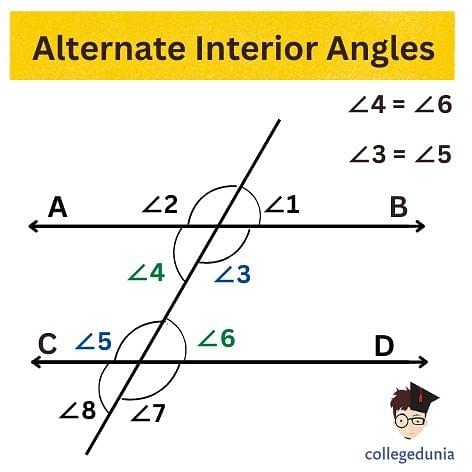
Alternate Interior Angles
The pairs of alternate interior angles in the figure are:
- ∠4 and ∠6
- ∠3 and ∠5
As alternate interior angles are equal, so,
- ∠4 = ∠6
- ∠3 = ∠5
Read More:
| Related Topics | ||
|---|---|---|
| Alternate Angles | Linear Pair of Angles | Properties of Parallel Lines |
| Linear Pair Axiom | Angle between Two Lines | Types of Angle |
Properties of Alternate Interior Angles
[Click Here for Sample Questions]
Here are a few important properties of alternate interior angles:
- Alternate Interior angles are always congruent to each other.
- The sum of the angles that are formed on the same side of the transversal which are inside the two parallel lines is always equal to 180°.
- Alternate interior angles do not have any specific properties in the case of non-parallel lines.
Alternate Interior Angles Theorem and Proof
[Click Here for Sample Questions]
According to the Alternate Interior Angles Theorem “If a transversal crosses the set of parallel lines, then the alternate interior angles are congruent to each other”.
Given: Line l is parallel to Line m.
To Prove: ∠4 = ∠5 and ∠3 = ∠6
Proof: Let line l and line m be two parallel lines and n is the transversal that intersects parallel lines l and m at points P and Q. The figure for the same is given as:

From the properties of the parallel lines, we know that if a transversal cuts any two parallel lines, then the corresponding angles and vertically opposite angles are always equal to each other. Therefore, it can be said that
∠2 = ∠5 ……….. (1) (Corresponding angles)
∠2 = ∠4 ……….. (2) (Vertically Opposite Angles)
From equations (1) and (2), we get
∠4 = ∠5
Similarly, we can say that,
∠3 = ∠6
Hence Proved.
Read More: Exterior Angle Theorem
Converse of Alternate Interior Angles Theorem
[Click Here for Sample Questions]
According to the Antithesis of the Alternate Interior Angle Theorem, “If the alternate interior angles produced by the transversal line on two coplanar are congruent, then the two lines are considered to be parallel to each other.”
Given: ∠4 = ∠5 and ∠3 = ∠6
To Prove: Line l is parallel to Line m (l || m)
Proof: Consider the figure given below:
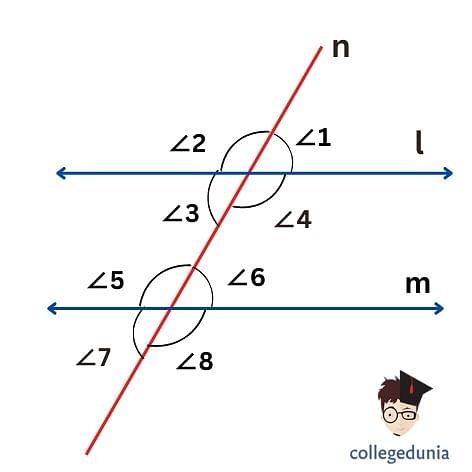
We know that,
∠2 = ∠4 (Vertically Opposite Angles)
So, we can write that
∠2 = ∠5, (Corresponding Angles)
Therefore, we can say that Line l is parallel to Line m.
Read More: Lines and Angles MCQs
How to Find the Alternate Interior Angles?
[Click Here for Sample Questions]
The alternate interior angles theorem states that the alternate interior angles of two parallel lines are equal. We can find alternate interior angles using this theorem.
Example: The following figure shows a map in which Street 1 runs perpendicular to Street 2 and Street 3, which are parallel. Another street named Street 4 makes an angle of 40° with Street 2. Find the measure of angle x.

Going with the alternate interior angles theorem, if the lines (parallel streets) are parallel, and Street 4 is considered to be the transversal, then x and 40° are the alternate interior angles. So, both these angles are equal.
Therefore, x = 40°
Solved Examples on Alternate Interior Angles
Example 1: What will be the value of B and D in the given figure? (3 Marks)
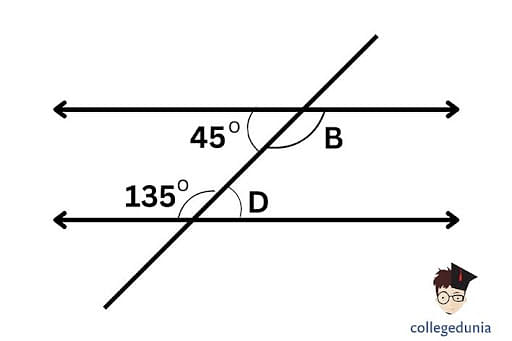
Solution: In the given figure,
45° and D are alternate interior angles, thus, both of them are congruent.
So, D = 45°
Similarly, 135° and B are also alternate interior angles, so, they are congruent.
So, B = 135°
Thus, the value of B and D in the given figure is 135° and 45° respectively.
Example 2: What will be the value of the missing angles A, C, and D in the following figure?
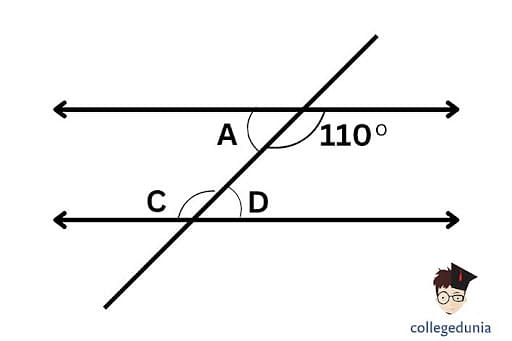
Solution: From the given figure, we can clearly see that
∠A, 110°, ∠C and ∠D are all alternate interior angles. Thus,
∠C = 110°
We know that,
∠C+∠D = 180° (Supplementary Angles)
∠D = 180° – ∠C = 180° – 110° = 70°
Now, ∠A = ∠D (Alternate Interior Angles)
∠A = 70°
Read More: Lines and Angles Important Questions
Alternate Exterior Angles
[Click Here for Sample Questions]
Alternate Exterior Angles are defined as those angles that have different vertices and lie on the alternate sides of the transversal and are exterior to the lines. In simpler terms, when a transversal intersects two parallel lines, the alternate exterior angles formed are always equal.
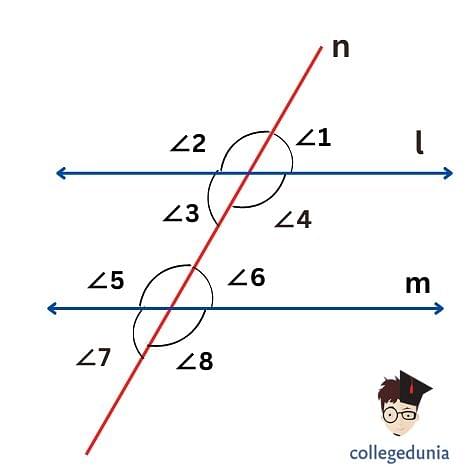
In the given figure, ∠1 & ∠7 and ∠2 & ∠8 are the pairs of alternate exterior angles.
Co-interior Angles
[Click Here for Sample Questions]
Co-interior angles are two angles that lie on the same side of the transversal. They are the interior angles that sum up to 180 degrees. It can be said that the sum of two interior angles, which are on the same side of the transversal is supplementary. Co-interior angles are also known as consecutive interior angles or the same side interior angles.
- Co-interior angles have different vertices but they lie on the same side of the transversal.
- Co-interior angles lie between two parallel or non-parallel lines.
- They are non-adjacent angles.
- The sum of co-interior angles formed is always 180 degrees.
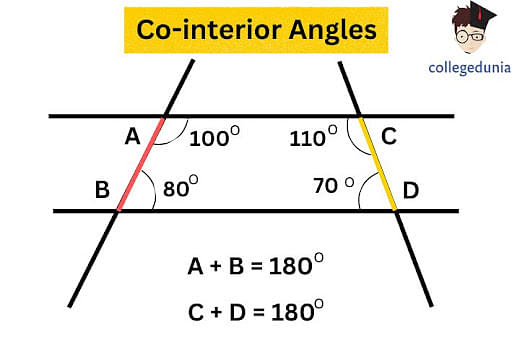
Co-interior Angles
Read More:
Things to Remember
- Alternate interior angles are the angles that are formed by a transversal intersecting two parallel or non-parallel lines.
- They lie on the inner side of the two parallel lines but on the opposite sides of the transversal.
- Each pair of alternate interior angles is congruent, i.e, they are equal.
- The Alternate Interior Angle Theorem states that “ if a transversal intersects the set of parallel lines, the alternate interior angles are congruent”.
- The converse of the alternate interior angle theorem states that “if the alternate interior angles produced by the transversal are congruent, then the two lines are parallel.”
Sample Questions
Ques. What is a transversal? (3 Marks)
Ans. Transversal refers to the line that crosses or passes through two or more other lines. At times, the two other two or three lines are parallel, and sometimes the transversal passes through all these lines at the same angle. However, it is not necessary for the other lines to be parallel in order for a transversal to cross them. When a transversal intersects with two lines, it produces various types of angles in pairs, such as consecutive interior angles, corresponding angles, and alternate angles.
Ques. Calculate the value of x from the given below figure. Also, find the values of the two alternate interior angles. (3 Marks)
Ans. As we know that alternate interior angles are congruent.
So, 4x – 19 = 3x + 16 (Alternate Interior Angles)
4x – 3x = 19+16
x = 35
Now, substituting the value of x in both the interior angles equation, we get,
(4x – 19)° = 4 x 35 – 19 = 121°
(3x + 16)° = 3 x 35 + 16 = 121°
Thus, the value of the two alternate interior angles is 121°
Ques. What is meant by a straight angle? (3 Marks)
Ans. A straight angle is defined as an angle that is formed by a straight line. A straight angle is also known as a flat angle. The measure of a straight angle is equal to 180 degrees. In simpler terms. A straight angle is an angle whose sides lie in opposite directions from the vertex in the same straight line. This type of angle can also be formed by two or more angles which gives 180 degrees on addition.
Ques. If two alternate interior angles are given as A = 3x + 5° and B = 2x – 2°. What will be the value of x and the angles? (3 Marks)
Ans. Given that,
A = 3x + 5°
B = 2x -2°
Since alternate interior angles are equal,
A= B
3x + 5° = 2x – 2°
3x - 2x = -2 +5
x = 3
Value of A = 3x + 5° = 3 x 3 + 5 = 9+5 = 16°
As A = B (Alternate Interior Angles)
B = 16°
Ques. Define Parallel Lines. (3 Marks)
Ans. Parallel lines refer to any two lines on a two-dimensional plane that never meet or cross each other. These lines do not have a common intersection point. Parallel lines are equidistant from each other. The symbol for parallel lines is ‘||’. Some specific or special properties about the angles which are formed when a transversal passes through parallel lines are not applicable when the lines are not parallel.
Ques. What are Co-interior Angles? (3 Marks)
Ans. Co-interior angles are the two angles that are on the same side of the transversal. They are also known as Consecutive interior angles or the same side interior angles. The sum of the co-interior angles is 180 degrees. It means that the co-interior angles are supplementary. Co-interior angles are not equal to each other.
Ques. What does the converse of the alternate interior angle theorem say? (2 Marks)
Ans. The converse of the alternate interior angle theorem states that “If the alternate interior angles produced by the transversal line on two coplanar are congruent to each other, then the two lines are parallel to each other”.
Ques. List the properties of alternate interior angles. (3 Marks)
Ans. The properties of alternate interior angles are as follows:
- Alternate interior angles are congruent.
- Alternate interior angles have no geometric relation with each other in the case of non-parallel lines.
- Alternate interior angles are supplementary if the transversal intersects two parallel lines at right angles.
Ques. What are the two types of alternate angles in Geometry? (3 Marks)
Ans. There are two types of alternate angles in Geometry:
- Alternate Interior Angles: The pair of angles that are formed on the inner side of the two parallel lines but on the opposite side of the transversal are known as the alternate interior angles.
- Alternate Exterior Angles: The pair of angles that are formed on the outer side of the parallel lines but on the opposite side of the transversal are called alternate exterior angles.
Ques. What are the applications of alternate interior angles? (3 Marks)
Ans. Here are a few most common applications of alternate interior angles:
The most popular application of alternate interior angles is by a famous Greek scientific writer, Eratosthenes, who used alternate interior angles to prove that the earth is round.
- Windows that have panes divided by mun-tins have alternate interior angles.
- In a letter Z, the top and bottom horizontal lines are parallel and the diagonal line is taken as the transversal. Thus, there are two alternate interior angles in the letter Z.
Read More:



Comments