



Content Curator
Triangle is a simple closed two-dimensional figure with three-line segments. There are diverse ways to construct a triangle. If the three sides are given, a triangle can be easily constructed. Likewise, the construction of a triangle can also be done when two sides and one included angle is given or when two angles and one included side is given.
Read Also: Lines and Angles
| Table of Content |
Key Takeaways: Triangle, Perimeter, Angles, Constructing triangles, Polygons
Triangle
[Click Here for Sample Questions]
A triangle is a simple two-dimensional polygon that is created by three-line segments. In geometry, any three points, specifically non-collinear, when joined, form a unique triangle and. The basic features of the triangle are sides, angles, and vertices.
Perimeter
[Click Here for Sample Questions]
The term perimeter can be known as the path surroundings an area. It is the total length of the sides or edges of a polygon, a two-dimensional figure with angles. In the case of a triangle, Perimeter is the sum of the three sides.
Check Important Notes for Practical Geometry
Constructing Triangle with Perimeter and Two Angles
[Click Here for Sample Questions]
Requirements: A pencil, a ruler, a protractor and a compass.
Steps: Steps are as follows:
- Step 1: Aline segment/base equal to the perimeter is drawn.
- Step 2: From point X a ray at one of the given base angles is drawn. From point Y another ray at second base angles is drawn.

From points, X and Y rays on the given base angles are drawn
- Step 3: Angle bisectors of X and Y are drawn. These two angle bisectors intersect each other at point A.

Angle bisectors of X and Y are drawn and they intersect each other at point A
- Step 4: Lines bisecting XA and AY respectively are drawn. These two-line bisectors intersect XY at points B and C respectively.
- Step 5: Points A to B and A to C, are joined.
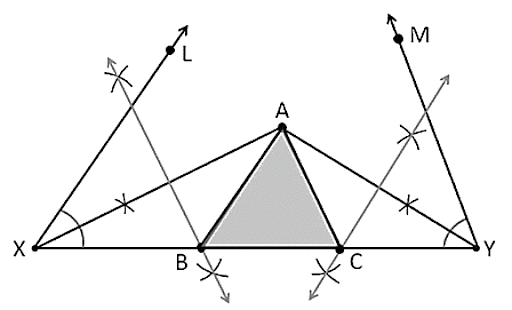
- Step 6: Triangle ABC is our required triangle.
Read More: Perimeter and Area
Points to Remember
[Click Here for Sample Questions]
Following are some important points:
- The perimeter of a triangle is the total distance around the outside of a closed 2D shape per area, which can be obtained by adding the length of each side.
- The addition of the three angles of a triangle is always 180°. Additionally, the summations of the lengths of any two sides of a triangle are always greater than that of the third side of the triangle.
- We can make infinite similar triangles using three angles with a total of 180 degrees
- A median in a triangle joins one vertex of the triangle to the midpoint of the line segment opposite to it.
- The mathematical term "perimeter" is derived from two Greek words, “peri” which means around, and “meter/matron” which means measure.
Sample Questions
Ques: Construct a triangle ABC with a perimeter of 12 cm and base angles 50º and 80º. (4 Marks)
Ans: Steps for construction:
- Draw a line segment PQ=AB+BC+CA=12cm.
- Make ∠LPQ=50 and ∠MQP=80.
- Now bisect ∠LPQ and ∠MQP such that their bisection meets at A.
- Draw perpendicular bisectors of AP and AQ as XY and ST intersecting PQ at B and C respectively.
- Join AB and AC.
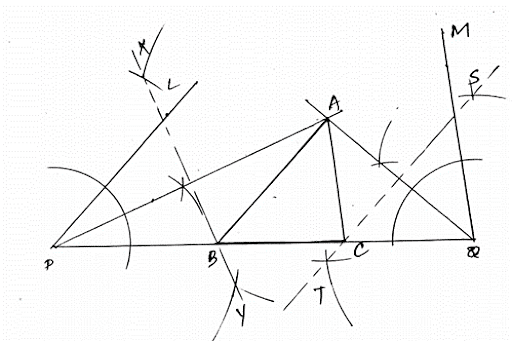
Ques: Construct a triangle ABC whose perimeter is 12cm and whose base angles are 65º and 85º. (4 Marks)
Ans: Steps for construction:
- Draw a line segment PQ=AB+BC+CA=12cm
- Mark ∠LPQ=650 and ∠MQP=800
- Now bisect ∠LPQ and ∠MQP such that their bisector meets at A
- Draw a perpendicular bisector of AP and AQ i.e XY and ST intersecting PQ at B and C respectively.
- Join AB and AC.

Ques: A triangle ABC, AB +BC + CA = 15 cm, ∠B = 55° and ∠C = 60° is given. Draw a triangle ABC with given parameters. (4 Marks)
Ans: Given in question, Perimeter= AB + BC + CA = 15 cm; ∠B = 55° and ∠C = 60°
The steps of construction are:
- A line segment XY of length 15 cm (AB + AC + BC), is drawn.
- From point X, ∠LXY measuring 550 is drawn, which is equal to ∠B.
- From the other point Y, ∠MYX of 600 is drawn, which is equal to ∠C.
- The bisectors of ∠LXY and ∠MYX is drawn using compass. The point intersection of these bisectors is marked as A.

- A perpendicular bisector of AX is drawn and named PQ.
- Another perpendicular bisector of AY is drawn and named RS.
- Point of intersection of PQ and XY is B and that of RS and XY is C.
- The points A and B as well as A and C are joined.

- ABC is our required triangle with the given parameters.
Ques: Construct a triangle whose perimeter is 9.8 cm and whose base angles are 45º and 60º. (4 Marks)
Ans: Steps for construction:
- Draw a line PQ such that PQ=AB+BC+AC=9.8 cm.
- Construct angle P=60º and angle Q=45º.
- Bisect both angles. Let the angle bisectors meet at A.
- Join A−P and A−Q.
- Draw perpendicular bisectors of AP and AQ.
- The perpendicular bisector of AP meets PQ at B and that of AQ at C.
- Join A−B and A−C.
- ABC is the required triangle.

Ques: Construct a triangle XYZ when perimeter is 15cm and base angles are 60º and 70º. (4 Marks)
Ans: Steps for construction:
- Draw a line segment PQ=XY+YZ+XZ=15cm.
- Make ∠LPQ=60º and ∠MQP=70º.
- Now bisect ∠LPQ and ∠MQP such that their bisection meets at X.
- Draw perpendicular bisectors of XP and XQ as AB and CD intersecting PQ at Y and Z respectively.
- Join XY and XZ.
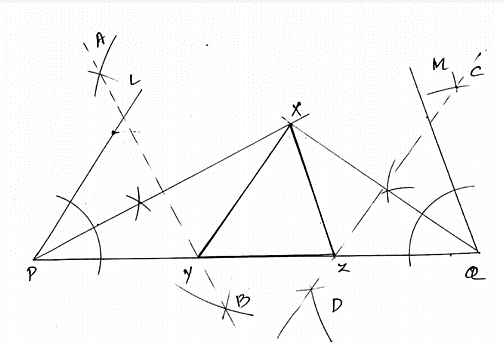
Ques: Draw a triangle ABC, whose perimeter is 12cm and whose sides are in the ratio 3:4:5. (4 Marks)
Ans: Steps of construction:
- Draw a line segment XY with length 12cm.
- Taking an acute angle with XY, draw a ray XZ in the downward direction.
- From X, find (3+4+5) =12 points at distances along XZ.
- Spot point L, M, N on XZ such that XL=3 parts, LM=4 parts and MN=5 parts.
- Join N and Y. Through points L and M, LBY and MCY are drawn, joining the line XY at points B and C respectively.
- With B taken as centre and BX as radius, draw an arc; then with C as a centre and CY as radius, draw an arc intersecting the previous arc at point A.
- Join AB and AC.
- ABC is our required triangle.

Ques: Construct triangle LMN, where base MN=5cm, <LMN=75º and LM+LN=9cm. (4 Marks)
Ans: Steps for construction:
- Draw MN=5 cm.
- Construct ∠M=75º and produce it to Y.
- Cut off line segment MO=9 cm on MY.
- Join N−O.
- Draw a perpendicular bisector of NO such that it intersects MY at L.
- Join L−N.
- LMN is the required triangle.

Ques: Construct triangle ABC, where BC=6cm, angle A=45º, Median AD=5cm. (4 Marks)
Ans: Steps of Construction:
- Draw a line segment BC=6 cm
- Make an angle PCB = 45º with the help of a protractor
- Draw the perpendicular bisector RQ of AB
- Draw BE⊥BP at B
- Let RQ and BE intersect at O
- Draw the circle with centre O and radius OB
- Then any angle in the major segment = ∠PBC=45º.
- Let RQ intersect BC to D is the midpoint of BC. Taking D as centre and 5 cm radius draw arcs intersecting the circle in A, A′.
- Join AB, AC and A′B, A′C.
- Then the required triangle is ABC or A′BC.

Ques: Construct triangle ABC, where AB=5.5cm, AC=6cm, angle BAX=105º.FInc the locus equidistant from BA and BC. (4 Marks)
Ans: Steps for construction:
- Draw a line segment AB of length 5.5 cm.
- Make an angle BAX = 105° using a protractor
- Draw an arc AC with radius AC = 6 cm on AX with centre at A.
- Join BC.
- Thus, ABC is the required triangle.
- Draw BR, the bisector of ABC, which is the locus of points equidistant from BA and BC.
- Draw MN, the perpendicular bisector of BC, which is the locus of points equidistant from B and C.
- The angle bisector of ABC and the perpendicular bisector of BC meet at point P.
- Thus, P satisfies the above two loci.
- Length of PC = 4.8 cm

Ques: Construct triangle XYZ, where Y=30o, Z= 90o, XY+YZ+ZX= 11cm. (4 Marks)
Ans: Steps for construction:
- Draw a line segment AB of 11 cm
- Construct 30° from A and 90° from B
- Construct angle bisectors for both the angles
- They will meet at X
- Draw perpendicular line bisectors for AX and BX.
- Both lines will meet AB at X and Y
- Join XY and XZ
- XYZ is our required triangle.



Comments