



Content Curator
Pisces is a category of organisms that includes all types of fish. Pisces are vertebrates. They have specific organs for processes such as blood circulation, excretion, respiration, locomotion, etc. Pisces cannot regulate their body temperatures and are cold-blooded organisms. For the purpose of easy identification organisms on the earth are classified into a kingdom, phylum, class, family, genus, etc.
| Table of Content |
Keyterms: Pisces, Vertebrates, Blood circulation, Excretion, Respiration, Locomotion, Phylum, Genus, Fish, Poikilotherms
Pisces
[Click Here for Sample Questions]
Pisces is a category of organisms that includes all types of fish. Pisces are vertebrates. They have specific organs for processes such as blood circulation, excretion, respiration, locomotion, etc. Pisces are poikilotherms. They do not have the ability to regulate their own body temperature.
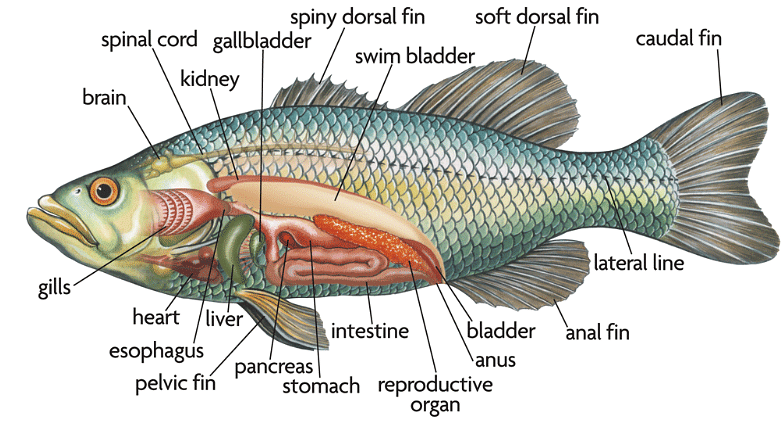
Pisces Anatomy
Read More:
Hierarchy Of Pisces
[Click Here for Sample Questions]
The hierarchy of Pisces is as follows:
Kingdom: Animalia
Phylum: Chordata
Class: Pisces
Also Read: Difference between Osteichthyes and Chondrichthyes
Characteristics Of Pisces
[Click Here for Sample Questions]
Some common characteristics of Pisces are:
- Pisces are aquatic organisms. They can be found in freshwater as well as saltwater.
- Pisces can be herbivorous or carnivorous.
- Pisces are vertebrates.
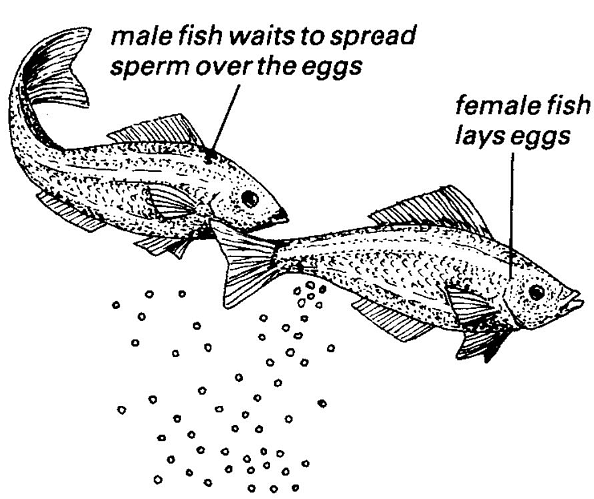
- Pisces can be oviparous or ovoviviparous.
- The bodies of Pisces are classified into three parts: head, tail, and trunk.
- Pisces have a streamlined body. Some Pisces have elongated or spindle-shaped bodies.
- Pisces use their tail for locomotion underwater. Their tails are usually muscular.
- The skin of Pisces is covered in scales.
- Pisces intake oxygen dissolved in water through their gills. They help in respiration.
- Pisces have unpaired and paired fins which appendages. These fins help the Pisces to maintain balance while swimming.
- Pisces can sense the disturbances and vibrations around them through the lateral line system. It functions as a sensory organ.
- Pisces have closed-type blood circulation.
- Pisces have an internal skeleton that is cartilaginous or bony.
- Pisces have separate male and female sexes.
- Pisces can fertilize their eggs internally or externally.
Pisces Reproduction
- Pisces do not have extraembryonic membranes.
- Pisces have a well-developed digestive system.
- Pisces have a nervous system comprising the ten pairs of cranial nerves and the brain.
- Pisces are cold-blooded organisms.
- Pisces have two heart chambers.
- Pisces have well-developed skulls.
- Pisces do not have ear ossicles or tympanic cavities.
- Pisces have internal ears. They have three canals that are semi-circular in shape.
- Pisces have direct development. They do not undergo metamorphosis.
Read More:
Classification Of Pisces
[Click Here for Sample Questions]
[Click Here for Sample Questions]
There are a large number of animals belonging to the class Pisces. Categorizing each of them into a small number of categories is difficult. That is why several researchers and scientists have classified Pisces into various categories. J. Muller classified Pisces into six subclasses such as:
- Dipnoi
- Teleostei
- Ganoidei
- Elasmobranchii
- Marsipo Brachii (Cyclostomi)
- Leptocardii (Amphioxini)
But the most commonly accepted classification of Pisces is where Pisces is further classified into three categories such as:
- Placodermi (Aphstohyoids)
- Osteichthyes
Chondrichthyes
The characteristics of Chondrichthyes are:
Found in: Marine Environment
Exoskeleton: Placoid scales
Endoskeleton: Cartilaginous
Jaw suspension: Amphistylic
Respiratory organs: Gills
Caudal fin: Heterocercal
Reproductive organs (in males): Claspers
Air-bladders: Absent
Sub-classes: Selachi and Brady Odonti
Examples: Heteroloatas, Scoliodon, etc.

Chondrichthyes Anatomy
Read More:
| Difference between bony fish and cartilaginous fish | Phylum Chordata |
| Biological Classification | Difference Between Chordates and Non-Chordates |
Placodermi (Aphstohyoids)
The characteristics of Placodermi (Aphstohyoids) are:
Exoskeleton: Shields
Endoskeleton: Bony
Jaw suspension: Autodiastylic
Caudal fin: Heterocercal
Survival status: Extinct
Survival period: End of the Devonian period
Examples: Climatius, Bothriolepis, etc

Placodermi
Read More:
Osteichthyes
The characteristics of Osteichthyes are:
Found in: Marine environment, brackish water, or freshwater
Endoskeleton: Bony
Jaw suspension: Autostylic
Respiratory organs: Gills covered in the operculum
Reproductive organs (in males): Absent
Air-bladders: Present
Sub-classes: Crossopterygii and Actinopterygii
Examples: Protopterus, Lepidosiren, etc.

Osteichthyes
Read More: Difference between Aestivation and Hibernation
Things to Remember
[Click Here for Sample Questions]
- Pisces is a category of organisms that includes all types of fish.
- Pisces belong to the kingdom Animalia and phylum Chordata.
- Pisces have distinct characteristics that set them apart from other organisms.
- Pisces are classified into three categories viz. Chondrichthyes, Placodermi (Aphstohyoids), and Osteichthyes.
Read More:
Sample Questions
Ques. What are Pisces? [3 Marks]
Ans. Organisms are classified according to their hierarchy. All the fishes in the environment are classified as Pisces. Pisces is a class of animals that comes under the phylum Chordata. All Pisces are poikilotherms i.e. they are unable to regulate their own body temperature.
Ques. Give the hierarchy of Pisces. [3 Marks]
Ans. Pisces belong to the kingdom Animalia. In kingdom Animalia, the phylum Chordata is present. Pisces comes under the phylum Chordata. Pisces itself is a class of animals.
Ques. Explain the Osteichthyes category of Pisces. [4 Marks]
Ans. Osteichthyes is a category of the class Pisces. Osteichthyes are found in marine environments, brackish water, or freshwater. Their endoskeleton is bony. Their jaw suspension is autostylic. Their respiratory organs are gills that are covered in the operculum. The reproductive organs, claspers, in males are absent. Their air-bladders are present. Chondrichthyes are classified into two sub-classes viz. Crossopterygii and Actinopterygii. Examples of Osteichthyes are Proptopterus, Lepidosiren, etc.
Ques. What are the major characteristics of Pisces? [5 Marks]
Ans. The major characteristics of Pisces are:
- They are aquatic organisms.
- They are vertebrates.
- They can be herbivorous or carnivorous.
- They can be oviparous or ovoviviparous.
- They are cold-blooded organisms.
- Their skin is covered in scales.
- They have well-developed skulls.
- They have an internal skeleton that is cartilaginous or bony.
- They have closed-type blood circulation.
- Their bodies are classified into three parts viz. head, tail, and trunk.
Ques. Give examples of organisms that belong to the class Pisces. [3 Marks]
Ans. Organisms that belong to the class Pisces are Heteroloatas, Scoliodon, Climatius, Bothriolepis, Proptopterus, Lepidosiren, etc.
Ques. How are Pisces categorized further? [3 Marks]
Ans. Pisces are further classified into three categories. These categories are Chondrichthyes, Placodermi (Aphstohyoids), and Osteichthyes. Each of these categories has its distinctive features. One can tell an organism belongs to which category of Pisces if they are aware of the characteristics that each category possesses.
Ques. What are Chondrichthyes? [4 Marks]
Ans. Chondrichthyes is a subclass of the class Pisces. Chondrichthyes are found in marine environments. Their exoskeleton has placoid scales. Their endoskeleton is cartilaginous. Their jaw suspension is amphistylic. Their respiratory organs are gills. Their caudal fin is heterocercal. The reproductive organs, in males, are claspers. Their air-bladders are absent. Chondrichthyes are classified into two sub-classes viz. Selachii and Bradyodonti. Examples of Chondrichthyes are Heteroloatas, Scoliodon, etc.
Ques. Which other classes belong to the same phylum as Pisces? [3 Marks]
Ans. Pisces belongs to the phylum Chordata. Other classes in phylum Chordata are Class Mammalia, Class Amphibia, and Class Reptilia.
Also Read:



Comments