



Education Journalist | Study Abroad Lead
Polarization formula is calculated by considering the waveform of physical phenomena such as light or electromagnetism. In case of electromagnetism polarization refers to the direction of electric flux lines in an electromagnetic field. And in case of light waves Waves with the same direction of vibration for all waves.
- Polarization differs between transverse and longitudinal waves.
- Polarization depends on the refractive index (µ) of a material.
- The degree of polarization is dependent on the material and the angle at which the light is reflected.
Read More: Coherent and Incoherent Addition of Waves
| Table of Content |
Key Terms: Polarization, Electromagnetic Wave, Light Wave, Polarized light, Transverse wave.
What is Polarization?
[Click Here for Sample Questions]
Polarization is a property of transverse waves determining the direction of wave oscillations which is perpendicular to the direction of wave motion. Such polarization property is also observed in electromagnetic waves as they have wave nature too. For optics, polarization is the property in which the light waves are vibrating along a single plane.
- Polarization is observed in transverse waves, in which all points on a wave oscillate along the right angle to the wave motion.
- The process of transforming unpolarized light into polarized light is called polarization.
- An unpolarized light can be polarized by Transmission, Reflection, Refraction and Scattering.
- In sunglasses, 3D movies and infrared spectroscopy polarization of light is used.
Read More: Wave Optics
Polarization of Waves
[Click Here for Sample Questions]
The vibration direction of the lighting material is the cause of light polarization. Natural light is uniform wave vibrations in all directions. As a result, natural light lacks polarization and is classified as a non-polarized Electromagnetic wave.
- The electric field's force lines are perpendicular to the magnetic field's.
- The polarization of an electromagnetic wave is determined by the direction of the electric field.
- There are two types of polarization – linear and circular polarization.
- In linear polarization waves can be thought of as vibrating in one plane.
- In circular polarization with each cycle of energy, electric lines of force rotate 360 degrees.
- There’s one more kind of polarization called elliptical polarization, a mixture of both linear and vertical polarization.
Also Read:
Formula of Polarization
[Click Here for Sample Questions]
The formula of polarization can be derived from the law of Brewster’s angle. This law establishes that the maximum polarization of a light ray can be obtained by allowing that ray to fall on a transparent material surface so that the refracted ray forms a 90° angle with the reflected ray. Brewster’s law is used in modern lasers to make the reflections at the laser cavity's mirror surfaces produce linearly polarized light.
- Brewster’s angle can be expressed as the tangent inverse form of the ratio between initial and final medium’s refractive index.
- It neither has any unit nor has any dimension.
- The angle is denoted by the symbol “θ”.
The mathematical form of the equation will be– tan θ = n2/n1
Here, θ is the Brewster’s angle, n1 is the refractive index of media 1 and n2 is the refractive index of media 2.
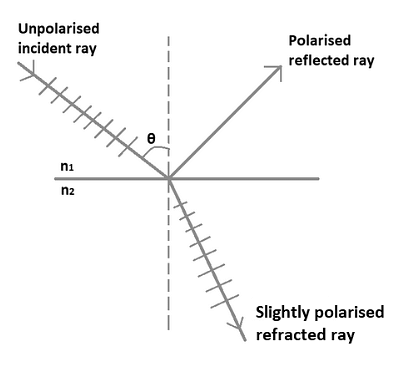
Formula of Polarization
Read More: Huygens Principle
Things to Remember
- Polarization is a transverse wave feature that determines the direction of wave oscillations that is perpendicular to the direction of wave motion.
- Transforming unpolarized light into polarized light is called polarization.
- The electric field's force lines are perpendicular to the magnetic field's.
- There are two types of polarization – linear and circular polarization.
- Brewster’s angle can be expressed as the tangent inverse form of the ratio between initial and final medium’s refractive index.
- The mathematical form of polarization formula is– tan θ = n2/n1. Here, θ is the Brewster’s angle, n1 is the refractive index of media 1 and n2 is the refractive index of media 2.
Sample Questions
Ques: Calculate the polarization angle if the refractive index of initial and final media are 1.671 and 1.261. (2 Marks)
Ans: From the above problem, the refractive index of fist media (n1) is n1 = 1.671
And the refractive index of second media (n2) is n2 = 1.261
So, according to the formula of polarization – tan θ = n2/n1
∴ Angle of polarization (θ) = tan -1 (n2 /n1) = tan-1 (1.6761/1.261) = tan-1 0.75 = 37.04°
Ques: Calculate the polarization angle if the refractive index of initial and final media are 2 and 1.5. (2 Marks)
Ans: From the above problem, the refractive index of fist media (n1) is n1 = 2
And the refractive index of second media (n2) is n2 = 1.5
So, according to the formula of polarization – tan θ = n2/n1
∴ Angle of polarization (θ) = tan -1 (n2 /n1) = tan-1 (1.5/2) = tan-1 0.75 = 37.04°
Ques: Calculate the refractive index of the initial media if the polarization angle is 27° and the final media index is 2.6. (2 Marks)
Ans: From the above problem, refractive index of final media (n2) is n2 = 2.6
And the polarization angle (θ) = 27°
So, according to the formula of polarization – tan θ = n2/n1
∴ Refractive index of initial media (n1) = n2/tan θ = 2.6/tan 27° = 5.103
Ques: Calculate the refractive index of the final media if the polarization angle is 56° and the initial media index is 1.2. (2 Marks)
Ans: From the above problem, refractive index of initial media (n1) is n1 = 1.2
And the polarization angle (θ) = 56°
So, according to the formula of polarization – tan θ = n2/n1
∴ Refractive index of final media (n2) = n1tan θ = 1.2tan 56° = 1.779
Ques: What is polarization? (2 Marks)
Ans: Polarization is defined as the process of converting unpolarized light into polarized light. When unpolarized light is transmitted via a filter, the oscillations are confined to only one line. As a result, the light gets polarized.
Ques: What are the applications of polarization? (2 Marks)
Ans: In glasses, polarization methods are employed to decrease light glare.
In the plastics industry, Polaroid filters are used to perform stress analysis testing.
Infrared spectroscopy makes use of polarization.
Ques: What are the methods used in the polarization of light? (2 Marks)
Ans: The ways for polarizing light are as follows:
- Reflective polarization
- Refraction Polarization
- Scattering Polarization
- Transmission Polarization
Ques: Calculate the refractive index of the final media if the polarization angle is 32° and the initial media index is 1.8. (2 Marks)
Ans: From the above problem, refractive index of initial media (n1) is n1 = 1.8
And the polarization angle (θ) = 32°
So, according to the formula of polarization – tan θ = n2/n1
∴ Refractive index of final media (n2) = n1tan θ = 1.8tan 32° = 1.125
For Latest Updates on Upcoming Board Exams, Click Here: https://t.me/class_10_12_board_updates
Check-Out:



Comments