



Education Journalist | Study Abroad Lead
Fractions can be defined as the terms that are used to determine the parts of a whole object. Fractions can be classified into mainly three types- proper fractions, improper fractions and mixed fractions. When the numerator and denominator are positive, the fraction is proper if the numerator is less than the denominator and improper if the numerator is more than the denominator. One must note that the value of proper fractions after further simplification is always less than 1. Some of the examples of proper fractions are 3/4, 6/10, 2/5, etc. Some properties of the proper fractions are identical to those of real numbers and whole numbers.
| Table of Content |
Key Terms: Fractions, Proper fractions, Improper Fractions, Mixed Fractions, Numerator, Denominator, Addition, Multiplication, Whole Numbers, Division, Subtraction
What are Fractions?
[Click Here for Sample Questions]
The term "fraction" is used to determine the parts of a whole object. In other words, it refers to the portion, section, or division of a quantity. A number, for example, is split into five pieces. It will then be written as x/5. x/5 signifies one-fifth of a number x in this example.
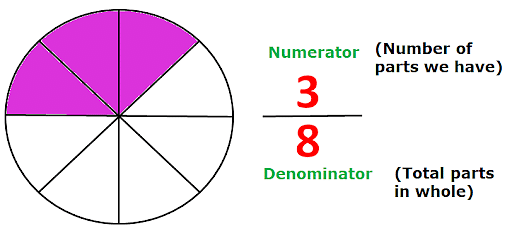
Fraction
Types of Fractions
The different types of fractions are as follows:
- Proper Fractions: Proper fractions have a numerator that is always smaller than the denominator. 5/7, for example, is a proper fraction.
- Improper Fractions: Improper Fractions have a numerator that is bigger than the denominator. For example, 7/5 is an improper fraction.
- Mixed Fractions: A mixed fraction is a combination of a natural number and a fraction. Mixed fractions are, in general, improper fractions.
- Like Fractions: Like fractions are those with the same and comparable denominators. Fractions include 1/2, 6/2, 2/2, and 4/2.
- Unlike Fractions: Unlike fractions have different denominators. Unlike fractions include 4/5, 9/2, 1/8, and 3/6.

Types of Fractions
Fractional Notation
There are mainly two parts of a fraction:
- Numerator: The numerator of a fraction is the fraction's top number. It denotes the number of components being evaluated as a proportion of the total.
- Denominator: A fraction's denominator is the lower number in the fraction. It denotes the number of equal portions into which a whole is subdivided.
For example, 1/2.
In the above example, 1 is the fraction's numerator, and 2 is the fraction's denominator.
Read More: Decimal To Fraction Formula
Proper Fractions
[Click Here for Sample Questions]
A proper fraction has a numerator that is always less than the denominator, which means Numerator<Denominator. The denominator is always greater than the numerator in proper fractions. The number at the bottom of the fraction representing the number of equal parts into which the total is divided is the denominator. The numerator is the number at the top of the fraction, indicating the number of evaluated components.
The fraction 5/6, for example, denotes "5 of 6 equal parts." The denominator is 6, and the numerator is 5. This is a proper fraction as the denominator is more than the numerator in this case.

Proper Fraction
Examples of Proper Fractions
- Four out of six equal pizza slices are a proper fraction, which may be expressed as 4/6 or 2/3, where the numerator is smaller than the denominator.
- A proper fraction is 80 out of 100 marks in a test since the number of marks scored is less than the total number of marks. The fraction is expressed as 80/100, while its simplified form is 4/5.
- A proper fraction can be 3 out of 20 students in a group, provided that the number of individuals in question (3) is fewer than the total number of students in the group (20). The fraction is represented as 3/20.
- A proper fraction in a book is 110 pages out of 530, which may be expressed as 110/530 or 11/53. In this situation, the number of pages under consideration is less than the total number of pages in the book, meaning that the numerator is less than the denominator.
One must note that proper fractions are always less than one. In other words, all proper fractions are less than one. In other words, when we convert a proper fraction to a decimal, we always get a value less than 1.
Read More: Addition and Subtraction In Decimals
Properties of a Proper Fraction
[Click Here for Sample Questions]
Some properties of the proper fraction are identical to those of real numbers and whole numbers which are as follows:
- Fractional addition and multiplication both retain commutative and associative properties.
- y/x is the multiplicative inverse of x/y, where x and y must never be zero.
- Fractional numbers obey the distributive property of multiplication over addition.
- The identity element in fractional multiplication is 1, but it is 0 in fraction addition.
- When the numerators of two fractions are similar, the fraction with the lower denominator is larger. If x, y, and z are all integers, then the fraction with the greater numerator wins if the denominators are similar.
Operations on Proper Fractions
[Click Here for Sample Questions]
Given below is the detailed explanation on how to perform various mathematical operations such as addition, multiplication, subtraction and division of proper fractions:
- Adding Proper Fractions
To combine two proper fractions, add the numerators if the denominators are the same, i.e., like fractions. Because the denominators are the same, adding 2/8 + 3/8 is as simple as adding the numerators. The sum of 2/8 and 3/8 equals 5/8.
To add, unlike proper fractions with different denominators, we take the LCM of the denominators and rewrite the fractions as equivalent fractions with the LCM as the common denominator. When the denominators are all the same, we add the numerators and write the result on top of the common denominator.
For example, to add 2/5 + 4/7, we take the LCM of the denominators. The LCM of 5 and 7 is 35. Now, we multiply both fractions by such a number (in this case, 7 and 5) that the denominators are the same. This results in (14 + 20)/35 = 34/35.
Read More: Relation Between HCF and LCM
- Subtracting Proper Fractions
To get the difference between two proper fractions that are comparable, subtract the numerators while keeping the same denominator. The difference between 6/9 and 4/9, for example, is 2/9.
To subtract, unlike proper fractions with different denominators, we take the denominators' LCM (Least Common Multiple). We rewrite the fractions as equivalent fractions with the LCM as the common denominator. When all of the denominators become the same, we subtract the numerators and write the result on the common denominator.
For example, to subtract 8/9 - 3/4, we compute the LCM of the denominators. The LCM of 9 and 4 is 36. Now, we multiply both fractions by such a number (in this case, 4 and 9) that the denominators are the same. This results in (32 - 27)/36 = 5/36.
- Multiplying Proper Fractions
Multiplication and division of proper fractions are easier than addition and subtraction in several respects. Multiply the numerators and denominators, then simplify or reduce the resultant fraction.
To multiply 2/6 5/4, for example, we multiply the numerators 2 and 5, getting 10, and the denominators 6 and 4, yielding 24. Although the product is listed as 10/24, it may also be written as 5/12.

Multiplication of Fractions
- Dividing Proper Fractions
The division is the same as proper fraction multiplication. The only change is that a multiplication sign replaces the division sign, and the first fraction is multiplied by the reciprocal (inverse) of the second fraction. Divide 4/9 by 2/3, for example. As a consequence, 4/9 3/2 = 12/18. This may be cut down to two-thirds.
Read More: Least Common Denominator
Improper Fractions
[Click Here for Sample Questions]
In an improper fraction, the denominator is always smaller than the numerator, i.e, Numerator > Denominator. If we recall the notion of fractions, we can see that if the denominator in a fraction is smaller than the numerator, the total value will be more than one, complicating matters. It is worth noting that if a fraction is greater than one, it can be divided into a whole integer and a fractional component. 5/2, for example, signifies two and a half.

Improper Fraction
Read More: Integers as Exponents
Things to Remember
- Fractions are those terms that are used to determine the parts of a whole object.
- A fraction basically has two parts- a numerator (upper number) and a denominator (lower number).
- Fractions can be divided into three types mainly- proper fractions, improper fractions and mixed fractions.
- Proper fractions can be defined as those fractions whose numerator is less than the denomination, i.e, Numerator < Denominator. For example, 4/7 is a pepper fraction.
- One must note that, after simplification, the value of a proper fraction is always less than 1.
- Improper fractions are those fractions whose numerator is more than the denomination such as 5/2.
Read More: Addition and Subtraction of Fractions
Sample Questions
Ques. Check if 1/8, 4/4, and 5/3 are proper fractions? (3 Marks)
Ans. Yes, 1/8 is a proper fraction since the denominator, 8, is less than the numerator, 1.
4/4 is not a proper fraction since its value is one after simplification, and all proper fractions have a value less than one.
5/3 is not a proper fraction; it is an improper fraction. In this example, the numerator (5 in this case) is more than the denominator (3).
Ques. Add the fractions: 2/3 + 4/5 (3 Marks)
Ans. Clearly, the denominators are different in this case.
So, to make the denominators equal, we shall determine the LCM.
LCM of 5 and 3 = 15.
Accordingly,
4 x 3/ 5 x 3 = 12/15
2 x 5 / 3 x 5= 10/15
Now, we'll add both integers that have comparable denominators, i.e.,
= 12/15 + 10/15
= 22/15
Ques. Subtract the fractions: 1/4 -1/5 (3 Marks)
Ans. We can see that the denominators are different in this case.
So, to make the denominators equal, we shall determine the LCM.
The LCM of 4 and 5 equals 20.
Accordingly,
(1 x 5) /(4 x 5) = 5/20
(1 x 4)/(5 x 4) = 4/20
= 5/20 - 4/20
=1/ 20
Ques. Add the following fractions: 2/4 and 3/4. (3 Marks)
Ans. Given that,
(2/4) + (3/4)
Now the denominators are same, so we will simply add up the numerator,
(2/4) + (3/4) = (2 + 3)/4
= 5/4
Ques. Subtract the following fractions: 6/10 from 3/4. (3 Marks)
Ans. (3/4) – (6/10)
Here, the denominators are not equal.
The denominators are required to be made equal
LCM of 4 and 10 = 20
Thus,
(3/4) = (3/4) × (5/5) = 15/20
(6/10) = (6/10) × (2/2) = 12/20
Hence, (3/4) – (6/10) = (15/20) – (12/20) = (15 – 12)/20 = 3/20
Ques. Multiply the fractions: 4/5 and 2/6. (3 Marks)
Ans. To multiply 4/5 and 2/6, we must first multiply the numerators, then the denominators, and lastly, the fraction.
Multiplying the numerators 4 and 2, we obtain 8 and the denominators 5 and 6, we get 30.
Thus, the product of 4/5 and 2/6 will be 8/30, which may be simplified to 4/15.
Ques. Divide the following fractions: 14/5 and 23/6 (3 Marks)
Ans. The given fractions are
(14/5) / (23/6)
Reciprocal the second fraction and then multiply it with the first fractions to get the answer.
= (14/5) x (6/23)
= 84/115
Ques. Arrange the following fractions in ascending and descending order 1/2, 2/3, 3/4 (3 Marks)
Ans. LCM of 2, 3, 4 is 2 x 3 x 2 = 12
½ = (1 x 6)/(2 x 6) = 6/12
2/3 = (2 x 4) / (3 x 4) = 8/12
¾ = (3 x 3) / (4 x 3) = 9/12
Denominator is common.
And 9 > 8 > 6
Therefore, ascending order= 1/2< 2/3 < 3/4
And descending order 3/4> 2/3 > 1/2
Ques. Write the natural numbers from 10 to 20. What fraction of them are prime numbers? (3 Marks)
Ans. Natural numbers from 10 to 20 are 10, 11, 12, 13, 14, 15, 16, 17, 18, 19, 20.
The prime numbers in the given range are 11, 13, 17, and 19.
There are 4 are prime numbers among 11 numbers. It represents a fraction 4 / 11



Comments