



Education Journalist | Study Abroad Lead
In a fast-moving bike or a car, you might have at times felt the vehicle slowing down as it approached a sudden bump on the road. That bump is known as a speed breaker which obstructs the speed of the car. Similarly, when an electric current passes through a bulb or any conductor, the conductor releases a certain kind of obstruction to the current and this obstruction is called electrical resistance. It is denoted by R. Every material has electrical resistance and this is the reason why conductors release heat when current passes through it. The topic resistance comes under the Chapter Electricity and is one of the most important topic of this chapter.
| Table of Content |
Keyterms: Electricity, Resistance, Conductor, Electrical resistance, Electric current, Ohm’s Law, Potential difference, Metallic wire
Ohm’s Law
[Click Here for Sample Questions]
In 1827, a German physicist George Simon Ohm found out that there exists a relationship between the current I, flowing in a metallic wire, and the potential difference across its terminals. This relation is regarded as the Ohm’s Law and is represented as-
V ∝ I
V = IR
Where,
V refers to the potential difference measured in Volts across the conductor
I refers to the current flowing through the conductor, measured in Amperes
R refers to the constant of proportionality, known as resistance, measured in Ohms
The above-mentioned relationship explains that the current passing through a resistor is inversely proportional to its resistance. For instance, if the resistance is doubled the current will be half.
Ohms Law Explained
Ohms law video
Also Read:
Resistance
[Click Here for Sample Questions]
According to the Ohm’s Law, Resistance can be defined as the ratio between the voltage applied to the current flowing through a circuit.
R = V / I
Where, V is Voltage and I is Current. The S.I. unit of resistance is Ohms.

Resistance
Factors affecting Resistance
The factors that affect the electrical resistance of a conductor are–
- Length of Conductor
Electrical resistance (R) is directly proportional to the length of a conductor. A longer wire will have more resistance as compared to a shorter wire. This is because current travels farther through a more extended wire, so there are more possibilities for it to collide with particles of the matter.
R ∝ L

Factors affecting Resistance
- Area of Cross Section
It is observed that the resistance of the conductor also depends on its area of cross-section. A wire having a larger area of cross section has less resistance than a wire with lesser area of the same material. Electricity flowing through a wire is like water flowing through a pipe and we know that more water flows through a wider pipe as compared to a narrow one. This can be represented as follows –
R ∝ 1/A
From the above two factors, we can conclude that
R ∝ L/A
So, the Resistance of the wire will be –
R = ρ (L/A)
Here, V is Voltage, I is Current, and ρ is the Resistivity
- Other factors
Apart from the two factors mentioned above, there are other factors that affect the resistance of a conductor such as the temperature of conducting material and the material used as a conductor.
- The nature of materials can be further segregated into –
- Conductors: They have very low resistance. Examples – Metals like Silver, Gold, Aluminium, Iron, etc
- Insulators: They have a very high resistance. Examples – Rubber, Diamond, Glass, etc
- Alloys: They offer a substantially lower amount of resistance. Their small lengths are used for wires of a given diameter to make standard resistance. Examples – Manganin, Constantan, etc.
- Temperature of the material-
It has been observed that when the temperature of the material increases, the thermal energy of the material also increases. Due to the increase in the thermal energy of the material, the ions of the conductor starts vibrating with higher frequency. As a result, the free electron starts moving towards the positive end of the conductor and the resistance of the conductor increases.
The video below explains this:
Resistance Formula Detailed Video Explanation:
Read more: Insulators
Electrical Resistivity of Substances at degrees celsius
[Click Here for Sample Questions]
| Category | Material | Resistivity (Ohm) |
|---|---|---|
| Conductors | Silver | 1.60 × 10⁻⁸ |
| Copper | 1.62 × 10⁻⁸ | |
| Aluminium | 2.63 × 10⁻⁸ | |
| Iron | 10.0 × 10⁻⁸ | |
| Mercury | 94.0 ×10⁻⁸ | |
| Alloys | Constantan (alloy of Cu and Ni) | 49 × 10–6 |
| Nichrome (Ni, Cr, Mn and Fe) | 100 × 10–6 | |
| Insulators | Glass | 1010 – 1014 |
| Hard Rubber | 1013 – 1016 | |
| Diamond | 1012 - 1013 |
Resistivity
[Click Here for Sample Questions]
Electric resistivity is the electrical resistance that is offered per unit length on a unit cross-sectional area at a certain temperature. It is denoted by ρ. It is also referred to as specific electrical resistance. Its SI unit is ohm meter. The formula of electrical resistivity can be derived from formula of resistance-
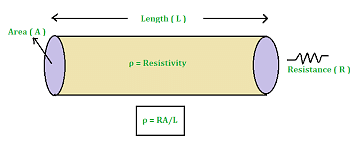
We know that,
R = ρ (L/A)
Hence,
ρ = R (A/I)
= ohm x m2 / m
= ohm x meter
Read more: Resistors in parallel
Difference between Resistance and Resistivity
[Click Here for Sample Questions]
| Resistance | Resistivity |
|---|---|
| 1. Resistance is the physical property of a substance due to which it opposes the flow of current, say electrons. | 1. Resistivity is the physical property of a specific substance which has particular dimensions. |
| 2. The symbol for denoting resistance is R. | 2. The symbol for denoting resistivity is ρ. |
| 3. Formula R = V/I or R = ρ(L/A) where V is Voltage, I is Current, and ρ refers to Resistivity | 3. Formula ρ = (R×A)/L where R is Resistance, L is Length, and A is Cross-sectional area |
| 4. The SI unit of resistance is Ohms. | 4. The SI unit of resistivity is Ohms meter. |
| 5. Application - The property of resistance is used in several places like heaters, fuses, stabilizers, etc. | 5. Electrical resistivity measurement concept which is used as a quality control test for calcareous soil. |
Important Topics for JEE MainAs per JEE Main 2024 Session 1, important Subtopics from Resistance are as follows:
Some memory based important questions asked in JEE Main 2024 Session 1 include: 1. A wire of length L and resistance R is cut into 5 equal parts and those parts are connected in parallel, then R across it will be equivalent to? 2. A wire has a resistance of 60 Ω at a temperature of 27°C. When it is connected to a 220 V DC supply, a current 2.75 A flows through it at a certain temperature. Find the value of the temperature, if the coefficient of thermal resistance is 2 x 10⁻⁴°C 3. Two resistances having the coefficient of variation of resistivity a, and a have equal resistance. Find the equivalent temperature coefficient of resistivity in series and parallel combinations. |
Sample Questions
Question: Study the following electric circuit and find (3 marks)
(i) The current flowing in the circuit .
(i) The potential difference across 10 Ω resistor.

Answer: 10 Ω and 20 Ω are connected in a series, their equivalent resistance is
Rs = R1 + R2
= 10 + 20 = 30 Ω
- Current flowing in the circuit
I = V/ Rs = 3/30
= 1/10 = 0.1 A.
- Potential difference across 10 Ω resistor
V = IR
= 1/10 * 10
= 1 Volt
Read more : Important Formula in electricity
Question: What is meant by electric current? Name and define its SI unit. What is the direction of conventional current in a conductor where electrons flow from B to A? Give justification for your answer. (3 marks)
Answer. Electric Current is the amount of charge ‘Q’ flowing through a particular area of cross section in unit time ‘t’, i.e.
Electric current, I = Q/t
The SI unit of electric current is Ampere. One ampere of current is that current which flows when one coulomb of electric charge flows through a particular area of cross-section of the conductor in one second, i.e. 1A = 1 Cs-1.
Question: State Ohm's law and draw the graph between I and V. (3 marks)
Answer. According to Ohm’s Law, the electric current flowing through a conducting wire, I, is directly proportional to the potential difference across its ends, V, provided its temperature stays unchanged.
Therefore, V∝I.
The graph can be plotted as follow –

Question: When is the potential difference, i.e. V, between two points in a circuit equal to 1 volt? (2 marks)
Answer: Potential difference between two points of a circuit is said to be 1 volt when a work of 1J is to be done for moving a charge of 1 C between these two points.
Read more: Difference between resistance and resistivity
Question: Three resistors of 5Ω, 10Ω, and 15Ω are connected in parallel. Find their equivalent resistance. (3 marks)
Answer: R1 = 10Ω, R2 = 15Ω, R3 = 5Ω
R1, R2 and R3 are connected in parallel, then the equivalent resistance (R) is given by
1/R = 1/R1 + 1/R2 + 1/R3
= 1/10 + 1/15 + 1/5
= 11/30
Hence equivalent resistance, R = 30/11 = 2.72 Ω



Comments