



Content Curator
Everybody uses different forms of batteries in their daily lives. A battery is a device that converts chemical energy into electrical energy. There are various types of batteries that vary in shape and size, as well as the amount of power and energy they can produce. But, what will happen if there are no batteries left? In this science experiment, we will teach you how to produce electricity using salt and water. The presence of a high concentration of salt in water is referred to as brine water.
| Table of Content |
Read More: Relation between Molarity and Molality
Objective of Salt Water Battery Experiment
[Click Here for Sample Questions]
The main goal of the experiment is to learn about the battery components, how electrons flow in the battery and its effects on electricity generation. You are already familiar with the various applications of batteries in everyday life. Let’s get started with the experiment.
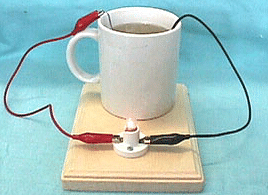
Salt water battery or Air Battery
Materials Required
- Salt
- Copper-Coated wire
- Tape
- Zinc Coated Nail
- Graph, Paper
- Two insulated wires with alligator clips on both the ends
- Voltmeter
- Small Glass Jar
- Water
- Measuring Spoons

Salt Water Battery Procedure
[Click Here for Sample Questions]
Step 1: First, prepare a salt water solution. Then, mix a small amount of water with two or three pinches of salt in a jar.
Step 2: Soak the zinc-coated nails in the solution.
Step 3: Now, attach the nail to one end of the container i.e. negative electrode.
Step 4: Attach an alligator clip to the dangling end of the zinc-coated wire that is hanging outside the jar.
Step 5: Press the alligator clip to remove it.
Step 6: Connect the alligator clip of the wire to the voltmeter’s negative (-ve) terminal.
Step 7: Connect the nail covered with copper to the voltmeter’s positive terminal. To do this, follow the same process mentioned above for zinc-coated nails.
Step 8: Examine the voltmeter reading and jot down the readings that indicate the amount of current passing between the electrodes.
Step 9: Again, add a pinch of salt to the solution and record the readings. Repeat the procedure to record additional readings.
Read More:
Result of Salt Water Battery Experiment
[Click Here for Sample Questions]
Examine the differences in the readings. For visual reference, you can plot it on graph paper. The graph plotting will show a point where the current stops increasing.
Read More:
Salt Water Battery Chemical Reaction
The positive and negative electrodes are separated by a chemical electrolyte, which in this experiment was liquid (salt water). However, the batteries that are used in daily life contain dry powder as an electrolyte. The chemical reaction starts as soon as you switch on the electrical device connected to the battery. The positive ions and electrons are created on the negative electrode because of the reaction. The positive ions enter the electrolyte and electrons travel through the circuit to the positive electrode, where they light up the device. On the positive side, a chemical reaction is taking place in which arriving electrons combine with ions and emit out of the electrolyte to complete the circuit.
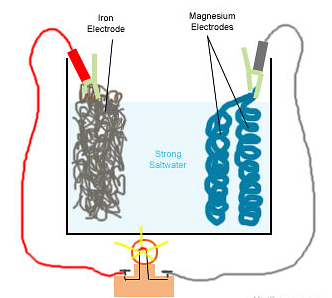
Types of Batteries
[Click Here for Sample Questions]
There are various types of batteries based on their size, shape, voltage and capacities (amount of charge/energy stored). Although the materials and chemical composition of electrodes and electrolytes can vary, there are two major types of batteries i.e. primary and secondary. The primary batteries are non-rechargeable; you must dispose of them once they are depleted. The secondary batteries are rechargeable. You can recharge them by allowing the current to flow in the opposite direction, which it normally does while discharging.
Read More:
Primary Battery
You might think that this type of battery is outdated and bad for the environment because you have to throw it away when it runs out of power. However, their storage capacity is more and lasts for a longer period of time than rechargeable batteries of the same capacity.

Heart pacemakers are powered by disposable lithium batteries. Opening a patient’s chest to recharge the battery is absurd and outrageous. Disposable batteries come in handy on a variety of occasions. There are three types of primary batteries – alkaline, lithium and zinc-carbon. As the electrolyte is solid, it is also known as a dry cell.
Read More:
Zinc Carbon
It is the commonly used and least expensive battery used in everyday life to power radios, flashlights and clocks. In 1865, the zinc-carbon battery was invented by French inventor Georges Leclanche. A carbon rod surrounded by dust carbon and manganese oxide acts as a positive electrode. A zinc alloy is used to make the negative electrode (the external casing). The electrolyte is ammonium chloride glue contained within the battery.

Alkaline Batteries
Alkaline batteries resemble zinc-carbon batteries in appearance, but they last much longer and have greater storage capacity. The positive electrode is composed of manganese oxide and the negative electrode is composed of zinc. The battery’s electrolyte is a concentrated alkaline solution (potassium hydroxide).
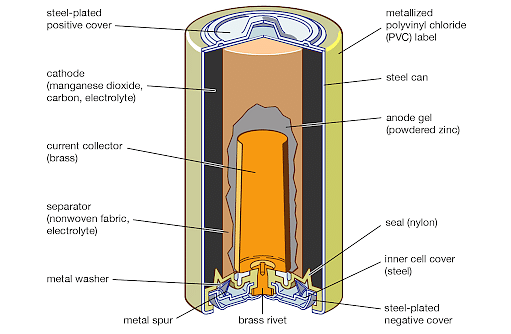
Button Batteries
Button batteries work just like ordinary alkaline batteries. The electrolyte and electrode materials are also the same as in zinc-carbon batteries whereas others use lithium and other organic electrolytes and operate via various chemical reactions.

Things to Remember
[Click Here for Sample Questions]
- The amount of energy that a battery can store is determined by its size.
- Larger batteries can accommodate larger electrodes and more electrolytes, resulting in more power.
- AA, AAA, C and D size batteries are 1.5V but the dimensions are different. The larger ones, C and D have more energy storage capacity than the smaller ones.
- Voltage is also used for the measurement of the battery. When connected to a given circuit, the higher the voltage, the more electricity it produces.
Read More: Number of Moles Formula
Sample Questions
Ques: Define an electron. (3 marks)
Ans: There are a variety of concepts about electrons. The most common of all is, an electron is a part of an atom. Depending on the type of atom, it can have 1 to 103 electrons. Electrons are very small particles and each electron’s mass is just about 1/1836 mass of hydrogen atom. A hydrogen atom contains one proton and one electron therefore the electron’s size is 1/1836 of that of a proton. It is a negatively charged particle.
Ques. What is an ion? (2 marks)
Ans: A charged atom or molecule is defined as an ion. It becomes charged when the number of electrons and protons in an atom or molecule is not equal. If the number of electrons in an atom is more, it obtains a negative charge and if the number of electrons is less than of proton, it obtains a positive charge.
Ques. What do you mean by voltage in a battery? (2 marks)
Ans: The voltage in a battery is defined as the difference in electric potential between the negative and positive terminals. The greater the difference, the greater is the voltage. The difference in charge between two terminals of a battery is referred to as electric potential.
Ques. What is a voltmeter? (2 marks)
Ans: A voltmeter is a device that calculates the difference in electrical potential between two points in an electrical circuit. A voltmeter’s built-in pointer moves across the scale to show the difference. In a modern digital voltmeter, a numerical display is provided on the LCD screen.
Ques. How do electrons flow? (3 marks)
Ans: An electric current is similar to the flow of electrons. The electric current is of two types – direct current and alternate current. Direct current is produced when electrons flow in a single direction, as in batteries or solar cells. AC current is produced when electrons flow from positive to negative terminals as well as from negative to positive terminals, eventually alternating between the two. You may believe that electrons freely travel from one end to the other. However, the mechanism is slightly different in reality. Any conductor through which electricity flows contains atoms.
Read More:



Comments