



Exams Prep Master
The process of germination corresponds to the growth of an organism from a seed or spore. The term, “germination” is used for sprouting the seedling from a seed (angiosperm or gymnosperm), and the growth of a sporeling from a spore. Germination takes place when the embryo starts developing from a dormant state and proceeds towards an active life. All the different stages of the development that a seed goes through fall under germination.
| Table of Content |
Key Takeaways: Germination, Seed formation, Temperature, Respiration, Embryo
Also Read: Reproductive Health
What is Seed Germination?
[Click Here for Sample Questions]
Seed germination can be defined as the fundamental process by which any plant species could grow from a single seed to a fully developed plant. The process of seed germination affects both crop yield and quality. In simple words, seed germination corresponds to the sprouting of a seed, spore, or any other reproductive body, after the period of dormancy. The embryo continues to be dormant where a mature seed starts its life and begins to live. A seed consists of ten to fifteen percent of water and this low water content is a reason to be one of the most prominent agents responsible for the seed’s dormancy.
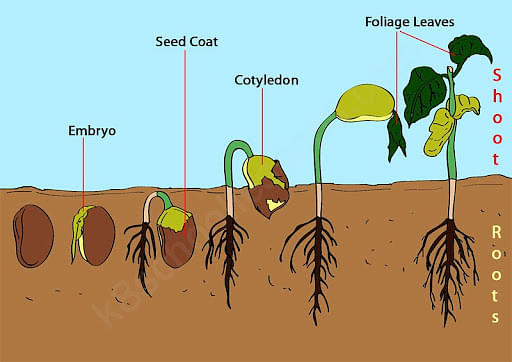
After the peripheral conditions would be sated, the dormant embryo begins its active life.
In other words, seed germination combines all the stages or events. It begins from the hydration of the seed and culminates in the emergence of the embryonic axis from the coat.
How do plants procreate?
[Click Here for Sample Questions]
The process by which plants create their offspring or new plants can be termed reproduction. The reproduction process can be further classified into two types
- Reproduction through seeds
- Reproduction through spores
Read More:
Seed Formation
[Click Here for Sample Questions]
Plants are not very different when it comes to reproduction. Just like human beings and animals, plants also rely on sperms and eggs for the process of reproduction. A male plant releases pollen in order to impregnate the ovaries. Over time the reproduction takes place, and these ovaries evolve and become new seeds, and they form new plants.
While the development of the process of the impregnated ovaries takes place, a surfeit of carbohydrates and proteins gets accumulated within the seeds. These become the major source of food for the plant by the time it develops its leaves.

After some time, the impregnated ovaries of the plants reach a level of maturity. And it can develop a hardened external coat of a seed. With the help of this coat or cover, the seed protects itself from harsh climatic conditions and other weather impacts.
The seeds can be dispersed to different places because of the wind blowing, water splashing, animals grazing, and hence, new plants get created.
Read More:
Factors affecting Seed Germination
[Click Here for Sample Questions]
Seed germination is dependent on various factors, and there could be mainly four factors to look upon. Let’s see what are they:
Water Absorption
Firstly, the process of germination has to go through the absorption of water. In this initial stage, the seed absorbs water and swells as rehydration takes place in the cellular constituents. The bloating happens with great force, and consequently, it mutilates the seed coats and finally allows the radical to ooze out as primary roots.
The absorption of the water by the seeds is pretty feasible as the rehydration of certain significant elements takes place, for example, anatomical and storage macromolecules, repository polysaccharides, and the wall of the cells including the proteins.
Respiration
After the absorption of water is, several metabolic activities continue to take place in the rehydrated seed. The respiration in these plants is anaerobic, and it is based on the energy coming from glycolysis. The respiration turns aerobic, once this energy enters a living body which is the plant itself. Now, you must be wondering how this happens with the underwater plant? So, the seeds of the underwater plants utilize a fixed amount of oxygen dissolved in water. Germination of the seed of the terrestrial plants cannot take place underwater. These plants need supplemental oxygen.
Ever wondered why ploughing of soil is significant for fertility? It is because it allows more air to pass into the soil. The seeds are sown in close proximity to the surface so that they would be able to get the right amount of oxygen from the air. Seeds that are sown deep down in tightly packed soil with no passage of air will not be able to germinate. They cannot get an adequate amount of oxygen.
Temperature
For germination to happen, the seed must get the proper heat. The process of germination requires a moderate temperature between 25 to 30 degrees celsius. It is important to note that different plant seeds need different temperatures for seed germination.
You may come across some seeds which need special requirements. It can be as low as 5 degrees Celsius or as much as 40 degrees celsius.
Light or Dark
It is common knowledge that plants need sunlight to grow, and it is true when it comes down to seed germination as well. Sunlight or light is an important factor for seed germination or gestation. Seeds that have a positive response to the light conductivity to germination are said to be photo-blastic seeds. There are mainly three types of photo-blastic seeds:
- Positive photo-blastic seeds
- Negatively photo-blastic seeds
- Non-photo-blastic seeds
Positive photo-blastic seeds: The positive photo-blastic seeds will never be able to germinate when there is no light.
Negatively photo-blastic seeds: The negatively photo-blastic seeds will not be able to germinate in the presence of light.
Non-photo-blastic seeds: The non-photo-blastic seeds will be able to germinate in either condition, in the presence or the absence of light. Plants are dependent on sunlight, and there is a reason behind it. A pigment called ”phytochrome” regulates the dependency of plants on lights.
The above-mentioned factors affect the seed germination of so many levels. Rapid expansion and growth of the embryo take place. The covering layers rupture, and the radicle emerges, hence completing the germination process.
Read More: Heterotrophic Bacteria
ABA: Seed Germination and Growth Regulation
[Click Here for Sample Questions]
The embryo cell has to maintain its metabolic activities while the process of germination takes place. It also has to endure expansion and division. The protein and starch that has been preserved need to be digested. And the digestion process is conducted through the cellular conversion of energy.
The dormancy is induced by the hormone Abscisic acid or ABA in the plant. ABA is responsible for the prevention of germination as well. You can say that the concentration of ABA is directly proportional to the onset of dormancy of the embryo while going through the phase of attaining maturity.
Evolution of Embryo Axis into Seedling
The embryo cells located in the developing regions tend to be metabolically active as the segment of assimilation and translocation of food takes place. After some time, the cells start evolving in size through the process of cell division which becomes the seedling.
Internal Factors Affecting Seed Germination
Seed Dormancy
Seed dormancy is a condition in which the seed will not be able to germinate even if all the favorable conditions have been provided. How is that possible? Let’s find out!
- Seed dormancy could happen when the seed coat, which has the quality to be resistant to water and gas, prevents water absorption and passage of oxygen.
- If a seed has an underdeveloped embryo, then it will not be able to germinate. The same would happen in the case of an immature embryo.
- Some seeds might be having a plant growth regulator, which stops germination. We should always keep in mind the fact that some seeds will take a longer period of time to germinate.
Read More:
Things To Remember
- Seed germination can be defined as the fundamental process by which any plant species could grow from a single seed to a fully developed plant. It corresponds to the sprouting of a seed, spore, or any other reproductive body, after the period of dormancy. It begins from the hydration of the seed and culminates in the emergence of the embryonic axis from the coat.
- The process by which plants create their offspring or new plants can be termed reproduction. The reproduction process can be further classified into two types. They are reproduction through seeds and reproduction through spores.
- Just like human beings and animals, plants also rely on sperms and eggs for the process of reproduction. A male plant releases pollen in order to impregnate the ovaries. The impregnated ovaries of the plants reach a level of maturity and develop to a hardened external coat of a seed.
- Firstly, the process of germination has to go through the absorption of water. In this initial stage, the seed absorbs water and swells as rehydration takes place in the cellular constituents. After the absorption of water is done, several metabolic activities continue to take place in the rehydrated seed. The process of germination requires a moderate temperature between 25 to 30 degrees celsius.
Further Read:
Sample Questions
Ques: What is Seed Germination? (2 marks)
Ans: Seed germination can be defined as the fundamental process by which any plant species could grow from a single seed to a fully developed plant. It corresponds to the sprouting of a seed, spore, or any other reproductive body, after the period of dormancy. It begins from the hydration of the seed and culminates in the emergence of the embryonic axis from the coat.
Ques: What are the key factors seed germination is based on? (3 marks)
Ans: Moisture or Water Supply:
Germination will not be initiated until sufficient water is provided. The reason behind this is the property of seeds to absorb water, which tends to soften the “seed coat” to make it permeable.
Thermal Conditions:
Seeds can germinate in a wide range of temperatures. Freshly harvested seeds need a more favourable temperature to germinate.
Oxygen Supply:
Ploughing or soil aeration is another prominent factor required for seed germination. Aerobic respiration is a key factor in germination. Through respiration or oxygen supply, seeds acquire requisite energy for the development of embryos.
Ques: What is the role of ABA in seed germination? (2 marks)
Ans: Dormancy is induced by the hormone Abscisic acid or ABA in the plant. ABA is responsible for the prevention of germination as well. You can say that the concentration of ABA is directly proportional to the onset of dormancy of the embryo while going through the phase of attaining maturity.
Ques: State the reasons for Seed Dormancy. (2 marks)
Ans: Reasons for Seed Dormancy are:
- Seed dormancy could happen when the seed coat, which has the quality to be resistant to water and gas, prevents water absorption and passage of oxygen.
- If a seed has an underdeveloped embryo, then it will not be able to germinate. The same would happen in the case of an immature embryo.
Ques: State different types of photo-blastic seeds. (3 marks)
Ans: Various forms of photo-blasatic seeds are-
- Positive photo-blastic seeds
The positive photo-blastic seeds will never be able to germinate when there is no light.
- Negatively photo-blastic seeds
The negatively photo-blastic seeds will not be able to germinate in the presence of light.
- Non-photo-blastic seeds
The non-photo-blastic seeds will be able to germinate in either condition, in the presence or the absence of light.
Ques: What is Reproduction in plants and its types? (2 marks)
Ans: The process by which plants create their offspring or new plants can be termed reproduction. The reproduction process can be further classified into two types. They are reproduction through seeds and reproduction through spores.
Ques: Explain underwater respiration for seed germination. (2 marks)
Ans: The seeds of the underwater plants utilize a fixed amount of oxygen dissolved in water. Germination of the seed of the terrestrial plants cannot take place underwater. These plants need supplemental oxygen.
Ques: State the advantage of ploughing or aeration of soil. (2 marks)
Ans: Ploughing or aeration of soil allows more air to pass into the soil. The seeds which are sown with proximity to the surface would be able to get the right amount of oxygen from the air.
Read More:



Comments