



Content Curator
Parallelogram is a quadrilateral with two pairs of parallel sides in two dimensions. A parallelogram's opposite angles and opposite sides are congruent, and the total of its internal angles is 360°. Rhombus, Square and Rectangle are all types of Parallelograms which possess all the properties of a parallelogram and also have their own unique properties. Thus they are also called Special Parallelograms.
Key Terms: Parallelograms, Special parallelogram, Square, Rectangle, Rhombus
Parallelograms
[Click Here for Sample Questions]
"Parallelogram" is derived from the Greek word "parallelogrammon," which means "bounded by parallel lines." As a result, a parallelogram is a quadrilateral that is divided by parallel lines. It is a shape with opposite sides that are parallel and equal.
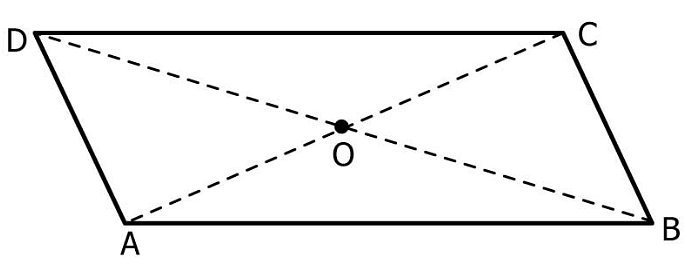
Parallelogram
There are six key properties of parallelograms to be aware of:
- Opposite sides are congruent (AB = DC).
- Opposite angels are congruent (D = B).
- Consecutive angles are supplementary (A + D = 180°).
- If one angle is right, then all angles are right.
- The diagonals of a parallelogram bisect each other.
- A parallelogram is divided into two congruent triangles by each diagonal.
Special Parallelograms
[Click Here for Sample Questions]
A rectangle, a square and a rhombus are special parallelograms because they not only show the properties of a parallelogram but also have unique properties of their own.
Rectangle
A quadrilateral having four right angles is known as a rectangle. As a result, every angle in a rectangle is the same (360°/4 = 90°). Also, the diagonals of a rectangle bisect each other, and the opposite sides of a rectangle are parallel and equal. Some of the real-life examples of a rectangle are books, mobile phones, etc.
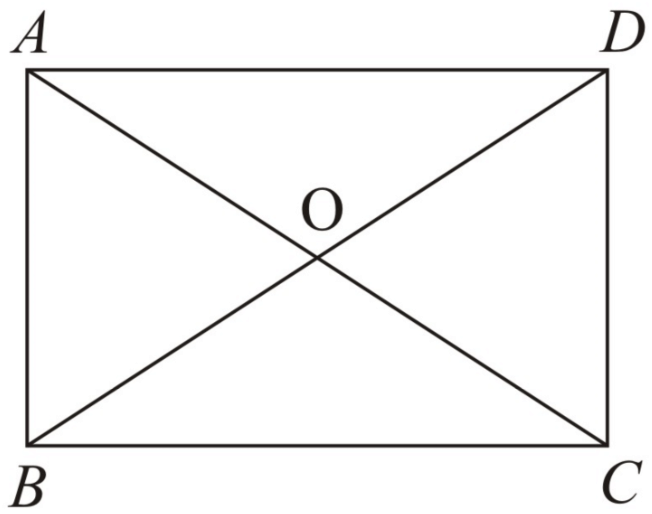
Rectangle
Properties of Rectangle:
- The opposite sides are equal in length.
- The opposite sides are parallel.
- The interior angles measure 90 degrees each.
- Diagonals are equal in length.
- Diagonals bisect each other.
- Each diagonal bisects the rectangle into 2 congruent triangles.
- It has 2 lines of symmetry – a horizontal and a vertical.
- The mid-points of the 4 sides of a rectangle, when joined in order, form a rhombus.
Rectangle formula:
If the length of the rectangle is L and breadth is B, then,
- Area of a rectangle = Length × Breadth or L × B
- Perimeter of rectangle = 2 × (L + B)
Square
A quadrilateral having four equal sides and angles, is known as a square. It is also a regular quadrilateral, with equal sides and angles. A square, like a rectangle, has four 90-degree angles. It can alternatively be visualized as a rectangle with two equal sides. Some of the real-life examples of a square are a slice of bread, a chessboard etc.

Square
Properties of Square:
- All 4 sides are equal in length.
- The opposite sides are parallel.
- The interior angles measure 90 degrees each.
- Diagonals are equal in length.
- Diagonals bisect each other at right angles.
- Diagonals bisect opposite vertex angles.
- It is a highly symmetric figure with 4 lines of symmetry – a horizontal, a vertical, and 2 diagonals.
- Each of the diagonals bisects the square into 2 congruent triangles. In fact, both the pairs of congruent triangles are also congruent to one another.
Square formula
If the side of a square is ‘a’ then,
- Area of the square = a × a = a²
- Perimeter of the square = 2 × (a + a) = 4a
Rhombus
A quadrilateral with equal-length sides and opposite sides that are parallel to each other is known as a rhombus. The angles aren't all 90 degrees, though. A rhombus with right angles would make a square. Because it resembles the diamond suit in playing cards, the rhombus is frequently referred to as the 'diamond.'

Rhombus
Properties of a Rhombus
- Opposite angles are equal.
- All sides are equal and, opposite sides are parallel to each other.
- Diagonals bisect each other perpendicularly, at right angles.
- The sum of any two adjacent angles is 180°
- Diagonals bisect opposite vertex angles.
- Each of the diagonals divides the rhombus into 2 congruent triangles.
Rhombus Formulas
- If the side of a rhombus is a, then, the perimeter of a rhombus = 4a.
- If the length of the two diagonals of the rhombus is d1 and d2, then the area of a rhombus = ½ × d1 × d2.
Read more:
Comparison of the Properties
[Click Here for Sample Questions]
Comparison of the properties of all the special parallelograms is tabulated below.
| Properties | Rectangle | Rhombus | Square |
|---|---|---|---|
| All sides are congruent | X | ✓ | ✓ |
| Opposite sides are parallel and congruent | ✓ | ✓ | ✓ |
| All angles are congruent | ✓ | X | ✓ |
| Opposite angles are congruent | ✓ | ✓ | ✓ |
| Diagonals are congruent | ✓ | X | ✓ |
| Diagonals are perpendicular | X | ✓ | ✓ |
| Diagonals bisect each other | ✓ | ✓ | ✓ |
| Adjacent angles are supplementary | ✓ | ✓ | ✓ |
Things to Remember
- A quadrilateral is a four-sided two-dimensional figure with 360 degrees of inner angles.
- A quadrilateral with four sides, two of which are parallel to each other, is known as a parallelogram.
- A square is a specific parallelogram with diagonals that are perpendicular to each other and are both equilateral and equiangular.
- A rectangle is a particular parallelogram with congruent opposite sides and 90° angles on each side.
- A rhombus, often known as a diamond, is a unique parallelogram with four congruent sides and diagonals that are perpendicular to one another.
- Every square is a rectangle.
- Every square is a rhombus.
- Every rhombus, square and rectangle is a parallelogram.
- All parallelograms are quadrilaterals.
Sample Questions
Ques: What is the difference between a rhombus and a parallelogram? (2 marks)
Ans: We know that all the sides of a rhombus are the same length, whereas a parallelogram simply states that opposite sides are congruent.
Ques: What is the difference between a square and a rhombus? (2 marks)
Ans: A square and a rhombus both have four congruent sides, but a square also has four congruent right angles, whereas a rhombus merely stipulates that opposite angles are congruent, not that they must be 90 degrees.
Ques: Why is a square a rectangle? (2 marks)
Ans: A square is a rectangle because it has all of the characteristics of one. Remember that a parallelogram must have four right angles, opposite sides that are congruent, opposite sides that are parallel, opposite angles that are congruent, diagonals that are bisecting each other, and diagonals that are congruent for it to be a rectangle. Because a square meets all of these characteristics, it is always a rectangle.
Ques: When is a rhombus a rectangle? (2 marks)
Ans: Only if all four angles of a rhombus are 90 degrees can it be classified as a rectangle.
Ques: In rectangle ABCD, AO = 5cm. Find the length of the diagonal BD. Also find the perimeter of rectangle if AB = 8cm and AD = 6cm. (2 marks)
Ans: AO = OC = 5cm (diagonals bisect each other)
Therefore, AC = 10cm
BD = AC = 10cm (diagonals of rectangle are equals)
Perimeter = AB + BC + CD + DA
= 8 + 6 + 8 + 6 (opposite sides are equals)
= 28cm.
Ques: Find the area and the perimeter of a square whose side is 6 cm. (2 marks)
Ans:
Given: Side, a = 6 cm
We know the formulas,
Area of Square = a2 square units
A = 6 × 6 = 36cm2
Therefore, the area of a square is 36 cm2.
The perimeter of a Square = 4a units
P = 4 × 6 = 24cm
Therefore, the perimeter of a square is 24 cm.
Ques: Find the area and perimeter of a rhombus whose diagonal measures are 3cm and 5cm and the side measure is 4 cm. (2 marks)
Ans:
Given that, side, a = 4 cm
Also, the diagonal measures are:
p = 3 cm and q = 5 cm
The formula to find the area and perimeter of a rhombus are:
Area of a rhombus, A = pq/2 square units
A = (3×5) / 2 = 15/2 = 7.5
Therefore, the area of a rhombus = 7.5 cm2
The perimeter of a rhombus, p = 4a square units
p = 4 × 4 = 16
Therefore, the perimeter of a square = 16 cm.
Ques: In rectangle ABCD, ∠ABD = 3x – 7 and ∠CBA = 6x – 2. Find the value of x. (2 marks)
Ans: Each angle of the rectangle is 90°
Therefore, ∠ABD + ∠CBA = 90°,
3x – 7 + 6x – 2 = 90
Or, 9x – 9 = 90
Or, 9x = 99
Or, x = 11.
Ques: In rectangle ABCD AO = 2x – 10 cm, OB = x + 4 cm. Find the length of the diagonal BD.(2 marks)
Ans: In rectangle diagonals bisect each other and are equal.
Therefore, AO = OB
2x – 10 = x + 4
Or, x = 14
OB = 14 + 4 = 18 cm
OD = 18 cm (as diagonals bisect each other)
Therefore, BD = 36 cm.
Ques: Diagonals of a rhombus are 24cm and 10cm. Find the side of the rhombus. (2 marks)
Ans: AC = 24cm
BD = 10cm
Therefore, AO = 12cm and OB = 5cm (diagonals bisect each other)
In right-angled triangle AOB, (diagonals of rhombus are perpendicular)
AB2 = OA2 + OB2
Or, AB2 = 122 + 52
Or, AB2 = 144 + 25
Or, AB2 = 169
Or, AB = 13cm
Therefore, the side of the rhombus is 13cm.
Ques: In a rhombus one of the diagonals is equal to a side of the rhombus. Find the angles of the rhombus. (2 marks)
Ans: In rhombus PQRS PR = PQ (given)
Therefore, PQ = QR = RS = SP = PR (as all sides of the rhombus are equal)
In triangle PQR
PQ = QR = PR
Therefore, it is an equilateral triangle.
∠QPR = ∠Q = ∠QRP = 60°
>||ly ∠SPR = ∠S = ∠PRS = 60°
Therefore, angles of rhombus are ∠P = 120° , ∠Q = 60°, ∠R = 120°, ∠S = 60°.
Ques: In rectangle ABCD below, diagonals AC and BD intersect at point R. If AR = 2x - 6 and CR = x + 10, find BD. (2 marks)
Since the diagonals of a rectangle bisect each other, we can say that AR = CR.
We equate the values of AR and CR and solve for x.
2x - 6 = x + 10
Or, 2x - x = 10 + 6
Or, x = 16
Use either of the given equations to determine that each segment equals 26. Since they are all equal, BD = 26.
For Latest Updates on Upcoming Board Exams, Click Here: https://t.me/class_10_12_board_updates
Check More:



Comments