



Content Curator
A rhombus is a quadrilateral having two pairs of opposite sides that are parallel to one another and four equally length sides.
- Quadrilaterals are geometric shapes such as rectangles, squares, parallelograms, and rhombuses.
- In general, the sides and angles of a quadrilateral will not be the same length or measure.
- But a square is a different kind of quadrilateral which signifies 4 same sides, i.e, equal sides of equal length and each angle of 90 degrees.
- A rhombus is a quadrilateral with the same sides i.e. equal sides of equal length.
- In a rhombus, the exact opposite sides are parallel, and the vertex angles are equal.
- The diagonals of a rhombus are always perpendicular to one another.
| Table of Content |
Key Terms: Quadrilateral, Geometric shapes, Rectangles, Squares, Parallelograms, Rhombus, Angle, Right angle, Length, Diagonals, Vertex, Length
Introduction to Construction of Rhombus
[Click Here for Sample Questions]
The construction of a rhombus is not a very difficult concept to understand. One can draw a Rhombus with the provided combination of measurements, such as:
- The length of its two diagonals
- The length of one of its sides and the measurement of one angle
- The length of one of its sides and one diagonal.
A rhombus is a quadrilateral with all 4 sides of the same length. The diagonals of the rhombus intersect at a right angle. A rhombus's opposite angles are also similar in size, and its opposite sides are parallel to one another.
Also Read:
Construction of Rhombus Given Length of Two Diagonals
[Click Here for Sample Questions]
A quadrilateral with equal sides of length is known as a rhombus.
- Opposite sides are parallel and opposite vertex angles are the same i.e. equal.
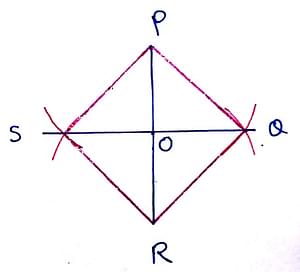
- Let’s imagine we have to make a PQRS rhombus with PR = 8 cm and SQ = 9 cm for the lengths of its two diagonals.
- The diagonals of a rhombus are meant to bisect one another at 90∘ angles.
- As a result, we don’t need any other dimension to build a rhombus.
The steps are as follows:
Step 1
Draw an 8 cm long vertical line segment PR.

Step 2
Using a compass of any radius, draw two arcs from point P, one to the left and the other to the right of PR. Without adjusting the compass radius, repeat from point R.

Step 3
Measure 9 cm on the other diagonal. As a result, draw a line connecting the spots where the arc intersected so that OS is equal to OQ,
OS = OQ = 9/2 = 4.5 cm.
Step 4
Connect the points P and Q, Q and R, R and S, and S and P.
PQRS is the requisite rhombus, with diagonals of 8 cm and 9 cm in length. Note that O is the mid-point of the two diagonals and ∠QOR = ∠POQ = ∠ROS = ∠SOP = 90 degrees.
Construction of Rhombus Given One Side and One Angle
[Click Here for Sample Questions]
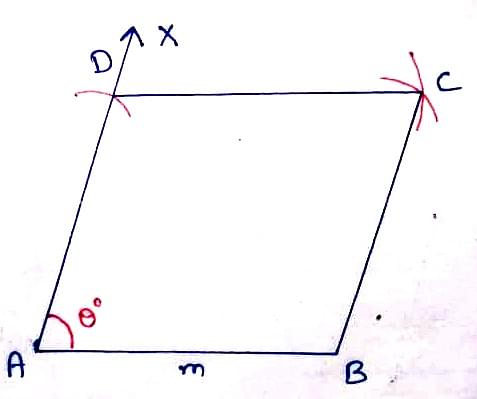
If we are given one side and one angle to work with, we can draw a rhombus by using the steps below:
- Create a line segment of the specified length, such as AB.
- Draw an angle of a particular measure, such as BAX, at one endpoint of the line segment.
- Draw an arc with A as the center and AB as the length, cutting the ray AX at D.
- Draw an arc with D as the center and AB as the radius.
- Cut the preceding arc at C, using B as the center and the same radius as before.
- Now you can join DC and BC.
As a result, the needed rhombus is ABCD.
Construction of Rhombus Given one Diagonal and one Side
[Click Here for Sample Questions]
If we only have one diagonal and one side to work with, we can make a rhombus by following the instructions below:
- Draw an arc on the right side of point A and above B with a radius equal to the length of the specified side of the rhombus and a center equal to the length of the diagonal.
- Cut the preceding arc at C, with B as the center and AB as the radius.
- Draw an arc with C as the center and AB as the radius.
- Cut the preceding arc at D with A as the center and the same radius as A.
- Join AD, BC, and CD
As a result, the needed rhombus is ABCD.

Also Read:
Things to Remember
- Quadrilaterals are geometric shapes such as rectangles, squares, parallelograms, and rhombuses.
- A rhombus is a quadrilateral with the same sides i.e. equal sides of equal length.
- It has 4 sides of the same length.
- The diagonals of a rhombus are always perpendicular to one another.
- A square is a quadrilateral that has 4 equal sides and each angle of 90 degrees.
Sample Questions
Ques. Is square a Rhombus? (2 Marks)
Ans. Both a square and a rhombus have an equal number of sides. The square's diagonals also bisect opposite angles and are perpendicular to one another. Therefore, a square is a rhombus.
Ques. What are the properties of a Rhombus? (3 Marks)
Ans. The following are the properties of a Rhombus
- The lengths of the four sides are the same.
- All angles are congruent.
- The diagonals cut each other in half.
- The diagonals intersect at right angles.
- The diagonals are each other's perpendicular bisectors.
- The shape is divided into four congruent triangles.
- The area is determined by dividing the product of the diagonals by two.
- Four times the length of one side makes up the perimeter.
Ques. Given BC = 4.5 cm, AD = 5.5 cm, CD = 5 cm, diagonal AC = 5.5 cm, and diagonal DB = 7 cm, Construct a quadrilateral ABCD with the given information. (3 Marks)
Ans. Construction: Steps are given below :
- Draw a BC of 4.5 cm.
- Draw an arc with a radius of 5 cm and a center C.
- To meet the previous arc at D, draw another arc with a center B and a radius of 7 cm.
- Join CD with BD.
- To meet at A, draw two arcs with centers D and C and a radius of 5.5 cm each.
- Join CA, DA, and AB together.
Hence, ABCD is the needed quadrilateral.
Ques. Construct a quadrilateral PQRS with PQ = 4 cm, QR = 3.5 cm, RS = 5 cm, PS = 5.5 cm, and Q = 75°. (3 Marks)
Ans. Construction: Steps are given below:
- Draw PQ = 4 cm.
- Cut QR = 3.5 cm by drawing a 75° angle at Q.
- Draw an arc with a radius of 5 cm and a center of R.
- To meet the preceding arc at S, draw another arc with a center P and a radius of 5.5 cm.
- Connect the RS and the PS.
Hence, the needed quadrilateral is PQRS.
Ques. Construct a square with a 5 cm side. (3 Marks)
Ans. Construction: Steps are given below:
- Draw PQ = 5 cm.
- Cut QR = 5 cm by drawing a 90° angle at Q.
- Draw two arcs with centers P and R and 5 cm radii that meet at S.
- Bring PS and RS together.
As a result, the needed square is PQRS.
Ques. Construct a PQRS rhombus with PQ = 5.8 cm and PR = 7.5 cm. (3 Marks)
Ans. Construction: Steps are given below :
- Draw PQ = 5.8 cm.
- Draw an arc with a radius of 5.8 cm and a center Q.
- To meet the preceding arc at R, draw another arc with a center P and a radius of 7.5 cm.
- To meet at S, draw two arcs with centers P and R with the same radius of 5.8 cm.
- Bring QR, PR, RS, and PS together.
As a result, the needed rhombus is PQRS.
Ques. Construct a rhombus with diagonals of 6 and 8 cm. (3 Marks)
Ans. Construction: Steps are given below :
- Make a drawing of DB = 8 cm.
- At O, draw a right bisector of DB.
- To cut the right bisector at A and C, draw two arcs with a center O and a radius of 3 cm each.
- Join AB, BC, CD, and DA
As a result, ABCD is the necessary rhombus.
Ques. Construct a rectangle with a 5 cm diagonal and a 50° angle between the diagonals. (3 Marks)
Ans. Construction: Steps are given below :
- Make a PR of 5 cm.
- At O, draw PR's right bisector.
- At O, draw a 50-degree angle and produce both sides.
- To cut at Q and S, draw two arcs with the same center O, and a radius of 2.5 cm.
- Collaborate with PQ, QR, RS, and SP.
As a result, the needed rectangle is PQRS.
Ques. Construct a quadrilateral PQRS with QR = 4 cm, Q = 60 degrees, R = 135 degrees, PQ = 5 cm, and P = 90 degrees. (2 Marks)
Ans. Construction: Steps are given below :
- Draw PQ = 5 cm.
- At Q, draw a 60° angle and cut QR = 4 cm.
- At R, draw a 135° angle, and at P draw a 90° angle that meets at S.
As a result, the needed quadrilateral is PQRS.
Ques. Construct a PQRS parallelogram with PQ = 5.5 cm, PR= 7 cm, and QS = 8 cm. (3 Marks)
Ans. Construction: Steps are given below :
- Draw PQ = 5.5 cm
- Draw an arc with a radius of 82 cm = 4 cm and a center Q.
- Create a new arc with a center of P and a radius of 72 cm = 3.5 cm that intersects the previous arc at O.
- Join PO and produce R so that PO equals OR.
- Combine QO and S in such a way that QO = OS.
- Join QR, RS, and PS together.
As a result, the required parallelogram is PQRS.
For Latest Updates on Upcoming Board Exams, Click Here:https://t.me/class_10_12_board_updates
Check-Out:



Comments