



Education Journalist | Study Abroad Lead
Tetraethyl Lead (TEL) is an organometallic compound that consists of the toxic metal lead and has the chemical formula (CH3CH2)4Pb. Tetraethyl lead is a colourless and dense liquid that is quite volatile. It is manufactured by the action of ethyl chloride on a powdered alloy of lead and sodium. Though the compound had been identified chemically in the mid-19th century, its effectiveness as an antiknock agent was discovered by General Motors in 1921. However, due to the toxic and poisonous effects of lead, TEL was banned as an automotive fuel at the beginning of the 1970s.
| Table of Content |
Key Terms: Tetraethyl Lead, Organolead Compound, Antiknock Agent, Gasoline, Lead Oxide, Steam Distillation, Fuel Additive, Combustion, Refractive Index, Alloy
What is Tetraethyl Lead?
[Click Here for Sample Questions]
Tetraethyl Lead is an organolead compound that is produced by reacting chloroethane with sodium–lead alloy. The chemical formula of Tetraethyl lead is (CH3CH2)4Pb, where Pb refers to the chemical formula of lead.
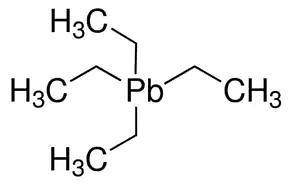
Structure of Tetraethyl Lead
Tetraethyl Lead was the chief antiknock agent for automotive gasoline or petrol in the 20th century.
Later on, at the beginning of the 1970s, various concerns were raised over the toxic effects of lead, especially on children. Lead and lead oxides poison catalytic converters and are considered to be a major cause of spark plug fouling. From the 1970s onward, many countries began phasing out Tetraethyl lead and eventually banning it in automotive fuel.
Read More: Lead Acetate Formula
Synthesis of Tetraethyl Lead
[Click Here for Sample Questions]
In order to produce Tetraethyl Lead, chloroethane is combined with sodium–lead alloy. Given below is the reaction for the formation of TEL:
4 NaPb + 4 CH3CH2Cl → (CH3CH2)4Pb + 4 NaCl + 3 Pb
The product is recovered through the process of steam distillation, leaving a sludge of lead and sodium chloride.
Properties of Tetraethyl Lead
[Click Here for Sample Questions]
Tetraethyl Lead is a viscous colourless liquid that has a sweet odour. It is highly lipophilic and soluble in petrol (gasoline) as it is charge neutral and contains an exterior of alkyl groups. Owing to this property only, it diffuses through the blood-brain barrier and accumulates within the limbic forebrain, frontal cortex, and hippocampus.
Tabulated below are some of the important properties of Tetraethyl Lead:
| Chemical Formula | (CH3CH2)4Pb |
| Molar Mass | 323.4 g·mol−1 |
| Molecular Shape | Tetrahedral |
| Appearance | Colorless and Dense Liquid |
| Odour | Sweet and Pleasant |
| Density | 1.653 g cm−3 |
| Melting Point | −136 °C (−213 °F; 137 K) |
| Boiling Point | 84-85 °C (183-185 °F; 357-358 K) 15 mmHg |
| Solubility In Water | 0.00002% (20 °C) |
| Vapor Pressure | 0.2 mmHg (20 °C) |
| Refractive Index (nd) | 1.5198 |
Uses of Tetraethyl Lead
[Click Here for Sample Questions]
Some of the major uses of Tetraethyl Lead have been listed down below:
- Initially, Tetraethyl Lead was widely in use as a gasoline additive at the beginning of the 1920s. It was an effective antiknock agent and thus helped to prevent exhaust valve and valve seat wear. However, the issues concerning the extreme health effects of fine lead particles were posed alongside.
- In order to prevent uncontrolled combustion, also known as engine knocking, a gasoline-fueled reciprocating engine needs fuel with a high octane level. Tetraethyl Lead anti-knocking agents enable higher compression ratios, thus, leading to increased efficiency and peak power.
- Tetraethyl Lead was also used in World War II, and it had achieved 150 octanes, enabling the supercharged engines like that of the Griffon and Rolls-Royce Merlin to gain high horsepower ratings at a much lower cost.
- Another use of Tetraethyl Lead is that it acts as a barrier between the hot exhaust valves and their seats, which eventually helped in preventing micro welds from developing. The micro welds separate when these valves reopen, leaving behind a rough surface on the valves that abrade the seats, thus, causing valve recession.

Tetraethyl Lead (Anti-knocking Agent)
Reactions of Tetraethyl Lead
[Click Here for Sample Questions]
The weakness of the four C–Pb bonds is one characteristic feature of Tetraethyl Lead. TEL decomposes entirely into the lead as well as combustible, short-lived ethyl radicals at the temperature found in internal combustion engines. Lead is the reactive antiknock agent whereas the ethyl groups act as a gasoline-soluble carrier.
Upon burning, Tetraethyl Lead produces carbon dioxide and water along with lead and lead(II) oxide.
- Pb(C2H5)4 + 13 O2 → 8 CO2 + 10 H2O + Pb
- Pb(C2H5)4 + 27/2 O2 → 8 CO2 + 10 H2O + PbO
Read More: Lead II Nitrate Formula
Things to Remember
- Tetraethyl Lead (TEL), also referred to as tetraethyllead, is an organolead compound with a chemical formula (CH3CH2)4Pb.
- It is produced by the reaction of ethyl chloride on an alloy of lead and sodium.
- It is a viscous colourless and dense liquid with a pleasantly sweet odour and is volatile in nature.
- As tetraethyl lead is charge neutral and contains an exterior of alkyl groups, it is highly lipophilic and soluble in gasoline.
- Tetraethyl Lead not only produces CO2 and water but lead and lead(II) oxide as well on burning.
Sample Questions
Ques. Elaborate upon the use of Tetraethyl Lead as an antiknock agent. (5 Marks)
Ans. After years of searching for a highly effective and inexpensive additive, it was in 1921 when General Motors discovered the effectiveness of tetraethyl lead as an antiknock agent. Thus, tetraethyl lead was the most effective antiknock agent for automotive gasoline or petrol in much of the 20th century.
Tetraethyl Lead enables higher compression ratios to be used, thus, leading to increased efficiency and peak power of the vehicle and improved fuel economy. TEL had the additional benefit of being commercially viable as its application for this purpose could be patented.
Ques. Why was Tetraethyl Lead banned as an automotive fuel? (3 Marks)
Ans. Tetraethyl Lead was banned as an automotive fuel at the beginning of the 1970s. It was banned on account of its contribution to lead poisoning. Another reason for the phaseout of TEL around the world was its interference with pollution-control devices installed in automobiles and the raised concerns over air and soil lead levels and the accumulative neurotoxicity of lead.
Ques. How is Tetraethyl Lead produced? (3 Marks)
Ans. For the production of Tetraethyl Lead, ethyl chloride is made to react with a powdered alloy of lead and sodium. The reaction to produce TEL is
4 NaPb + 4 CH3CH2Cl → (CH3CH2)4Pb + 4 NaCl + 3 Pb
The final product after the reaction is recovered by the process of steam distillation, leaving a sludge of lead and sodium chloride.
Ques. How was the need for Tetraethyl Lead reduced? (5 Marks)
Ans. After the complete phaseout and ban on Tetraethyl Lead, several advancements in automotive engineering and petroleum chemistry helped in bringing down the necessity of tetraethyl lead. The safer options and methods for making higher-octane blending stocks like reformate and iso-octane resulted in less dependency on TEL.
Apart from that, various other antiknock additives of varying toxicity including metallic compounds such as methylcyclopentadienyl manganese tricarbonyl (MMT) as well as oxygenates including methyl tert-butyl ether (MTBE), tert-amyl methyl ether (TAME), and ethyl tert-butyl ether (ETBE) were investigated.
Ques. Give the reaction involved in the burning of Tetraethyl Lead. (5 Marks)
Ans. When Tetraethyl Lead is burned, it produces lead and lead(II) oxide along with Carbon Dioxide and Water. The reactions involved in the burning of Tetraethyl Lead are as follows;
- Pb(C2H5)4 + 13 O2 → 8 CO2 + 10 H2O + Pb
- Pb(C2H5)4 + 27/2 O2 → 8 CO2 + 10 H2O + PbO
Lead (Pb) and Lead Oxide (PbO) used to quickly over-accumulate and foul an engine. Thus 1,2-dichloroethane and 1,2-dibromoethane were also added to gasoline as lead scavengers and they would form volatile lead(II) chloride and lead(II) bromide respectively, to flush the lead from the engine and into the air.
- Pb(C2H5)4 + C2H4Cl2 + 16 O2 → 10 CO2 + 12 H2O + PbCl2
- Pb(C2H5)4 + C2H4Br2 + 16 O2 → 10 CO2 + 12 H2O + PbBr2
Ques. Explain the molecular structure of Tetraethyl Lead. (2 Marks)
Ans. A molecule of tetraethyl lead consists of a single atom of lead (Pb) that is bonded to the four ethyl groups (CH2CH3) through a carbon (C) atom. The resulting arrangement has the chemical formula (CH3CH2)4Pb, where Pb refers to lead. Tetraethyl Lead adopts a tetrahedral structure.
Ques. What is Lead Tetraacetate? (3 Marks)
Ans. Lead Tetraacetate, also known as lead (IV) acetate, is a chemical compound with the chemical formula Pb(C2H3O2)4. Lead Tetraacetate is a colourless solid which is soluble in nonpolar organic solvents, however, this compound is not a salt. It is degraded by moisture, thus, it is usually stored with more acetic acid. The use of lead tetraacetate lies in the synthesis of organic compounds.
Ques. How are antiknock agents categorized? (5 Marks)
Ans. Antiknock agents have been categorized into two major categories. The first one is high-percentage additives such as alcohol and the second one is low-percentage additives like heavy metals. As Tetraethyl Lead was banned due to its toxic lead content, the scientists investigated a variety of alternative additives containing less toxic metals.
Initially, for some time, methylcyclopentadienyl manganese tricarbonyl (MMT), a manganese-carrying additive, was used as an antiknock agent, however, it has been the subject of bans and lawsuits and its protection has been questioned. Another organometallic iron compound, Ferrocene, is also used as an antiknock agent, however, it also has a number of disadvantages.



Comments