



Education Journalist | Study Abroad Lead
Ultrasound can be defined as the sound waves with frequencies more than the upper audible limit of human hearing capacity. Have you ever wondered how bats can travel so smoothly in the dark? One shall be surprised to know that they do it with the help of sound waves! Bats are able to avoid any obstruction even on pitch-black nights through the help of these waves that are inaudible to the human ear. These sound waves have a much greater frequency and form a type of sound called ultrasound. Sound waves with a frequency of more than 20,000 Hz or 20 kHz are called ultrasound waves. Ultrasound has many similar applications and uses that we come across in our daily lives. It has applications in the scientific and medical fields and is even used by doctors for treating patients. Here we shall learn all about ultrasound, its definition, its origin, applications, and examples of it in our daily lives.
| Table of Contents |
Key Terms: Ultrasound, High Frequency, Sound Waves, Ultrasonography, Imaging, Echolocation, Ultrasonic Waves, Sonar, Pitch
Also Read: Air Composition
What is Ultrasound?
[Click Here for Sample Questions]
Sound waves have different frequencies at different times. Often, human ears cannot hear certain sounds because they are either above or below the audible sound range for humans. Although the limit varies from person to person, the approximate sound frequency of audible sound waves is 20,000 Hertz. These sound waves that are higher than the audible range of sound are called ultrasound waves. They have physical properties quite similar to the normal audible sound waves.
Ultrasound waves are unique and have significant applications in their respective areas of use. They are used in various fields of science, medicine, navigation, etc. To get a better understanding of ultrasound, we must study some examples where ultrasound is used.
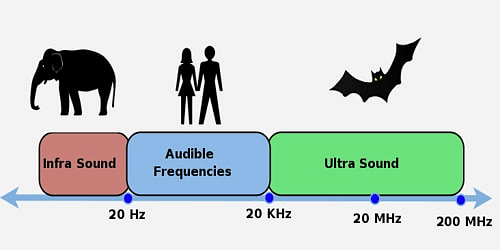
Ultrasound
Properties of Ultrasound Waves
[Click Here for Sample Questions]
The four main properties of ultrasound are given in the points below:
- Ultrasound waves cannot travel through a vacuum.
- These waves are high-frequency sound waves that have a smaller wavelength.
- These waves travel with a speed that is equal to that of sound in the given medium.
- The velocity of ultrasound waves remains constant in homogenous media.
Applications of Ultrasound
[Click Here for Sample Questions]
Ultrasound is used for various applications. It is useful in various fields of science, medicines, and even in daily practical activities because of its precision in results. Ultrasound waves have been used for a long time for multiple actions. It has only gained momentum with time and in today’s world, it is one of the most useful sources. Scientists are still discovering even newer applications of ultrasound in the field of medical sciences for conducting minor surgeries and treating patients. Given below are some applications of ultrasound:
- Ultrasonography: Ultrasound waves are used to project diagnostic imaging techniques to detect internal problems in the body. In this technique, internal body structures like muscles, bones, internal organs are imaged by passing pulses of ultrasound through the body. The sound hit the tissues issuing probe and echo off. Different issues reflect varying degrees of sound and form the final image. The images produced by ultrasound are called sonograms. Ultrasonography is used the most by doctors to check on a developing baby.

Ultrasonography
- Crack Detection: Ultrasound is used for crack detection in metallic components used in the construction of buildings and high-rise structures. The waves generate and display a type of ultrasonic waveform that is studied by a trained operator to locate and categorize cracks or flaws, often through the medium of analysis software. Since these waves have a very high frequency. they reflect from cracks and fissures in predictable ways, thus forming distinct echo patterns. These patterns are easily displayed and recorded on portable instruments. Trained operators identify specific patterns corresponding to the echoes produced from the good parts and the flawed parts.
- Echocardiography: Another application of ultrasound in the medical field is Echocardiography or ECG. This is also an imagining technique used to detect a patient’s heart condition. Ultrasonic waves are used in this technique to produce reflections from various parts of the heart and detect diseases

Echocardiography
- Lithotripsy: Ultrasonic waves are also used to break kidney stones. High energy sound waves are passed directly through the body that breaks the stones into small pieces without causing any injury. These fragmented stones move through the urinary tracts and are eliminated from the body easily.
- Cleaning and Clearing: Ultrasound is very helpful in cleaning objects like spiral tubes or electronic components, that have parts difficult to reach normally. In this process, the desired objects are put in a cleaning solution and ultrasonic waves are passed through it. The high frequency of these waves causes the grease and dirt to detach from the surface, thus cleaning them easily.
- Echolocation: One of the most important usages of ultrasound is in the process of echolocation, where sound waves are used to determine the movement of objects in the space. Echolocation is also the technique used by bats to navigate smoothly through the dark. Bats send out high-frequency sound waves from their mouths and nose that hit close objects like trees or buildings in the dark. These waves then reflect off from the surface. The nature of the echoes produced from these surfaces helps the bats determine the shape and distance of the objects and accordingly navigate through them.
- SONAR: Another major application of ultrasound is in the technique of SONAR- Sound Navigation and Ranging. In this process, high-frequency ultrasonic sound waves are passed through waterbodies for navigational purposes. The sound waves easily travel underwater and are used for communication and detection. The SONAR is the process of how submarines are detected as well.

SONAR
Things to Remember
- Any sound that is beyond the audible sound range of humans is called ultrasound.
- The approximate frequency of audible sound waves for humans is 20,000 Hertz.
- The physical properties of ultrasound are similar to that of normally audible sound.
- Ultrasound has applications in various fields of science, medicine, navigation, our practical activities, etc.
- Some examples where ultrasound is used are cleaning, detection of cracks, echocardiography, ultrasonography, lithotripsy, echolocations, SONAR, etc.
- Doctors use ultrasound in many medical treatments to perform minor surgeries, detect internal diseases or treat patients.
Also Read: Agriculture Soil
Sample Questions
Ques. What is the frequency of ultrasound waves? (2 Marks)
Ans. Ultrasound refers to those sound waves that are audible to humans. Sound waves with a frequency of more than 20,000 Hz or 20 kHz are called ultrasound waves. These sound waves are inaudible to the human ear as they lie beyond the audible sound range.
Ques. How does ultrasound help cancer patients? (2 Marks)
Ans. Ultrasound is used to detect cancer in patients. The waves are passed through the internal organs issuing a probe where they reflect off the surface and form an image called the sonogram. This imaging technique and the sound reflections help in detecting cancer. The high-frequency waves are also used in treatment processes for cancer patients.
Ques. Can ultrasound waves travel through water? (2 Marks)
Ans. Yes, ultrasound waves can travel underwater bodies. This is the reason why it is used in applications of Sonar to detect obstructions underwater or communicate with other submarines.
It is one of the most useful advantages of ultrasonic waves. Because of the higher frequencies of ultrasonic waves (or shorter wavelengths), they will travel greater distances with less diffraction.
Ques. How does ultrasound help in navigation? (2 Marks)
Ans. Ultrasound has a very high frequency which when hits surfaces, sends back reflections. These echoes are detected to locate these objects that lie in the path. This is how ultrasound helps in navigation. Some examples of navigational usage of ultrasound are seen in echolocation, where space objects are located through ultrasound, and in the movement of bats through the dark.
Ques. Name some applications of ultrasound in the medical field? (3 Marks)
Ans. The concept of ultrasound has turned out to be very useful in the medical field. So mpplications of ultrasound in the medical field are:
- Echocardiography
- Ultrasonography
- Lithotripsy
- Imaging Technique
- Mechanical Vibrations to relieve pain
Ques. What is the main difference between ultrasound and normally audible sound? (2 Marks)
Ans. The main difference between ultrasound and normally audible sound is that ultrasound waves have high frequencies with smaller wavelengths while normal audible sound waves usually have smaller frequencies with broader wavelengths.
The normal range of human hearing is around 20 to 20,000Hz while sound waves with a frequency of more than 20,000 Hz or 20 kHz are called ultrasound waves.<
Ques. Why can’t the human ear hear ultrasound? What is the usual speed of ultrasound waves? (2 Marks)
Ans. The ultrasound waves have frequencies as high as 20,000 Hertz which cross the audible sound range. This is why these sounds are not heard by the human ear in normal circumstances.
Ultrasound waves have a speed equal to the speed of sound in the given medium. The velocity of these waves remains constant in homogenous media.
Check More:



Comments