



Content Writer-SME
Ever wondered about the various things existing around you in the environment? Though some of them don’t have life, but they are very useful in making our work easier. What are they?
These are living and non-living things in the ecosystem that interdependent on each other for survival. The environment comprises land, air, water, trees, plants, animals, etc., and the entire ecosystem can be divided into two categories: Biotic and Abiotic Factors.
- The living elements of an ecosystem that have impact on the surroundings and interact with other living things are referred to as biotic factors.
- All living things, from tiny bacteria to giant mammals, and their interactions within the ecosystem are included in these components.
- Biotic factors can be broadly classified into three categories: producers, consumers and decomposers.
In this article, we will have a look at the biotic factors and their components with examples.
| Table of Content |
What are Biotic Factors?
[Click Here for Sample Questions]
The living organisms that make up, build, and shape the environment are called Biotic Factors. These are the important and major parts of the ecosystem. The interaction of biotic and abiotic factors forms the basis of an ecosystem.
- A biotic factor comprises living organisms that depend on others for survival.
- Some common examples of biotic factors involve animals, plants, and microorganisms.
- On the other hand, abiotic factors are non-living things that are available in the ecosystem.
- Examples of abiotic factors are temperature, sunlight, chemistry, geography and etc.,
However, some of the invasive species cause great threats and dangers to the ecosystem which in turn creates an imbalance in the ecosystem. So interaction, cooperation, and ccompetition are the three important key factors for a balanced ecosystem.
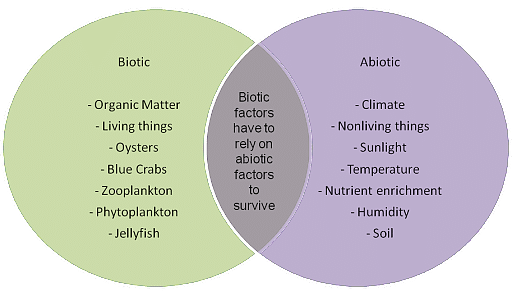
Interaction between biotic and abiotic factors
Biotic Components
[Click Here for Previous Year Questions]
Depending on the ecosystem and various living organisms, following are some of the important components of biotic environment:
Producers
Producers are also known as Autotrophs. An autotroph is a Greek word meaning self food. They make their own food without dependency on any other organisms.
- They are the first life forms that came into existence in the ecosystem.
- So, they didn’t depend on other things for survival.
- In a nutshell, life is impossible without producers on the earth.
- Thus, producers are subdivided into two groups:
Photoautotrophs
Photoautotrophs are green plants and trees that are capable of making their own food in the presence of sunlight by the process of photosynthesis. The majority of the living organisms present in the ecosystem are these Photoautotrophs.
- A pigment called chlorophyll present in the leaves of the plant captures photons from the sun and generates energy.
- This energy is used by photoautotrophs to form sugars, lipids, proteins, etc., for their consumption.
- They grow fruits and vegetables that in turn become food for the consumers.
- Therefore, photoautotrophs are considered as food manufacturers for all living organisms.
Green plants are multicellular, complex, and highly efficient for generating fuel and producing building materials. In the energy pyramid, the most bottom form is the photoautotrophs that manufacture food for the whole ecosystem.
Examples: Green plants, Trees, Green algae, Bacteria

Autotrophic Nutrition in Green Plants
Chemoautotrophs
Chemoautrophs are found rarely in the ecosystem. They generate energy from the chemicals in the atmosphere. For example, methanogens are the microorganisms that produce Methane, one of the most harmful gas responsible for greenhouse effect and global warming. Scientists were not able to find out the distinction between Photoautotrophs and Chemoautotrophs. As the majority of the Photoautotrophs use sunlight for energy, they are mostly recognized.
Consumers
These are also known as Heterotrophs. A heterotroph is a Greek word meaning other’s food. They depend on other living organisms to obtain energy and food. Autotrophs are their main source of energy and food. For their survival, they need to feed on the other living organisms. In this way, they develop a relationship of symbiosis with the other organisms.
- The consumers may be of various types such as herbivores, carnivores, and omnivores.
- Herbivores are animals that feed on green plants and trees.
- Carnivores are the organisms that further feed on herbivores.
- Omnivores are the animals that feed on Herbivores and Carnivores.
In the energy pyramid, there are various levels of consumers. For example, angiosperms are plants that produce fruits and flowers. Birds and insects get attracted to the nectar which helps in the reproduction of animals.

Biotic and Abiotic Factors of an Ecosystem
Decomposers
These are also known as detritivores. They feed on consumers and producers and break down the leftover materials into simpler materials. This doesn’t mean that they are carnivores. Decomposers are entirely different from carnivores. The carnivores feed on living organisms while the decomposers only feed on the dead animals.
- The waste and rotten materials of the dead organisms are completely eaten by the decomposers.
- In this way, they convert it into metabolic food and detritivores gain more energy.
- Besides, the heterotrophs also feed on these decomposed foods.
Now, here comes the main question that how are the dead organisms and rotten materials turned into metabolic food?
It is done through the process of composting. When a pile of waste materials of plants and animals is put together, the decomposers like algae, fungi, and other bacteria consume them and turn them into rich fertilizers. In fact, some of these materials are used for a good harvest of crops.
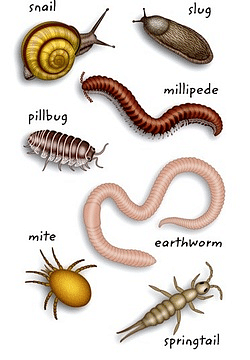
Examples of Decomposers
Thus, the autotrophs consume these fertilizers and produce food. The same cycle continues accordingly in the order of Producers, Consumers and Decomposers. This is the whole process that occurs in the ecosystem between the various components of biotic factors.
Examples for Biotic Factors
[Click Here for Sample Questions]
The various examples of biotic factors that exist in various ecosystems are:
Marine Ecosystem
- Algae
- Plankton
- Bacteria
- Plants
- Corals
- Fish
- Sharks
- Jellyfish
Terrestrial Ecosystem
- Trees
- Green Plants
- Soil Bacteria
- Fungi
- Mushrooms
- Herbs
- Shrubs
- All animals
- All Human beings
Things to Remember
- Biotic Factors are the living organisms that make, build and shape the environment.
- It comprises all the living organisms that depend on each other for their survival.
- Interaction, cooperation, and competition between these organisms are the important things for a balanced Ecosystem.
- The three types of Biotic Factors are Producers, Consumers, and Decomposers.
- Producers make food for themselves and the entire ecosystem.
- Consumers feed on other living organisms for food. The consumers may be of various types such as herbivores, carnivores, and omnivores.
- Herbivores are animals that feed on green plants and trees.
- Carnivores are the organisms that feed on herbivores.
- Omnivores are the animals that feed on Herbivores and Carnivores.
- Decomposers feed on consumers and producers and break down the leftover substances into simpler materials.
- Some of the examples of Biotic Factors are Green plants, trees, all animals, all human beings, microorganisms, etc.
Previous Year Questions
- Which of the following aquatic plant does not show pollination by water? … (KCET 2021)
- Aquatic reptiles are … (NEET 1999)
- Upper part of sea/aquatic ecosystem contains … (NEET 1988)
- An ecosystem which can be easily damaged but can recover … (NEET 2004)
- Energy transfer from one trophic level to other...[NEET 1999]
- the rate of production of organic matter by consumers….[NEET 2012]
- About 70% of total global carbon is found in...[NEET 2008]
- An ecosystem which can be easily damaged but can….[NEET 2004]
- The biomass available for consumption by the herbivores...[NEET 2010]
- Both hydrarch and xerarch successions lead to...[NEET 2011]
- During ecological succession...[NEET 2015]
- In a biotic community, the primary consumers are...[NEET 1995]
- In an ecosystem, which one shows one-way passage...[NEET 1988]
- Upper part of sea/aquatic ecosystem contains...[NEET 1988]
- Vertical distribution of different species occupying different...[NEET 2015]
- What is true of ecosystem?...[NEET 1988]
- Which ecosystem has the maximum biomass ?...[NEET 2017]
Sample Questions
Ques. What do Biotic Factors need to survive? (3 marks)
Ans. Biotic Factors include humans, animals, microorganisms, and all other living organisms in the ecosystem. Each organism requires food, nutrition, and energy to stay healthy and maintain a properly balanced ecosystem. They depend and feed on the other biotic and abiotic components to obtain energy.
Producers depend on sunlight to prepare their own food. Consumers feed on producers. And Decomposers feed on both producers and consumers. The mutual interaction between the organisms helps them obtain energy and help for reproduction as well. So, food and energy are needed for the biotic factors to survive.
Ques. Mention some examples of biotic factors? (5 marks)
Ans. Biotic Factors comprise all the living organisms present in the ecosystem. They may be plants, animals, Human beings, microorganisms and etc., These biotic factors are sorted as Producers or Autotrophs, Consumers or Heterotrophs, and Decomposers or Detritivores.
Some of the examples for Biotic Factors are:
Grass, Plants, trees as Producer.
Grasshopper, Mouse, Owl, deer as Consumers.
Earthworms as Decomposers.
Examples for Producers:
Green plants, trees, Small shrubs, phytoplankton, algae, herbs
Examples for Consumers:
Rabbit, Bear, Giraffe, Flies, Humans, Horses, Cows
Examples for Decomposers:
Fungi, earthworms, millipedes, termites, some insects, snails
Ques. Is paper biotic or Abiotic? (3 marks)
Ans. The ecosystem comprises living and nonliving organisms. The living organisms present are called Biotic Factors and the non-living organisms present are called Abiotic Factors.
Consider an example of Classroom as an ecosystem.
The human beings living in the classroom are considered biotic factors. And the non-living things such as desks, floors, lights, pens, pencils, paper, books are considered as Abiotic Factors. So, Paper is abiotic.
Ques. How do biotic and abiotic factors work together? (5 marks)
Ans. The ecosystem comprises both living and non-living organisms. Abiotic Factors like temperature, light, air, land interact with the biotic factors to produce food, generate energy, and help them grow. Water, sunlight, phosphorous, nitrogen, carbon are some of the examples.
Another way where biotic and abiotic factors are interconnected is changing the Geology and Geography of an area. Some animals may break down the rocks or create topsoil providing detritus that in turn forms new soil and provides nutrients. So, there is interaction, cooperation, and competition between the biotic and abiotic factors. Only then do the living and non-living organisms survive and maintain a balanced Ecosystem.
Ques. What are the most important biotic factors? (5 marks)
Ans. Producers are the most important biotic factors. They produce their own food and generate energy. They only depend on sunlight, water, and air or chemicals and prepare their own food. In fact, they prepare food for the whole ecosystem. They are the first life forms that start the life cycle in the ecosystem.
Only by feeding on the producers, the consumers survive. They make their own food and do not depend on any of the other organisms. They are the first life forms that came into existence in the ecosystem. So, they didn’t depend on other things for survival. In short, there is no life without the producers. Without producers, there is no life. So, Producers also known as Autotrophs are the most important biotic factors.
Ques. How are biotic factors divided? (5 marks)
Ans. Biotic Factors include all the living organisms present in the ecosystem. They are divided into three categories: Producers, Consumers, and Decomposers.
- Producers make food for themselves and the entire ecosystem.
- Producers are again subdivided into Photoautotrophs and Chemoautotrophs.
- Photoautotrophs are the plants that use sunlight and obtain energy While Chemoautotrophs are the organisms that use chemicals to obtain energy.
- Consumers feed on other living organisms for food. The consumers may be of various types such as herbivores, carnivores, and omnivores.
- Herbivores are animals that feed on green plants and trees.
- Carnivores feed on herbivores.
- Omnivores are the animals that feed on Herbivores and Carnivores.
- Decomposers feed on consumers and producers and break down the leftover materials into simpler materials.



Comments