



Education Journalist | Study Abroad Lead
Vascular cambium is a type of cell associated with the primary and secondary growth of plants. As these cells divide and multiply in number, the plants increase their girth. Xylem is a vascular tissue which transports water and minerals through the plants, growing inward from the vascular cambium. Phloem is a vascular tissue which transports sugar and large molecules, growing outward from the vascular cambium. When the vascular cambium cells divide, they result in the creation of more xylem and phloem cells.
| Table of Content |
Key terms: Vascular Cambium, Cork Cambium, Xylem, Phloem, Secondary Growth, Dicots, Monocots
Also Read: Xylem Vs Phloem
Occurrence of Vascular Cambium
[Click Here for Sample Questions]
Plants undergo primary and secondary types of growth. While primary growth of the plants involves growing taller, secondary growth occurs when plants grow wider. Vascular cambium is found in dicots and gymnosperms but not in monocots, which usually lacks the secondary growth of the plants.
Vascular Cambium
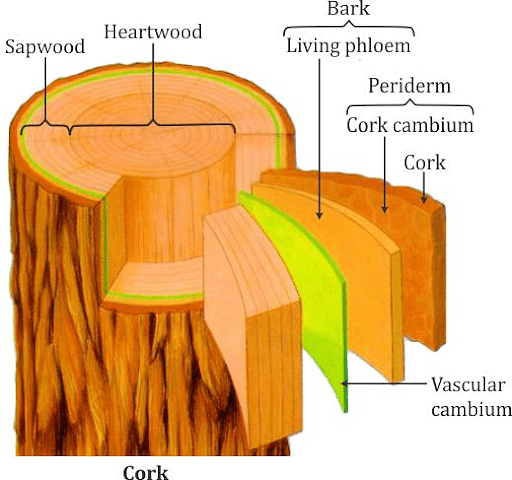
In the trees of dicots and gymnosperms, vascular cambium is a line which separates the bark and wood of trees, they also have a cork cambium. For successful grafting, the vascular cambia of the rootstock and scion must be aligned so that they can grow together efficiently.
Read More:
Cork Cambium
[Click Here for Sample Questions]
Cork cambium is found in the bark of wooded plants. It is used for creating cork cells for healthy trees. In cork cambium, primary growth occurs when plants grow towards the sunlight necessary for photosynthesis and enable them to absorb water and nutrients.
Cork Cambium
Read More: Budding
This type of up and down growth is known as apical meristem, which is a stem cell-like tissue that creates an undifferentiated cell that will become either a new root or shoot tip. Cork cambium is one of the plant's meristems which is a collection of tissues containing a number of embryonic cells for which the growth of plants is responsible. The function of the cork cambium is to develop the cork, which is a tough protective material and secondary cortex.
Read More:
Origin of Vascular Cambium
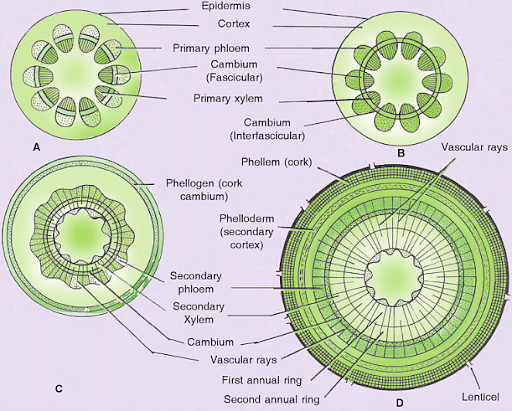
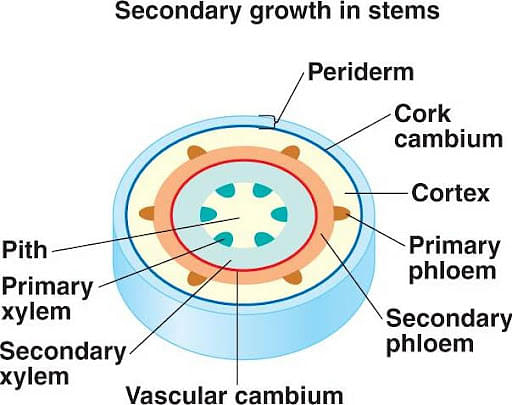
In stems, the vascular cambium and primary vascular tissues differentiate from procambium. Procambium develops derivative cells of the apical meristem. Transverse sections of a growing vegetative shoot apex disclose the presence of a cylinder of cells that are highly cytoplasmic and denser. The ring of cells is regarded as a residium of meristematic tissue or apical meristem and is known as residual meristem.
Origin of Vascular Cambium
Procambium gives rise to permanent tissues and it is normally to designate the tissues as primary. The derivative cells of the cambium are designated as secondary. In normal dicotyledonous roots, the vascular cambium seems to be wavy.
Also Read: Asexual Reproduction
Activity of Vascular Cambium
Vascular cambium is one cell thick and cells of cambium are compactly set without having any type of intercellular spaces. The derivative cells may differentiate directly into the new secondary phloem to the outer and the new secondary xylem to the interior. The cambial activity is related to rainfall and temperature in tropic and temperate zones.

Function of Vascular Cambium
In tropical zones, the vascular cambium of species is active throughout its entire life. In temperate zones, the vascular cambium remains inactive in winter. It activates in spring and produces secondary vascular tissue. Due to the cambial activity, the girth of plants increases. The circumference of the vascular cambium increases to cope up with increase in girth of the axis. Activation/deactivation of cambial activity occurs over the entire life of a plant which is followed by a period of latency.
Read More:
Things to Remember
- Cork cambium and vascular cambium are two types of cambia in plants that have secondary growth.
- Cork cambium and vascular cambium are meristematic tissues.
- Cork cambium develops from the secondary lateral meristem while the vascular cambium develops from the apical meristem.
- Cork cambium arises from the bark and the secondary cortex.
- Vascular cambium arises from the secondary xylem and secondary phloem.
- Both cork and vascular cambium are found in dicots.
- Both cork and vascular cambium are found in cylindrical rings.
Also Read: Anatomy of dicots and monocots
Sample Questions
Ques. What are the roles of vascular cambium? (3 Marks)
Ans. The vascular cambium is a meristematic tissue which is involved in the lateral growth and the production of new xylem and phloem. The shoot vascular cambium in woody plants comprises the wood. The arrangement of primary phloem and xylem in the roots avoids the vascular cambium initially from forming a circular configuration. The secondary xylem expands the capacity of the plants to conduct minerals and water up from the roots. The secondary phloem raises the transportation of food from the leaves. The old phloem cells cannot conduct as they are stretched and broken when new cells are generated by vascular cambium pushed towards the outside.
Ques. Describe the structure of the vascular cambium. (3 Marks)
Ans. The vascular cambium is situated between the primary xylem and primary phloem in the vascular bundle. The cells of vascular cambium divide and form the secondary xylem which comprises tracheid and secondary phloem which are made up of sieve elements and companion cells to the outside. The vascular cambium consists of two types of meristems -
- Fascicular cambium or intra-fascicular cambium
- Interfascicular cambium
Fascicular vascular cambium is a primary meristem which is situated as strips in vascular bundles while interfascicular cambium arises from the cells of medullary rays which occur at the level of intra-fascicular strips.
Ques. What are the functions of Vascular cambium? (3 Marks)
Ans. The major function of vascular cambium is the formation of xylem and phloem cells.
- Vascular cambium plays a major role in the growth of roots and shoots.
- It forms the inner bark of the tree and wood of the tree and is responsible for the thickness of the plants.
- It forms the secondary xylem internally and the secondary phloem externally.
Ques. Define the following terms Angiosperms, dicotyledons, monocotyledons (3 Marks)
Ans. Angiosperms - Angiosperms are flowering plants. They are seed-producing plants and are the most diverse group of terrestrial habitat plants.
Dicotyledons - Dicotyledons are flowering plants which produce seeds that have two cotyledons. They are also known as dicots. Grains are an example of dicotyledons.
Monocotyledons - Monocotyledons are flowering plants which produce seeds that have only one cotyledon. They are also known as monocots. Ginger is an example of dicotyledons.

Angiosperms
Ques. State differences between monocot roots and dicot roots. (5 Marks)
| Monocot roots | Dicot roots |
|---|---|
| Monocot root has a wide cortex area. | Dicot root has a narrow cortex area. |
| Monocotyledons contain only one embryonic leaf. | Dicotyledons contain two embryonic leaves. |
| In monocot root, there are more numbers of xylem and phloem vascular tissues. | In dicot root, there are less numbers of xylem and phloem vascular tissues. |
| Secondary growth is absent in the case of monocot root. | Secondary growth takes place to keep up vascular cambium and cork. |
| Cambium is absent in the monocot root. | Cambium is present in the dicot root and it is formed due to the conjunctive parenchyma. |
| Monocot roots have a well-developed pith. | Dicot roots have a very small pith, and sometimes it is absent. |
| In monocot roots, the number of xylem and phloem can be more than eight.
| In dicot roots, the number of xylem and phloem varies from 2-8.
|


Ques. What are the characteristics of meristematic tissues? (3 Marks)
Ans. Characteristics of meristematic tissues are -
-
Meristematic tissues are very active and are capable of repeated divisions.
-
The shape of meristematic cells is isodiametric in shape.
-
There are no intercellular spaces in between the meristematic tissues.
-
There is an absence of chloroplast in meristematic tissues.
-
They contain young and immature cells.
-
They contain proto plastids instead of plastids.

Meristematic tissue
Ques. What are the similarities between cork cambium and vascular cambium? (2 Marks)
Ans. Similarities between cork and vascular cambium are -
- Both cork and vascular cambium are present in dicot plants.
- Both provide protection and structural support to the plants.
- Both are responsible for the secondary growth in stems and roots.
- Both originated from meristematic tissues.
Ques. What are the differences between cork cambium and vascular cambium? (5 Marks)
Ans. Differences between cork cambium and vascular cambium are as follows -
| Cork Cambium | Vascular Cambium |
|---|---|
| Cork cambium is a cylindrical layer of meristematic tissue. They are found between primary xylem and secondary phloem. | Vascular cambium is the lateral ring of meristematic tissue in woody plants. |
| They are located outside the vascular tissues. | They are located between primary xylem and primary phloem. |
| It gives rise to the secondary cortex and bark. | It gives rise to secondary xylem and secondary phloem. |
| The shape of the cork cambium is rectangular. | The shape of the vascular cambium is cuboidal. |
| Cork cambium is also called phellogen. | Vascular cambium is also called cambium. |
| Cork cambium is responsible for the protection against physical damage and prevents water losses. | Vascular cambium is required to produce vascular tissues to help conduction inside the plants and provide structural support to them. |
| Cork cambium produces lentils that allow exchanges of gases between wood and the outside air. | Vascular cambium produces vascular rays which allow water and nutrients transformation between the secondary xylem and secondary phloem. |
Read More:



Comments