



Content Writer-SME
Vegetative Propagation, also referred to as vegetative reproduction, vegetative multiplication or cloning, is an asexual reproduction that takes place in all vascular plants. Through this process, a new plant grows from a fragment of the parent plant or specialised reproductive structures like rhizome, tuber, corn, scion or bulb.
- Natural and artificial propagation are the two means of vegetative reproduction in plants.
- Grafting, cutting, and layering falls under the category of artificial vegetative propagation.
Define Vegetative Propagation
[Click Here for Sample Questions]
The living organisms reproduce either sexually or asexually. Asexual reproduction is the process by which an organism reproduces its offspring without the involvement of the male and the female gametes. It takes place through the Binary Fission in Spirogyra, Regeneration in Planaria, Budding in Hydra, and Vegetative propagation in the plants.
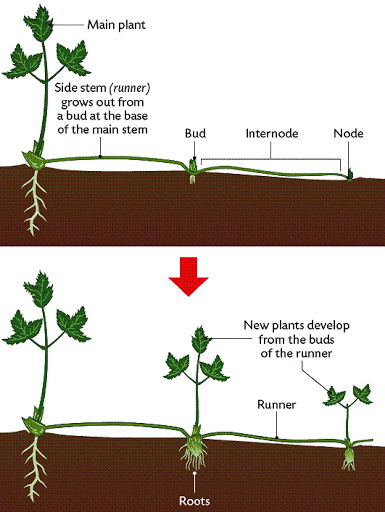
Fig: Vegetative Propagation
Vegetative Propagation occurs through the means of the roots, stems, and leaves of the plants. So basically, a whole new plant could be generated through existing different parts of the plants. The plants like Banana, Sweet potato, Cassava, and pineapple propagate vegetatively. This process may vary within various plant systems, meaning, it is not necessary that every plant could grow through roots only, or leaves only, the process is very unique to the plant species.
Types of Vegetative Propagation
[Click Here for Sample Questions]
- Natural Vegetative Propagation
- Artificial Vegetative Propagation

Natural Vegetative Propagation
This type of vegetative propagation occurs naturally, that is without any human intervention. Every plant is unique because of the adaptations or modifications acquired by it due to the environmental conditions around it. Hence, in some plants, the roots can vegetatively propagate, while in others the stem can propagate vegetatively. Let’s look at the various plant parts involved in natural vegetative propagation:
- Roots: Tubers (modified roots) help in the propagation of a whole new plant from the parent plant. For example, Dahlia (tubers).
- Stem: Runners (Modified Stem) have buds at the nodes that can give rise to a completely new plant. Mint runners propagate vegetatively into a new plant.
- Leaves: The vegetative propagation occurs through the leaves of that plant bearing a special character. For example, Bryophyllum.
- Bulbs: Few plants develop a bulbous shoot. These bulbs help in the vegetative propagation of that plant species. For example, onions, Garlic, etc.
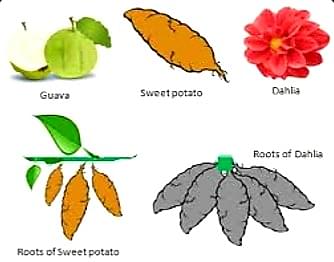
Artificial Vegetative propagation
This type of propagation involves human intervention. We use the following mentioned techniques to artificially grow the plants for selling, manufacturing of different plant products, and many other purposes. These techniques are used by the farmers to cultivate and even mix the plant breeds. These methods are:
Tissue Culture

- Plants have the characteristic of totipotency. Basically, it is the tendency of a single cell of the plant to grow into a whole new plant.
- Scientists take advantage of this property of plants in order to increase the production of the plants.
- This type of technique is used when the conditions are not favorable for plants to grow in the outdoor atmosphere.
- It is also useful in culturing the endangered species of various plants. For example, potatoes and Sugarcane.
Grafting

- This method is widely used by farmers to produce a variety of plant characteristics from different plants into one.
- Basically, a stem from one plant is placed on the stem of the other plant to form a hybrid.
- Here, the stem of plant A bears a cut on the surface, such that the inner cortex is visible.
- The stem of Plant B is cut from it and its end is duly attached to the cut surface of Plant A and these are covered with plastic, tightly.
- A few days after this procedure, one might have a plant with a stem bearing mixed characteristics of both the plants. Mostly, Apples and Pears are grown by this method.
Cutting
?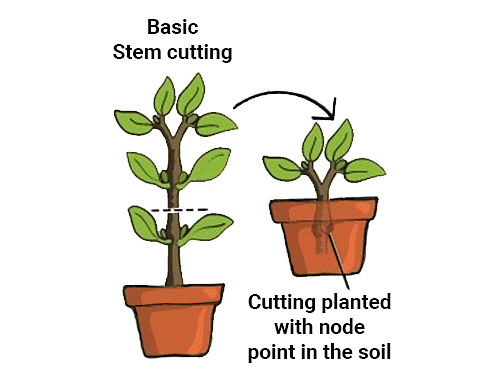
- In this technique, the plant part, especially the shoot or the root part, is cleaved.
- A slanting cut is provided to these stems to increase the surface area for even more absorption of water.
- A few days after conducting these procedures, one must observe the growth of the adventitious root on the end of the stem.
- At times, some growth hormones are applied to increase the rate of growth taking place in the plant. Roses are grown by using this method.
Layering
- In this method, a deep rectangular cut is provided to the plant stem, so deep that it reaches the outer pericycle of the vascular bundles.
- Above the surface of this cut, a moist moss is placed and the whole stem is covered with it.
- The plastic is wrapped around this stem part, in order to retain moisture.
- This procedure is a type of Air-layering, done mostly in case of the woody plants.
- The other technique is soil layering, wherein the extended plant stem is bent downward and buried under the soil.
- This technique will help in the growth of adventitious roots on the buried part of the stem. Examples: Boxwood, Honeysuckle, Wax myrtle, etc.
Frequently Asked Questions
Ques: What is Vegetative propagation? (1 mark)
Ans. Vegetative propagation is a method by which a plant reproduces without the involvement of male and female gametes. Basically, a vegetative part of the plant is used for the generation of a completely new plant.
Ques: What are the types of vegetative propagation? (2 marks)
Ans. The Natural and Artificial ways are the types of Vegetative propagation. They have the following methods:
- Natural vegetative Propagation by:
- -Roots
- -Stem
- -Leaves
- -Bulbs
- Artificial vegetative Propagation by:
- -Tissue culture
- -Grafting
- -Cutting
- -Layering
Ques: Give examples of vegetative propagation. (1 mark)
Ans. Vegetative Propagation is observed in garlic and onions through the bulb, Dahlia through Tubers, Mint through the stem, etc.
Ques: What are the advantages of Vegetative propagation? (1 mark)
Ans. The most important advantage of vegetative propagation is that the offspring is a complete copy of the parent, genetically. This helps in retaining the characteristics and having multiple pure copies of one species. Apart from this, the vegetative propagation methods are cost-effective and provide high yield, and are easy to use.
Ques: What are the disadvantages of vegetative propagation? (1 mark)
Ans. Vegetative Propagation may seem easy, but the disadvantages are visible when the environment of the plant is changed. The plants grown by this method are not so adaptive to the environment.
Ques: State the difference between asexual and Vegetative reproduction? (1 mark)
Ans. The basic difference between asexual reproduction and vegetative reproduction is that the latter is a type of asexual reproduction. Apart from that, it is unique to the plant world only. Hence named ‘vegetative’ propagation.
Ques: What kind of reproduction takes place in Bryophyllum? (1 mark)
Ans. Bryophyllum undergoes vegetative reproduction through its leaves. This is a type of natural Vegetative Propagation.
Ques: What is totipotency? (1 mark)
Ans. Totipotency is the property possessed by the plants. It is the tendency of a single cell of the plant to develop/grow into a whole new plant.
Ques: How is fragmentation different from regeneration?
Ans. Fragmentation is seen in the Spirogyra, where the linear fragments are ‘regenerated’ into a whole new organism. Whereas, Regeneration may take place in a plant or any other organism through a part that is shaped anyhow.
Ques: Which is the most widely used technique from artificial vegetative propagation? (1 mark)
Ans. The most widely used technique for artificial propagation is Air layering or gootee technique, as it provides the results faster and the yield is also more in this case.
Sample Questions
Ques: Write the method used for growing rose plants. (1 mark)
Ans: In order to grow rose plants, artificial methods of vegetative propagation like cutting are used.
Ques: State the type of method used for growing jasmine plant. ? (1 mark)
Ans: For growing jasmine plant, artificial methods of vegetative propagation like layering are used.
Ques: Write any four reasons for vegetative propagation being practised in the growth of some type of plants. (2010) (2 marks)
Ans: Any four reasons for vegetative propagation being practised in the growth of some type of plants are:
(i) Vegetative propagation is a cheaper, easier and more rapid procedure of propagation in plants than growing plants from their seeds.
(ii) By this method, better quality of plants can be maintained.
(iii) Then, it results in propagation of those plants which do not produce viable seeds with a prolonged period of dormancy.
(iv) The plants that are generated from vegetative means are more uniform and genetically similar to the parent stock.
Ques: Explain vegetative propagation with the help of two examples. Write two advantages of vegetative propagation. (3 marks)
Ans: In vegetative propagation, new plants grow from the parts of old plants like stem, root, leaves, without the help of any reproductive organs.
There are two types of vegetative reproduction:
- Natural Vegetative Propagation
- Artificial Vegetative Propagation
Natural vegetative propagation by leaves: The fleshly leaves of Bryophyllum bear adventitious buds in the notches along the leaf margin.
Grafting: In this type of propagation, two plants of closely related varieties are joined together so that they live as one plant.
The two advantages of vegetative propagation are:
(i) Vegetative propagation is a cheaper, easier and more rapid procedure of propagation in plants than growing plants from their seeds.
(ii) By this method, better quality of plants can be maintained.
Ques: Illustrate the following with the help of suitable diagrams:
(i) Regenaration of Planaria
(ii) Budding in Hydra (2 marks)
Ans:



Comments