



Content Curator
Volume of a Cylinder is basically used to measure the cylinder’s capacity as well as the amount of space occupied by the cylinder. Water tanks, gas cylinders, and cylindrical flasks are some examples of cylinders. The volume of a cylinder can be obtained using the area of the cylinder as well as the formula volume of the circle. Sum up the areas of all the faces of a cylinder to calculate the total surface area of a cylinder.
Also Read: Sphere Formula
| Table of Content |
Key Terms: Cylinder, Right circular cylinder, Volume, Right circular hollow cylinder, Oblique Cylinder
Volume of Cylinder and Types
[Click Here for Sample Questions]
The cylinder has a three-dimensional shape and has two congruent and parallel identical bases also.
- Right circular hollow cylinder: It has two right circular cylinders that are bounded one inside the other.
- Oblique Cylinder: It has sides that lean over the base at an angle that is unequal to a right angle.
- Right circular cylinder: It has bases that are circles as well as every line segment is perpendicular to the bases as a part of the lateral curved surface.
- Elliptic Cylinder: It has bases that are ellipses shaped.
The video below explains this:
Surface Area and Volume Detailed Video Explanation:
Derivation of Formula
[Click Here for Sample Questions]
To derive the formula of a cylinder, we require having the formula area of the cylinder. Assume two circular surfaces packed one upon the other having a curved surface in the middle as support. This is the basic structure of a cylinder. Before finding out the formula for the volume of a cylinder, we will first have to know the separate volume of each surface.
Let’s have 'h' as the height of a curved surface.
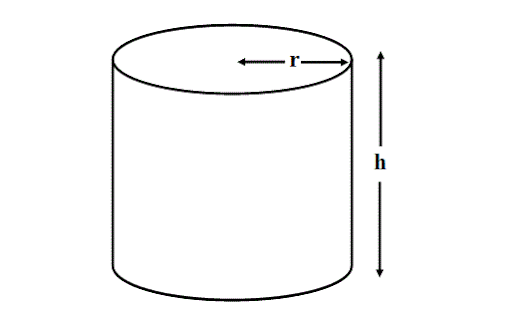
However, πr² is the formula for the area of a circle. We can get the formula of the cylinder, by adding the above formulas.
Hence, the volume of a cylinder, V is πr2h.
The radius of the circle is r.
Therefore, you can get the volume of a cylinder by the product of height with the area of the circle. This can also be defined as the volume of the right circular cylinder (πr2h).
Read More: Circle
Surface Area of a Cylinder
[Click Here for Sample Questions]
The curved surface area of a cylinder (CSA) is the measure of the curved surface area only that the cylinder occupies; apart from the flat circular surfaces.
The curved surface area of a cylinder formula (CSA) = 2πrh
Hence the total surface area of a cylinder (TSA) is the measure of the total area that is occupied by the surface of a cylinder.
Therefore, the total surface area of a cylinder formula (TSA) of a cylinder = 2πrh + 2πr2 = 2πr (h+r).
Also read: Difference between Area and Volume
Applications of Cylinder
[Click Here for Sample Questions]
We come across various situations where we have to handle cylindrical objects in our day to day life. If you want to calculate the volume or capacity of cylindrical objects, you need to know the volume of a cylinder. Also, the calculation can assist you in making cylindrical containers of any volume or capacity as per the requirement. For instance, cylindrical containers, cylindrical water tanks, perfume bottles, cylindrical flasks that are used in chemistry labs, etc. If you have the measurements of cylinders' height and radius, you can easily know the volume of a cylinder.
Read More: Area of a Circle
Things to Remember
- In addition to its three-dimensional shape, the cylinder has two parallel, congruent bases.
- Volume of a cylinder, V = πr2h
- Volume of the cylinder = Area of the circular base × Height
- Volume of a Right Circular Hollow Cylinder, V = π(R2 - r2)h
- Volume of an Elliptic Cylinder= V = πabh
Sample Questions
Ques: Name some of the properties of a cylinder. (2 Marks)
Ans: The properties of a cylinder are,
- It has a three-dimensional solid structure.
- It has two edges and three faces and does not have any vertices.
- It has two identical surfaces that are present at extreme positions.
Ques: Calculate the radius of the base (π = 22/7) if the volume and height of a cylindrical container are 440 m3 and 35m respectively. (3 Marks)
Ans: Given that,
Volume of the cylindrical container = 440 m3
Height of the cylindrical container = 35 m
Volume of a Cylinder = πr2h
= 440 m3= πr2h
= r2=440/ πh = (440 × 7 / 22 × 35)
= r2 = 4 m
= r = 2 m
Therefore, the radius of the base of the cylindrical container= 2 m.
Ques: Calculate the volume of a cylindrical water tank that has a base radius of 25 inches and height of 120 inches. (π = 3.14) (3 Marks)
Ans: Given that,
The radius of the cylindrical tank is, r = 25 inches.
Its height is, h = 120 inches.
To find that,
The volume of a cylindrical water tank
The volume of cylinder formula (Volume of the tank), V = πr2h
V = (3.14)(25)2(120) = 235500 cubic inches.
Therefore, the volume of the given cylindrical tank is 235,500 cubic inches.
Ques: What is the relation between a cone and a cylinder? (2 Marks)
Ans: As we already know, the cone and cylinder have circular faces. The volumes need an area of a circle formula. Consider ‘h’ as the height 'h' for the Cone.
Therefore, The volume of a Cylinder = πr2h and,
The volume of a Cone = (πr2h)
Ques: Calculate the litres of water that a cylindrical water tank with a base radius of 20 cm and height of 28 cm can hold? (3 Marks)
Ans: Given,
Height of the cylindrical water tank, h = 28 cm
Base radius of the cylindrical water tank, r = 20 cm
We know that,
Volume of the cylindrical water tank = πr2h
= Volume of the cylindrical water tank = 22/7 × 202× 28 = 35200 cm3
= 1 cubic centimeter = 0.001 litre =1 × 10⁻³ litre
= 35200 cubic centimeter = 35200 × 10-3 = 35.2 litres.
Hence, the cylindrical water tank can hold 35.2 litres of water.
Ques: Calculate the volume of an elliptic cylinder that has base radii of 7 inches and 10 inches, and has a height of 15 inches. (π = 22/7) (3 Marks)
Ans: Given that,
The base radii of the given elliptic cylinder are given as a = 7 inches and b = 10 inches.
The height is, h = 15 inches.
By the volume of cylinder formula,
The volume of the given elliptic cylinder is, V = πabh
= V = (22/7) × 7 × 10 × 15 = 3300 cubic inches.
Therefore, the volume of the cylinder given is 3,300 cubic inches.
Ques: Calculate the number of cubes formed if the solid cylinder having base radius of 10cm and a height of 7cm is melted and re-casted into small cubes of edge 2cm. (3 Marks)
Ans:
Given that,
The base radius of a solid cylinder =10cm
The height of solid cylinder =7cm
Edge (a) of the cube =2cm
We know that,
Volume of a cylinder =πr2h
Volume of a solid cylinder =22/7×10×10×7cm3=2200cm3
Volume of a cube =a3
Volume of small cube =23=8cm3
=2200cm3/8cm3=275
Therefore, the number of small cubes formed is 275.
Ques: Calculate the volume of the cylinder with a radius of 4 units and a height of 6 units. (2 Marks)
Ans: Given that,
Radius,r = 4 units
Height,h = 6 units
Volume of the cylinder, V = πr2h cubic units.
V = (22/7) × (4)2 × 6 V = 22/7 × 16 × 6
V= 301.71 Cubic units.
Hence, the volume of the cylinder is 301.71 cubic units.
Ques: Calculate the radius of the base of a cylinder with the volume of 220m3, and the height of 10m. (2 Marks)
Ans: Given that,
Height (h) of the cylinder =10m
and Volume of a cylinder =220m3
We know that,
Volume of a cylinder =πr2h
=220m3 = 22/7 × r2 × 10m
=r2 = 7m2
⇒r = √7m
Therefore, the radius of a cylinder is √7m.
Ques: Find the volume that a milk bottle of a base of 2 cm and height of 5 cm can hold? (2 Marks)
Ans: Given that,
Radius (r) of base = 2 cm
Height (h)= 5cm
We know that,
Volume of a cylinder = πr2h
=22/7×2×2×5cm3=62.86cm3
Therefore, the volume of a cylindrical milk bottle is 62.86cm3.
Read More:
Read More:
| Maths Study Material | ||
|---|---|---|
| NCERT Solutions for Class 10 Maths | CBSE Class 10 Notes | Class 10 Maths Notes |



Comments