



Exams Prep Master
The noble gases are the chemical elements that are present in group 18 of the periodic table. These elements are the most stable due to having the maximum number of valence electrons that their outer shell can hold. As they are already stable, they rarely react with other elements. Let’s know more about the topic, its properties along with few important questions.
What are Noble Gases?
Noble gases are the elements present in group-18 of the modern periodic table. Their valence shell configuration is full, due to which they are chemically inert. They are also known as inert gases and aerogens. Group-18 belongs to the p-block in the modern periodic table.
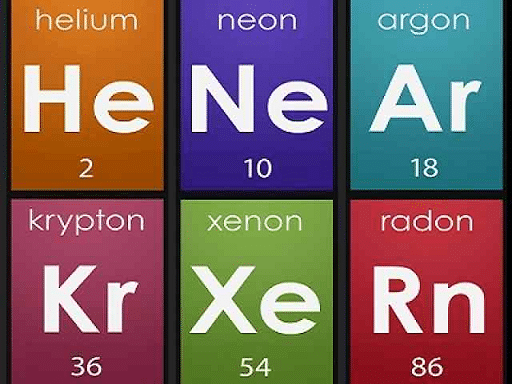
They have very low chemical reactivity because of their stable electronic configuration. Because of this, they do not form molecules and are found as monoatomic gases. At normal room temperature and pressure, they are in a gaseous state.
Elements of group-18: Helium, Neon, Argon, Krypton, Xenon, Radon
General electronic configuration: [inert gas] ns2np6 (exception He: 1s2)
Download the PDF of Noble Gases
Properties of Noble Gases
- Noble gases are found in the monoatomic form at room temperature and pressure.
- The atomic radius increases with atomic number as we go down in the group.
- These elements have low melting and boiling points.
- They do not possess any taste, color, or odor.
- They are sparingly soluble in water.
- Due to their stable electronic configuration, they are mostly chemically unreactive.
Properties of Helium
Of all the substances, Helium is found to have the lowest boiling point. It is a light and non-inflammable gas and is used in balloons for meteorological purposes. It is also used for experimental purposes, in nuclear reactors, and for clinical purposes. In small concentrations, helium is non-toxic. It is also the lightest noble gas.
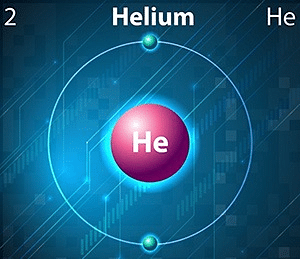
Moreover, Helium is an s-block element that corresponds to period 1 and group 18 of the modern periodic table. The electron configuration of helium is 1s2 which is why this element has a total of 2 electrons in its valence shell. The density of this element corresponds to 1.7186 grams per litre under standard conditions for temperature and pressure. But in its liquid state, the density becomes approximately equal to 0.145 grams per cube centimetre.
Atomic Symbol: He
Atomic Number: 2
Electronic Configuration: 1s2
Period: 1
Valence electrons: 2
Properties of Neon
Neon is the second-lightest noble gas. It is used in light bulbs and making advertising signs. Although under standard conditions for temperature and pressure (STP), it is colourless under normal conditions, it turns reddish-orange in a vacuum discharge tube. It is also used as a cryogenic refrigerant. This gas does not possess any characteristic odor.
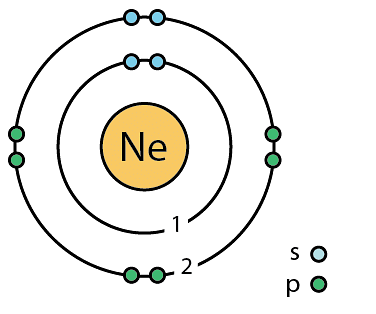
Moreover, neon is the second-lightest noble gas after helium. The boiling point of neon is 27.104 Kelvin (or -246.046 degrees Celsius). At STP, the density of this gas is approximately equal to 0.9 grams per litre. However, in its liquid state i.e, at a temperature equal to its boiling point, the density of neon is equal to 1.207 grams per cubic centimeter.
Atomic Symbol: Ne
Atomic Number: 10
Electronic Configuration: [He] 2s22p6
Period: 2
Valence electrons: 8
Properties of Argon
After nitrogen and oxygen, argon is the third most abundant gas in the atmosphere with a concentration of 0.93%. Argon is often used to create an inert atmosphere in industrial processes. One such use is for the production of titanium and other reactive elements.
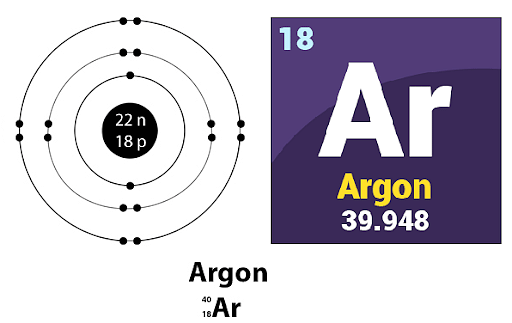
Under standard conditions for temperature and pressure, argon exists as a colorless gas that displays a violet or lilac-colored glow when it is placed in an electric field.
Moreover, Argon is a p-block element that is equal to group 18 and period 3 of the modern periodic table. The melting point of argon is 83.81 Kelvin while its boiling point corresponds to 87.302 Kelvin and under the STP, the density of argon is approximately equal to 1.784 grams per litre.
Atomic Symbol: Ar
Atomic Number: 18
Electronic Configuration: [Ne] 3s23p6
Period: 3
Valence electrons: 8
Properties of Krypton
Krypton is among the rarest gases found on Earth. It is used in fluorescent lights. One of its isotopes, 85Kr, is used in the medical field. It is not completely unreactive like other noble gases and reacts with chlorine gas and the gas is also known to be tasteless.
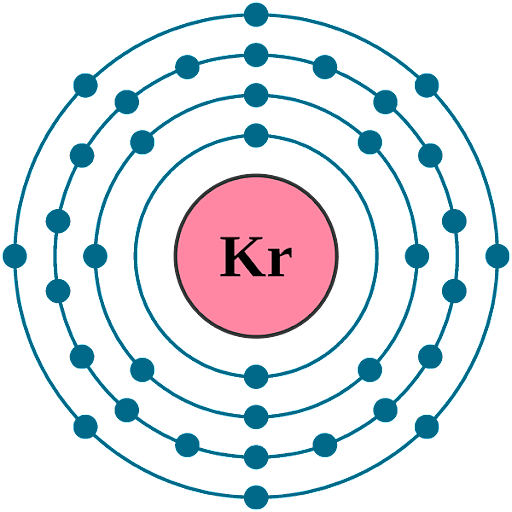
The melting point of this element corresponds to 115.78 Kelvin (approximately) whereas the boiling point of this element corresponds to 119.3 Kelvin. Under the standard temperature and pressure, the density of this element is roughly equal to 3.75 grams per litre.
Atomic Symbol: Kr
Atomic Number: 36
Electronic Configuration: [Ar] 3d104s24p6
Period: 4
Valence electrons: 8
Properties of Xenon
Xenon is a heavy and rare noble gas. It is 4.5 times heavier than air. In the medical field, it is used as an anesthetic agent. It has applications in photography where it is used in high-speed flashbulbs. Unlike other inert gases, Xenon is known to form some chemical compounds.
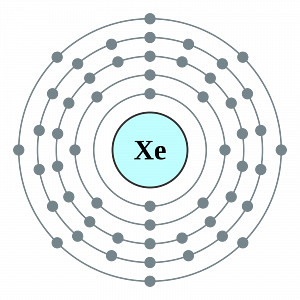
Under standard conditions, this element exists as a monoatomic gas that is colorless as well as odorless. The melting point of xenon corresponds to 161.4 Kelvin whereas the boiling point of this element corresponds to 165.05 Kelvin. Under the standard temperature and pressure, the density of xenon is approximately equal to 5.89 grams per litre.
Atomic Symbol: Xe
Atomic Number: 54
Electronic Configuration: [Kr] 4d105s25p6
Period: 5
Valence electrons: 8
Properties of Radon
Radon is a radioactive gas and is not found directly in the atmosphere. It is one of the rarest elements of the group. 222Rn is the most stable isotope of radon and has a half-life of 3.8 days. One of the prominent uses of radon is in cancer therapy.
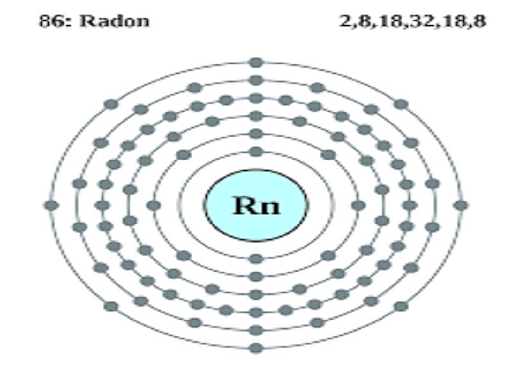
Under standard conditions of temperature and pressure, radon, like most other noble gases, is a colorless and odorless gas and does not have any characteristic taste. The melting and boiling points of radon correspond to 202 Kelvin and 211.5 Kelvin respectively.
Atomic Symbol: Rn
Atomic Number: 86
Electronic Configuration: [Xe] 4f145d106s26p6
Period: 6
Valence electrons: 8
Recommended video:
Things to Remember
- Group-18 elements are mostly chemically unreactive because of their stable electronic configuration and thus are known as noble gases or inert gases.
- Their general electronic configuration is of the type [inert gas] ns2np6, except for Helium, whose configuration is 1s2.
- Under normal conditions of room temperature and pressure, group-18 elements are found in gaseous form. They are found in monoatomic forms and are colourless, odorless, and tasteless.
- Helium has the lowest boiling point of all substances.
- Neon turns reddish-orange in a vacuum discharge tube but is otherwise colorless under normal conditions.
- Argon has the third-highest concentration of all gases on earth.
- Xenon was the first inert gas found to react to form chemical compounds.
- Radon is radioactive in nature and is used in cancer therapy.
Sample Questions
Ques: Why are group-18 elements known as noble gases? (2 marks)
Ans: The valence shell configuration of group-18 elements is full due to which they are mostly chemically unreactive in nature. And are hence known as noble gases or inert gases.
Ques: What are the uses of Helium? (3 marks)
Ans: Uses of Helium:
- It is used for creating an inert atmosphere to make fiber optics, semiconductors and for arc welding.
- As it diffuses quickly, it is used in car air-conditioning to detect leaks.
- One of the prominent uses of Helium these days is for cryogenic research.
- It is used as a breathing mix for deep-sea diving as it does not have any narcotic effects.
- It is also used in space shuttles and nuclear reactors.
Ques: List out the properties of noble gases. (5 marks)
Ans: Properties of noble gases
- They are found in a gaseous state at normal temperature and pressure and are colorless, odorless, and tasteless.
- As their valence shell is full, they are stable and are mostly chemically unreactive. Hence, they are found in the monoatomic form.
- They have low melting and boiling points.
- They have high ionization enthalpy because of their stable electronic configuration.
- Noble gases are sparingly soluble in water.
- As we go down in the group, their atomic radius increases with the atomic number.
Ques: Which of the following noble gas s is least polarized: (1 mark)
- Ar
- Xe
- Ne
- He
Ans: The correct option is d. He is the only noble gas s which is least polarized because of its small size.
Ques: Which of the following noble gas does not possess octate of e- in the outermost shell: (1 mark)
- Ne
- Rn
- Ar
- He
Ans: The correct option is a. Ne which is noble gas that does not possess octate of e- in the outermost shell.
Ques: What is the valency of inert gases? (2 marks)
- 2
- 8
- 0
- 1
Ans: Inert gases have 8 electrons in their valence shell, except Helium. Helium has 2 electrons. This makes their outermost orbit completely full and gives them a stable configuration. Hence, their valency is zero.
Ques: Which inert gas does not follow the ns2np6 electron configuration? (1 mark)
- Helium
- Krypton
- Xenon
- Argon
Ans: All inert gases have an ns2np6 electron configuration except Helium, whose electronic configuration is 1s2.
Ques: Which mixture is used for breathing by deep-sea divers? (2 marks)
- Oxygen and neon
- Oxygen and hydrogen
- Oxygen and nitrogen
- Oxygen and helium
Ans: Helium is used with oxygen for breathing by deep-sea divers because it does not have a narcotic effect and helps them to think clearly.
Ques: Write the properties of Argon. (3 marks)
Ans: After nitrogen and oxygen, argon is the third most abundant gas in the atmosphere with a concentration of 0.93%. Argon is often used to create an inert atmosphere in industrial processes. One such use is for the production of titanium and other reactive elements. Under standard conditions for temperature and pressure, argon exists as a colorless gas that displays a violet or lilac-colored glow when it is placed in an electric field.
Moreover, Argon is a p-block element that is equal to group 18 and period 3 of the modern periodic table. The melting point of argon is 83.81 Kelvin while its boiling point corresponds to 87.302 Kelvin and under the STP, the density of argon is approximately equal to 1.784 grams per litre.
Ques: What are the physical properties of Neon? (3 marks)
Ans: Under standard conditions for temperature and pressure (STP), it is colourless under normal conditions, it turns reddish-orange in a vacuum discharge tube. It is also used as a cryogenic refrigerant. This gas does not possess any characteristic odor. Moreover, neon is the second-lightest noble gas after helium. It is also nontoxic but can act as a simple asphyxiant.
Ques: Write the physical and chemical properties of Radon. (3 marks)
Ans: Radon is a radioactive gas and is not found directly in the atmosphere. It is one of the rarest elements of the group. 222Rn is the most stable isotope of radon and has a half-life of 3.8 days. One of the prominent uses of radon is in cancer therapy.
Under standard conditions of temperature and pressure, radon, like most other noble gases, is a colorless and odorless gas and does not have any characteristic taste. The melting and boiling points of radon correspond to 202 Kelvin and 211.5 Kelvin respectively.
Atomic Symbol: Rn
Atomic Number: 86
Electronic Configuration: [Xe] 4f145d106s26p6
Period: 6
Valence electrons: 8



Comments