



Study Abroad Expert | Updated On - Jul 15, 2026
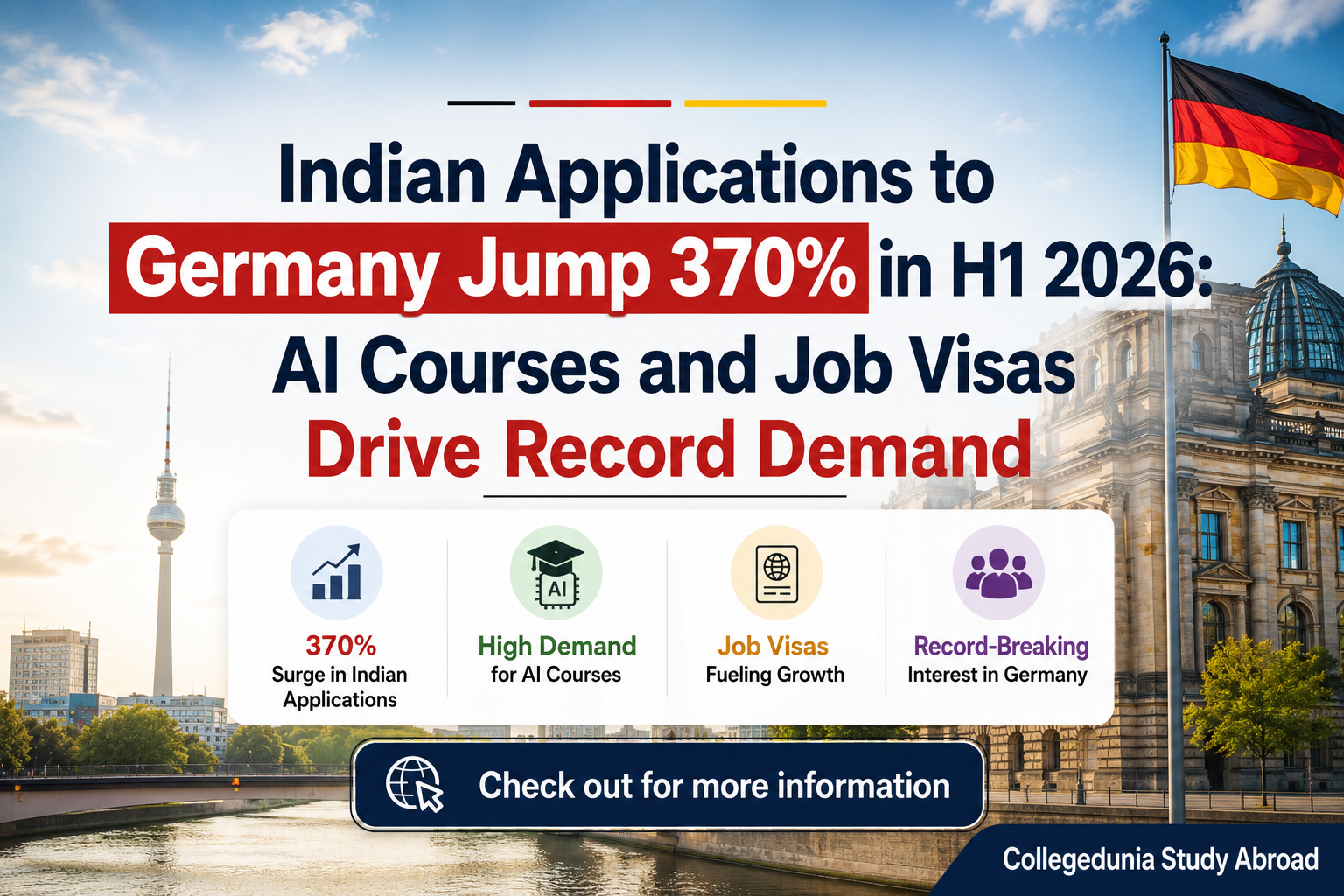
Indian applications to German universities rose 370 percent in January to June 2026. AI, computer science and data science courses drew the bulk of Master’s aspirants. DAAD confirms Indian enrolment at a record 59,419 for winter 2024/25. The 20 percent yearly rise cements Germany as India’s top study-to-work corridor.
- The 370 percent surge covers all Indian applicant categories in H1 2026. Postgraduate programmes absorbed 82 percent of that flow.
- AI Master’s interest rose 600 percent this cycle. Computer science climbed 273 percent and data science 173 percent.
- Germany’s Federal Employment Agency logged 630,000 open vacancies in early 2026. Tech and healthcare led the shortage.
The trend reshapes India’s outbound map. For a decade, the US, UK, Canada and Australia dominated Indian applicants. Public universities, low tuition and post-study work routes are redirecting STEM cohorts. Applicants now target Berlin, Munich and Aachen. The Opportunity Card, active since June 1, 2024, widens the runway further.
Also Read:
- Germany Opportunity Card 2026 Requirements and Application Guide for Indians
- Germany Work Visa for Indian Students: Types & Process
- MS in Germany: Top Universities, Eligibility and Cost
- How to Apply to German Universities 2026
What the H1 2026 Application Data Shows
Note: H1 2026 means January 1 to June 30, 2026 and H2 2026 means July 1 to December 31, 2026.
Industry counselling data released this week tracked over 1,24,000 Indian study-abroad aspirants. Germany logged a 370 percent jump against the same window in 2025. Course-page interactions climbed 72 percent year on year. Postgraduate applications made up 82 percent of the Germany volume. MBA interest fell 13 percent as students rotated into technology-linked Master’s routes.
| Programme cluster | H1 2026 rise in Indian interest |
|---|---|
| MSc Artificial Intelligence | 600% |
| Computer Science | 273% |
| Data Science and AI combinations | 173% |
| MBA | -13% |
Key Insight: Only 12 percent of H1 applicants got a German university offer. The 370 percent inflow is not a green light. It means the shortlist is tighter than ever. Indian applicants now compete in a much deeper pool.
Also Read:
- Data Science and Analytics in Germany: Top Universities
- Study in Germany: Find Universities, Fees and Visa Guide
- Study in Germany For Indian Students After 12th
Why Engineering and AI Courses Are Leading the Rush
DAAD puts 60 percent of Indian students in Germany in engineering programmes. Social sciences, economics and management take 21 percent. Mathematics and natural sciences absorb another 18 percent. That base cohort tilts heavily male at 69 percent, per Indian students in Germany hit an all-time high.
TU Munich, RWTH Aachen and TU Berlin lead Indian STEM searches. Public university tuition stays near €300 per semester, under ₹35,000. Private universities cost €10,000 to €20,000 a year. That is ₹10.9 lakh to ₹21.8 lakh at ₹109.23 per euro today. Even the ceiling stays below one year of US STEM fees.
Also Read:
- Best Universities in Germany: Rankings and Programs
- Top Cybersecurity Universities & Colleges in Germany
- Exams to Study in Germany for International Students
- How to Study in Germany for Free: Guide for Indian
How the Job-Seeker Visa and Opportunity Card Anchor the Rush
Germany offers Indian graduates an 18-month job-seeker visa after their degree. The visa lets them stay on to hunt for work in their field. The Opportunity Card, live since June 1, 2024, opened a second track under Section 20a of the Residence Act.
The Opportunity Card allows a 12-month stay without a prior job offer. Applicants need a recognised degree, German A1 or English B2, and at least 6 points on the skills grid. They must also show €13,092 a year in a blocked account, roughly ₹14.3 lakh. The EU Blue Card converts approved offers into a residence track. Average first-contract salaries in top city tech roles sit near €53,000, or ₹57.9 lakh a year.
| Post-study route | Duration | Key condition |
|---|---|---|
| Job-Seeker Visa (post-degree) | 18 months | German qualification, funds proof |
| Opportunity Card (Chancenkarte) | 12 months | 6 points, degree, language, €13,092 funds |
| EU Blue Card | Up to 4 years, PR track | Job offer at €48,300 or higher |
What it means for Indian Students: The math turns on break-even. A €53,000 starting salary offsets a public-university outlay under ₹5 lakh fast. Loans typically clear in 1.5 to 2.5 years. That is why the study-to-work label sticks. The US and UK do not match that speed today.
Also Read:
- Post Study Work Permit in Germany for Indian Students
- Germany Work Visa for Indian Students: Types & Process
- How to Get a Job in Germany After Masters
How Do Indian Students Apply for the Summer 2027 Intake?
Applications for the summer 2027 intake open in October 2026. Most universities close applications on January 15, 2027. Winter 2027/28 seats open in April 2027, with deadlines around July 15, 2027. The Application Deadlines for German Universities in 2027 guide lists university-level dates.
Indian undergraduate applicants must now clear a 70 percent Class XII academic threshold. Germany’s new 70 percent rule for winter 2026/27 took effect via the anabin database on March 15, 2026. Universities check the mark before shortlisting. An APS certificate from the German embassy is also required first.
Master’s aspirants apply through uni-assist or the target university’s portal. Admitted students file the visa via the Consular Service Portal. VFS Global handles biometrics and document submission. Germany student visa processing time runs 4 to 12 weeks. Indian files usually close in six to eight weeks.
Also Read:
- Summer Semester in Germany 2027: Dates and Deadlines
- APS Certificate Germany 2026: Full Form and Fees
- Documents Required for Student Visa Germany for Indians
- Germany Blocked Account for Indian Students: 2026 Guide
Action Plan for Indian Applicants This Cycle
- Check your qualification recognition on the anabin database before shortlisting universities.
- Book the APS interview at the German embassy in New Delhi three months before the deadline.
- Register on uni-assist by December 1, 2026 to hit the January 15, 2027 summer intake close.
- Open a blocked account with €13,092 as your visa funds proof.
- File the student visa via the Consular Service Portal once admitted, allowing six to eight weeks.
Keep an Eye On: The January 15, 2027 deadline closes the next summer 2027 intake. Winter 2027/28 seats close on July 15, 2027. Both cycles run under the new 70 percent Class XII rule and the APS check.
Indian applicants targeting Germany face a tighter window and a firmer bar. The January 15, 2027 deadline closes the next major intake. A second shot opens on July 15, 2027 for winter 2027/28. The 70 percent Class XII and APS rules apply to every file.



Comments