



Education Journalist | Study Abroad Lead | Updated On - Jul 18, 2026
The US Department of Homeland Security has finalised the end of F-1 Duration of Status from September 15, 2026. The rule hits every Indian student applying for or holding an F-1, J-1 or I visa. DHS published the final rule in the Federal Register on July 17, 2026, closing a framework that has stood since 1978. The new system replaces open-ended stays with a fixed admission period capped at four years.
- F-1 students get an admission period tied to their Form I-20 program length, not to exceed four years, plus a 30-day arrival window and a 30-day departure window.
- The post-completion grace period is halved from 60 to 30 days, matching J-1 and M-1 classifications.
- Anyone needing more time must file Form I-539 with USCIS before the I-94 "Admit Until Date", pay the filing fee, submit biometrics and show continued eligibility, per NAFSA.
India has been the top source of international students in the US for two consecutive years. Fall 2026 arrivals now face this cap on top of an already brutal consular slot cycle.
Also Read: F1 Visa Slots Open for Fall 2026: Indians Race Minutes-Long Windows
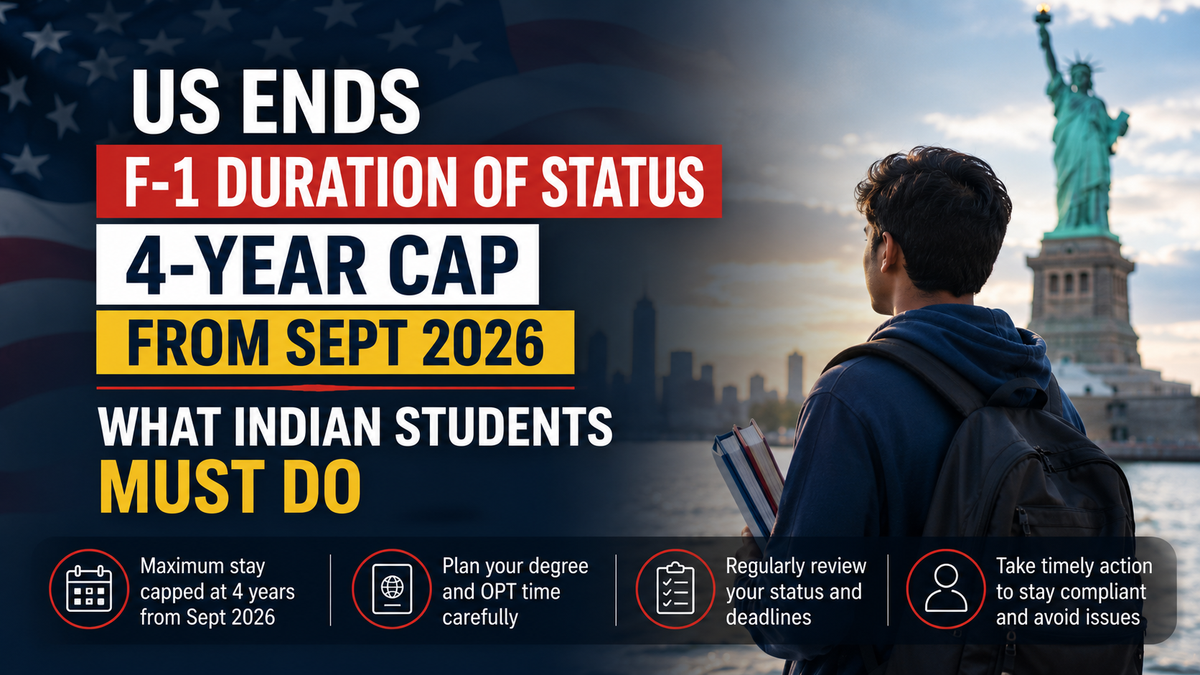
What Changes on September 15, 2026 for F-1 Students
Under the old system, an F-1 student’s I-94 read "D/S". They stayed lawful as long as they were enrolled and progressing. The new rule prints a hard end date on every I-94 issued at the port of entry.
| Feature | Before (Duration of Status) | After (From September 15, 2026) |
|---|---|---|
| I-94 end date | "D/S" (open-ended) | Fixed date on Form I-20, max 4 years |
| Arrival grace | 30 days before program start | 30 days before program start |
| Departure grace | 60 days after program end | 30 days after program end |
| Extension needed | Reported to Designated School Official | Form I-539 filed with USCIS + biometrics |
| English language cap | No fixed lifetime cap | 24 months lifetime aggregate |
Key Insight: The four-year clock is not the program clock. It is the ceiling. A one-year Master’s still gets one year on the I-94, not four. The four-year figure only helps students in longer programs, and even they must extend past it.
How the Four-Year Cap Hits Indian PhD and STEM Students
Indian students concentrated in PhD, dual-degree and STEM OPT pipelines feel this rule the hardest. Most US doctoral programs run five to seven years. A student admitted on September 20, 2026 for a six-year PhD receives an I-94 that expires at the four-year mark, not the dissertation defence.
The same trap sits at the end of OPT. Under the new rule, the admission period ends at the earlier of the program end date, the four-year mark, or the OPT/STEM OPT Employment Authorization Document expiry. STEM OPT holders who need the full 36 months of work authorisation must plan an extension filing well before their EAD end date.
What it means for Indian Students: A student on OPT to H-1B conversion timelines now needs to track three separate end dates: I-20 program end, OPT EAD end, and the I-94 admit-until date. Any one hitting first can end lawful status.
Intensive English Program students face an even tighter squeeze. The rule sets a 24-month lifetime aggregate cap on English language training. Someone who spends 18 months on ESL cannot later return for another full year of language study before moving to a degree program.
How Do Indian Students File the Form I-539 Extension?
The rule pushes extension filings out of the Designated School Official’s office and into USCIS. The process runs through Form I-539, Application to Extend/Change Nonimmigrant Status. Students must file before the current I-94 admit-until date and continue attending classes while the application is pending.
- Get an updated Form I-20 from the Designated School Official recommending the extension.
- File Form I-539 with the USCIS filing fee and any biometric services fee listed on the current USCIS fee schedule.
- Attend the biometrics appointment at an Application Support Center.
- Show continued eligibility, including progress in the program and financial support.
- Wait for the USCIS decision, which can take months and may include an interview.
DHS calls this a return to immigration accountability for student visa holders. Universities and immigration attorneys warn processing backlogs could leave students in visa limbo mid-program.
What Current Indian F-1 Students Should Do Now
Students already inside the US on Duration of Status on September 15, 2026 do not need to immediately swap their I-94 for a dated one. But the transition rules bite fast.
- Existing F-1 holders keep the 60-day departure grace period only until they travel abroad or file an extension. After either event, the 30-day rule applies.
- Any re-entry to the US after September 15, 2026 triggers a new dated I-94 subject to the four-year cap.
- Students staying past their program end date, the four-year mark, or their current status expiry, whichever hits first, must file Form I-539.
Important Distinction: A short trip home for Diwali or a family emergency now costs current F-1 holders their 60-day grace period. The old grace period ends the moment they land back in the US on a new I-94.
Action Plan for Fall 2026 Applicants
- Confirm your Form I-20 program end date with your Designated School Official before your visa interview.
- Check your F1 visa application materials to ensure they show a realistic program completion date, not a padded one.
- Plan degree timelines to finish within four years where possible, especially for PhDs.
- Diarise the I-94 admit-until date on arrival and set a reminder six months before it.
- Budget for Form I-539 filing fees and biometric costs if your program exceeds four years.
- Avoid non-essential travel in your final year to protect the 30-day departure grace period.
Indian applicants heading to US campuses this autumn no longer arrive on an open-ended timer. The rule locks in on September 15, 2026, and every I-94 issued after that carries a fixed exit date. Extensions are possible but paid, biometric, and slow. The next inflection point sits with USCIS, which must publish updated Form I-539 fee and processing guidance ahead of the effective date.
Keep an Eye On: The rule takes effect September 15, 2026. Fall 2026 arrivals landing on or after that date receive the first fixed I-94s under the new regime. Watch USCIS for updated Form I-539 processing timelines and fee schedules in the run-up.



Comments