



Education Journalist | Study Abroad Lead | Updated On - Jun 26, 2026
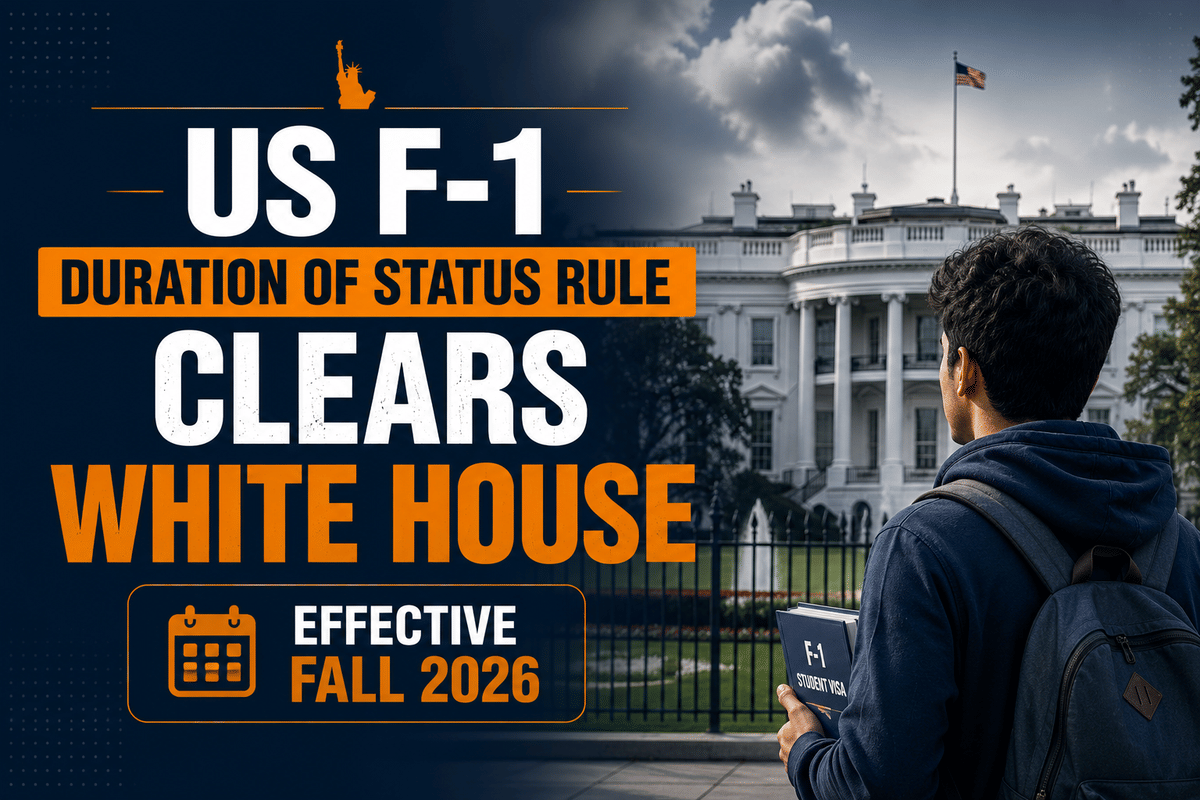
Indian students on F-1 visas are now days away from a fundamental change to how long they can legally stay in the United States. The White House Office of Management and Budget completed its review of the Duration of Status (D/S) final rule on June 17, 2026, clearing the way for the Department of Homeland Security to publish the rule in the Federal Register at any time. Once published, the rule takes effect in 60 days — placing its effective date squarely in late August or early September 2026, directly in the path of the 3.52 lakh Indian students arriving for Fall 2026.
For nearly 35 years, F-1 students could remain in the US for the full length of their programme without a fixed end date on their visa. That framework ends the moment this rule is published.
What Duration of Status Was — and What Replaces It
Since 1991, every F-1 student's I-94 arrival record has read "D/S" — duration of status. It meant a student's lawful stay was tied to their programme, not a calendar date. A PhD student taking six years, a student on approved medical leave, a student switching from a master's to a doctoral programme — all remained in valid status automatically, as long as their Designated School Official (DSO) updated their SEVIS record. No government application. No fee. No uncertainty.
The final rule replaces this entirely. Here is what changes:
| Rule Element | Current (D/S System) | Under Final Rule |
|---|---|---|
| Stay duration | Full programme length, no fixed end date | 4 years or programme length, whichever is shorter |
| Extension process | DSO updates SEVIS — no government application needed | Must file Form I-539 with USCIS; fee USD 420 (~₹39,700) |
| Grace period after programme | 60 days | 30 days |
| Graduate students — change of major or transfer | Permitted with DSO approval | Permanently barred at any stage |
| Undergraduates — transfer or major change | Permitted with DSO approval | Barred in first academic year |
| Second degree at same or lower level | Permitted | Barred if first degree completed in F-1 status in US |
| Extension decision authority | DSO at the student's institution | USCIS immigration officers — discretionary |
Source: NAFSA regulatory tracker, updated June 18, 2026. nafsa.org. Exchange rate: USD 1 = ₹94.53 as of June 26, 2026.
The OMB review was concluded "consistent with change" — meaning the final rule text may differ in some respects from the August 2025 proposal. The exact changes will not be known until DHS releases the public inspection version, which must appear at least 24 hours before Federal Register publication.
Why the Timing Hits Fall 2026 Indian Students Hardest
The rule's 60-day implementation window is not incidental — it is the administration's stated goal to have the rule in effect before Fall 2026 students arrive. Working backwards from a September 2026 arrival date:
- OMB review completed: June 17, 2026
- Federal Register publication: Expected any day — late June to mid-July 2026
- Rule effective date: 60 days after publication — late August to mid-September 2026
- Fall 2026 Indian students arrive: August–September 2026 — within the rule's effective window
Students arriving after the effective date will receive an I-94 with a fixed end date — not "D/S" — from the moment they enter the US. For a four-year undergraduate student, this is manageable. For a PhD student whose programme runs five to eight years, it means filing a USCIS extension application mid-degree, paying USD 420 (~₹39,700), and waiting for a discretionary decision from an immigration officer — with no guarantee of approval.
Also Read: OPT Program 2026: Rules, Risks and Alternatives for Indian Students
Three Indian Student Profiles Most at Risk
PhD and long-programme students.
India sends more doctoral students to the US than any other country. The average US PhD takes five to eight years. Under the final rule, any Indian PhD student who has not completed their programme within four years must file Form I-539 with USCIS before their I-94 expires. USCIS processing backlogs are currently at multi-year highs. A student whose I-94 expires while their extension is pending faces a serious compliance risk — and potentially unlawful presence.
MS students considering programme changes or transfers.
Graduate students are permanently barred from changing their major or transferring universities at any point under the final rule. Indian MS students in computer science, data science and engineering — who frequently switch specialisations or transfer to stronger programmes after their first year — lose that flexibility entirely once the rule takes effect. Any such change after enrolment puts a graduate student out of status.
Students on OPT and STEM OPT.
The grace period cut from 60 to 30 days is the most immediate pressure point for the 1,43,740 Indian students currently on OPT. Indians account for 48% of all STEM OPT participants in the US — approximately 79,000 students. The 60-day window after graduation currently gives students time to receive their OPT Employment Authorisation Document (EAD) and begin work. With 30 days, students who have not filed early enough face a gap between programme completion and work authorisation. A six-month transition period is expected for existing OPT students who remain in the US — but this will be confirmed only once the final rule text is published.
What Indian Students Must Do Before the Rule Publishes
If you are a Fall 2026 admit who has not yet arrived:
- The rule is expected to be in effect by the time you arrive in August–September 2026
- Your I-94 will show a fixed end date — not "D/S" — from the moment you enter the US
- Confirm your programme length with your DSO before arrival and understand what an I-539 extension would require if your programme runs beyond four years
- Do not plan to change your major or transfer universities in your first year as an undergraduate, or at any point as a graduate student
If you are a PhD student whose programme exceeds four years:
- Speak to your DSO now about the I-539 extension process — do not wait until your I-94 end date approaches
- Budget USD 420 (~₹39,700) for the USCIS extension fee; premium processing costs an additional USD 1,965 (~₹1.86 lakh)
- File your extension application well before your I-94 end date — USCIS processing backlogs mean delays are likely
If you are currently on OPT or STEM OPT:
- Your existing authorisation remains valid until its expiry date — continue working
- Apply for STEM OPT extension immediately if your degree qualifies and you have not already done so
- Do not leave the US if your OPT is active and the rule has taken effect — a six-month grace period is expected for OPT students who remain in the country, but confirm this once the final rule is published
- Consult an immigration attorney if your OPT expires in 2026 and your H-1B status is unresolved
Also Read: USCIS Makes Green Card Harder for F-1 Students — What Indian Students Must Know
A Destination Under Sustained Pressure
The Duration of Status rule does not arrive in isolation. It follows the USCIS Adjustment of Status memo in May 2026, which made Green Card applications harder for F-1 students; the SEVIS termination crisis earlier this year; and a 36% drop in F-1 visa issuances to Indian students in summer 2025. Indian enrolment in US institutions has already fallen 6.9% to 3,52,644 — the sharpest single-year decline in a decade.
What the D/S rule adds is structural uncertainty at the entry point itself. A student who previously arrived knowing their legal status was tied to their programme now arrives with a countdown clock on their I-94 — and a USCIS application standing between them and the ability to finish their degree. For Indian families investing ₹50–80 lakh in a US education, that is a material change in the risk calculus. Germany, Canada and the UK — all of which offer post-study work rights written into statute — are already seeing increased interest from Indian applicants who would previously have defaulted to the US. The D/S rule accelerates that shift.



Comments