




Download the Class 11 Biology Chapter 11 Photosynthesis in Higher Plants NCERT Book PDF, the official 2026-27 NCERT textbook chapter. It opens Unit 4 on plant physiology and explains how green plants trap light and make food through the light reaction and the Calvin cycle, one of the most examined chapters in the Boards, NEET and CUET.
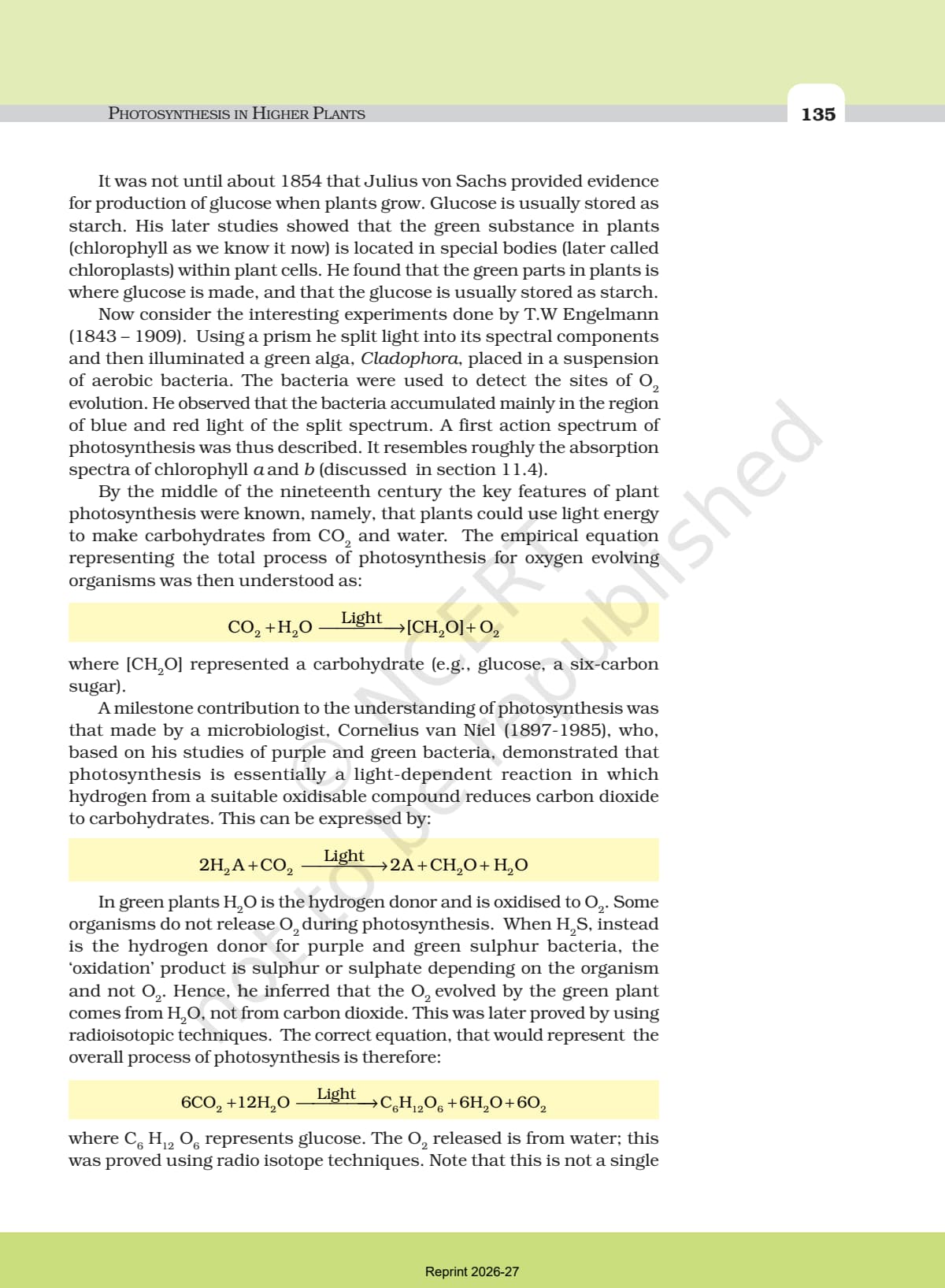
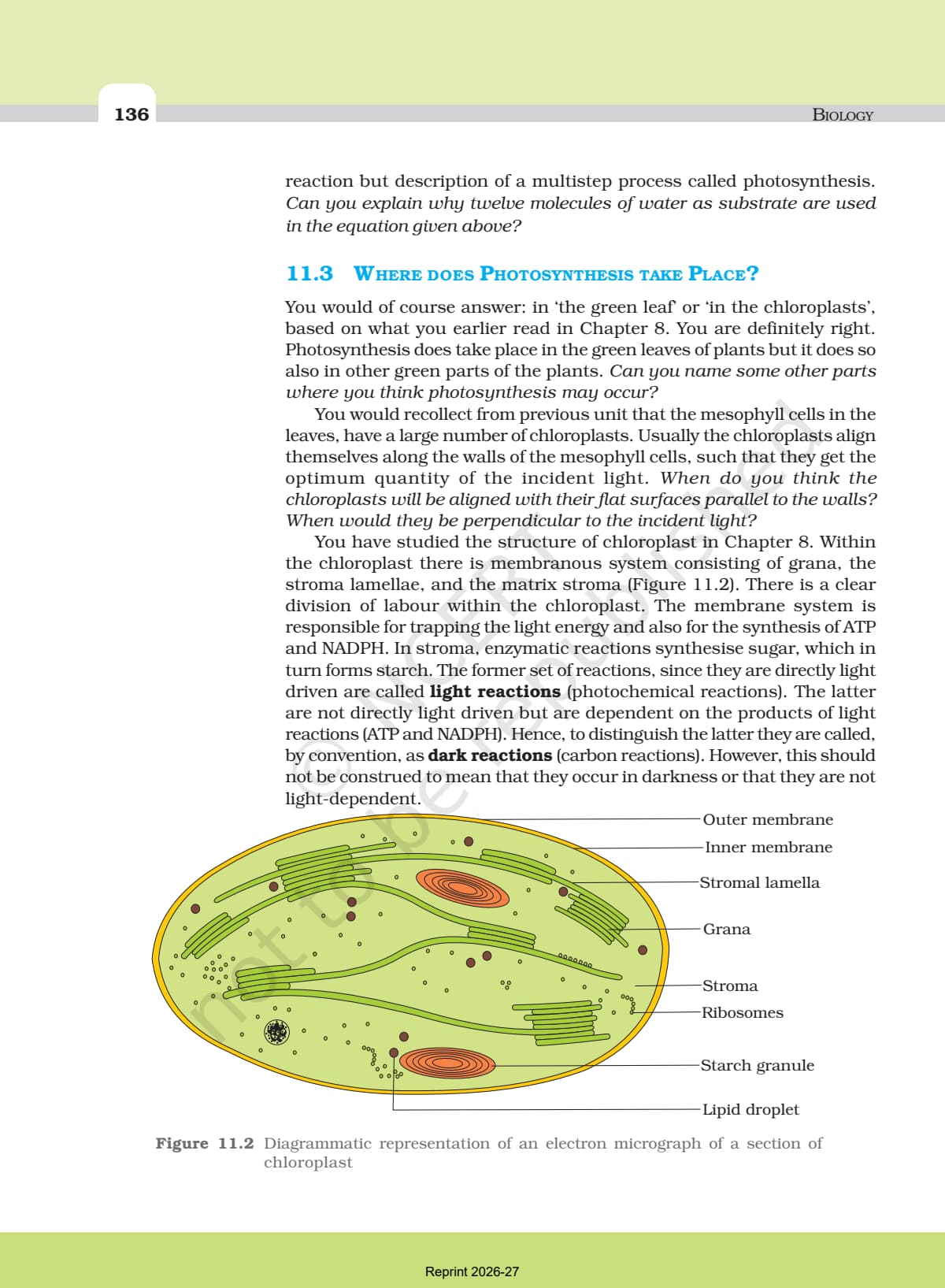
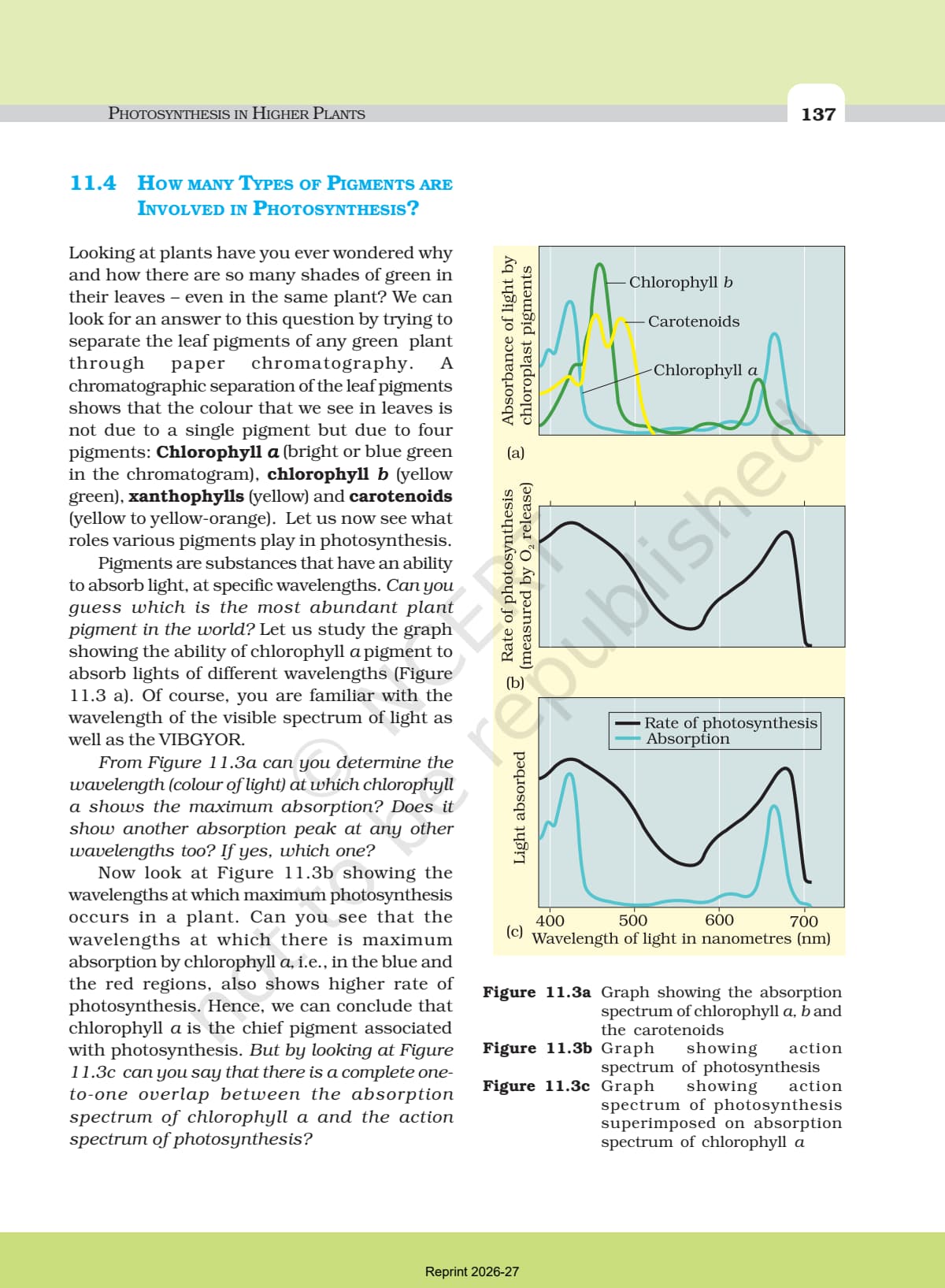
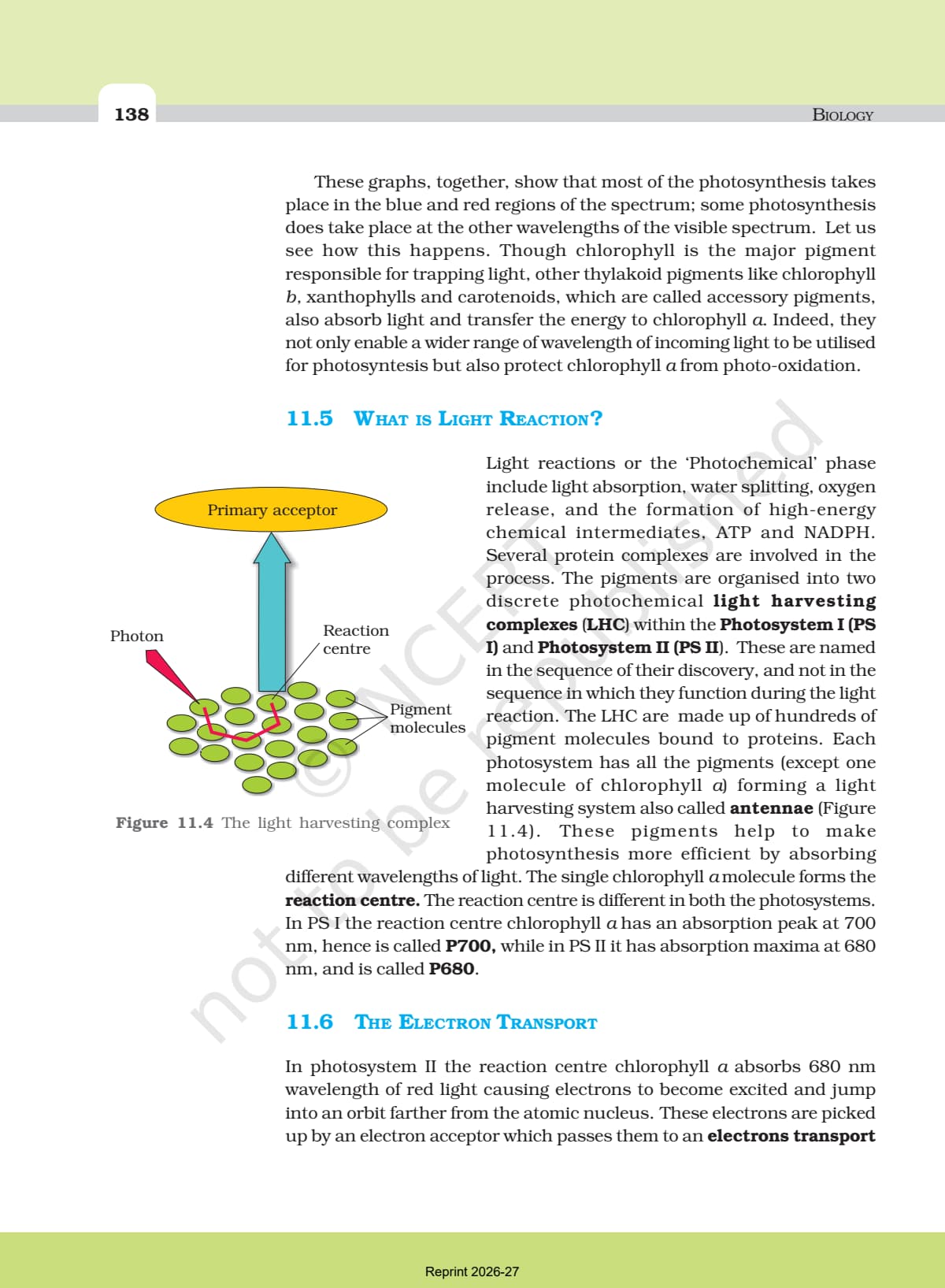
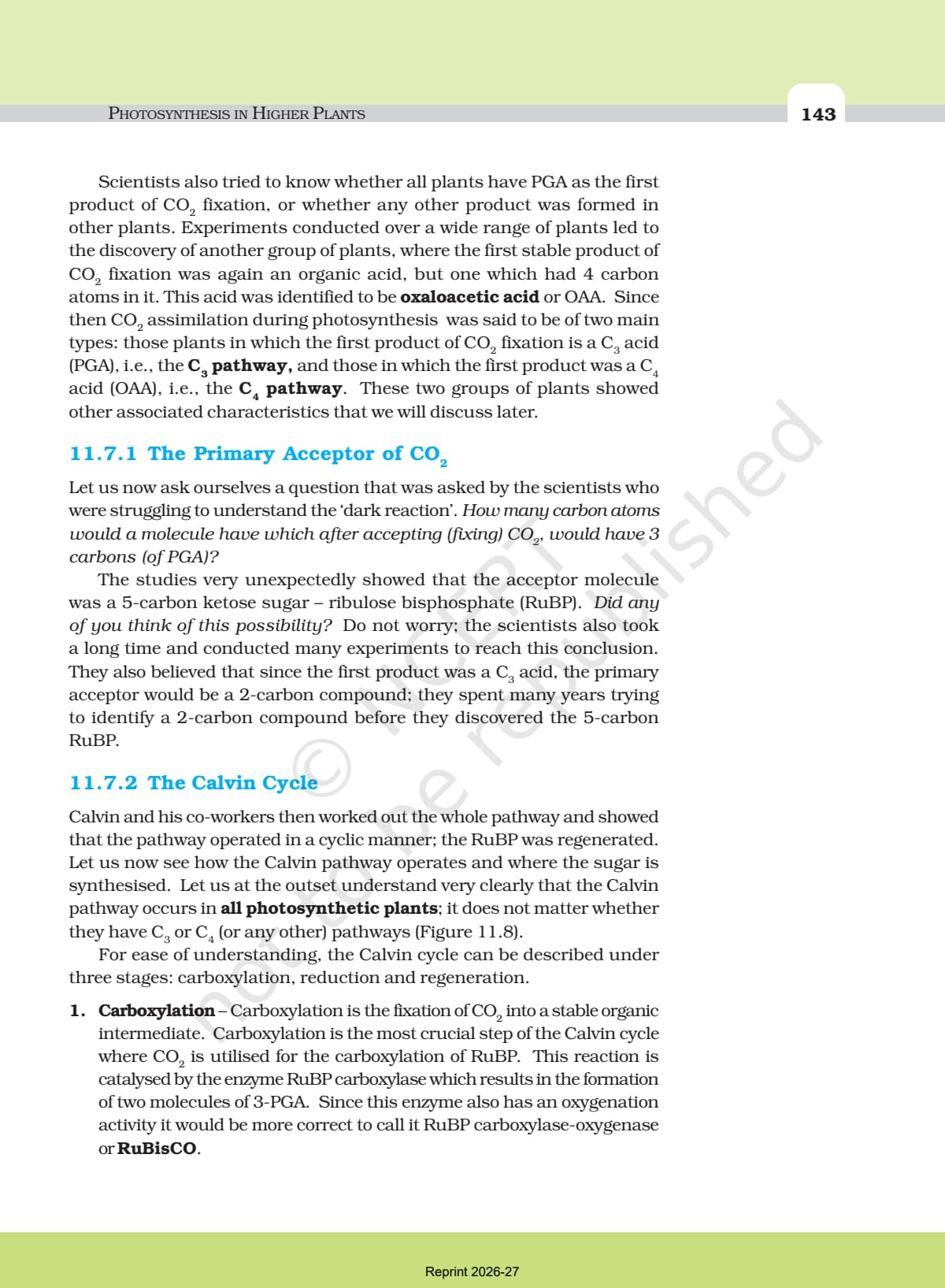
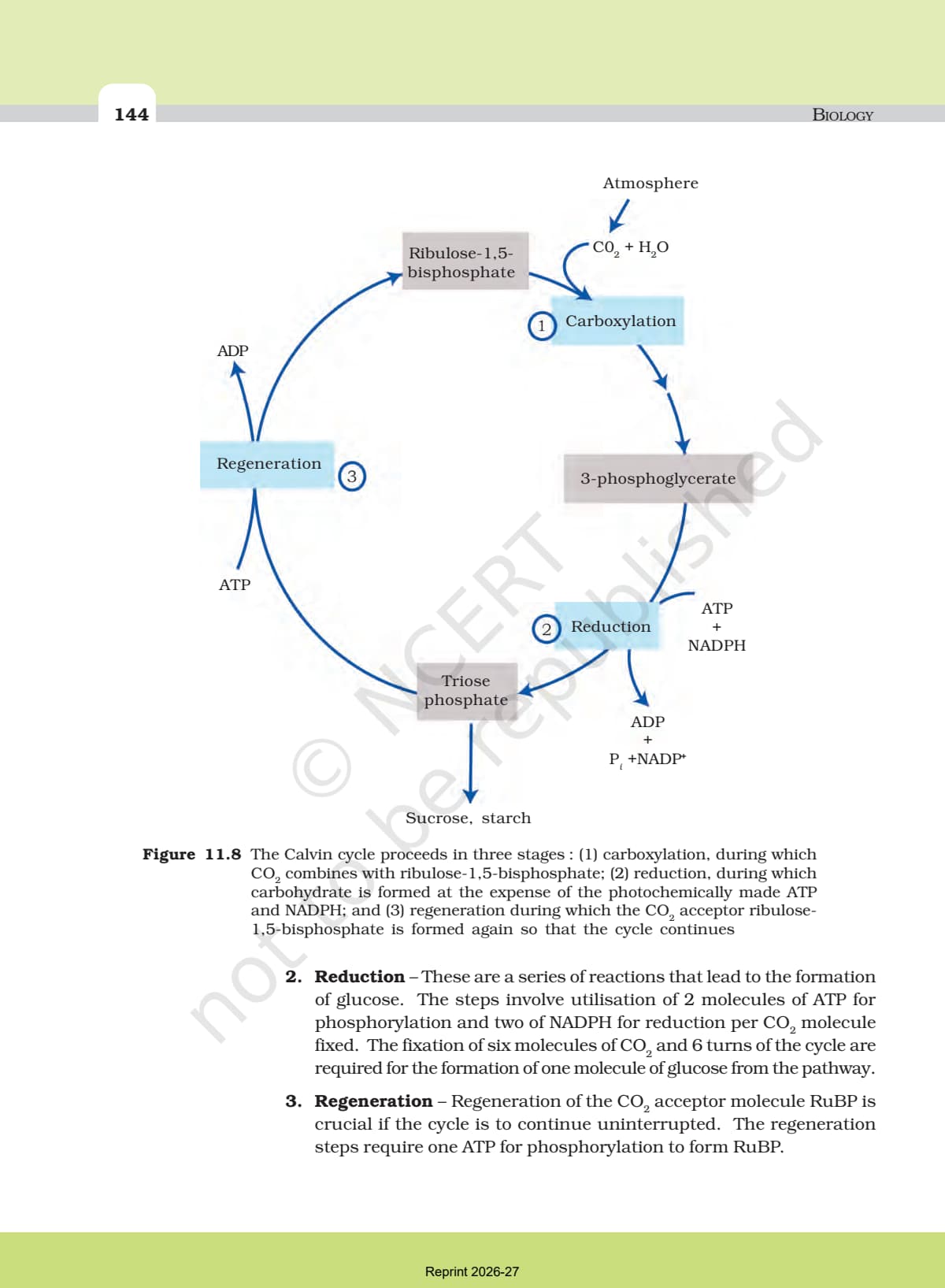
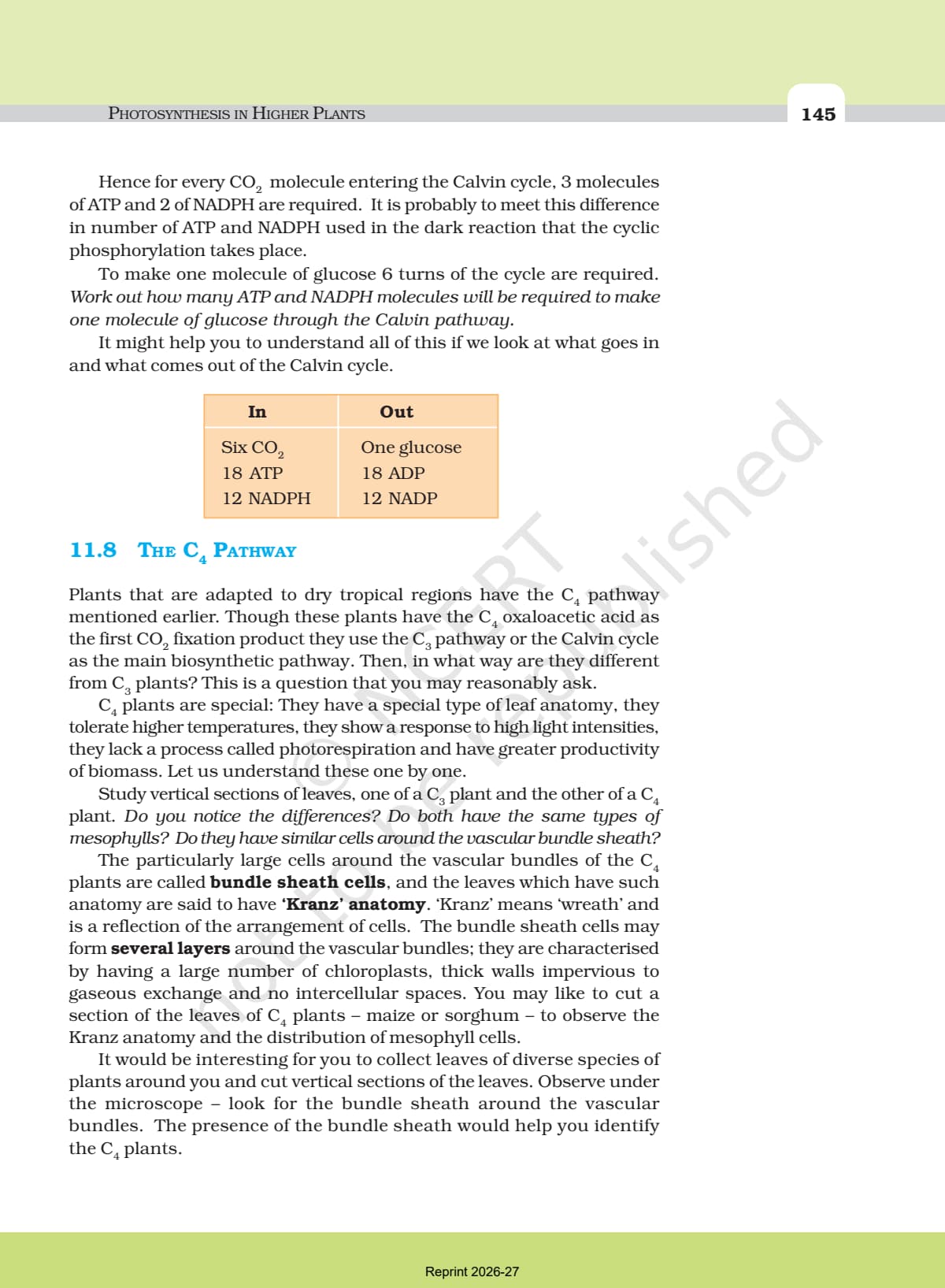
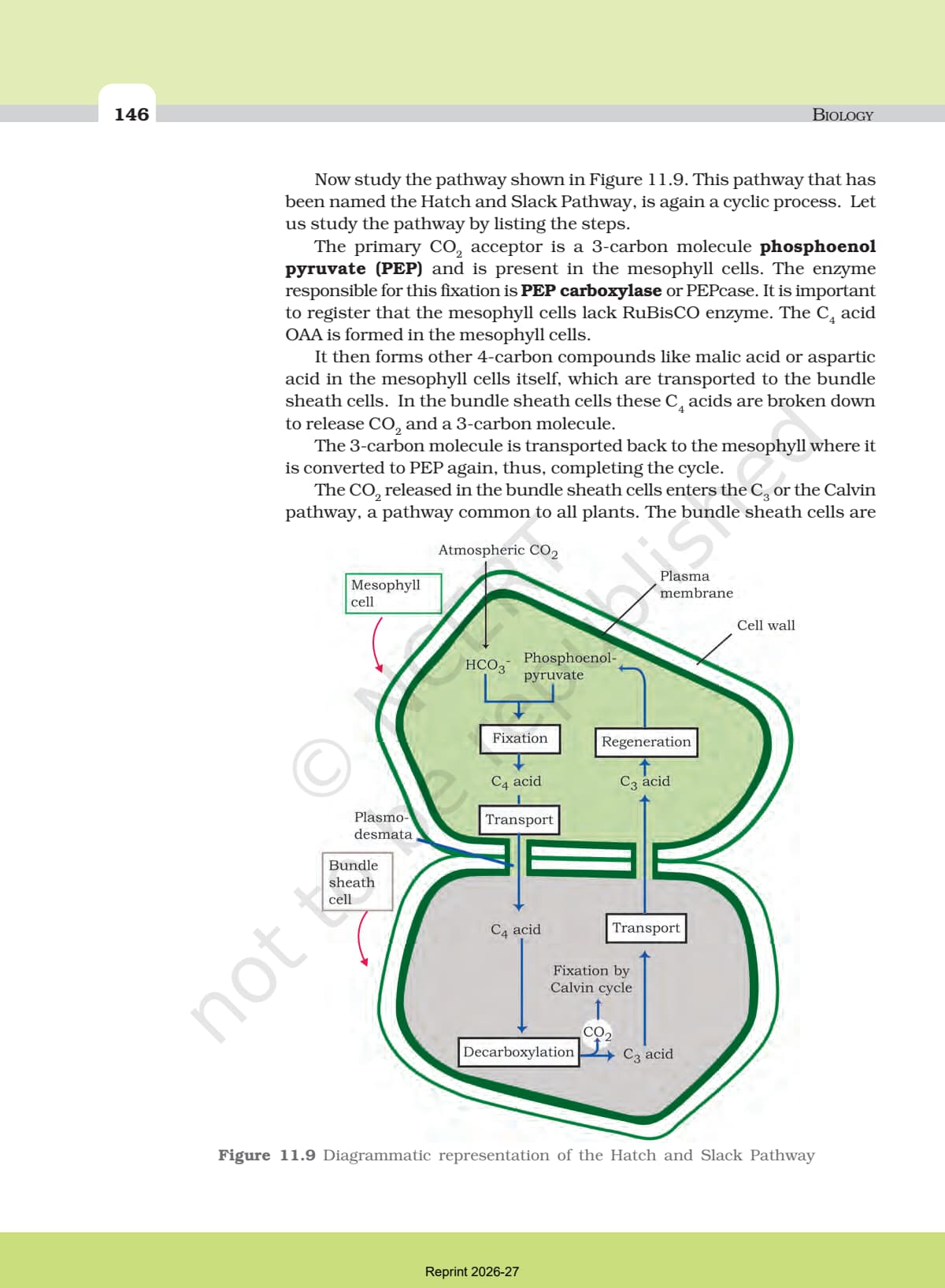
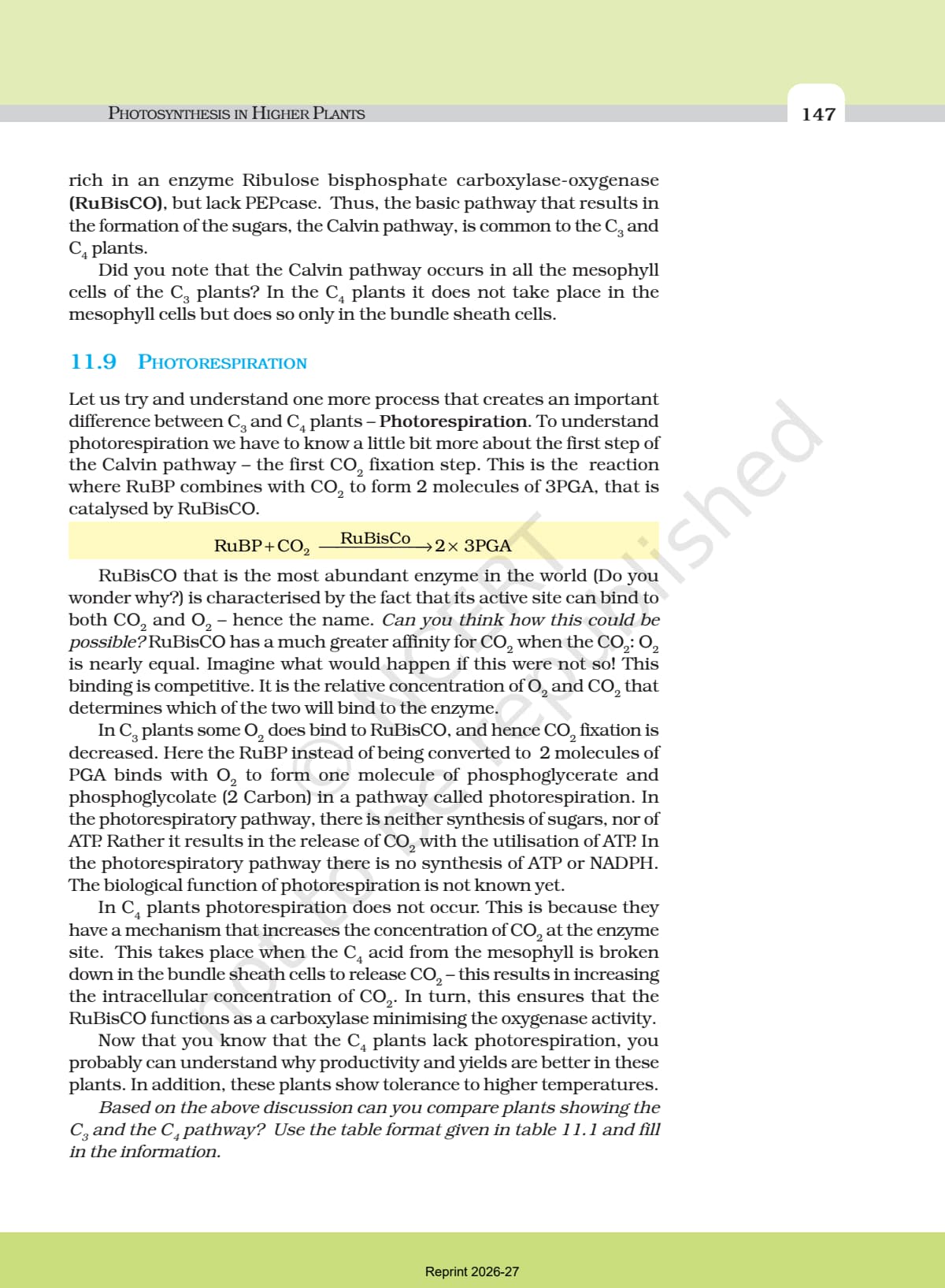
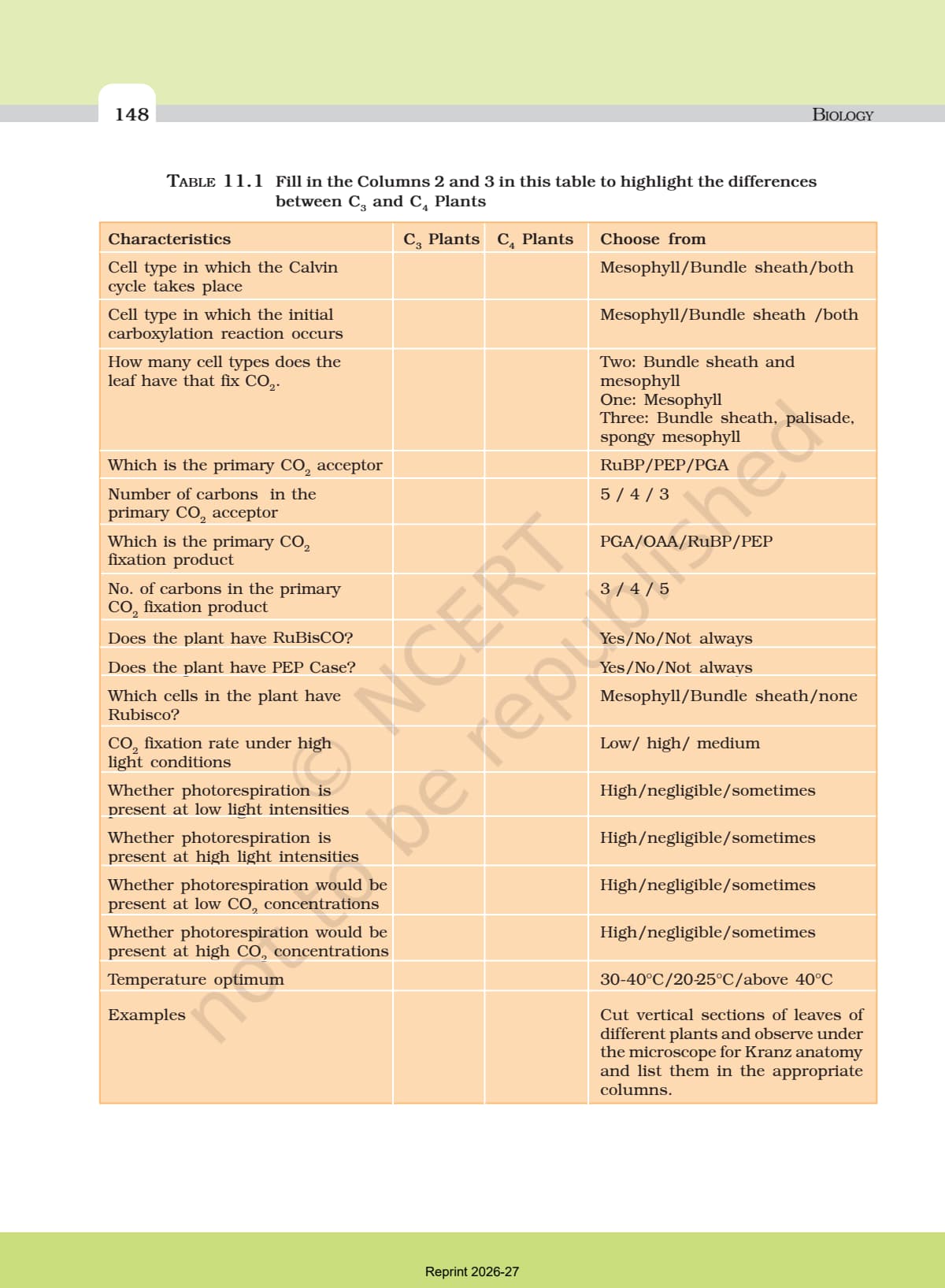
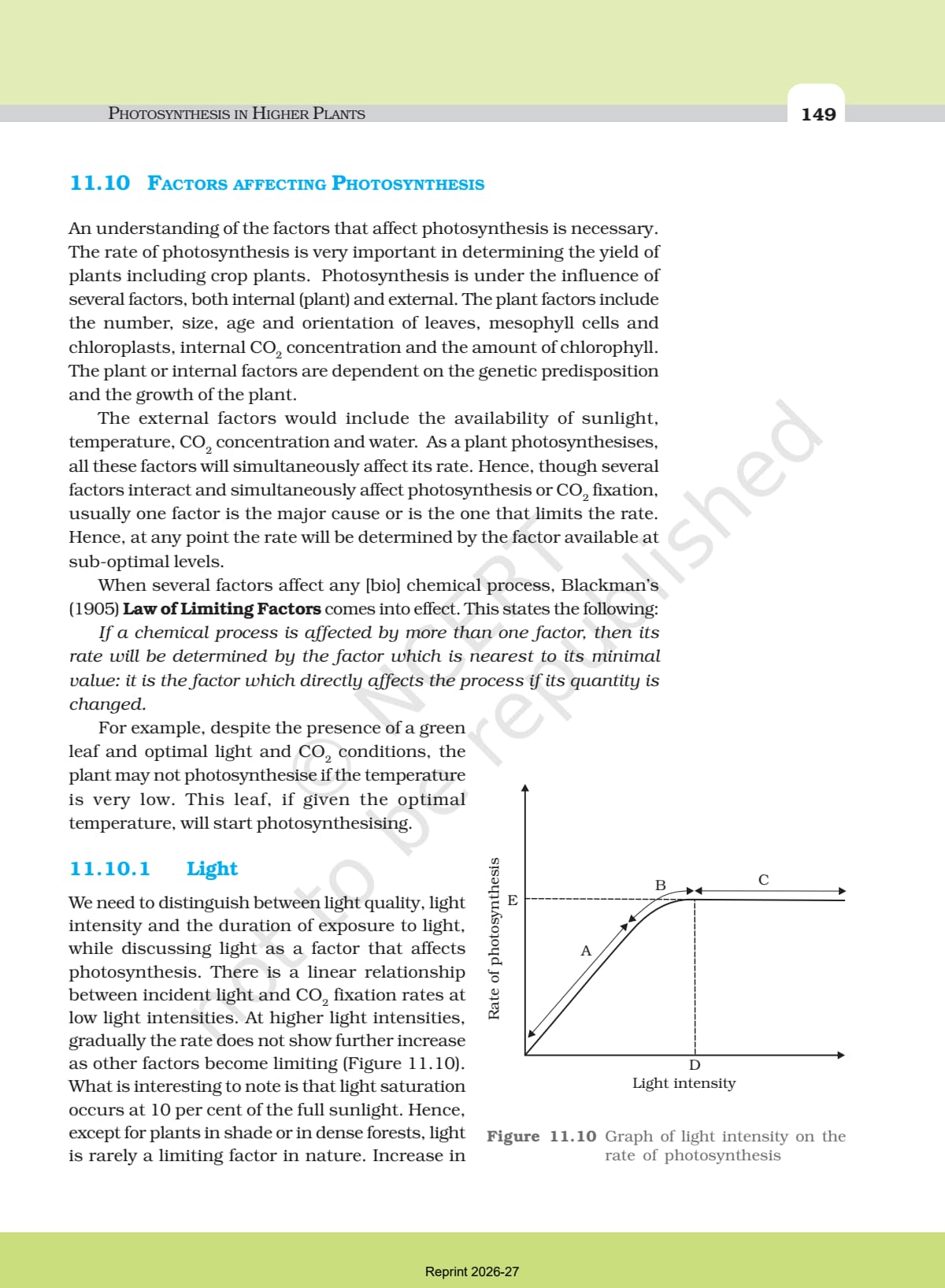
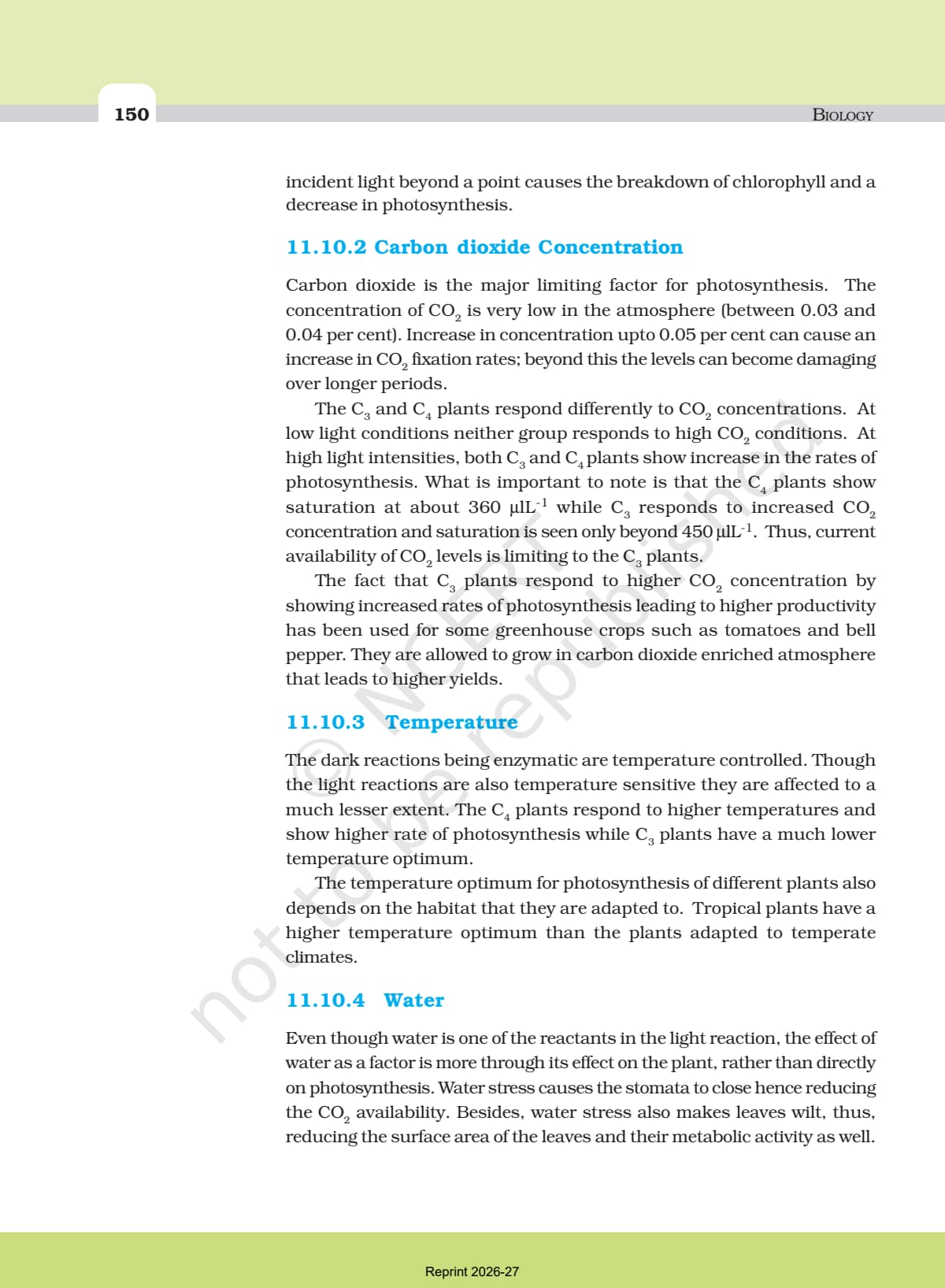
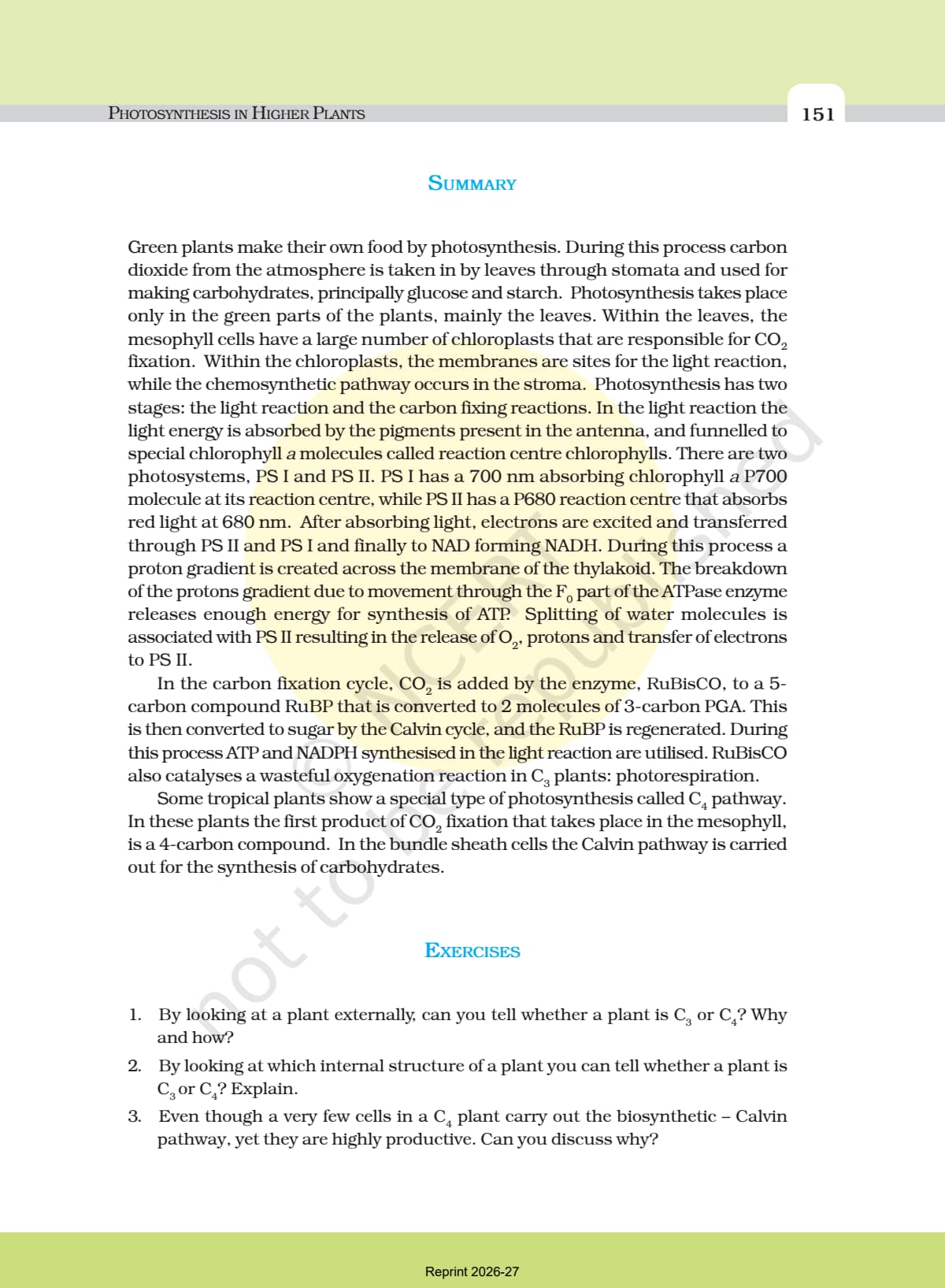
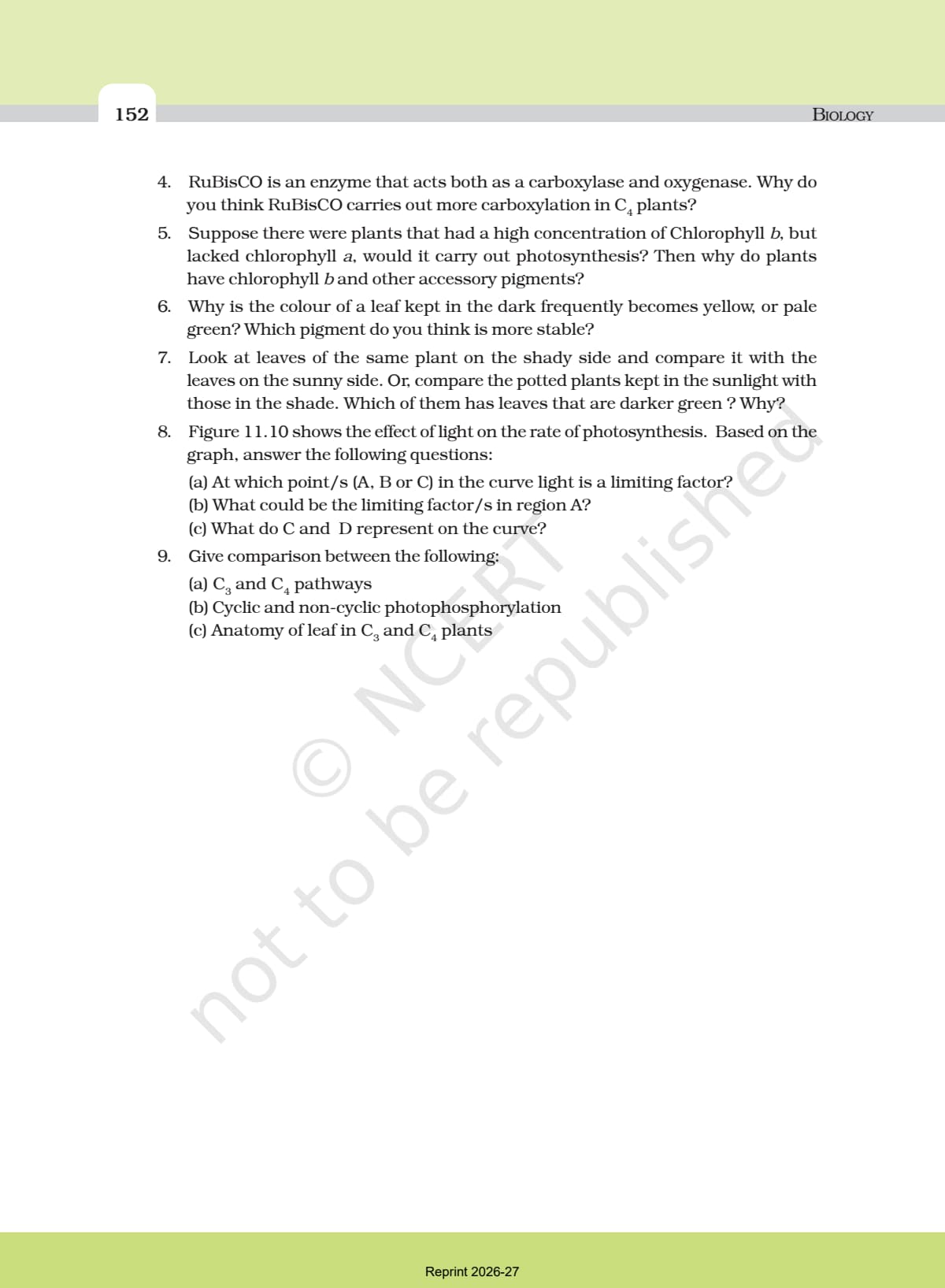
- Official NCERT 2026-27 chapter, clean and print-ready.
- Covers photosynthetic pigments, the light reaction, the Calvin cycle, the C4 pathway, photorespiration and limiting factors.
- Read it alongside the solved exercises and the revision notes linked below.
This Class 11 Biology Chapter 11 Photosynthesis in Higher Plants NCERT Book PDF is the official 2026-27 NCERT text, checked page by page against the latest edition.
What Class 11 Biology Chapter 11 Photosynthesis in Higher Plants Covers
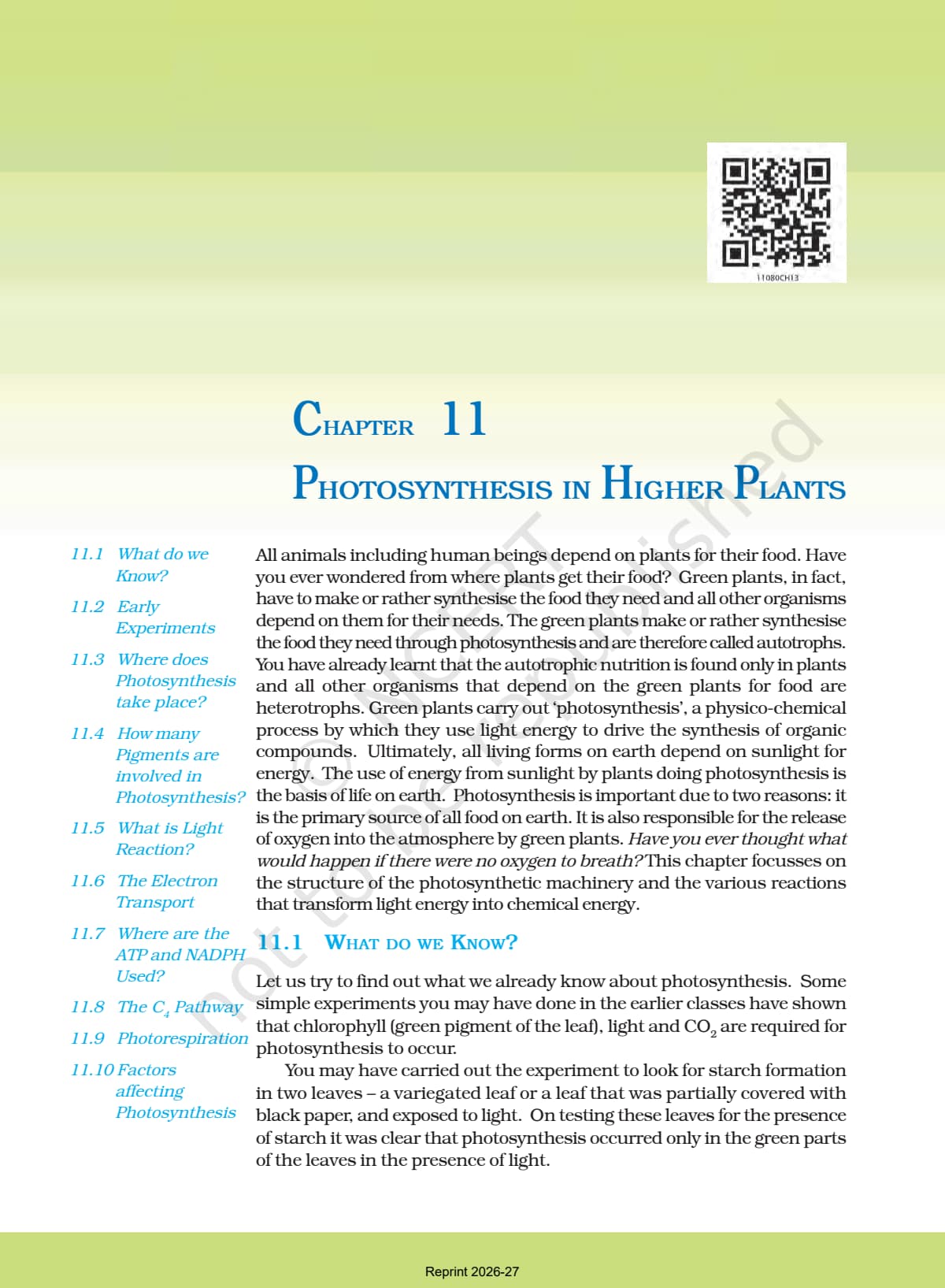
The chapter traces how higher plants convert light energy into chemical energy, starting from the early experiments that revealed photosynthesis and moving to the site and pigments involved. It then works through the light reaction, the biosynthetic Calvin cycle, the C4 pathway and photorespiration, and ends with the factors that limit the rate. The official NCERT sections are listed below so students can see exactly what the chapter contains before they start.
| Section | Topic |
|---|---|
| 11.1 | What do we Know? |
| 11.2 | Early Experiments |
| 11.3 | Where does Photosynthesis take Place? |
| 11.4 | How many Types of Pigments are involved in Photosynthesis? |
| 11.5 | What is Light Reaction? |
| 11.6 | The Electron Transport |
| 11.7 | Where are the ATP and NADPH Used? |
| 11.8 | The C4 Pathway |
| 11.9 | Photorespiration |
| 11.10 | Factors affecting Photosynthesis |
Key Concepts You Will Study
Students should read this chapter tracing each pathway as a diagram, because the exam rewards knowing where every molecule and electron goes rather than any single fact. The link between light and dark reactions set up here supports respiration and the whole of plant physiology. The main ideas to master are listed below.
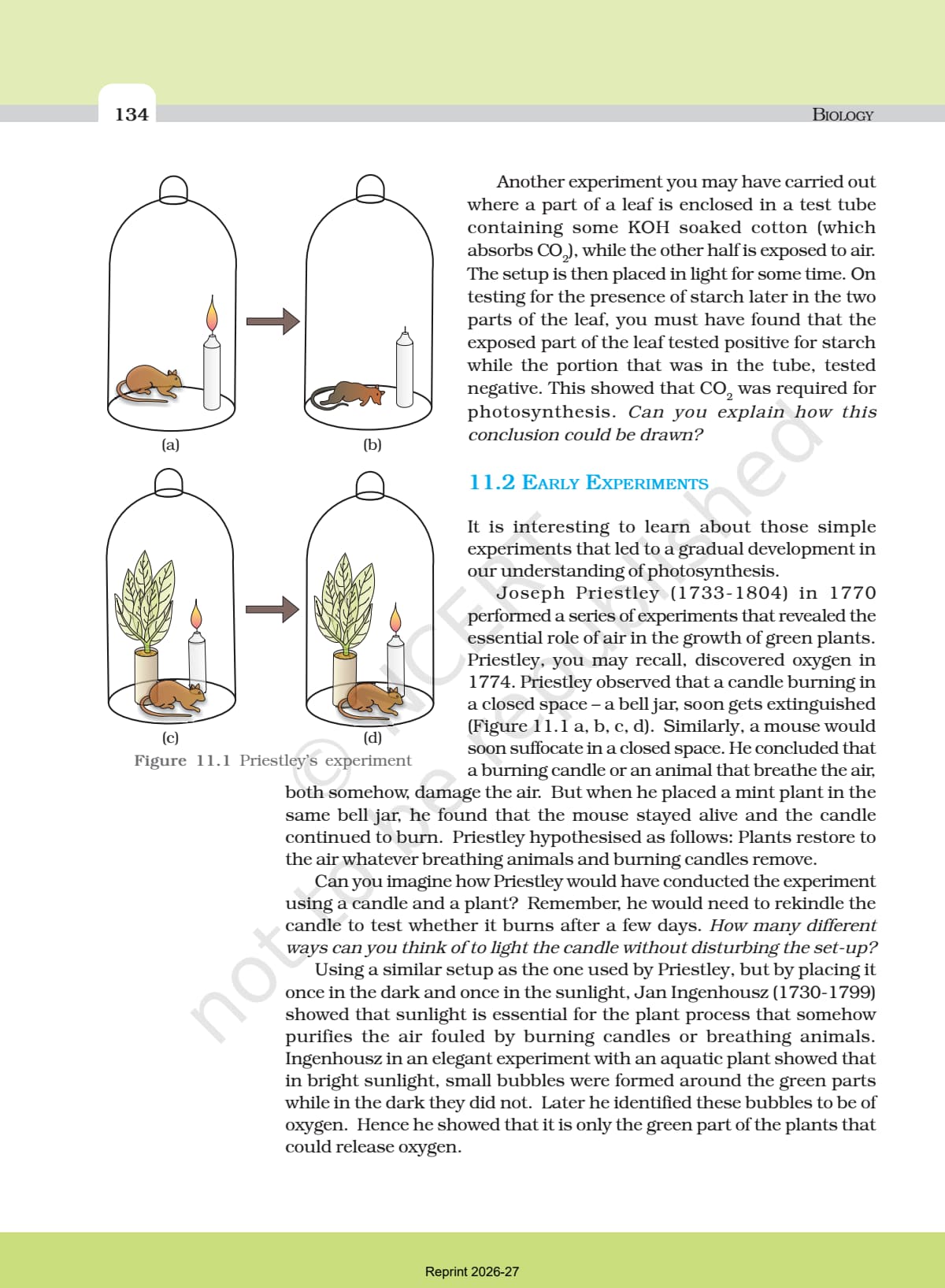
- The early experiments of Priestley, Ingenhousz, von Sachs and Engelmann that established photosynthesis.
- The site of photosynthesis in the chloroplast and the pigments chlorophyll a, chlorophyll b, xanthophylls and carotenoids.
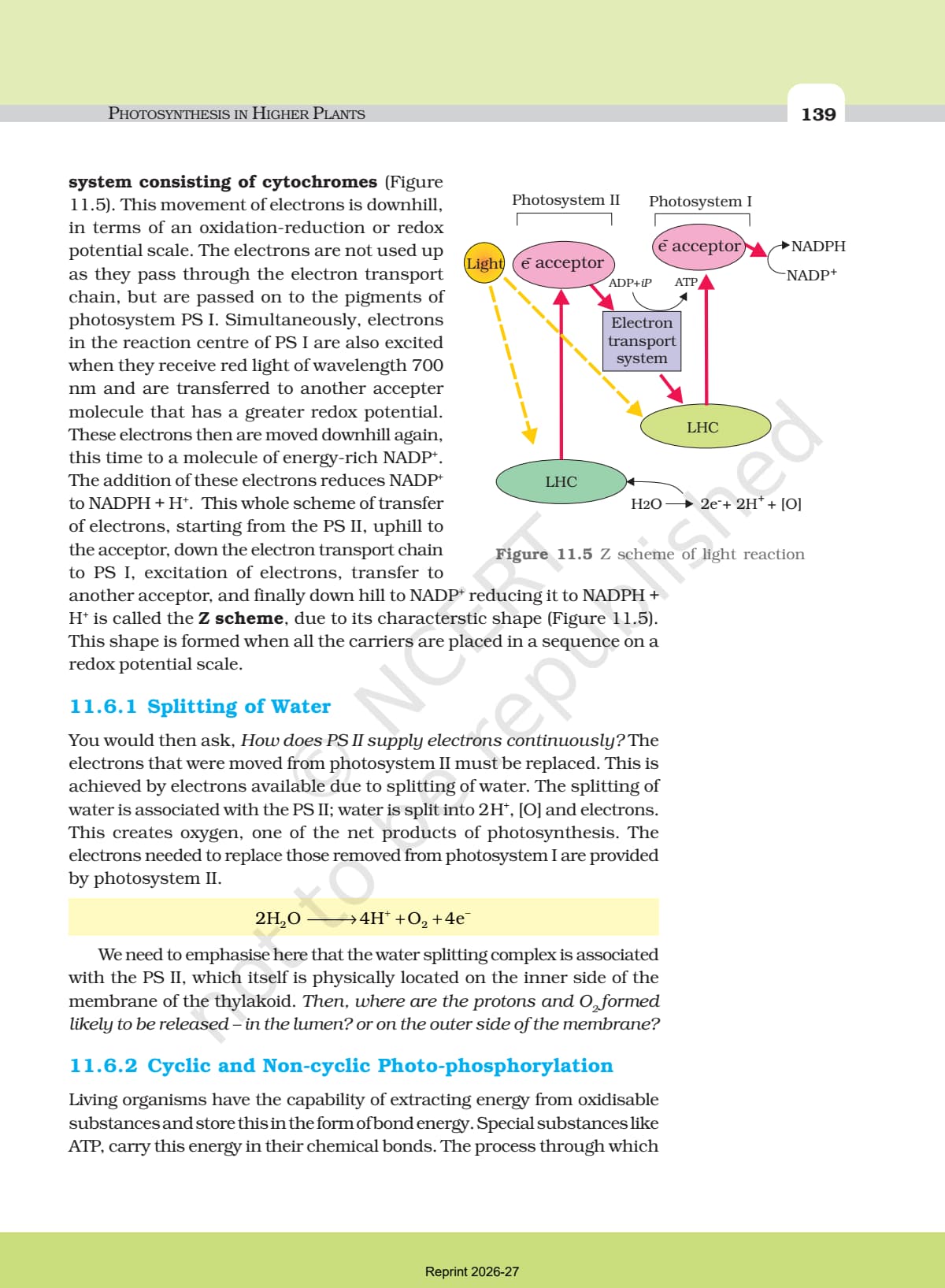
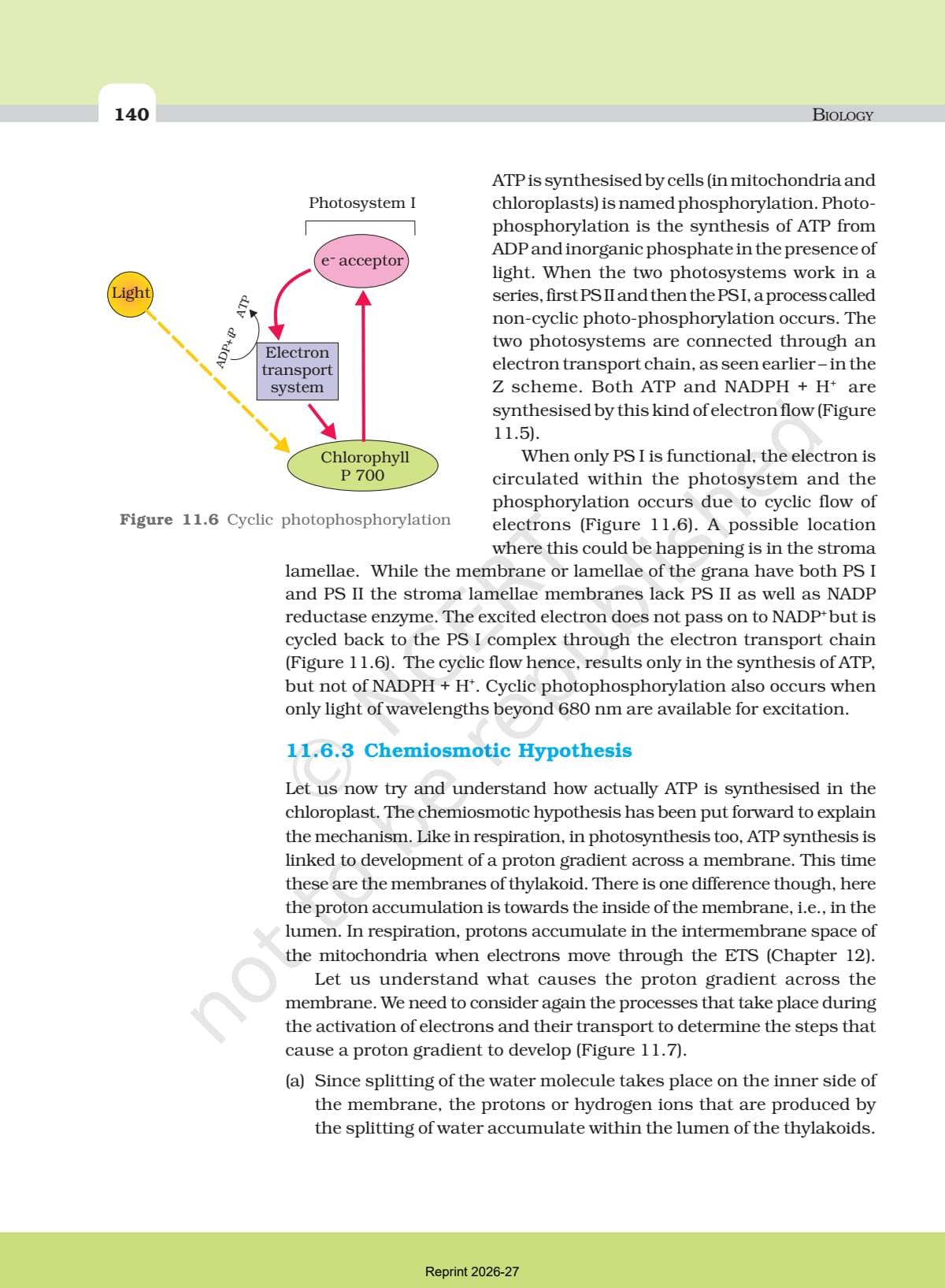
- The light reaction: photosystems PS I and PS II, splitting of water, and cyclic and non-cyclic photophosphorylation.
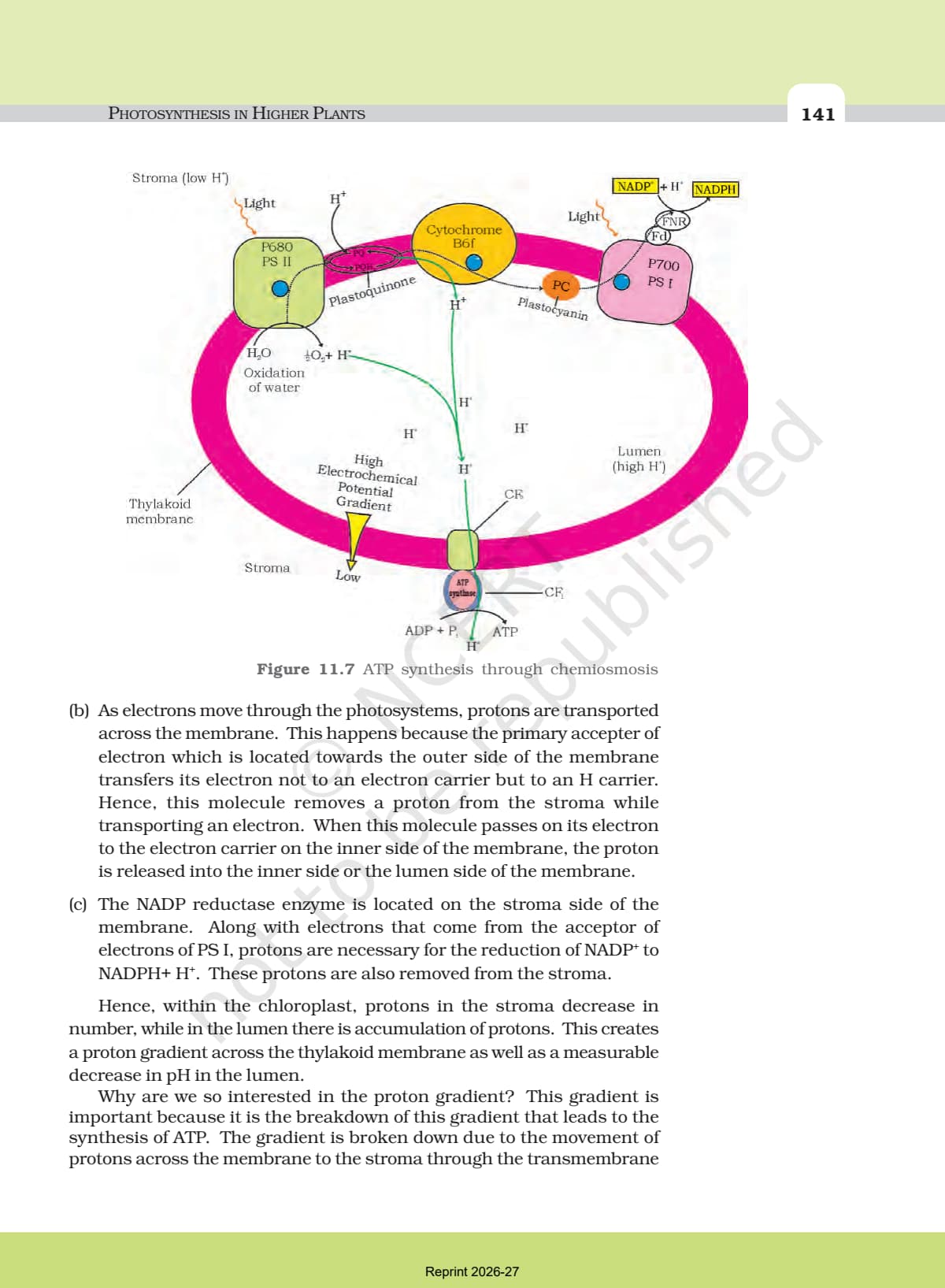
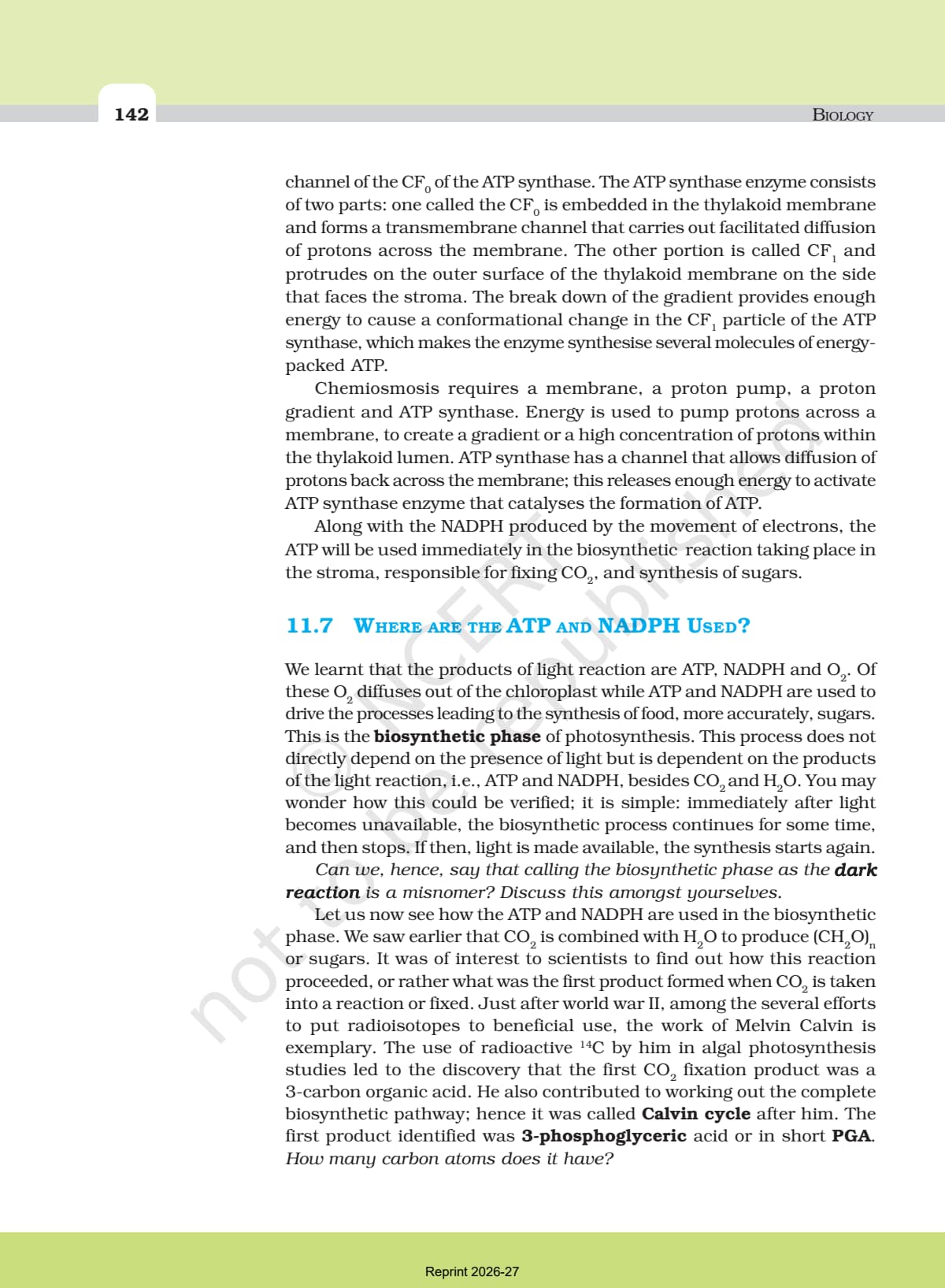
- The chemiosmotic hypothesis of ATP synthesis and the Calvin cycle that fixes CO2.
- The C4 pathway, photorespiration, and the factors of light, CO2, temperature and water that affect the rate.
Why Download the NCERT Book PDF for This Chapter
Photosynthesis is one of the most examined chapters in NEET, and questions on the light and dark reactions come straight from this text. Because the pathways are precise and diagram based, the exact NCERT figures such as the Z-scheme and the Calvin cycle matter, and reading them from the official PDF keeps students from learning a garbled version. The points below explain why the book PDF is worth keeping on your device.
- Photosynthesis is one of the highest-yield NEET chapters, and its light and dark reactions are asked straight from this text.
- The Z-scheme and the Calvin cycle diagrams are the exact ones examiners reference.
- Comparisons such as C3 versus C4 plants and cyclic versus non-cyclic photophosphorylation come directly from the chapter.
How to Use the NCERT Book PDF for Photosynthesis in Higher Plants
Read the chapter once for the overall flow from light capture to sugar, then redraw the Z-scheme and the Calvin cycle so each step is fixed by tracing rather than by memory alone. Since the pathways carry many molecules, a short ordered plan keeps the light and dark reactions clearly apart. The routine below works well for most students preparing for the Boards and NEET.
- Read each stage, then draw the Z-scheme and the Calvin cycle with the carbon count at each step.
- Make a table comparing the C3 and C4 pathways and the Kranz anatomy.
- Attempt the back exercises, then check them against the NCERT Solutions linked below.
- Revise the factors affecting photosynthesis and Blackman's law of limiting factors before the exam.
Other Class 11 Biology Photosynthesis in Higher Plants Resources
Pair the textbook PDF with the solved answers, revision notes, formula sheet and exemplar material for the same chapter so that reading, practice and revision all stay aligned to the same NCERT sections. The linked resources below cover Photosynthesis in Higher Plants in full and are matched to the 2026-27 syllabus.
| Resource | Link |
|---|---|
| NCERT Solutions | Photosynthesis in Higher Plants NCERT Solutions |
| Revision Notes | Photosynthesis in Higher Plants Notes |
| Formula Sheet | Photosynthesis in Higher Plants Formula Sheet |
| Exemplar Solutions | Photosynthesis in Higher Plants Exemplar Solutions |
| Exemplar Book PDF | Photosynthesis in Higher Plants Exemplar Book PDF |
Class 11 Biology Chapter 11 Student Feedback
Photosynthesis in Higher Plants is a chapter students revise many times before the Boards and NEET, and their feedback helps new students plan their reading. Across more than 10,000 students who used these Collegedunia resources for the 2026 boards, the response to the NCERT book PDF for this chapter has been strong, as the summary below shows.
- Over 9 in 10 students said the Z-scheme was clearest when traced from the NCERT figure.
- Students rated the C3 versus C4 comparison as the most examined table.
- Most reported the Calvin cycle was easier to recall after reading the book text.
Class 11 Biology NCERT Book PDF All Chapters
The full Class 11 Biology NCERT Book PDF is split chapter by chapter so students can download only what they need. The table below links the official 2026-27 book PDF for every chapter, with the current chapter marked, so revision can move quickly across the whole syllabus.
| Chapter | NCERT Book PDF |
|---|---|
| Chapter 1 | Chapter 1 The Living World |
| Chapter 2 | Chapter 2 Biological Classification |
| Chapter 3 | Chapter 3 Plant Kingdom |
| Chapter 4 | Chapter 4 Animal Kingdom |
| Chapter 5 | Chapter 5 Morphology of Flowering Plants |
| Chapter 6 | Chapter 6 Anatomy of Flowering Plants |
| Chapter 7 | Chapter 7 Structural Organisation in Animals |
| Chapter 8 | Chapter 8 Cell: The Unit of Life |
| Chapter 9 | Chapter 9 Biomolecules |
| Chapter 10 | Chapter 10 Cell Cycle and Cell Division |
| Chapter 11 | Chapter 11 Photosynthesis in Higher Plants |
| Chapter 12 | Chapter 12 Respiration in Plants |
| Chapter 13 | Chapter 13 Plant Growth and Development |
| Chapter 14 | Chapter 14 Breathing and Exchange of Gases |
| Chapter 15 | Chapter 15 Body Fluids and Circulation |
| Chapter 16 | Chapter 16 Excretory Products and their Elimination |
| Chapter 17 | Chapter 17 Locomotion and Movement |
| Chapter 18 | Chapter 18 Neural Control and Coordination |
| Chapter 19 | Chapter 19 Chemical Coordination and Integration |
FAQs on Class 11 Biology Chapter 11 NCERT Book PDF
Photosynthesis in Higher Plants NCERT PDF - Frequently Asked Questions
Ques. Is this the latest 2026-27 NCERT Book for Class 11 Biology Chapter 11?
Ans. Yes. This is the official NCERT 2026-27 textbook chapter for Class 11 Biology Chapter 11 Photosynthesis in Higher Plants, matched page by page against the latest rationalised edition.
Ques. What topics are in Class 11 Biology Chapter 11?
Ans. The chapter covers the early experiments, the site of photosynthesis, photosynthetic pigments, the light reaction with PS I and PS II, cyclic and non-cyclic photophosphorylation, the chemiosmotic hypothesis, the Calvin cycle, the C4 pathway, photorespiration and the factors affecting photosynthesis.
Ques. Is the NCERT Book enough for this chapter in NEET and CUET?
Ans. The NCERT Book is the base for this chapter, and most NEET and CUET questions on the light and dark reactions are drawn straight from its diagrams and descriptions. Pair it with the Exemplar for extra higher-order practice.
Ques. Where can I download the Class 11 Biology Chapter 11 NCERT Book PDF?
Ans. You can download the Class 11 Biology Chapter 11 Photosynthesis in Higher Plants NCERT Book PDF free from the download card at the top of this page, in both standard and HD quality.



Comments