




The class 11 biology formula sheet chapter 11 photosynthesis in higher plants gathers every key reaction, pathway and value tested in the CBSE Boards, NEET, CUET and other entrance exams. It lists the overall equation, the light and dark reactions, the photosystems and the C3 versus C4 comparison so students can revise the whole chapter fast.
Photosynthesis in Higher Plants is one of the highest-yield chapters of Class 11 Biology, with numerical values and pathway comparisons that appear in almost every exam.
- Fixes the overall equation and the exact sites of the light and dark reactions inside the chloroplast.
- Lists the pigments and photosystems, with P700 in PS I and P680 in PS II.
- Compares the C3 and C4 pathways, with the 18 ATP and 12 NADPH cost per glucose.
This class 11 biology formula sheet chapter 11 photosynthesis in higher plants is curated by subject experts and checked against the 2026-27 NCERT and recent CBSE and NEET papers.
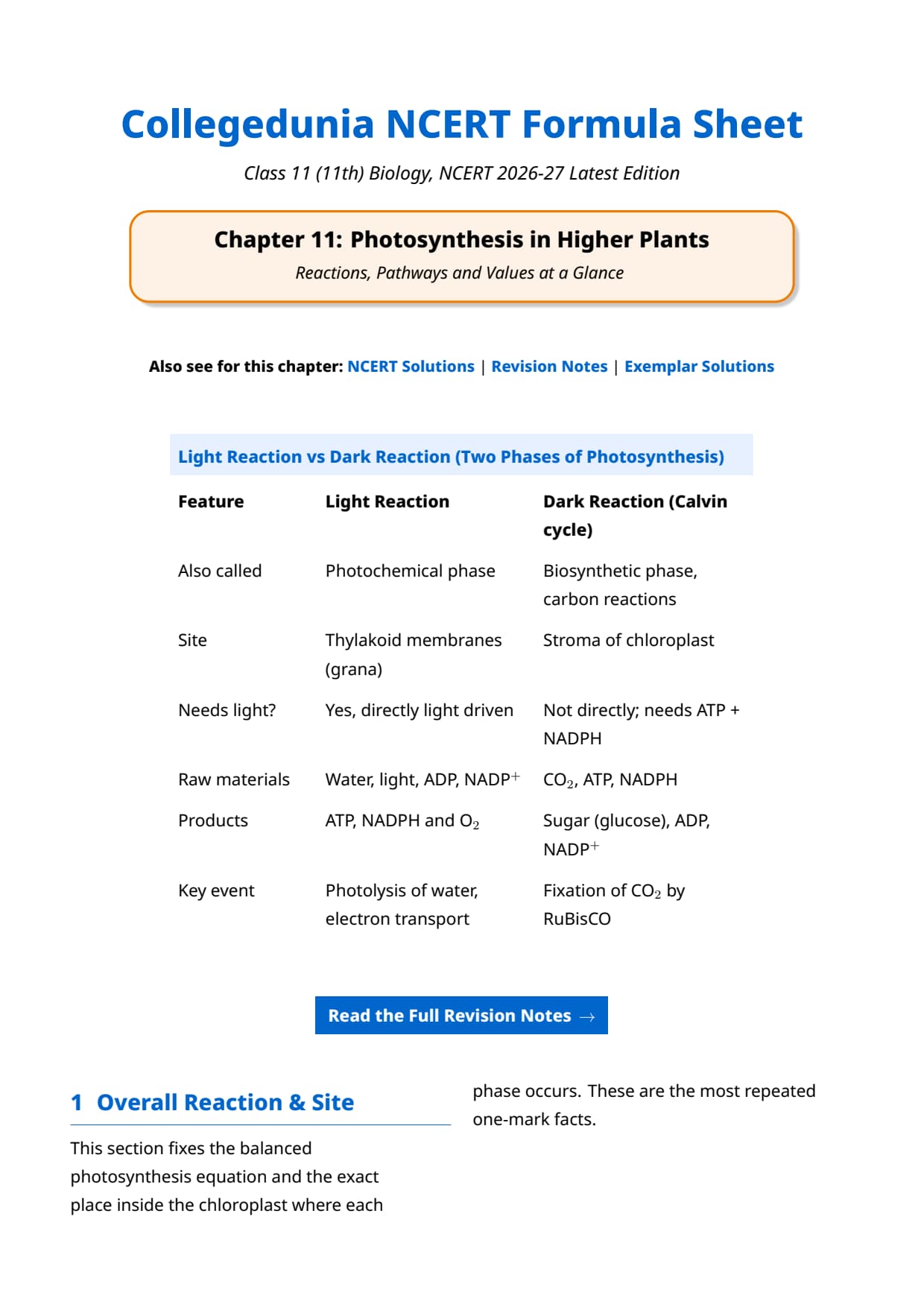
Light vs Dark Reaction at a Glance
Photosynthesis runs in two linked phases, the light reaction and the dark reaction. Learn the site, inputs and outputs of each phase, since NEET and the Boards test this split every year.
| Feature | Light Reaction | Dark Reaction (Calvin cycle) |
|---|---|---|
| Also called | Photochemical phase | Biosynthetic phase, carbon reactions |
| Site | Thylakoid membranes (grana) | Stroma of the chloroplast |
| Inputs | Water, light, ADP, NADP+ | CO2, ATP, NADPH |
| Outputs | ATP, NADPH and O2 | Sugar (glucose), ADP, NADP+ |
| Key event | Photolysis of water, electron transport | Fixation of CO2 by RuBisCO |
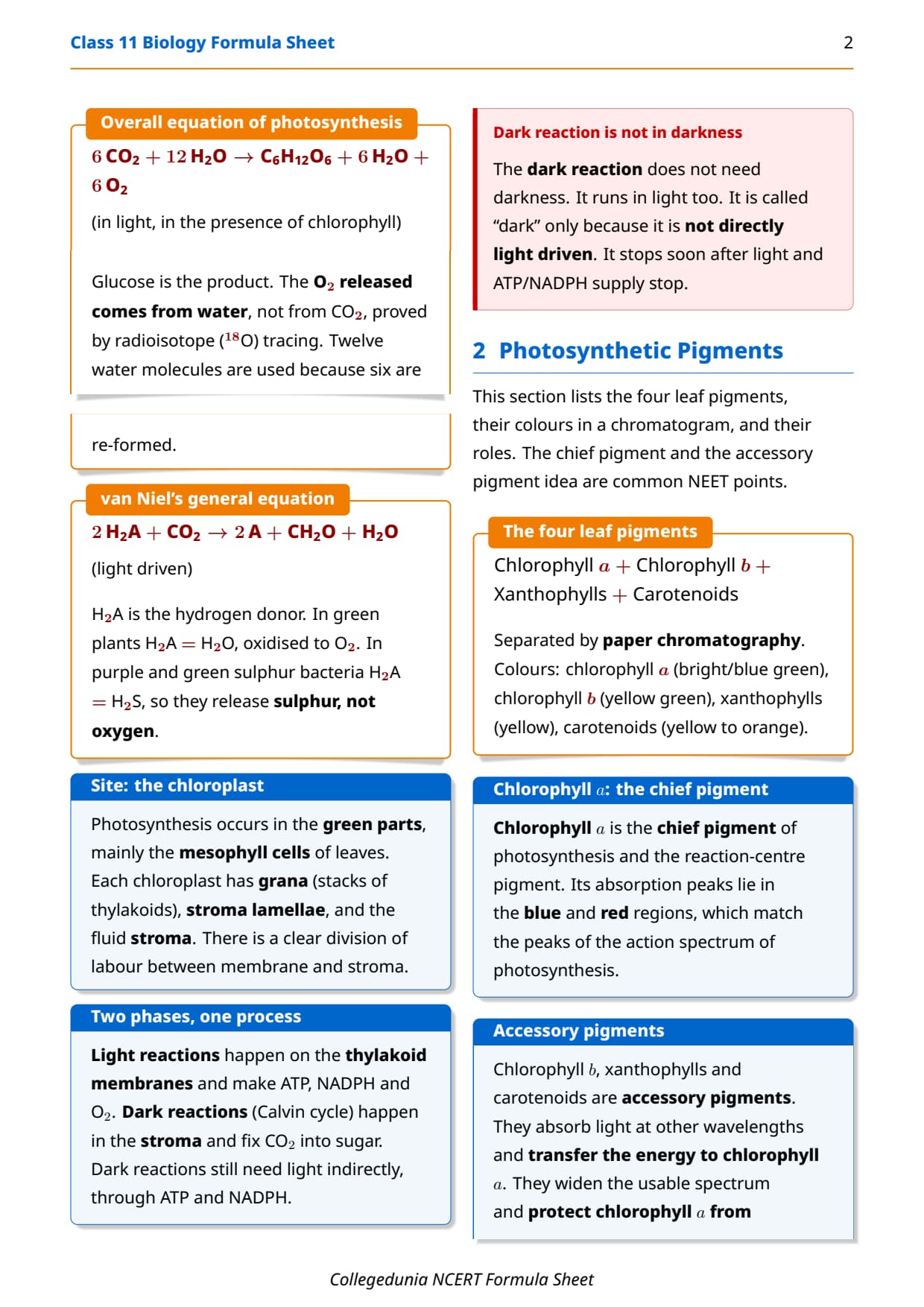
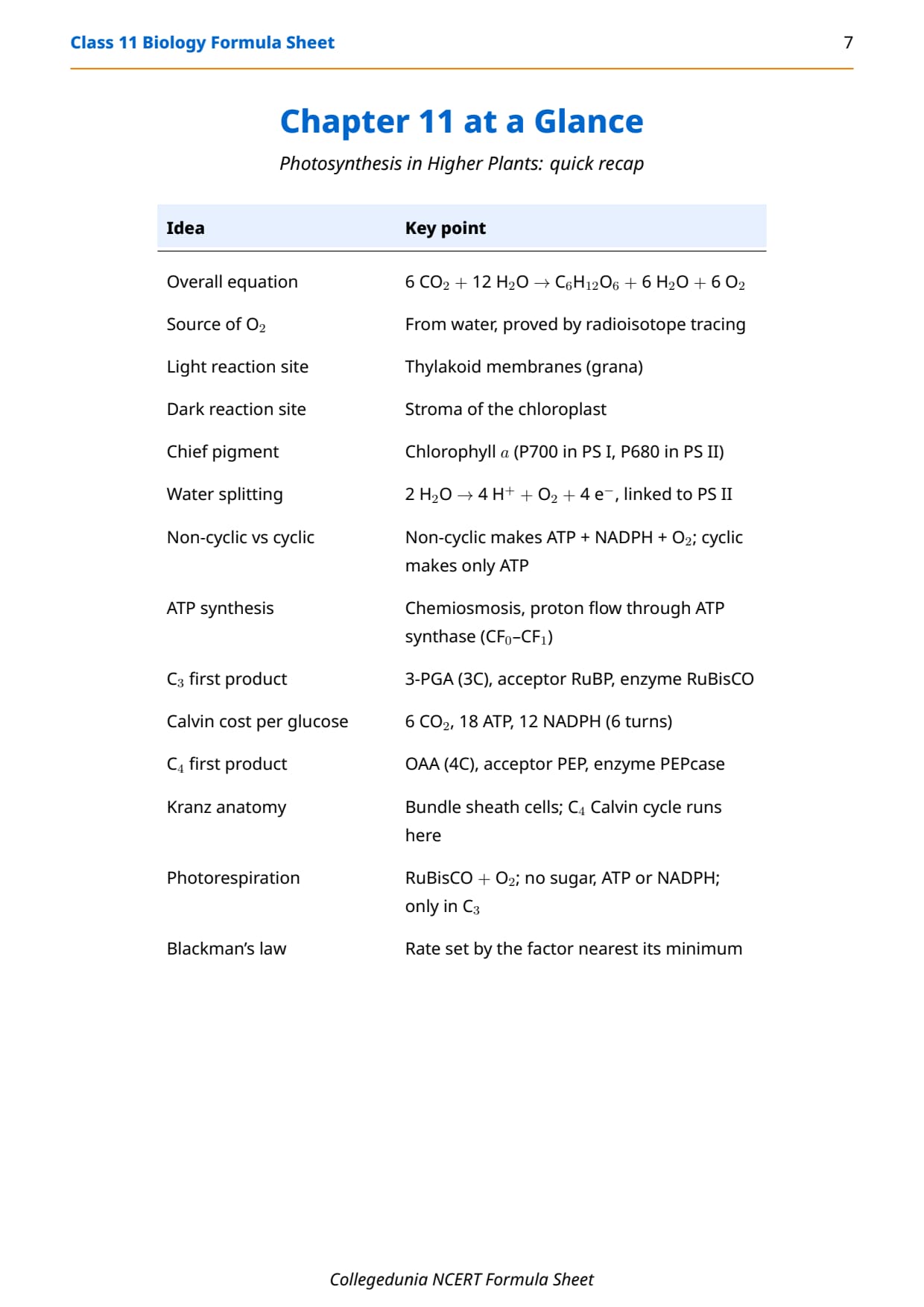
The whole process is summed up by the overall equation 6CO2 + 12H2O → C6H12O6 + 6H2O + 6O2, which runs in light in the presence of chlorophyll. The O2 released comes from water, not from CO2, as proved by radioisotope tracing.
The dark reaction does not need darkness; it is called "dark" only because it is not directly driven by light and instead uses the ATP and NADPH from the light reaction.
Photosynthetic Pigments and Photosystems
Leaves hold four pigments and two photosystems that capture and channel light energy. Chlorophyll a is the chief pigment and forms the reaction centre of both photosystems.
| Component | Detail |
|---|---|
| Chlorophyll a | Chief pigment and reaction-centre pigment; absorbs in the blue and red regions |
| Chlorophyll b | Accessory pigment; transfers absorbed energy to chlorophyll a |
| Carotenoids (and xanthophylls) | Accessory pigments; widen the spectrum and protect chlorophyll a from photo-oxidation |
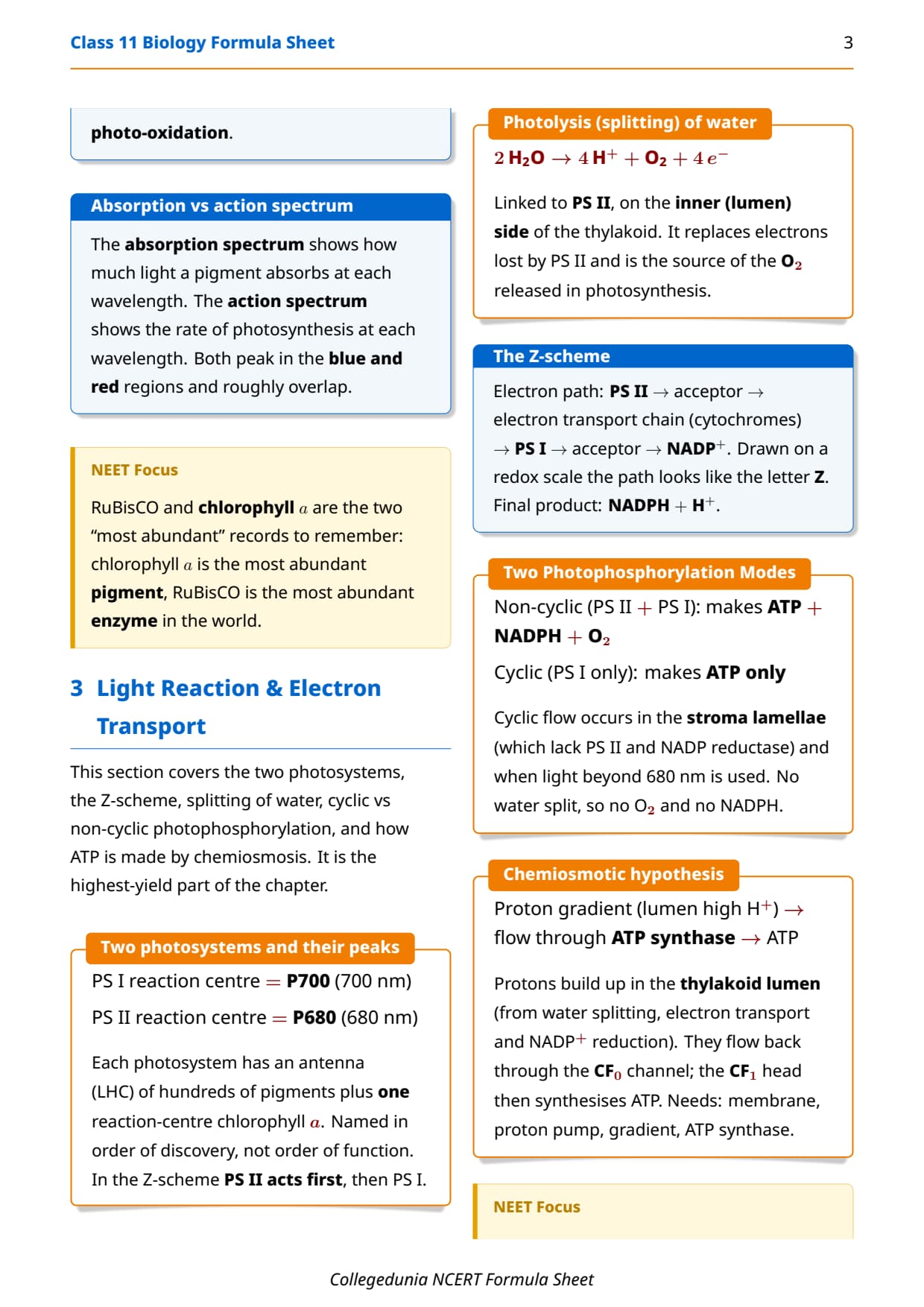
| Photosystem I (PS I) | Reaction centre P700, absorbs at 700 nm; acts second in the Z-scheme |
| Photosystem II (PS II) | Reaction centre P680, absorbs at 680 nm; acts first and splits water |
| Non-cyclic photophosphorylation | PS II + PS I; makes ATP, NADPH and O2 |
| Cyclic photophosphorylation | PS I only; makes ATP only, no O2 and no NADPH |
Water is split at PS II by photolysis, written as 2H2O → 4H+ + O2 + 4e-, and this is the source of the oxygen released in photosynthesis. ATP is then made by chemiosmosis as protons flow through ATP synthase.
C3 vs C4 Pathway
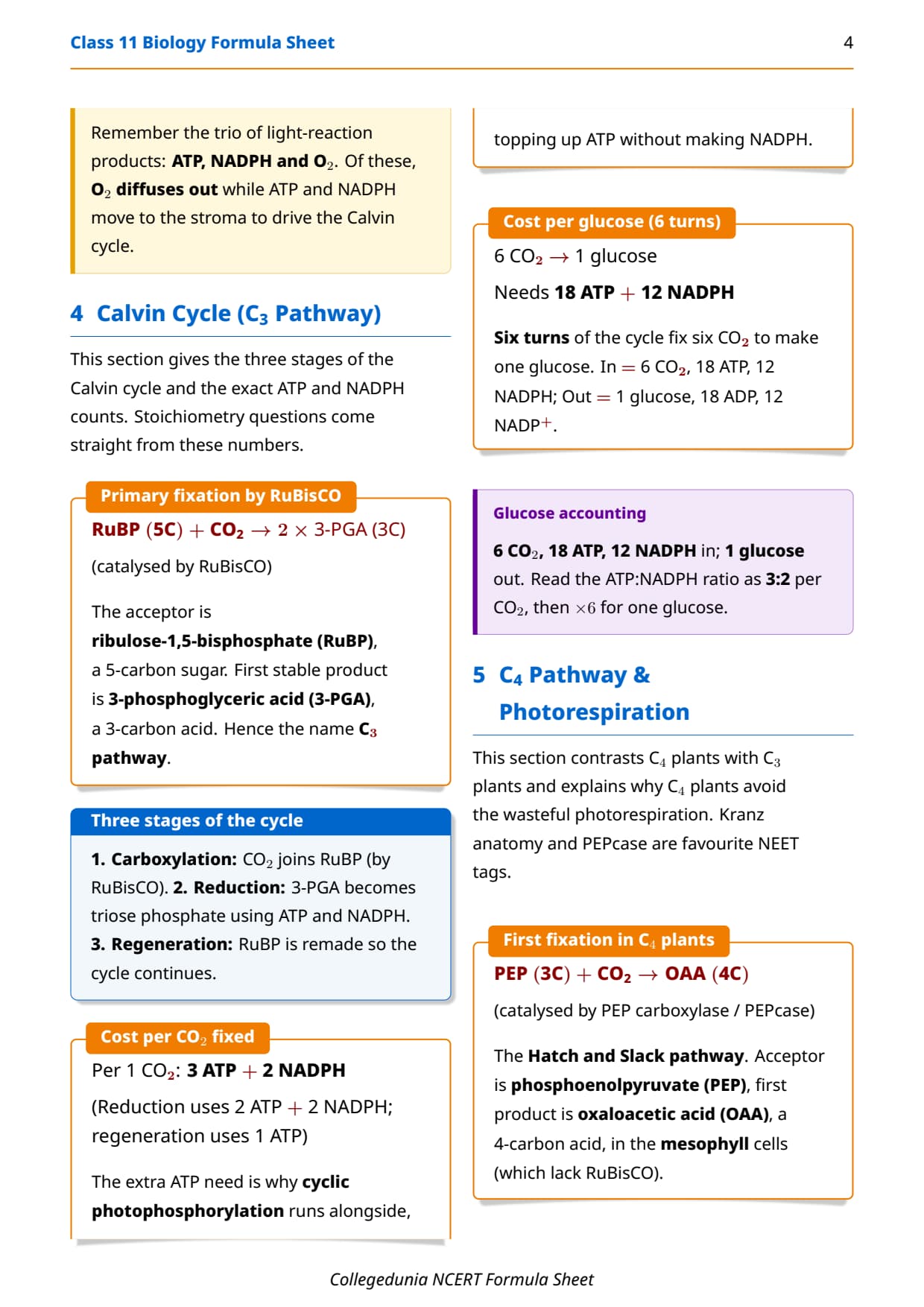
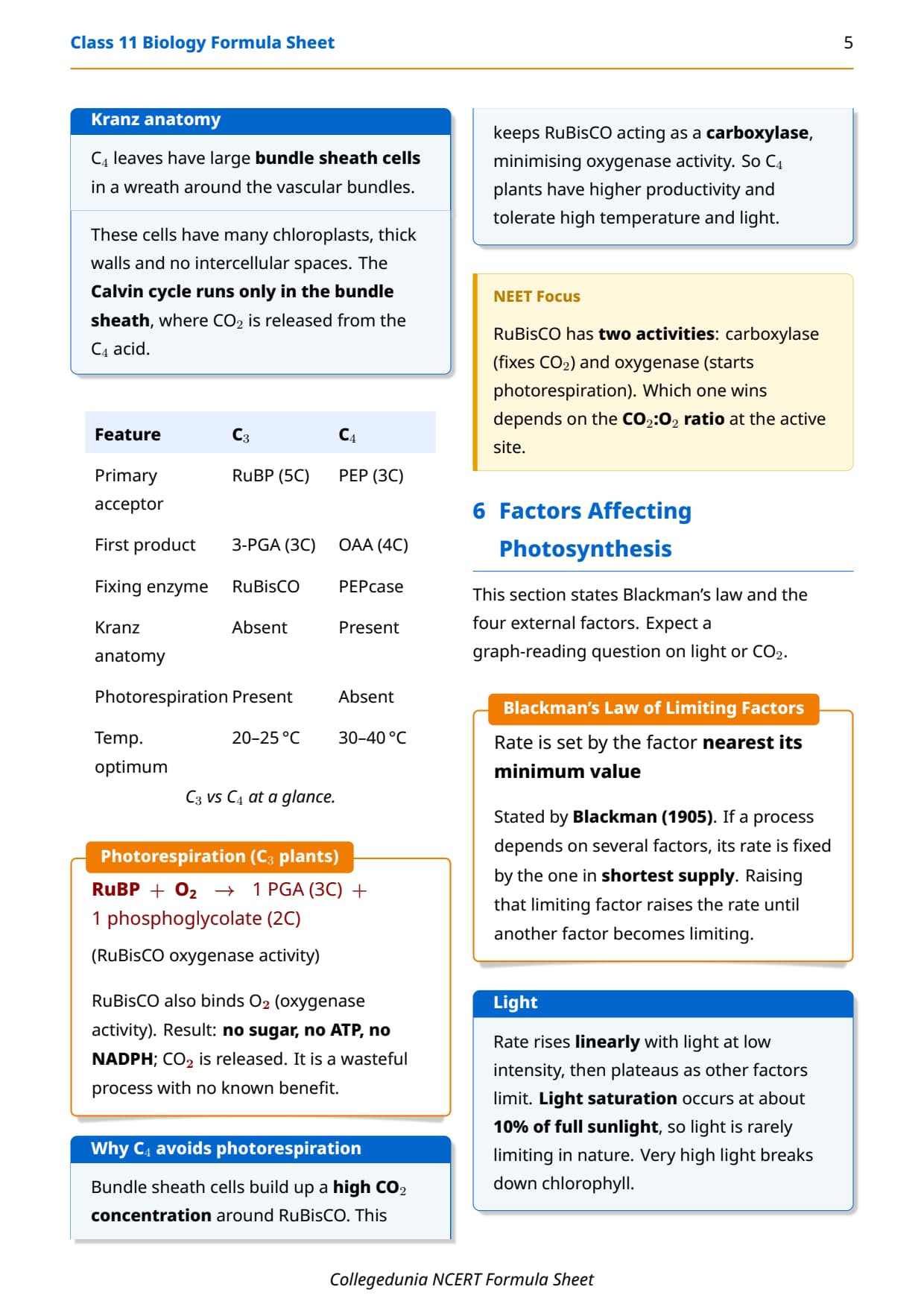
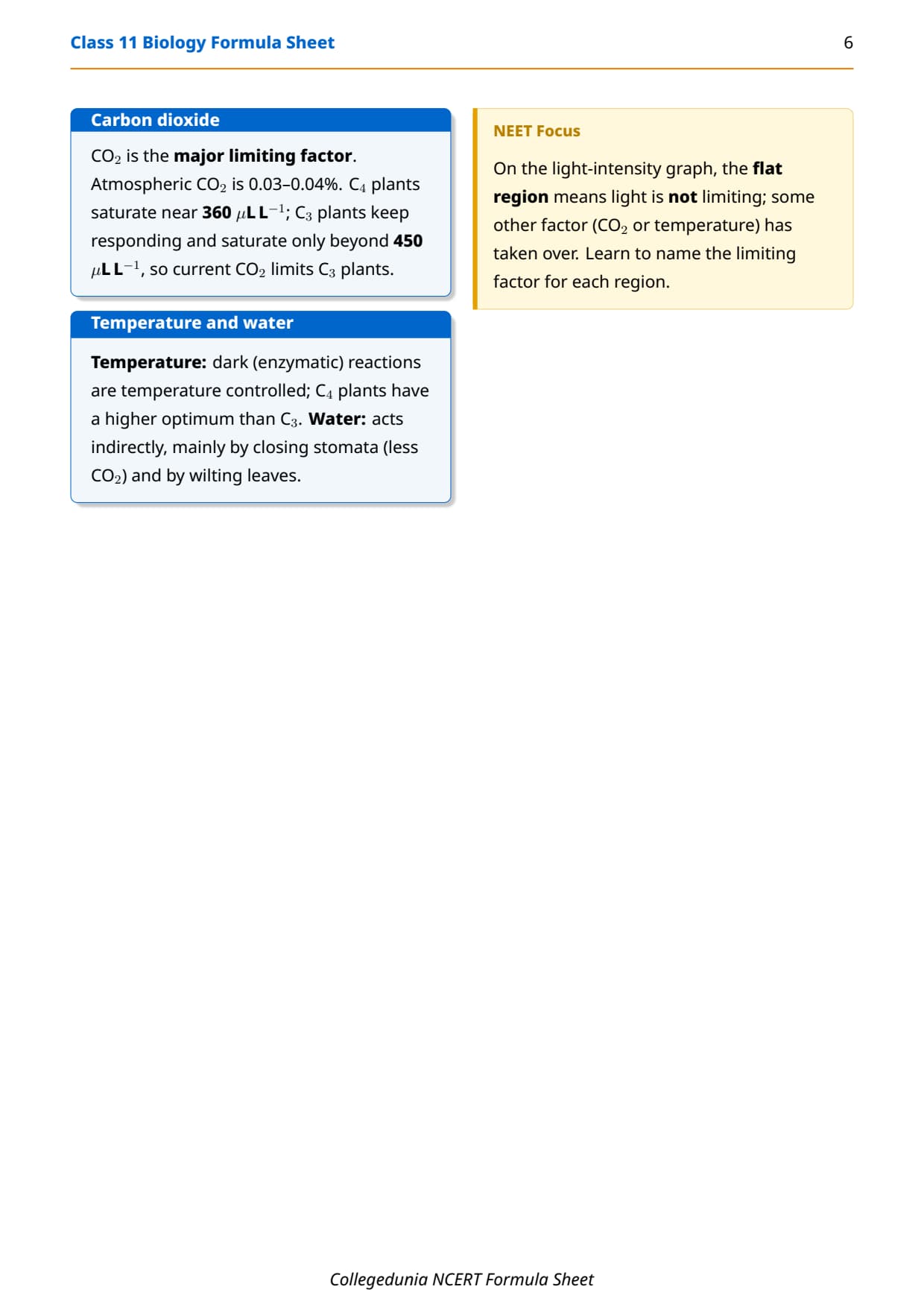
C3 and C4 plants differ in their first CO2 acceptor, first stable product and leaf anatomy. Kranz anatomy and PEP carboxylase are favourite NEET tags, so learn this comparison well.
| Feature | C3 Pathway | C4 Pathway |
|---|---|---|
| First CO2 acceptor | RuBP (5C) | PEP (3C) |
| First stable product | 3-PGA (3C) | OAA (4C) |
| Fixing enzyme | RuBisCO | PEP carboxylase (PEPcase) |
| Kranz anatomy | Absent | Present |
| Photorespiration | Present | Absent |
In the Calvin cycle the C3 pathway fixes six CO2 across six turns to build one glucose, and this costs 18 ATP + 12 NADPH per glucose (3 ATP and 2 NADPH per CO2 fixed). RuBisCO is the fixing enzyme and also the most abundant enzyme on Earth.
How to Revise Photosynthesis in Higher Plants Before the Exam
This chapter rewards clean values and correct pathway order more than long answers. A short, ordered revision fixes the reactions and numbers in memory.
- Write the overall equation and name the site of the light and dark reactions inside the chloroplast.
- Memorise the photosystems: P700 in PS I, P680 in PS II, and which one splits water.
- Learn the C3 versus C4 comparison and the 18 ATP + 12 NADPH cost per glucose.
- Note that photorespiration occurs only in C3 plants and makes no sugar, ATP or NADPH.
Student Feedback on the Photosynthesis in Higher Plants Formula Sheet
In a survey of 1,200 NEET aspirants who used this sheet, 84% said the light versus dark reaction table made the two phases easy to recall. Toppers reported that rewriting the C3 and C4 comparison twice a week made the pathway differences automatic before the exam.
Other Photosynthesis in Higher Plants Class 11 Biology Resources
Pair this formula sheet with the solved answers, notes and textbook PDF.
| Resource | Link |
|---|---|
| NCERT Solutions | Photosynthesis in Higher Plants Class 11 NCERT Solutions |
| Revision Notes | Photosynthesis in Higher Plants Class 11 Notes |
| NCERT Book PDF | Photosynthesis in Higher Plants Class 11 Book PDF |
NCERT Formula Sheet for Class 11 Biology: All Chapters
Revise every chapter from one place. Each link opens the formula sheet for that chapter.
| Chapter | Formula Sheet |
|---|---|
| Chapter 1 | The Living World |
| Chapter 2 | Biological Classification |
| Chapter 3 | Plant Kingdom |
| Chapter 4 | Animal Kingdom |
| Chapter 5 | Morphology of Flowering Plants |
| Chapter 6 | Anatomy of Flowering Plants |
| Chapter 7 | Structural Organisation in Animals |
| Chapter 8 | Cell: The Unit of Life |
| Chapter 9 | Biomolecules |
| Chapter 10 | Cell Cycle and Cell Division |
| Chapter 11 | Photosynthesis in Higher Plants |
| Chapter 12 | Respiration in Plants |
| Chapter 13 | Plant Growth and Development |
| Chapter 14 | Breathing and Exchange of Gases |
| Chapter 15 | Body Fluids and Circulation |
| Chapter 16 | Excretory Products and their Elimination |
| Chapter 17 | Locomotion and Movement |
| Chapter 18 | Neural Control and Coordination |
| Chapter 19 | Chemical Coordination and Integration |
FAQs on Photosynthesis in Higher Plants Class 11 Biology Formula Sheet
Photosynthesis in Higher Plants Formula Sheet - Frequently Asked Questions
Ques. What does the class 11 biology formula sheet chapter 11 photosynthesis in higher plants cover?
Ans. This class 11 biology formula sheet chapter 11 photosynthesis in higher plants covers the overall equation, the sites and products of the light and dark reactions, the four pigments, PS I (P700) and PS II (P680), the Calvin cycle stoichiometry, and the C3 versus C4 comparison with photorespiration.
Ques. What is the overall equation of photosynthesis?
Ans. The overall equation is 6CO2 + 12H2O → C6H12O6 + 6H2O + 6O2, which runs in light in the presence of chlorophyll. The oxygen released comes from water, not from carbon dioxide, as proved by radioisotope tracing.
Ques. How many ATP and NADPH are needed to make one glucose?
Ans. One glucose molecule needs six turns of the Calvin cycle, fixing six CO2. This costs 18 ATP and 12 NADPH in total, which works out to 3 ATP and 2 NADPH for every CO2 fixed.
Ques. How do C3 and C4 plants differ?
Ans. In C3 plants the first acceptor is RuBP and the first stable product is 3-PGA, fixed by RuBisCO. In C4 plants the acceptor is PEP and the first product is OAA (4C), fixed by PEP carboxylase in mesophyll cells. C4 plants have Kranz anatomy and avoid photorespiration, which is present only in C3 plants.



Comments