




These photosynthesis in higher plants class 11 notes pull together every experiment, site, pigment, reaction, and number that the CBSE Boards, NEET and CUET papers actually test in 2026-27. Revise the whole chapter fast, with the early experiments, the light reaction and Z scheme, the Calvin cycle, the C4 pathway, and the factors that set the rate in one place.
This is one of the plant physiology chapters of Class 11 Biology, and the vocabulary of light reactions, RuBisCO, and limiting factors you learn here returns in Respiration in Plants and in the metabolism topics of NEET.
- CBSE Weightage: 4 to 6 marks, usually one short answer on the light reaction or the Calvin cycle plus one question on C3 versus C4 plants or limiting factors.
- Topics covered: the early experiments, the site of photosynthesis, the four pigments, the light reaction with the Z scheme and chemiosmosis, the Calvin cycle, the C4 pathway, photorespiration, and the factors affecting the rate.
- Key rules: the O2 comes from water not CO2, water splitting is tied to PS II, RuBP is the 5-carbon acceptor while PGA is the 3-carbon product, and one glucose needs 18 ATP and 12 NADPH.
These photosynthesis in higher plants class 11 notes are curated by subject experts, based on the 2026-27 NCERT textbook, and checked against the last five years of CBSE Board and NEET papers.
Topic-by-Topic Summary of Photosynthesis in Higher Plants
The chapter follows light energy from a photon striking a leaf to a finished sugar molecule. It starts with the experiments that built the story, moves to the chloroplast and its pigments, then splits the process into the light reaction on the thylakoids and the carbon-fixing reactions in the stroma, and ends with the C4 shortcut and the outside factors that limit the rate. Here is the quick map of what each topic gives you before you revise the detail.
- Early experiments: Priestley, Ingenhousz, von Sachs, Engelmann, and van Niel, who showed the oxygen comes from water.
- Site and pigments: the chloroplast with its grana and stroma, and the four pigments led by chlorophyll a.
- Light reaction: the two photosystems, the Z scheme of electron flow, the splitting of water, and ATP made by chemiosmosis.
- Calvin cycle: the C3 pathway of carboxylation, reduction, and regeneration, using RuBisCO to fix CO2.
- C4, photorespiration and rate: the Hatch and Slack pathway, the wasteful oxygenation of RuBP, and the four external factors that limit photosynthesis.
Revise the topics in this order, because each one uses the one before it. Master the two phases and the ATP or NADPH budget first, and the C4 pathway and limiting factors fall into place around them. These photosynthesis in higher plants class 11 notes follow the same sequence as the NCERT textbook.
Early Experiments and the Source of Oxygen
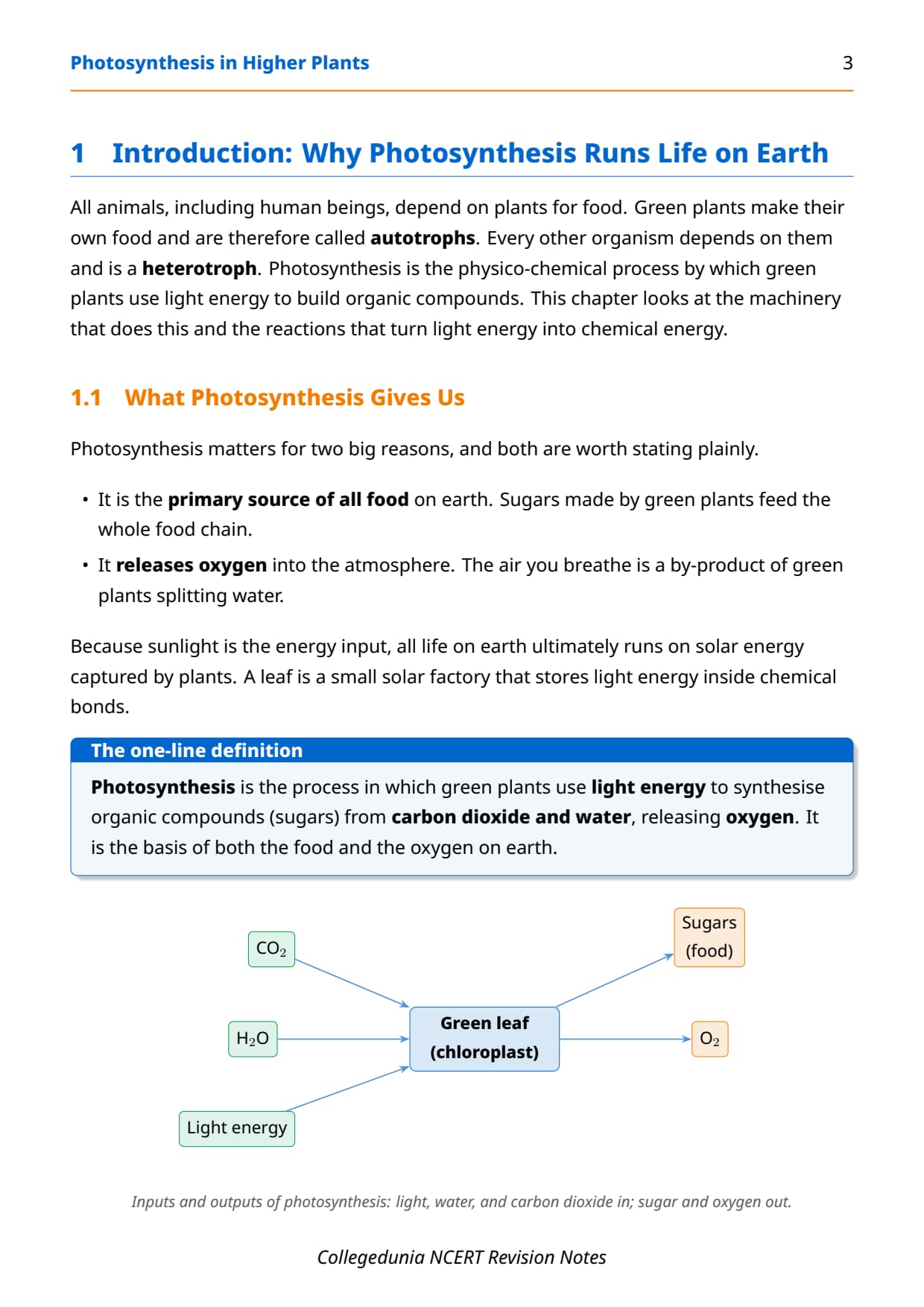
Our understanding of photosynthesis grew step by step through simple, clever experiments, and each scientist added one piece. Green plants make their own food and are therefore called autotrophs, while every other organism depends on them as a heterotroph. Photosynthesis matters for two big reasons: it is the primary source of all food on earth, and it releases the oxygen we breathe. The classic starch tests from earlier classes already show that chlorophyll, light, and carbon dioxide are all needed before we even study the chemistry.
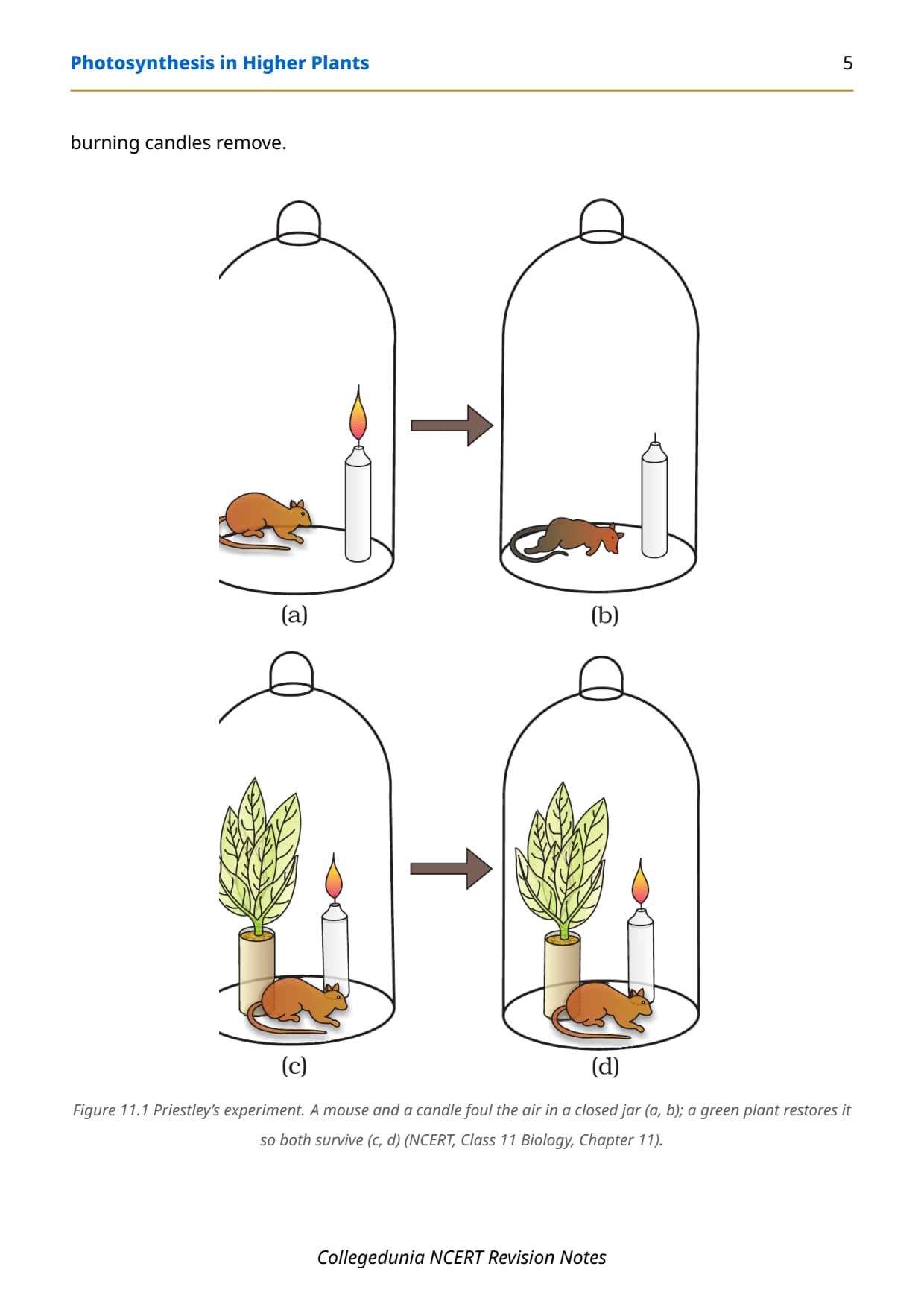
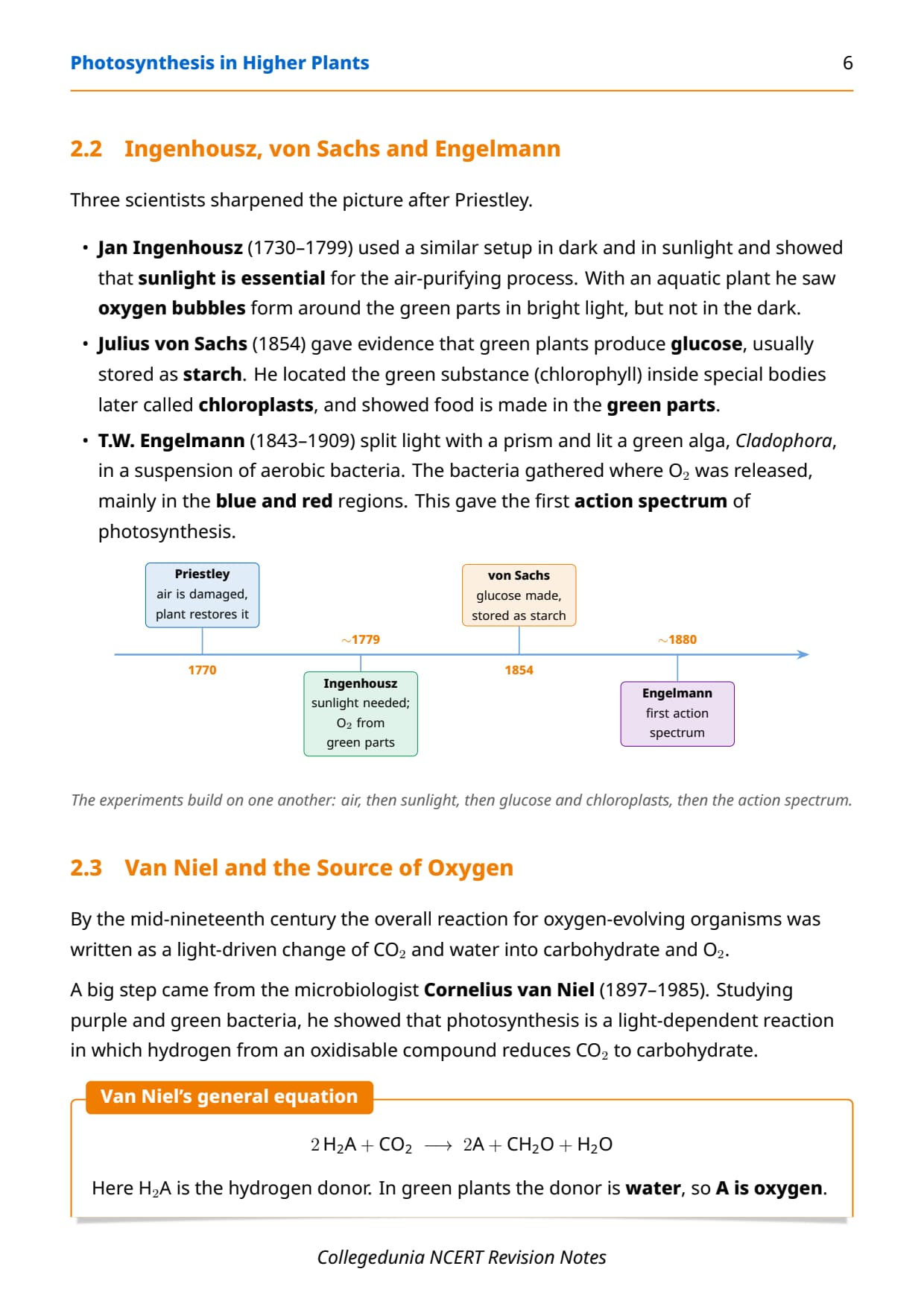
- Joseph Priestley (1770): a candle and a mouse foul the air in a closed jar, but a mint plant restores it, so plants replace what burning and breathing remove.
- Jan Ingenhousz: showed that sunlight is essential, and saw oxygen bubbles form around the green parts of an aquatic plant in bright light.
- Julius von Sachs (1854): found that green plants make glucose, usually stored as starch, inside bodies later called chloroplasts.
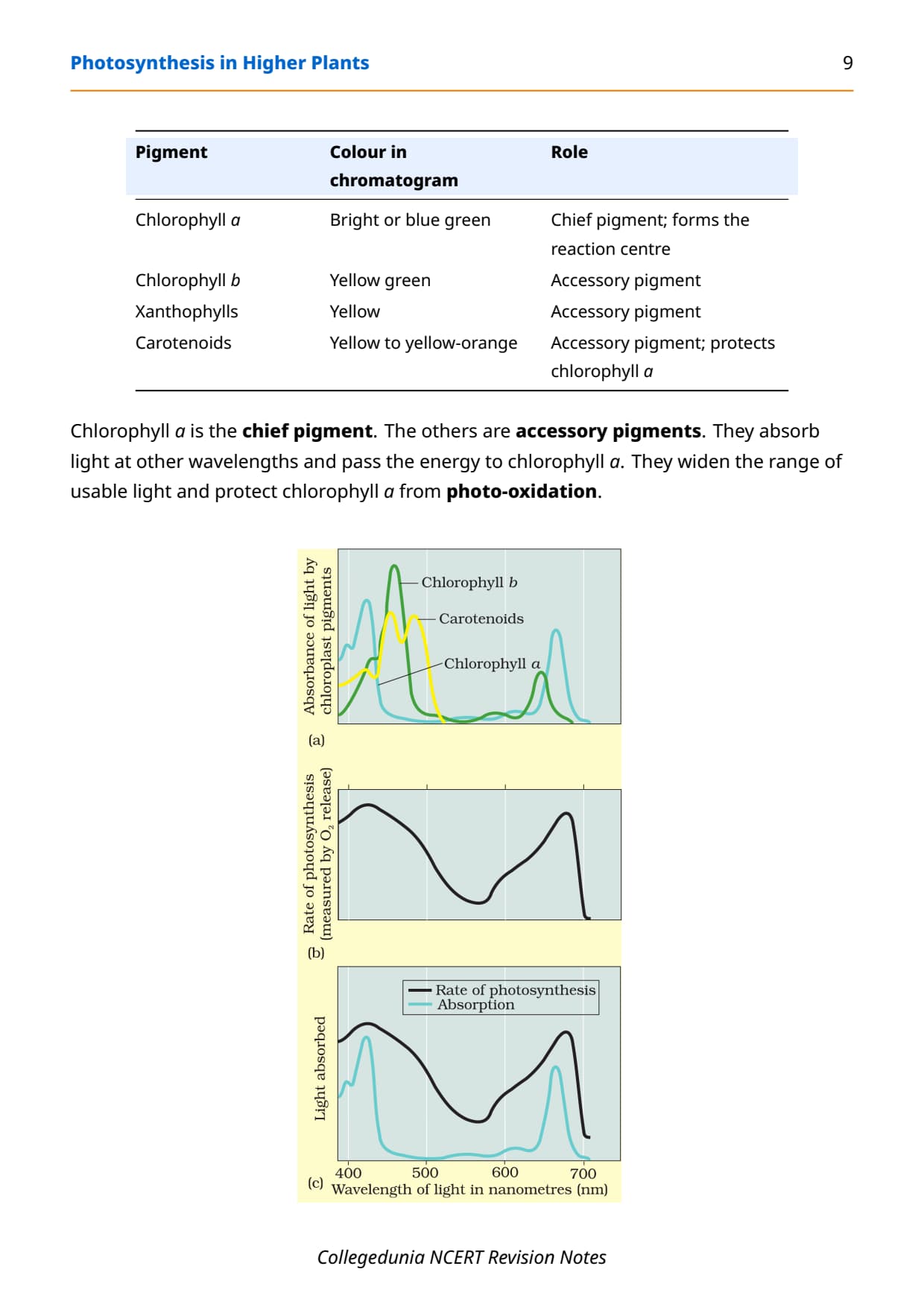
- T.W. Engelmann: split light with a prism over Cladophora and traced the first action spectrum, with most activity in the blue and red regions.
- Cornelius van Niel: studying bacteria, showed hydrogen from an oxidisable compound reduces CO2, so in green plants the O2 comes from water.
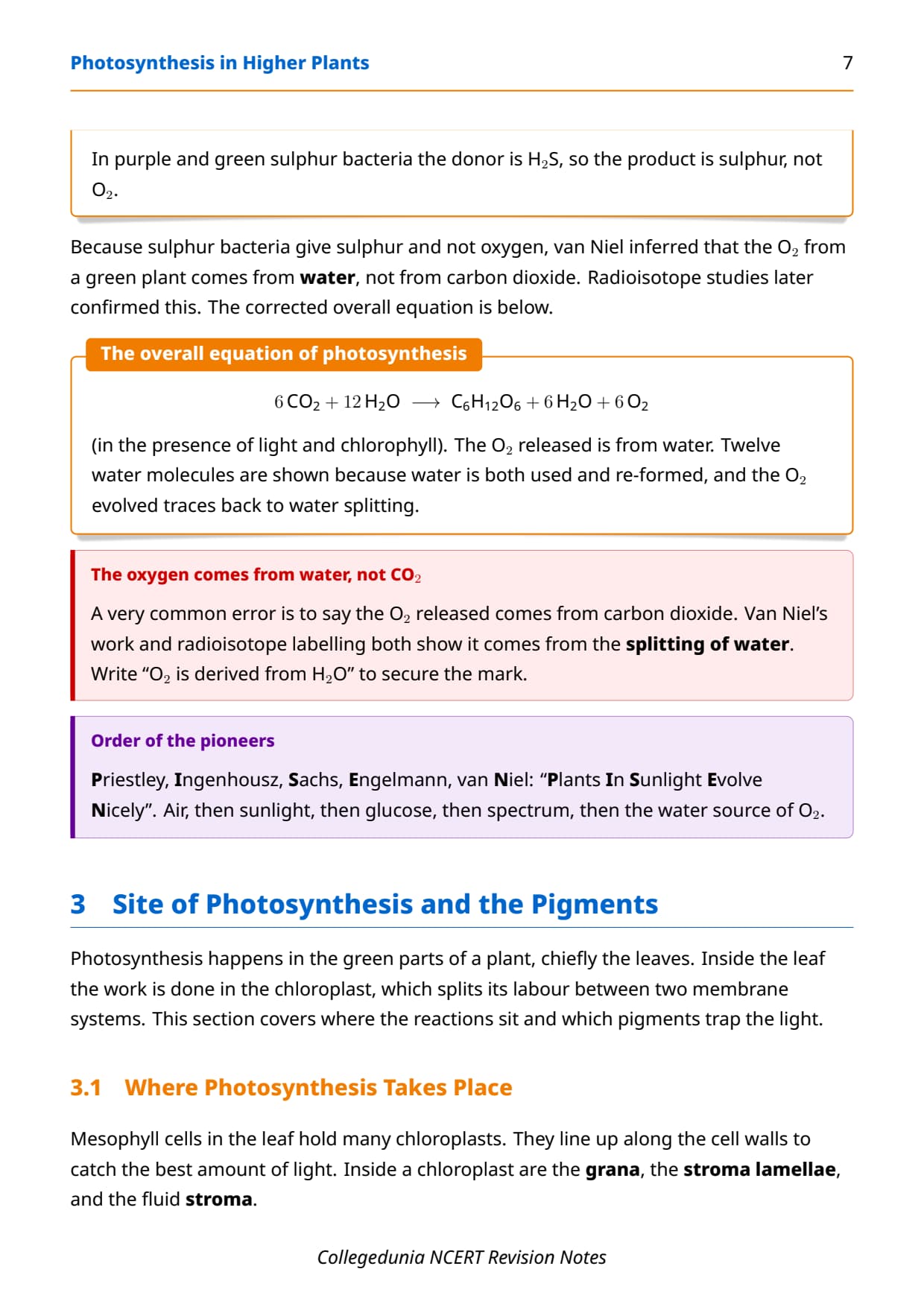
Van Niel's work and later radioisotope labelling both prove the oxygen released is from the splitting of water, not from carbon dioxide. The corrected overall equation is 6CO2 + 12H2O → C6H12O6 + 6H2O + 6O2 in the presence of light and chlorophyll. Always write that the O2 is derived from H2O to secure the mark. A useful memory order for the pioneers is Priestley, Ingenhousz, Sachs, Engelmann, van Niel, that is air, then sunlight, then glucose, then spectrum, then the water source of oxygen.
Site of Photosynthesis and the Photosynthetic Pigments
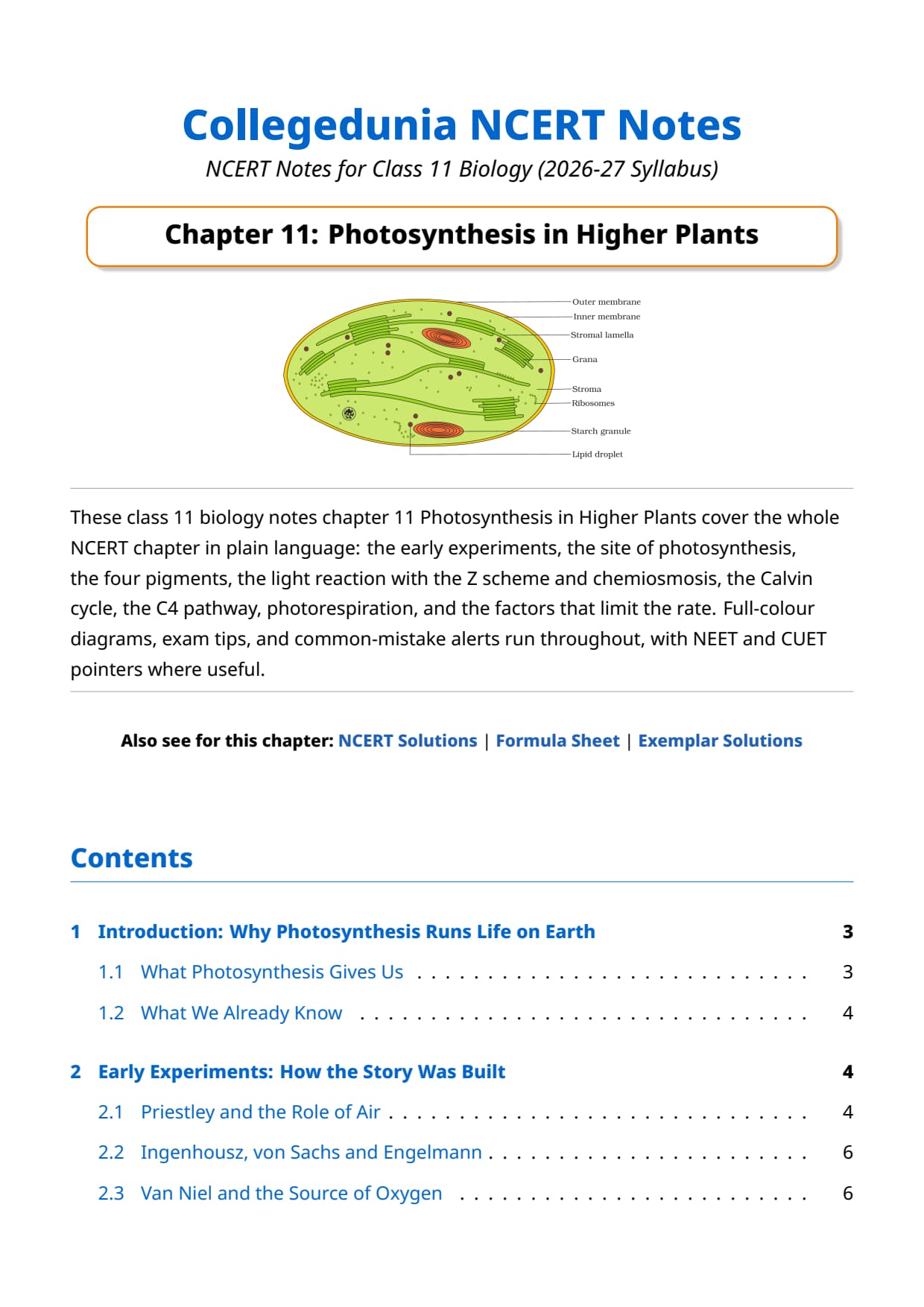
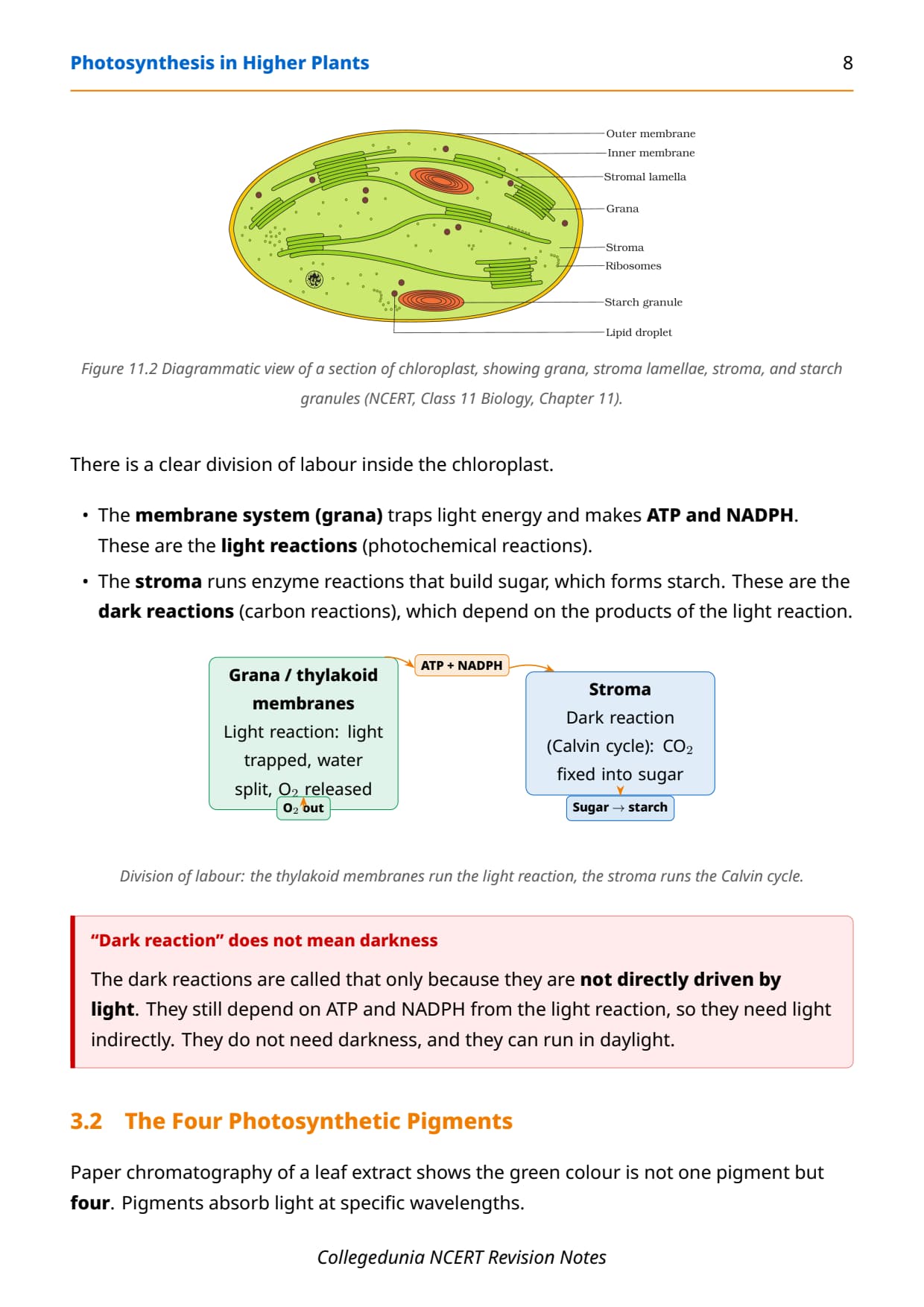
Photosynthesis happens in the green parts of a plant, chiefly the leaves, where mesophyll cells hold many chloroplasts lined up along the walls to catch the most light. Inside a chloroplast the work splits between two zones. The membrane system, the grana, traps light and makes ATP and NADPH in the light reactions, while the fluid stroma runs the enzyme reactions that build sugar in the dark reactions. The dark reactions are called that only because they are not directly driven by light; they still need the ATP and NADPH from the light reaction, and they can run in daylight.
- Chlorophyll a: bright or blue-green, the chief pigment that forms the reaction centre.
- Chlorophyll b: yellow-green accessory pigment that widens the range of usable light.
- Xanthophylls: yellow accessory pigment.
- Carotenoids: yellow to yellow-orange accessory pigment that protects chlorophyll a from photo-oxidation.
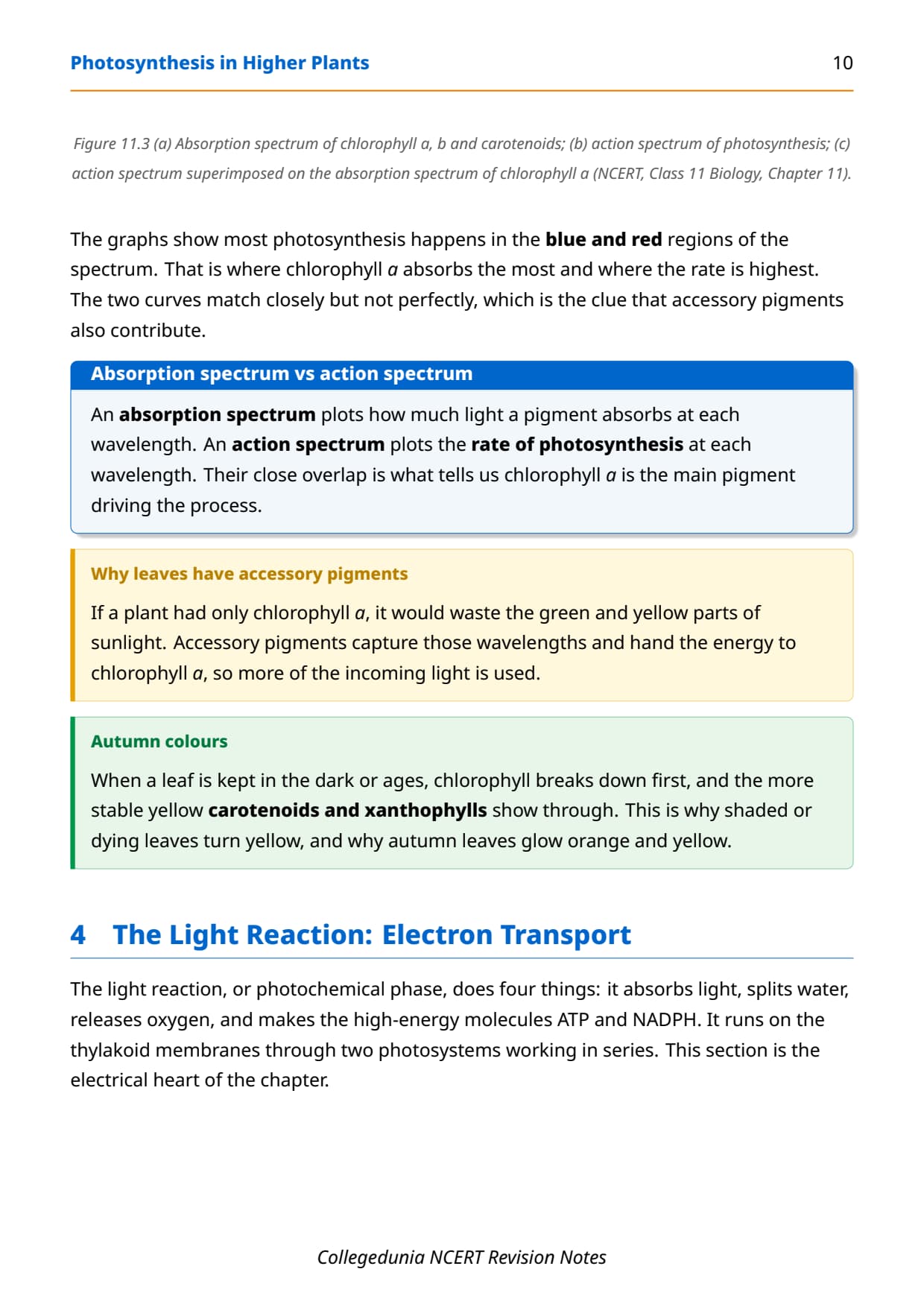
An absorption spectrum plots how much light a pigment absorbs at each wavelength, while an action spectrum plots the rate of photosynthesis at each wavelength. Both peak in the blue and red regions, and their close overlap is the clue that chlorophyll a is the main pigment driving the process. The accessory pigments capture the green and yellow light that chlorophyll a would waste and hand the energy to it. When a leaf ages or is kept in the dark, chlorophyll breaks down first and the stable yellow carotenoids and xanthophylls show through, which is why autumn leaves glow orange and yellow.
The Light Reaction, Z Scheme and Chemiosmosis
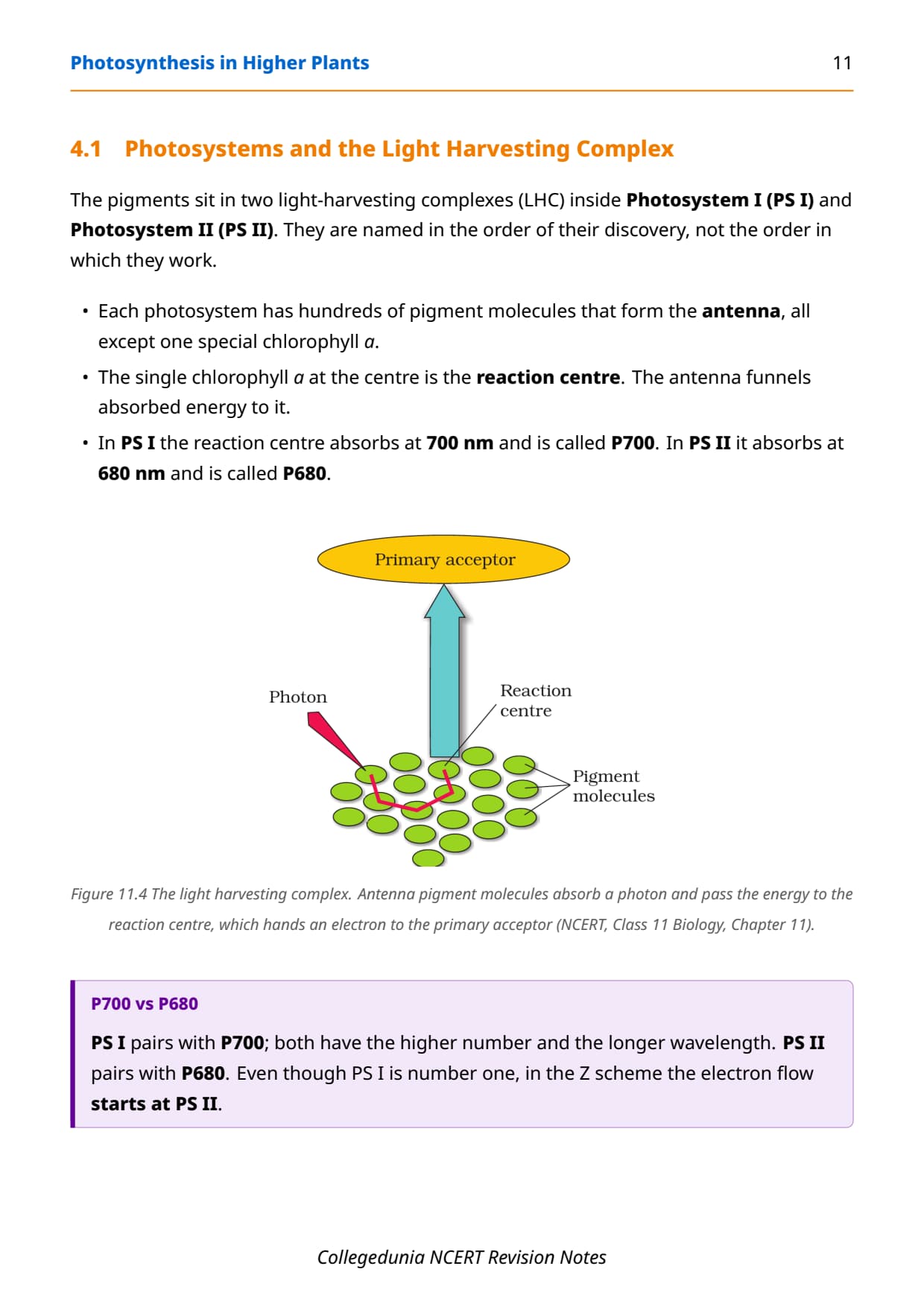
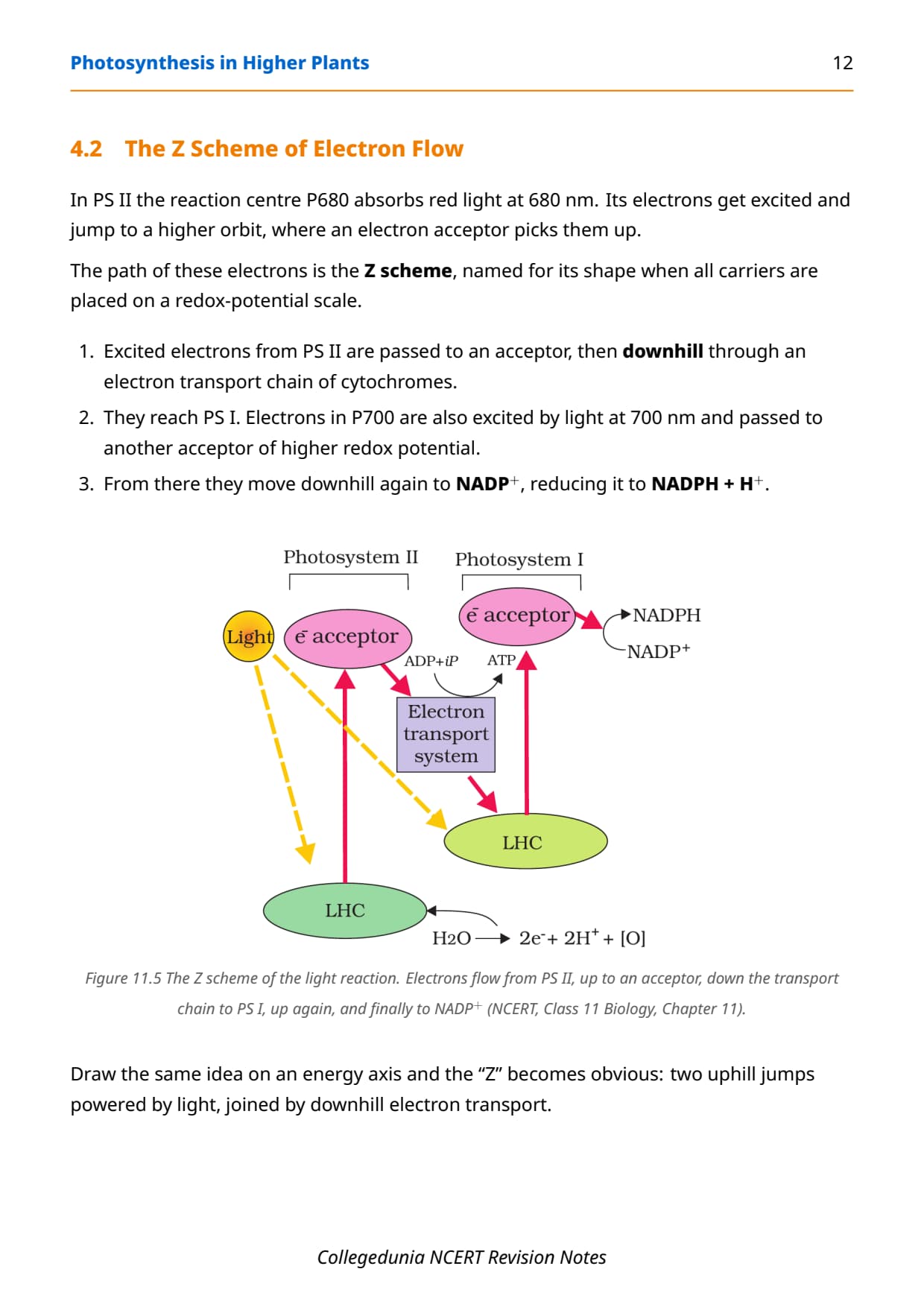
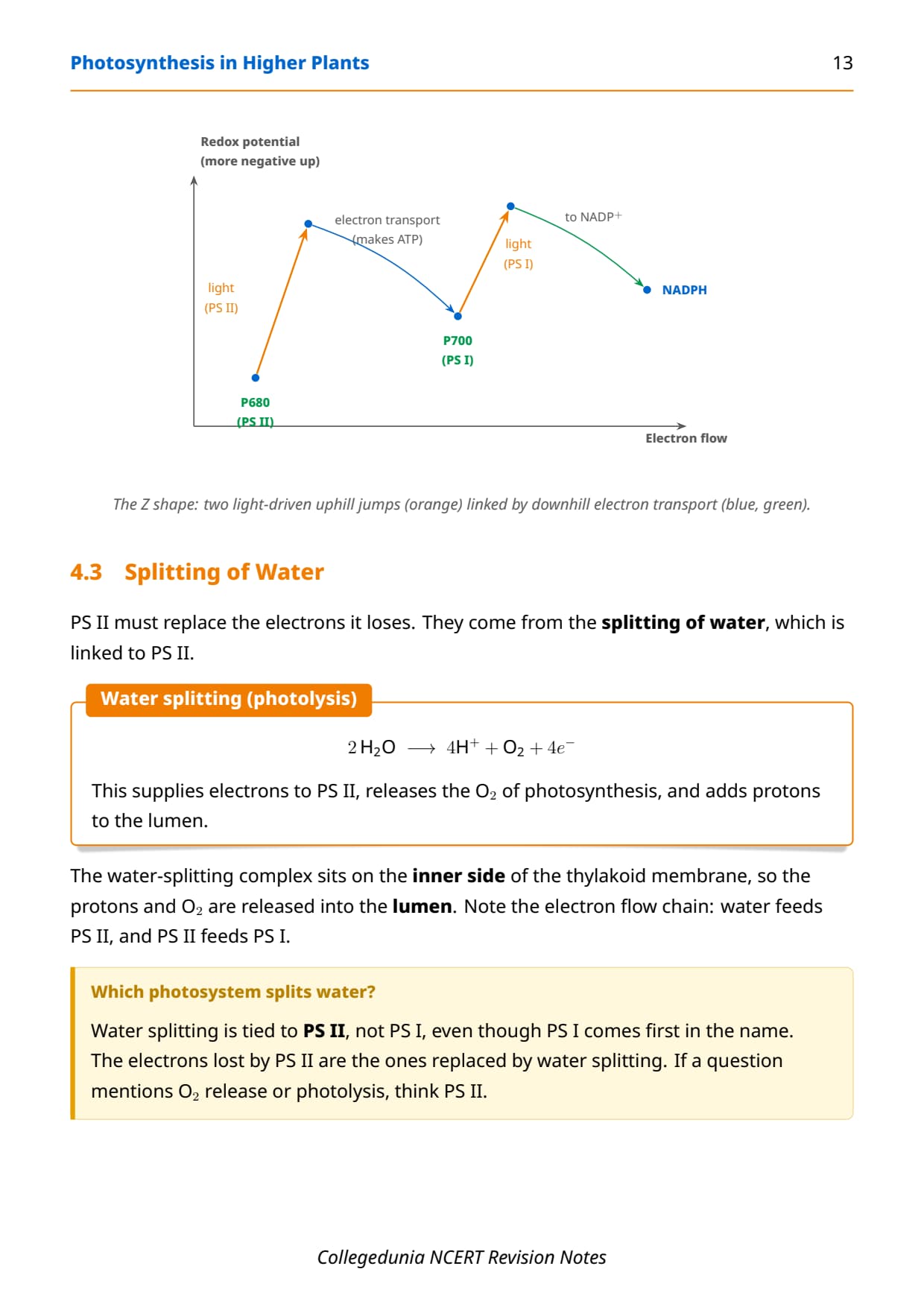
The light reaction, or photochemical phase, absorbs light, splits water, releases oxygen, and makes ATP and NADPH on the thylakoid membranes. The pigments sit in two light-harvesting complexes inside Photosystem I (PS I) and Photosystem II (PS II), named in the order of their discovery, not the order in which they work. Hundreds of antenna pigments funnel absorbed energy to a single chlorophyll a at the reaction centre, which is P700 in PS I and P680 in PS II. Even though PS I has the lower number, in the Z scheme the electron flow starts at PS II.
- Z scheme: excited electrons from PS II pass to an acceptor, then downhill through cytochromes to PS I, are re-excited, and finally reduce NADP+ to NADPH.
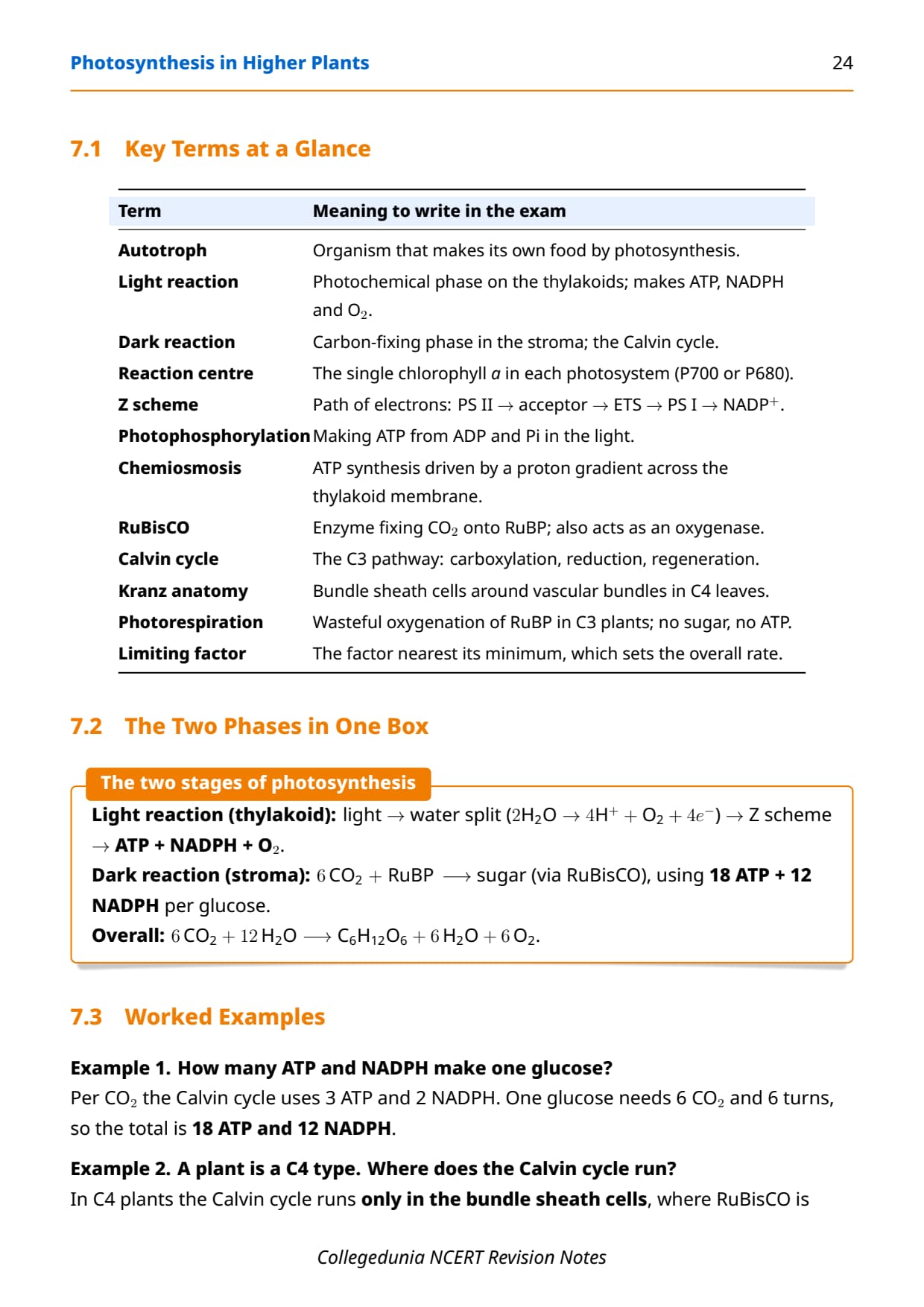
- Splitting of water: 2H2O → 4H+ + O2 + 4e−, tied to PS II, replacing its lost electrons and releasing the oxygen of photosynthesis into the lumen.
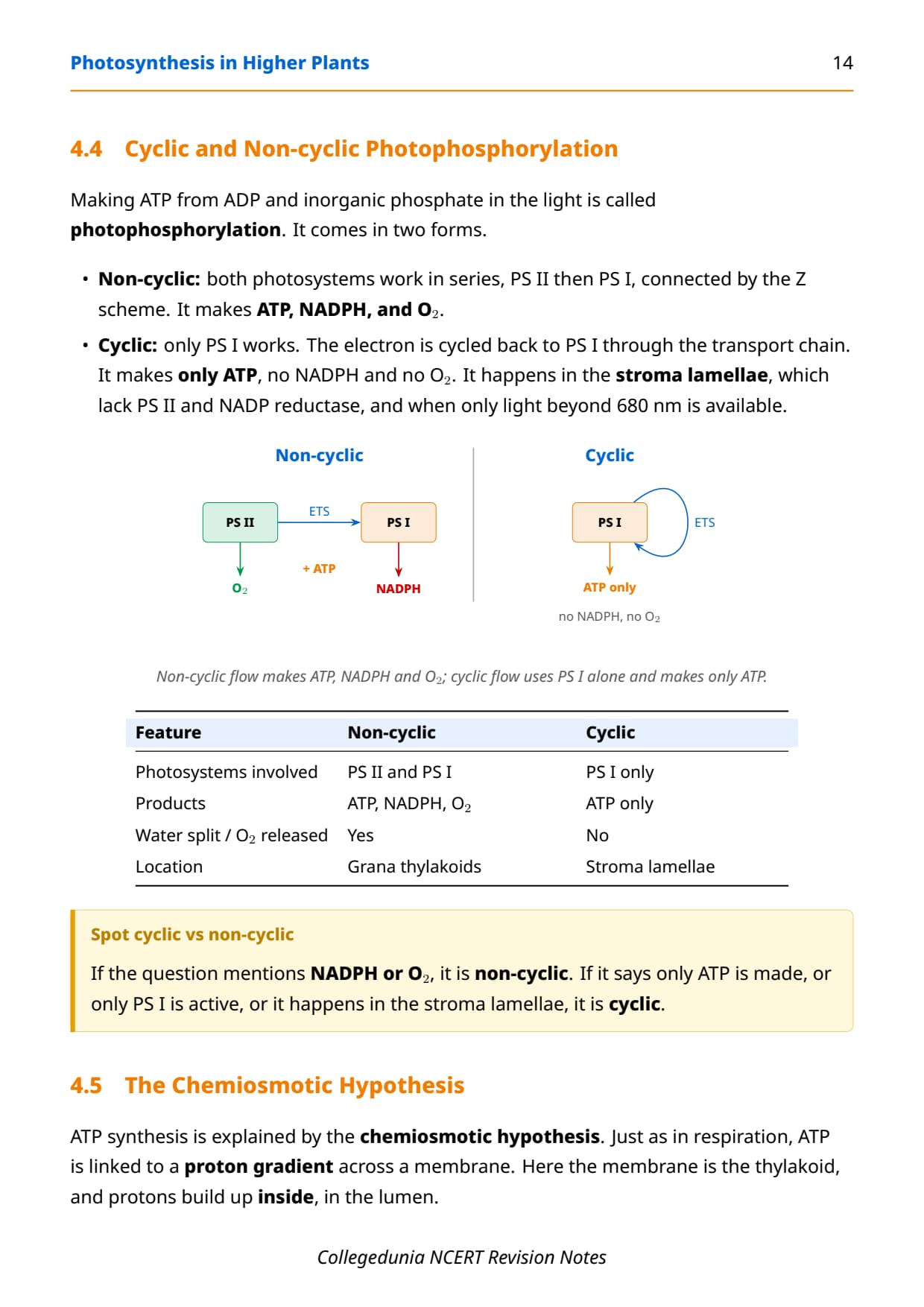
- Non-cyclic photophosphorylation: both photosystems in series make ATP, NADPH, and O2.
- Cyclic photophosphorylation: PS I alone, in the stroma lamellae, makes only ATP, no NADPH and no O2.
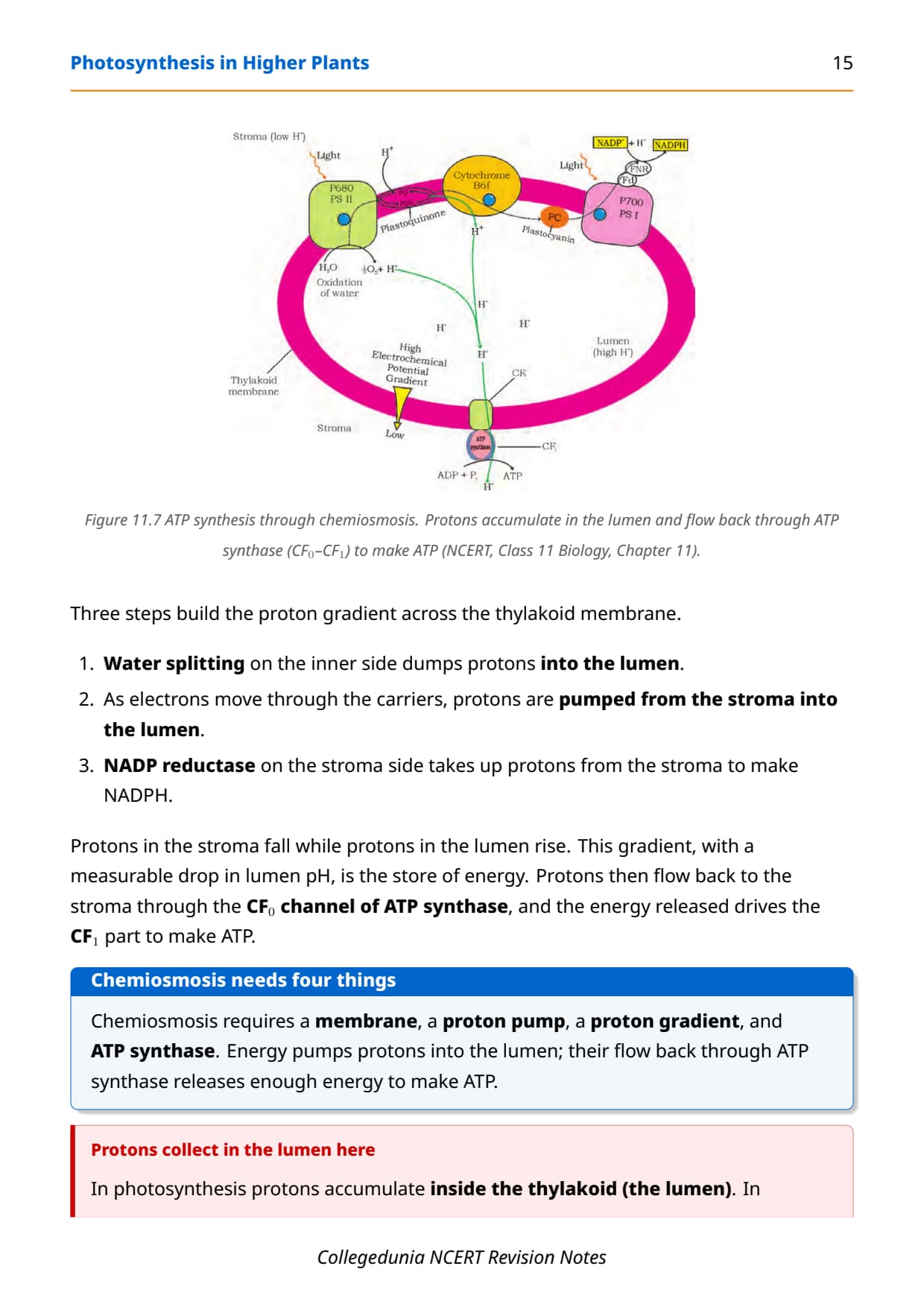
ATP synthesis is explained by the chemiosmotic hypothesis. Water splitting dumps protons into the lumen, electron carriers pump more protons from the stroma into the lumen, and NADP reductase removes protons from the stroma. Protons then flow back to the stroma through the CF0 channel of ATP synthase, and the energy drives the CF1 part to make ATP. In photosynthesis the protons accumulate inside the thylakoid lumen, not in the intermembrane space as in respiration. If a question mentions oxygen release or photolysis, think PS II.
The Calvin Cycle: The Biosynthetic Phase
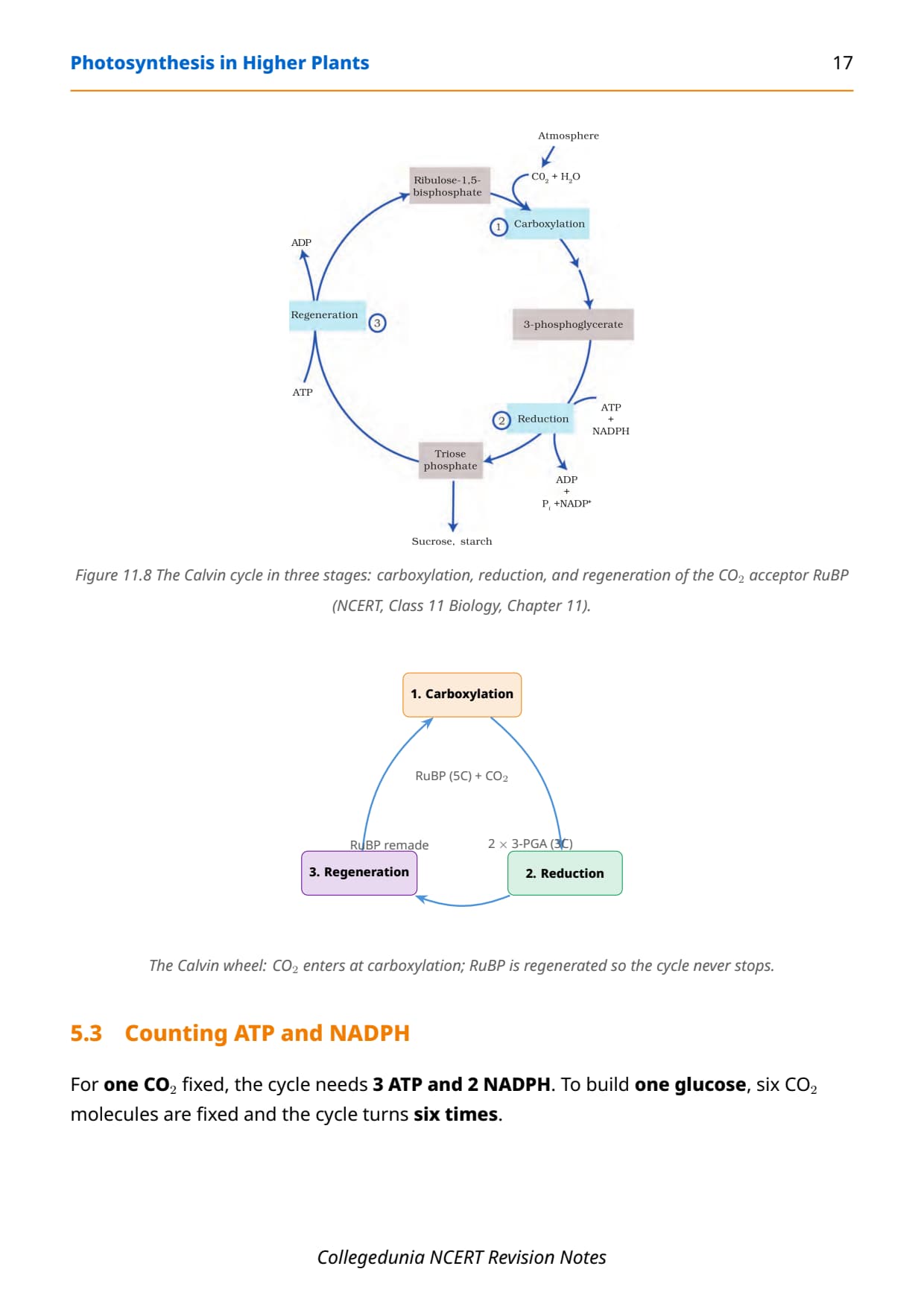
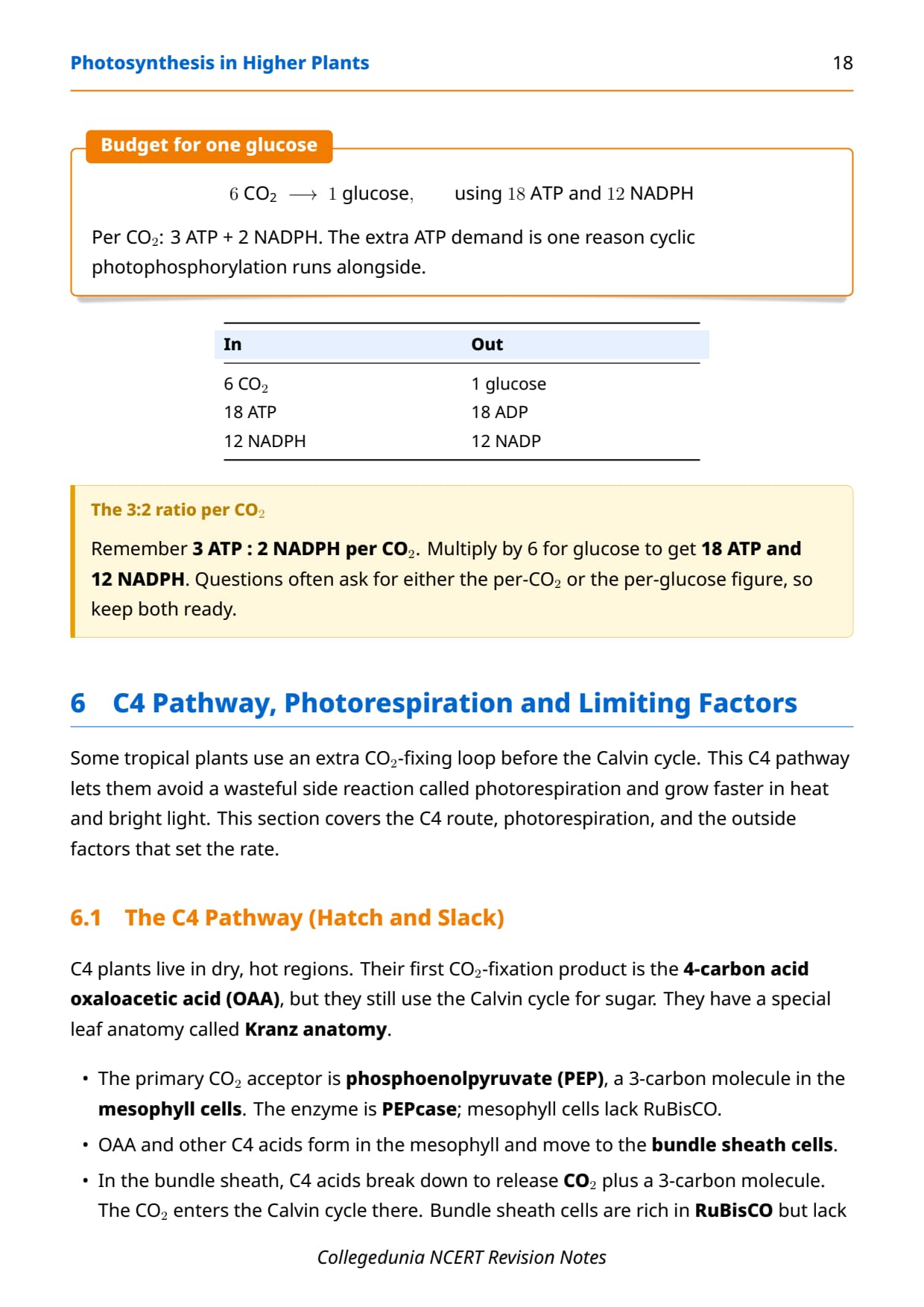
The ATP and NADPH from the light reaction are spent fixing CO2 into sugar in the stroma. Melvin Calvin traced this pathway with radioactive carbon, so it is the Calvin cycle, and because the first stable product is a 3-carbon acid it is the C3 pathway. The CO2 acceptor is the 5-carbon sugar ribulose-1,5-bisphosphate (RuBP), the first product is 3-phosphoglyceric acid (PGA), and the enzyme is RuBisCO. The cycle runs in every photosynthetic plant, in three ordered stages.
- Carboxylation: CO2 joins RuBP to give two molecules of 3-PGA, catalysed by RuBisCO. This is the crucial CO2-fixing step.
- Reduction: a series of steps forms sugar, using 2 ATP and 2 NADPH per CO2 fixed.
- Regeneration: RuBP is remade so the cycle continues, using 1 ATP per CO2.
For one CO2 fixed the cycle needs 3 ATP and 2 NADPH. To build one glucose, six CO2 molecules are fixed and the cycle turns six times, so the budget is 18 ATP and 12 NADPH. Remember the 3 ATP to 2 NADPH ratio per CO2, then multiply by six for glucose. A common slip is to call RuBP a 3-carbon acceptor; RuBP is 5-carbon and the pathway is named after the 3-carbon product PGA, not the acceptor. The extra ATP demand of the cycle is one reason cyclic photophosphorylation runs alongside the non-cyclic route.
C4 Pathway, Photorespiration and Limiting Factors
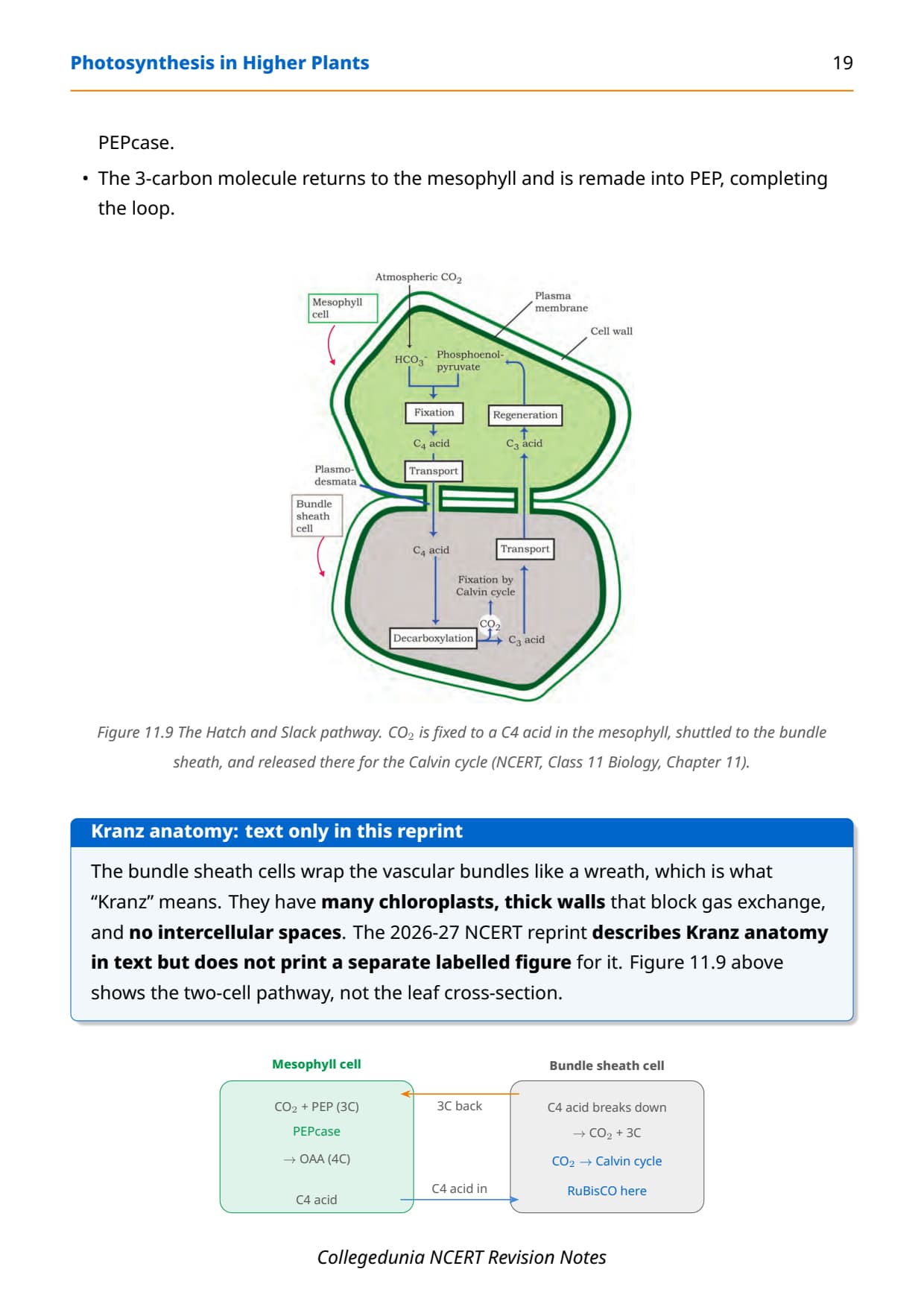
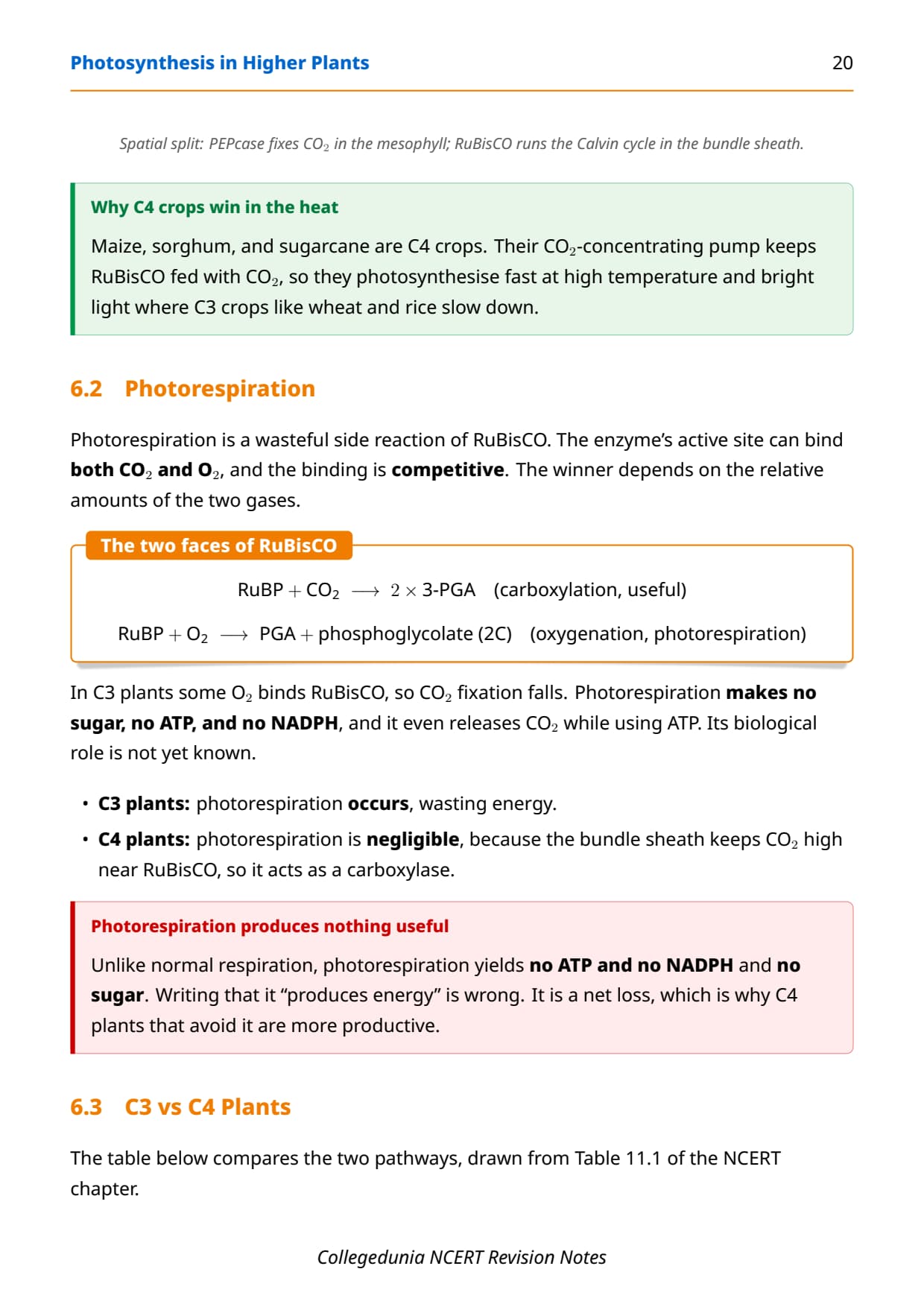
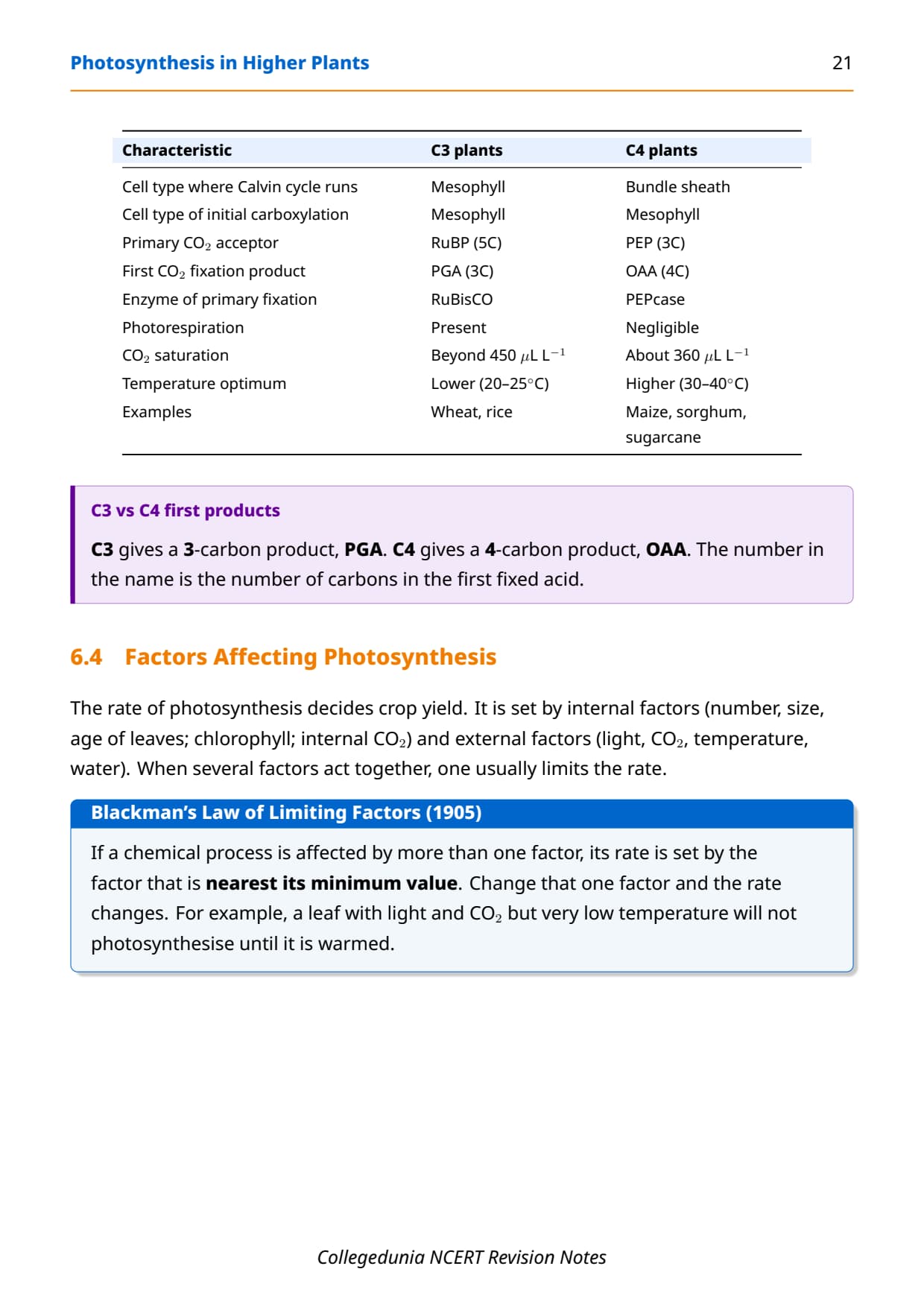
Some tropical plants add an extra CO2-fixing loop before the Calvin cycle to avoid a wasteful side reaction. In the C4 pathway of Hatch and Slack, the primary acceptor is phosphoenolpyruvate (PEP) in the mesophyll, the enzyme is PEPcase, and the first product is the 4-carbon acid oxaloacetic acid (OAA). The C4 acid moves to the bundle sheath cells, where it releases CO2 for the Calvin cycle run by RuBisCO. This needs a special leaf anatomy called Kranz anatomy, where thick-walled bundle sheath cells wrap the vascular bundles like a wreath.
- Photorespiration: RuBisCO can bind both CO2 and O2, and when O2 wins in C3 plants it makes no sugar, no ATP, and no NADPH. It is a net loss.
- C4 advantage: the bundle sheath keeps CO2 high near RuBisCO, so photorespiration is negligible and C4 crops like maize and sugarcane grow fast in heat.
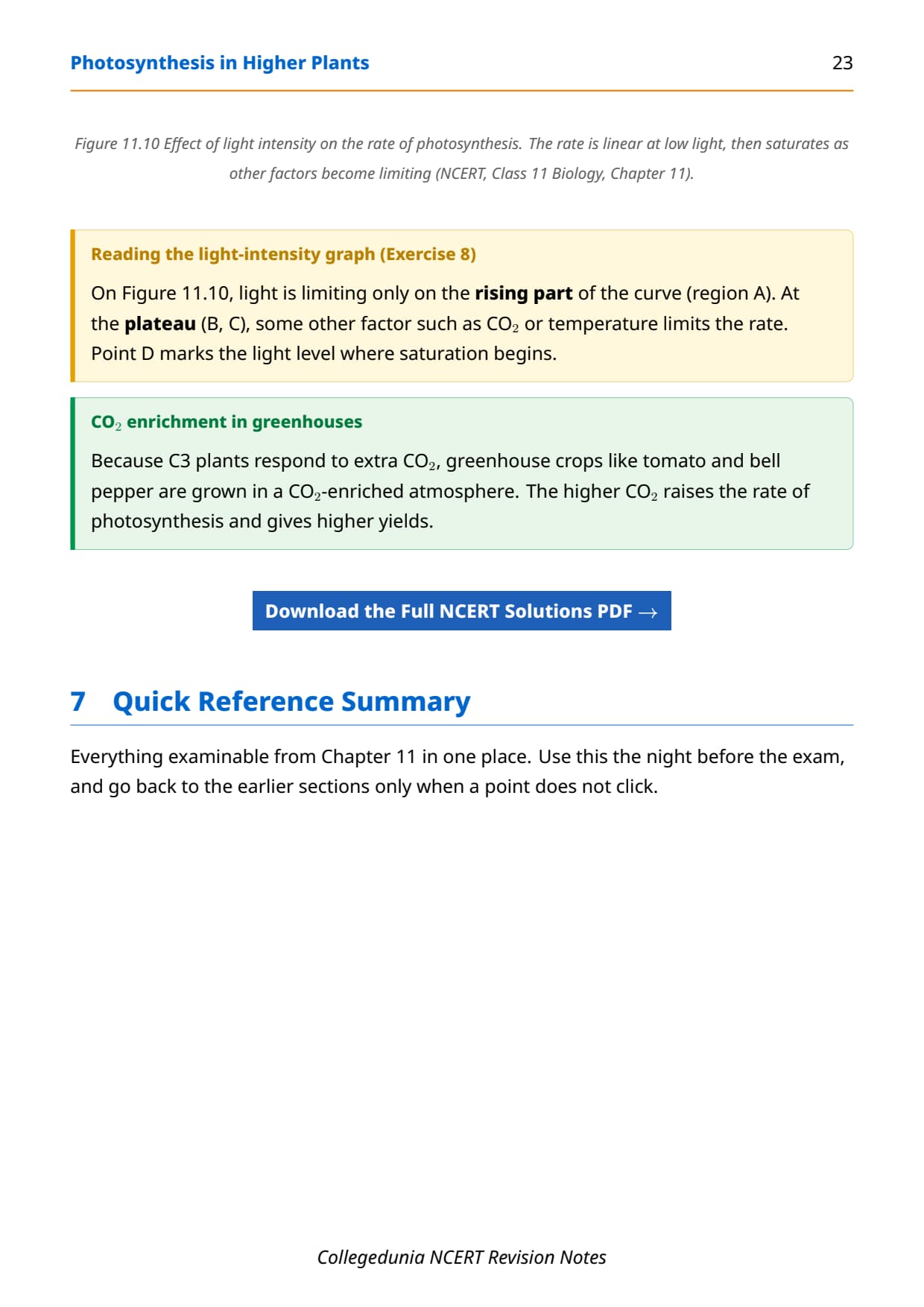
- Light: saturates at about 10% of full sunlight, so it rarely limits except in shade.
- Carbon dioxide: the major limiting factor, as atmospheric CO2 is only 0.03 to 0.04%.
- Temperature and water: the dark reactions are enzymatic, so temperature matters, and water stress closes stomata and cuts the CO2 supply.
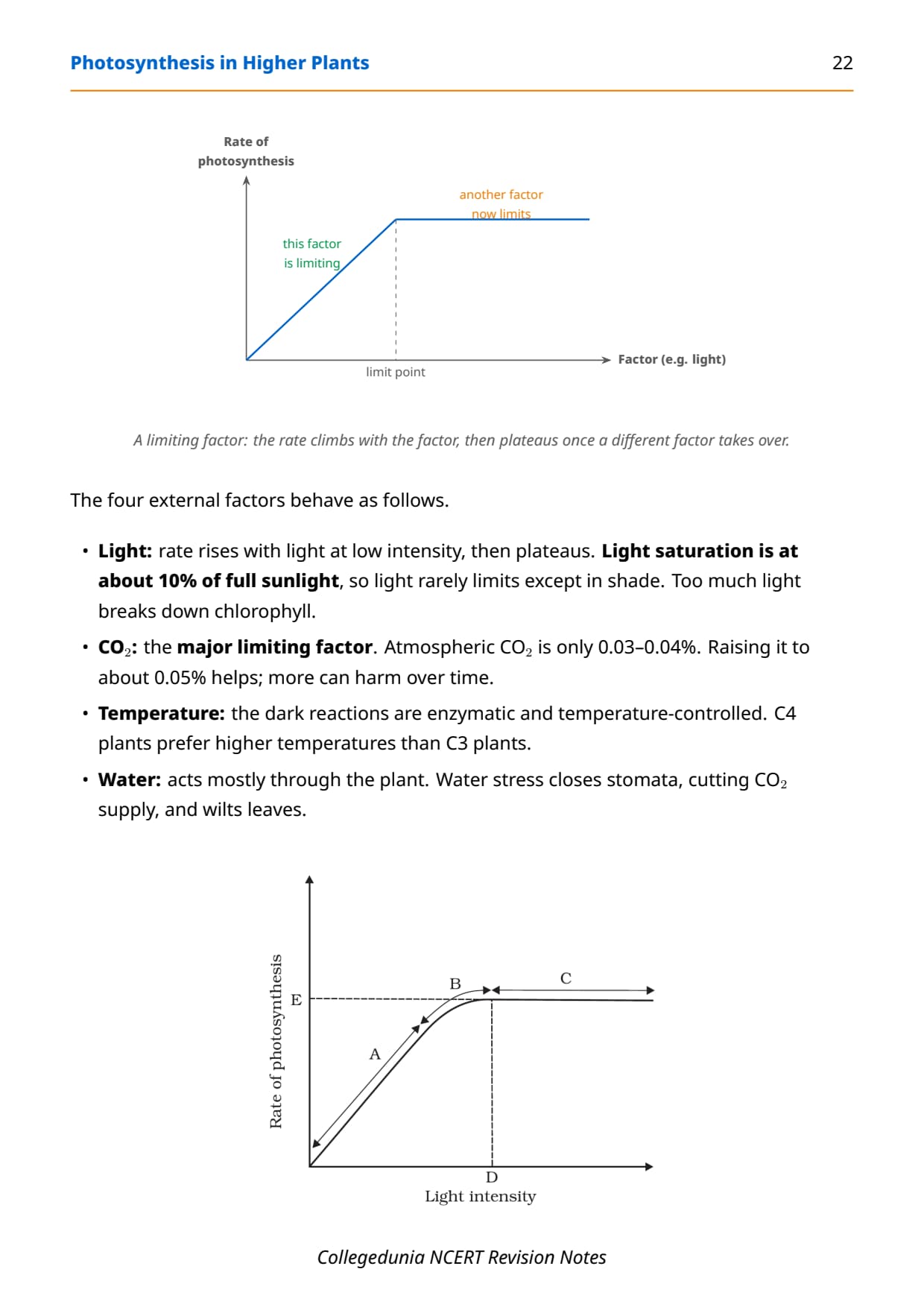
Blackman's Law of Limiting Factors states that when a process depends on several factors, its rate is set by the factor nearest its minimum value. On the light-intensity graph, light limits the rate only on the rising part of the curve, while at the plateau some other factor such as CO2 or temperature takes over. Because C3 plants respond to extra CO2, greenhouse crops like tomato and bell pepper are grown in a CO2-enriched atmosphere to raise the yield.
Key Definitions in Photosynthesis in Higher Plants
Board short-answer questions often ask for a clean definition in one or two lines, and a vague answer loses easy marks. Learn these word-for-word, because the wording of the exam question is usually built straight from the NCERT definition. Each term below also connects to a diagram or number you can be asked to explain.
| Term | Definition |
|---|---|
| Photosynthesis | The process in which green plants use light energy to make sugars from CO2 and water, releasing O2. |
| Light reaction | The photochemical phase on the thylakoids that makes ATP, NADPH, and O2. |
| Z scheme | The path of electrons: PS II to acceptor, down the transport chain to PS I, up again, then to NADP+. |
| Chemiosmosis | ATP synthesis driven by a proton gradient across the thylakoid membrane. |
| RuBisCO | Enzyme that fixes CO2 onto RuBP; it also acts as an oxygenase in photorespiration. |
| Calvin cycle | The C3 pathway of carbon fixation: carboxylation, reduction, and regeneration. |
| Photorespiration | Wasteful oxygenation of RuBP in C3 plants that makes no sugar, no ATP, and no NADPH. |
A common board question asks you to define photophosphorylation and distinguish its cyclic and non-cyclic forms. State that it is making ATP from ADP and inorganic phosphate in the light, then add that non-cyclic makes NADPH and O2 as well while cyclic makes only ATP. Learning these definitions makes the wording of almost every one-mark and two-mark question in this chapter familiar.
Common Mistakes Students Make in Photosynthesis in Higher Plants
These slips happen because two terms look alike, not because the concept is hard. Each one costs 1 to 2 marks in the paper, so watch for them at the exact step where they occur.
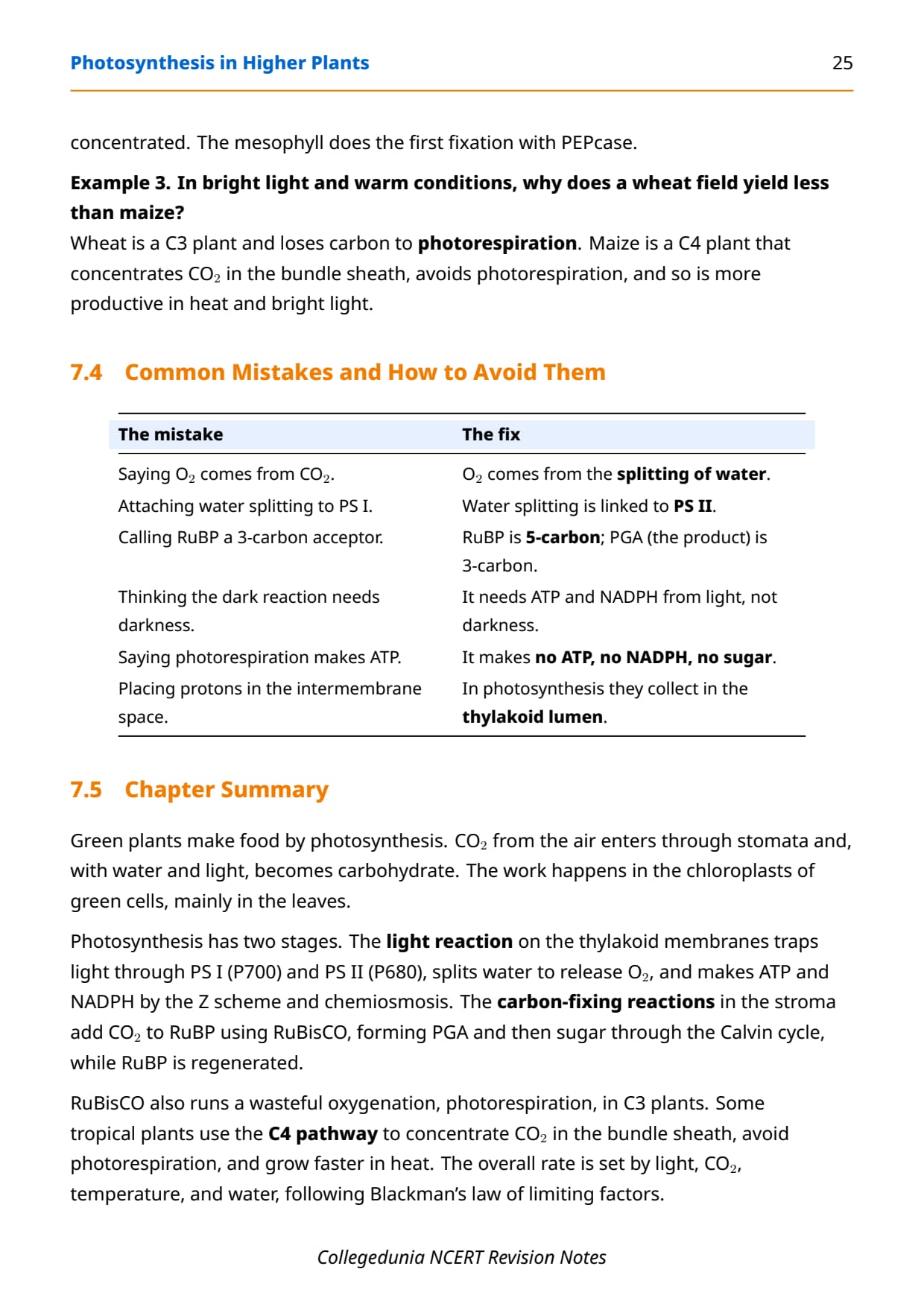
Mistake 1: Saying the O2 comes from carbon dioxide. It comes from the splitting of water, as van Niel and radioisotope labelling both show.
Mistake 2: Attaching water splitting to PS I. Water splitting and O2 release are tied to PS II.
Mistake 3: Calling RuBP a 3-carbon acceptor. RuBP is 5-carbon; PGA, the first product, is 3-carbon.
Mistake 4: Thinking the dark reaction needs darkness. It needs ATP and NADPH from the light reaction, not darkness, and runs in daylight.
Mistake 5: Saying photorespiration makes ATP. It makes no ATP, no NADPH, and no sugar, and even releases CO2 while using ATP.
Photosynthesis in Higher Plants Weightage in CBSE Boards, NEET and CUET
This chapter is a high-yield one because it mixes clean processes with a few numbers and two graphs. It appears every year as a short answer or a diagram-based question, and it is one of the most reliable sources of objective questions in the entrance exams. Here is how the marks split across the main exams for 2026-27.
| Exam | Typical weightage | What is asked |
|---|---|---|
| CBSE Boards | 4 to 6 marks | One short answer on the light reaction or Calvin cycle plus one on C3 versus C4 plants or limiting factors |
| NEET | 2 to 3 questions | The Z scheme, ATP and NADPH budget, photorespiration, and the C4 pathway |
| CUET | 1 to 2 objective questions | Definitions, the pigments, the site of the two phases, and the source of oxygen |
The two phases and the C3 versus C4 comparison are the most tested ideas from this chapter across all three exams. Master the Z scheme and the ATP or NADPH budget first, then the Calvin cycle stages, then the C4 pathway and limiting factors, in that order of return on effort for the 2026-27 session.
How to Revise Photosynthesis in Higher Plants Quickly
Use these photosynthesis in higher plants class 11 notes for a fast, ordered recap the night before a test. The checklist below takes about 25 minutes and hits every marks-heavy idea in the chapter without opening the full textbook.
- First 8 minutes: write the overall equation, state that O2 comes from water, and sketch the Z scheme from PS II to NADP+.
- Next 9 minutes: list the three Calvin cycle stages and the 18 ATP plus 12 NADPH budget for one glucose, then write the four chemiosmosis requirements.
- Last 8 minutes: fill a C3 versus C4 comparison, one-line photorespiration, and name the four limiting factors with the major one.
Close the loop by explaining why a maize field out-yields a wheat field in bright, hot conditions. If you can do all three blocks without notes, the chapter is exam-ready. Keep the Z scheme and the ATP or NADPH budget beside you for the first pass only, then try the whole checklist closed-book.
Student Feedback on the Photosynthesis in Higher Plants Notes
What 12,510 students told us about their Photosynthesis in Higher Plants revision:
- 73% of students rated the Z scheme and the ATP or NADPH budget as the part most worth memorising for the exam.
- Most-confused pair: the acceptor RuBP versus the first product PGA, mixed up by about 3 in 10 students.
- Students who learnt the C4 pathway with the mesophyll-versus-bundle-sheath split said the photorespiration questions felt easy afterwards.
Source: 2026-27 Class 11 Biology student poll. Sample of 12,510 students from CBSE schools across 15 states, conducted before the 2026 boards.
Other Photosynthesis in Higher Plants Class 11 Biology Resources
Pair these notes with the solved answers, the formula sheet, and the textbook PDF for the same chapter.
| Resource | Link |
|---|---|
| NCERT Solutions | Photosynthesis in Higher Plants Class 11 NCERT Solutions |
| Formula Sheet | Photosynthesis in Higher Plants Class 11 Formula Sheet |
| Exemplar Solutions | Photosynthesis in Higher Plants Class 11 Exemplar Solutions |
| NCERT Book PDF | Photosynthesis in Higher Plants Class 11 Book PDF |
| Exemplar Book PDF | Photosynthesis in Higher Plants Class 11 Exemplar Book PDF |
NCERT Notes for Class 11 Biology: All Chapters
Jump to the revision notes for any other Class 11 Biology chapter below.
| Chapter | NCERT Notes |
|---|---|
| Chapter 1 | The Living World |
| Chapter 2 | Biological Classification |
| Chapter 3 | Plant Kingdom |
| Chapter 4 | Animal Kingdom |
| Chapter 5 | Morphology of Flowering Plants |
| Chapter 6 | Anatomy of Flowering Plants |
| Chapter 7 | Structural Organisation in Animals |
| Chapter 8 | Cell The Unit of Life |
| Chapter 9 | Biomolecules |
| Chapter 10 | Cell Cycle and Cell Division |
| Chapter 11 | Photosynthesis in Higher Plants |
| Chapter 12 | Respiration in Plants |
| Chapter 13 | Plant Growth and Development |
| Chapter 14 | Breathing and Exchange of Gases |
| Chapter 15 | Body Fluids and Circulation |
| Chapter 16 | Excretory Products and their Elimination |
| Chapter 17 | Locomotion and Movement |
| Chapter 18 | Neural Control and Coordination |
| Chapter 19 | Chemical Coordination and Integration |
FAQs on Photosynthesis in Higher Plants Class 11 Biology Notes
Photosynthesis in Higher Plants Notes - Frequently Asked Questions
Ques. What topics do the photosynthesis in higher plants class 11 notes cover?
Ans. These photosynthesis in higher plants class 11 notes cover the early experiments of Priestley, Ingenhousz, von Sachs, Engelmann, and van Niel, the site of photosynthesis in the chloroplast, the four pigments, the light reaction with the two photosystems, the Z scheme, water splitting and chemiosmosis, the Calvin cycle with RuBisCO, the C4 pathway and Kranz anatomy, photorespiration, and the factors affecting the rate. Every key definition, value, and example is included for fast revision.
Ques. Where does the oxygen released in photosynthesis come from?
Ans. The oxygen released in photosynthesis comes from the splitting of water during the light reaction, written as 2H2O → 4H+ + O2 + 4e−. Van Niel showed this by studying purple and green bacteria that use H2S and release sulphur instead of oxygen, and radioisotope labelling later confirmed it. So the O2 is derived from water, not from carbon dioxide, and water splitting is linked to PS II.
Ques. What is the difference between the light reaction and the dark reaction?
Ans. The light reaction, or photochemical phase, happens on the thylakoid membranes. It traps light, splits water, releases O2, and makes ATP and NADPH through the Z scheme and chemiosmosis. The dark reaction, or the Calvin cycle, happens in the stroma and uses that ATP and NADPH to fix CO2 onto RuBP and build sugar. The dark reaction is called that because it is not directly driven by light, but it still needs the products of the light reaction and can run in daylight.
Ques. How many ATP and NADPH are needed to make one glucose?
Ans. The Calvin cycle uses 3 ATP and 2 NADPH to fix one molecule of CO2. Building one glucose needs six CO2 molecules and six turns of the cycle, so the total is 18 ATP and 12 NADPH. Keep both figures ready, because questions often ask for the per-CO2 ratio or the per-glucose total.
Ques. How do C4 plants avoid photorespiration?
Ans. In C4 plants, PEPcase first fixes CO2 into the 4-carbon acid OAA in the mesophyll cells. The C4 acid moves to the bundle sheath cells, where it releases CO2. This keeps the CO2 concentration high around RuBisCO, so the enzyme works as a carboxylase and photorespiration is negligible. That is why C4 crops like maize and sugarcane grow fast in heat and bright light, where C3 plants lose carbon to photorespiration.
Ques. What is the weightage of this chapter in the CBSE board exam?
Ans. Photosynthesis in Higher Plants carries about 4 to 6 marks in the CBSE Class 11 Biology paper, usually one short answer on the light reaction or the Calvin cycle plus one on C3 versus C4 plants or limiting factors. It is a high-yield chapter in NEET, with 2 to 3 questions on the Z scheme, the ATP or NADPH budget, photorespiration, and the C4 pathway, and it appears in CUET as objective questions for the 2026-27 session.
Ques. What is Blackman's law of limiting factors?
Ans. Blackman's law of limiting factors states that if a chemical process is affected by more than one factor, its rate is decided by the factor that is nearest its minimum value. For photosynthesis, light, carbon dioxide, temperature, and water can each limit the rate. On a light-intensity graph, light limits only on the rising part of the curve, while at the plateau another factor such as CO2 or temperature takes over. Carbon dioxide is usually the major limiting factor in the field.



Comments