




The class 11 biology NCERT solutions chapter 11 Photosynthesis in Higher Plants solve every back-exercise question, according to the latest 2026-27 CBSE syllabus, and help students prepare for the CBSE Boards, NEET and CUET. Each answer is worked step by step, from telling a C3 plant from a C4 plant to why RuBisCO favours carboxylation, how accessory pigments widen the light a leaf can use, and how limiting factors set the rate of photosynthesis.
This chapter sits at the heart of the Plant Physiology unit, and the ideas of light reaction, carbon fixation and Kranz anatomy return in Respiration in Plants and again in the Class 12 chapters on metabolism.
- CBSE Weightage: 4 to 5 marks, one of the highest-scoring chapters in the Plant Physiology unit of Class 11 Biology.
- Topics covered: site of photosynthesis, photosynthetic pigments, light reaction and photophosphorylation, the Calvin (C3) cycle, the C4 pathway and Kranz anatomy, photorespiration, and the factors affecting photosynthesis.
- Exercise count: 9 back-exercise questions, a mix of reasoning, a graph-reading question and a long comparison question.
These class 11 biology NCERT solutions chapter 11 Photosynthesis in Higher Plants are curated by subject experts, based on the 2026-27 NCERT textbook, and checked against the last five years of CBSE Board and NEET papers.
Why Photosynthesis in Higher Plants Matters and What the Chapter Covers
Photosynthesis is the process by which green plants trap light energy and use it to build carbohydrates from carbon dioxide and water, releasing oxygen along the way. It is the source of all the food and almost all the oxygen on Earth, which is why this chapter carries heavy weight in both the Boards and NEET. The back exercise does not ask students to recite the whole pathway; it asks them to apply it, question by question.
- Everyday role: every meal and every breath depends on the light reaction and carbon fixation studied here.
- Core skill: linking a structure, such as Kranz anatomy, to a function, such as concentrating CO2 around RuBisCO.
- Why it is central: the C3 and C4 distinction, photophosphorylation and limiting factors are among the most repeated NEET topics from Class 11.
Most questions in this chapter reward students who can reason from anatomy and biochemistry rather than memorise a diagram. The exercise deliberately mixes a graph, a comparison and several why questions, so understanding the mechanism pays off directly. The class 11 biology NCERT solutions chapter 11 Photosynthesis in Higher Plants below follow the NCERT order so students can check their working line by line.
Telling a C3 Plant from a C4 Plant
The first two exercise questions ask whether a plant can be identified as C3 or C4 from the outside, and then which internal structure settles it. The answer to the first is no. External features such as leaf shape, size, colour, venation and plant height are alike in both groups, because the whole C3 versus C4 difference is internal. Rice, a C3 plant, and maize, a C4 plant, look the same from outside, so only a section of the leaf under a microscope can separate them.
- Biochemical difference: the primary CO2 acceptor, the first stable product and the fixing enzyme are all different in the two groups.
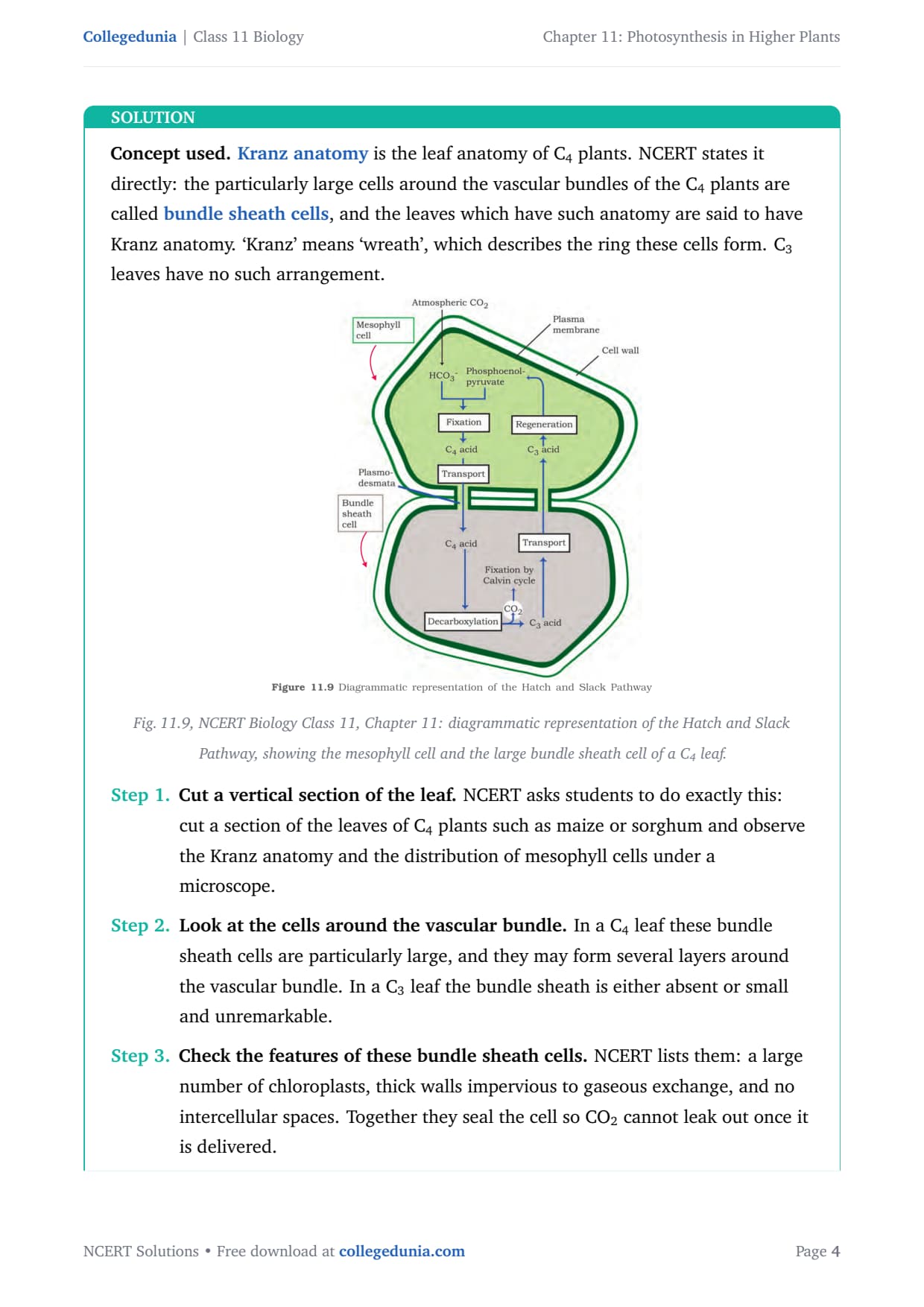
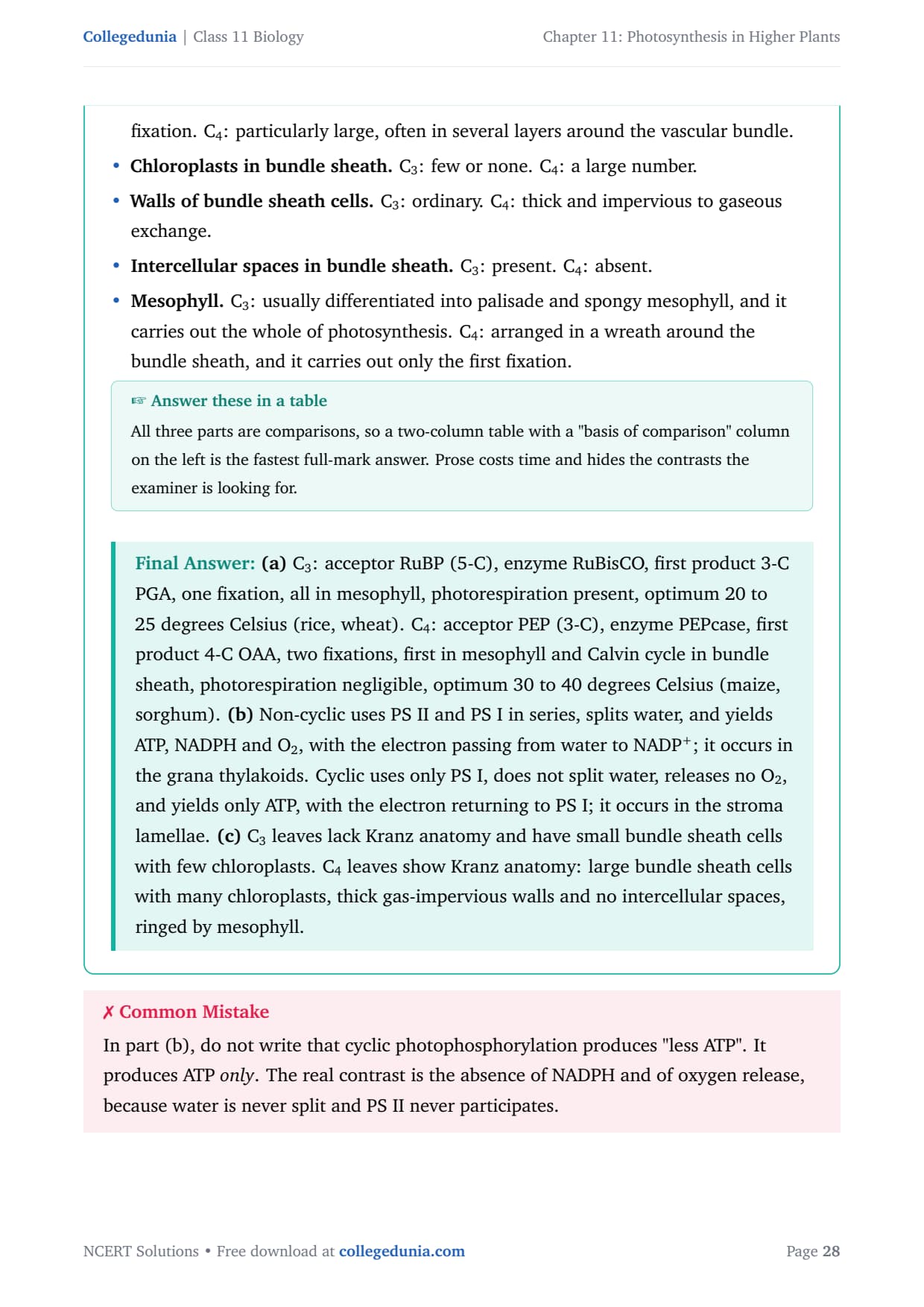
- Anatomical difference: C4 leaves show Kranz anatomy, large bundle sheath cells arranged in a wreath around the vascular bundle, packed with chloroplasts, with thick walls impervious to gases and no intercellular spaces, ringed by mesophyll cells.
- The test: a wreath of chloroplast-rich bundle sheath cells present means C4 (maize, sorghum); absent means C3 (rice, wheat).
So the internal structure to look for is Kranz anatomy, seen in a vertical section of the leaf. Because a C3 leaf has no such enlarged chloroplast-rich sheath, the presence or absence of the wreath is a clean, one-look diagnosis. Students should be able to name the four internal differences and draw the wreath arrangement to score full marks on both questions.
Why C4 Plants Are So Productive and RuBisCO Favours Carboxylation
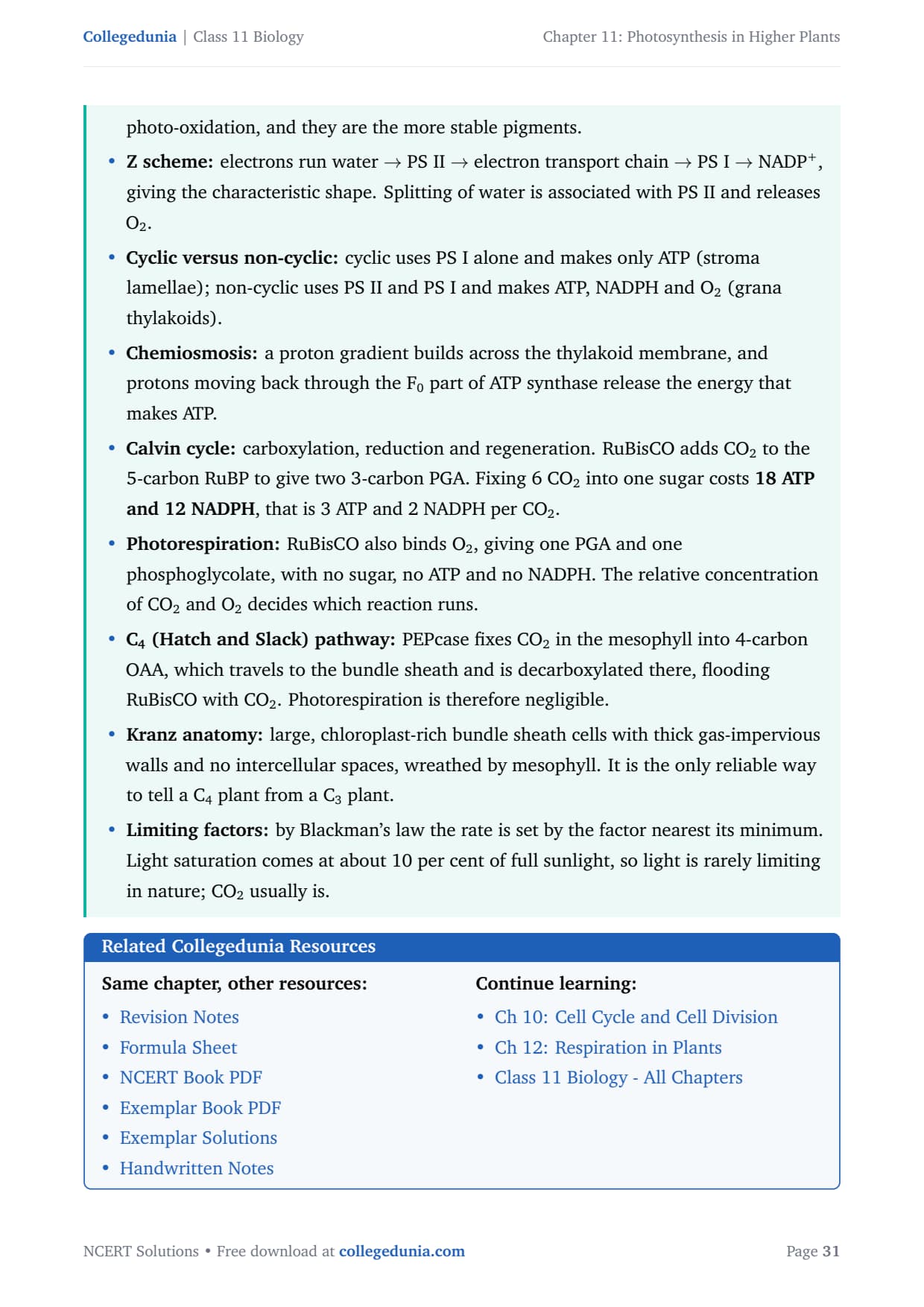
Questions 3 and 4 look strange at first: even though very few cells in a C4 plant run the Calvin pathway, the plant is highly productive, and its RuBisCO carries out more carboxylation than in a C3 plant. Both answers rest on the same idea, that the C4 pathway works as a CO2 pump. Mesophyll cells fix CO2 into four-carbon acids and ship them to the bundle sheath, where they are broken down to release CO2 right beside RuBisCO.
- The pump: decarboxylation of the C4 acids in the bundle sheath keeps the CO2 concentration around RuBisCO very high and the O2 relatively low.
- Gas-tight walls: the thick, gas-impervious bundle sheath walls with no intercellular spaces trap the released CO2 so it cannot escape.
- The result: RuBisCO works almost purely as a carboxylase, photorespiration is nearly eliminated, and each bundle sheath cell runs the Calvin cycle close to its maximum rate.
A few cells working at full efficiency, losing no carbon to photorespiration, outproduce many cells that each waste carbon. That is why so few Calvin-pathway cells still give high productivity. RuBisCO acts as both a carboxylase and an oxygenase, and the relative concentrations of CO2 and O2 decide which reaction it favours. Since the C4 pump keeps CO2 high and the enzyme already prefers CO2, it carries out far more carboxylation and almost no oxygenation.
Photosynthetic Pigments and Why Leaves Turn Yellow in the Dark
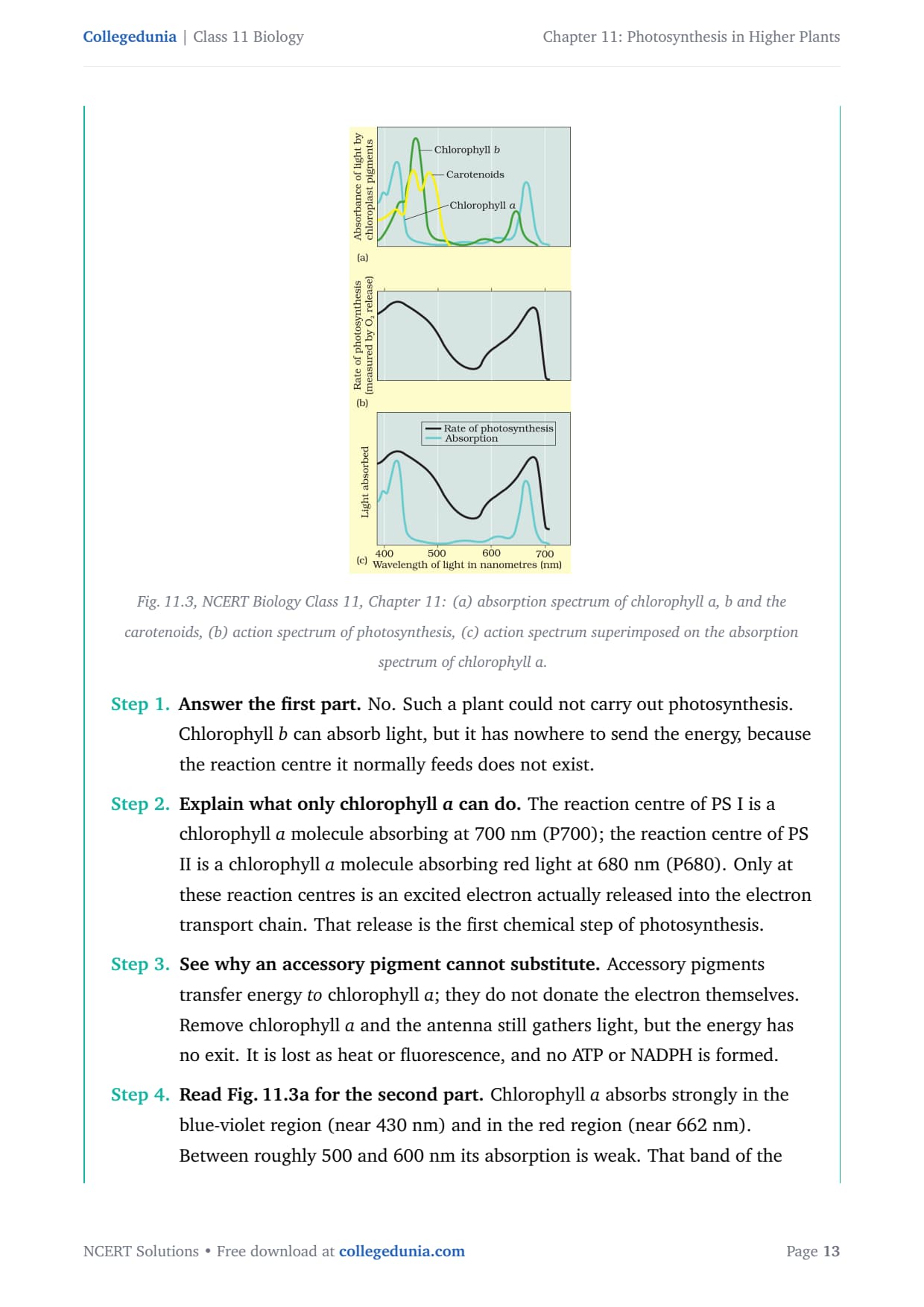
Question 5 imagines a plant with plenty of chlorophyll b but no chlorophyll a, and asks whether it could photosynthesise, and Question 6 asks why a leaf kept in the dark turns yellow and which pigment is more stable. The pigment hierarchy answers both. Chlorophyll a is the chief photosynthetic pigment, and it forms the reaction centres P700 in Photosystem I and P680 in Photosystem II, the only points where light energy is converted into an emitted electron.
- Without chlorophyll a: there is no reaction centre, so no electron is ever emitted and no ATP or NADPH is made; the plant cannot photosynthesise.
- Role of accessory pigments: chlorophyll b, xanthophylls and carotenoids absorb light but can only transfer that energy to chlorophyll a, so they broaden the range of usable wavelengths.
- Protective role: carotenoids and xanthophylls also protect chlorophyll a from photo-oxidation, so accessory pigments earn their place even though they cannot run the reaction themselves.
In the dark, chlorophyll cannot be synthesised because its formation needs light, while the existing chlorophyll keeps breaking down. As the green pigment is lost, the leaf turns pale green and then yellow, because the yellow carotenoids and xanthophylls, present all along but masked by the abundant chlorophyll, are now exposed. Carotenoids are the more stable pigment, because their synthesis does not depend on light and they resist degradation, while chlorophyll is unstable.
Chlorophyll, Sunlight and Shade: Which Leaves Are Darker Green
Question 7 asks students to compare the leaves on the shady side of a plant with those on the sunny side, and to say which are darker green and why. The answer is that the shady-side leaves are darker green. A shaded leaf receives little light, so light is the limiting factor for it, and it responds by building a higher concentration of chlorophyll per unit leaf area to trap as much of the weak light as possible. More chlorophyll per unit area gives a deeper green.
- Shade leaf: light is limiting, so it maximises chlorophyll to capture every bit of the dim light available.
- Sun leaf: already receives more light than it can use, since light saturation comes at about 10 per cent of full sunlight, so extra chlorophyll would not help.
- Photo-oxidation: strong sunlight also destroys some chlorophyll, so a sunny leaf holds less pigment per unit area and looks a paler green.
This is a neat example of a plant tuning its own structure to the light it receives, and it connects directly to the idea of limiting factors in the next question. The plant does not waste resources: it invests in chlorophyll only where light is scarce. A clear one-line reason plus the saturation figure of roughly 10 per cent of full sunlight is enough to earn the full marks on this question.
Limiting Factors and Reading the Light Response Graph
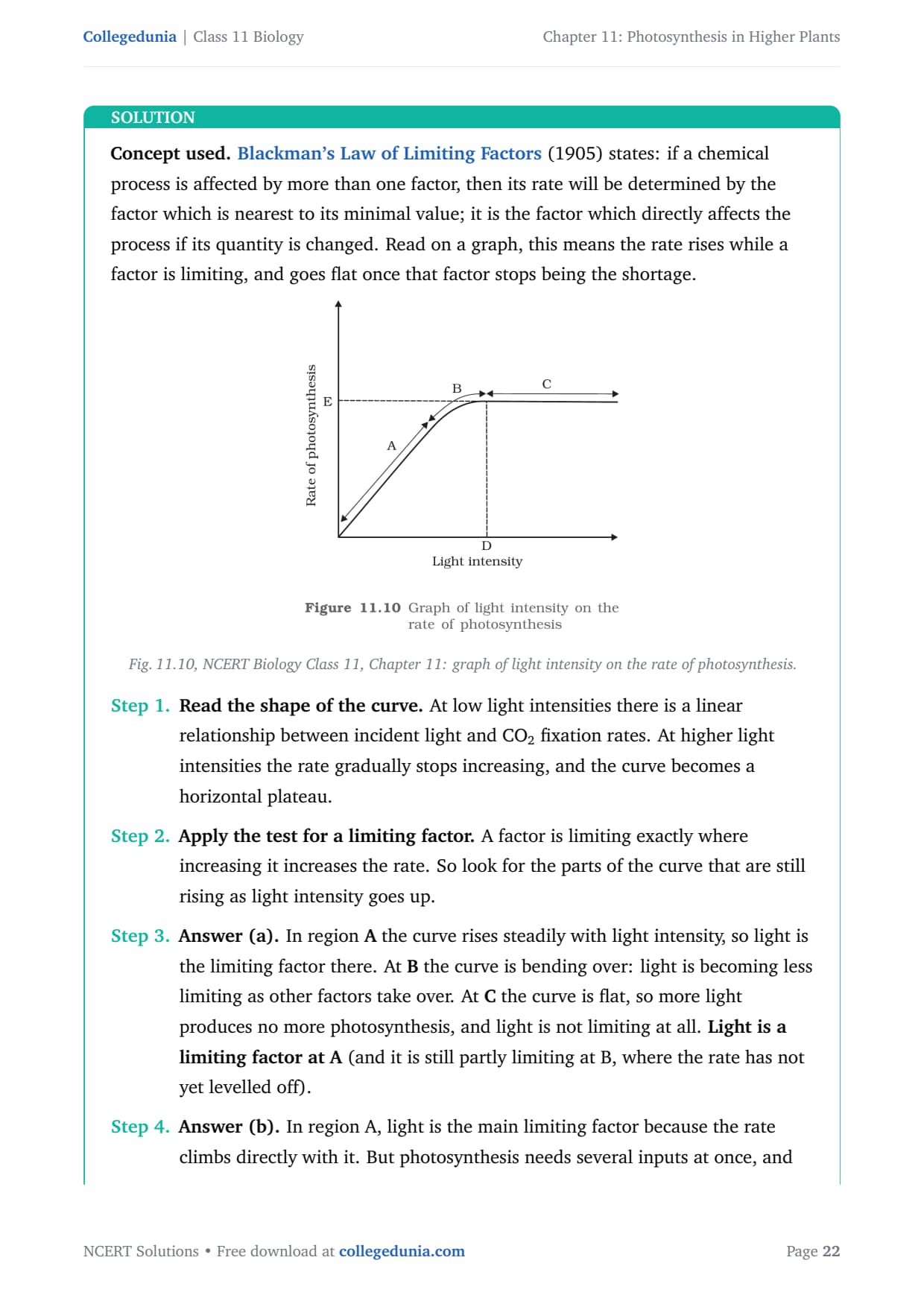
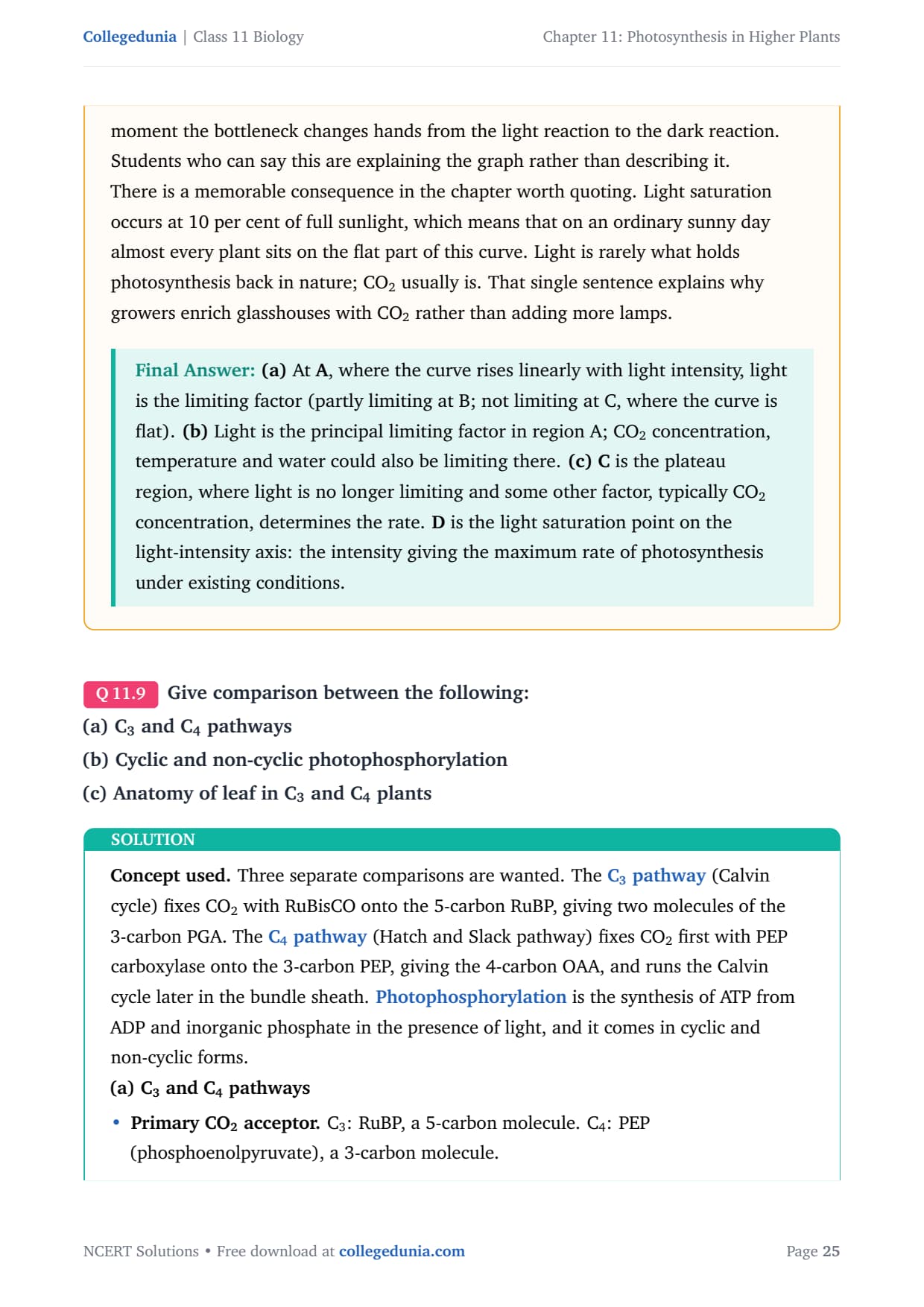
Question 8 is the only graph-based question in the exercise. Figure 11.10 plots the rate of photosynthesis against light intensity, and students must read off where light is limiting, what limits the rate elsewhere, and what the flat part of the curve represents. This tests Blackman's Law of Limiting Factors, which says that when several factors govern a process, the rate is set by the factor nearest its minimum value.
| Point on the curve | What it tells us |
|---|---|
| Region A (rising line) | Light is the limiting factor; the rate increases in direct proportion to light intensity. |
| Point B (bending over) | Light is only partly limiting; the curve is starting to flatten. |
| Point C (plateau) | Light is no longer limiting; some other factor, typically CO2 concentration, now sets the rate. |
| Point D | The light saturation point on the intensity axis, beyond which more light gives no more photosynthesis. |
So in region A light itself is the chief limiting factor, and the other factors that could limit the rate there are the CO2 concentration, temperature and water. C represents the plateau where the rate is capped by a non-light factor, and D marks the intensity at which light stops being limiting. A rising, straight portion always means the plotted factor is limiting, and a flat portion always means something else is. This reading skill is worth practising, because the same graph shape appears for CO2 and temperature too.
The Big Comparison: C3 versus C4, Cyclic versus Non-cyclic, and Leaf Anatomy
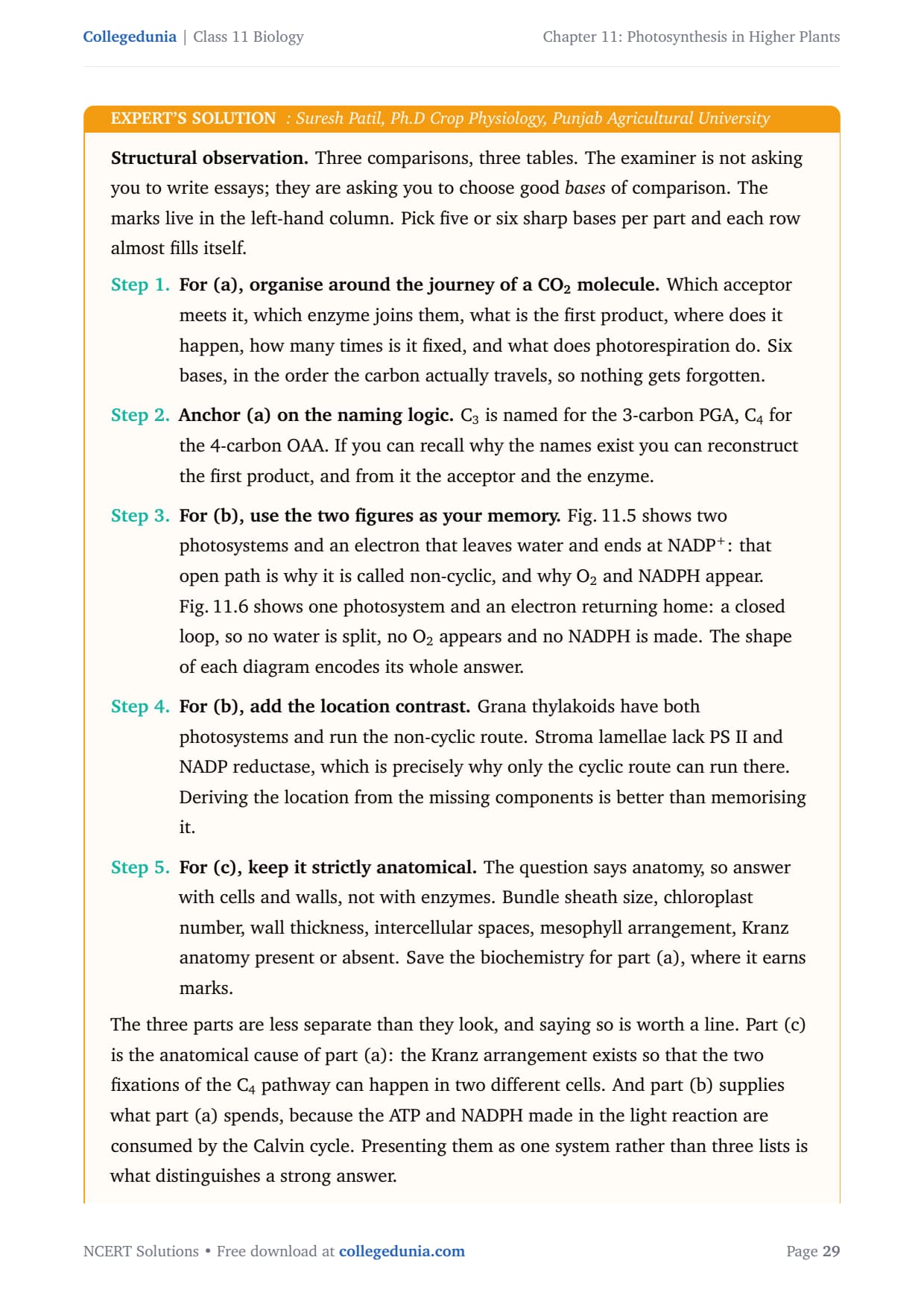
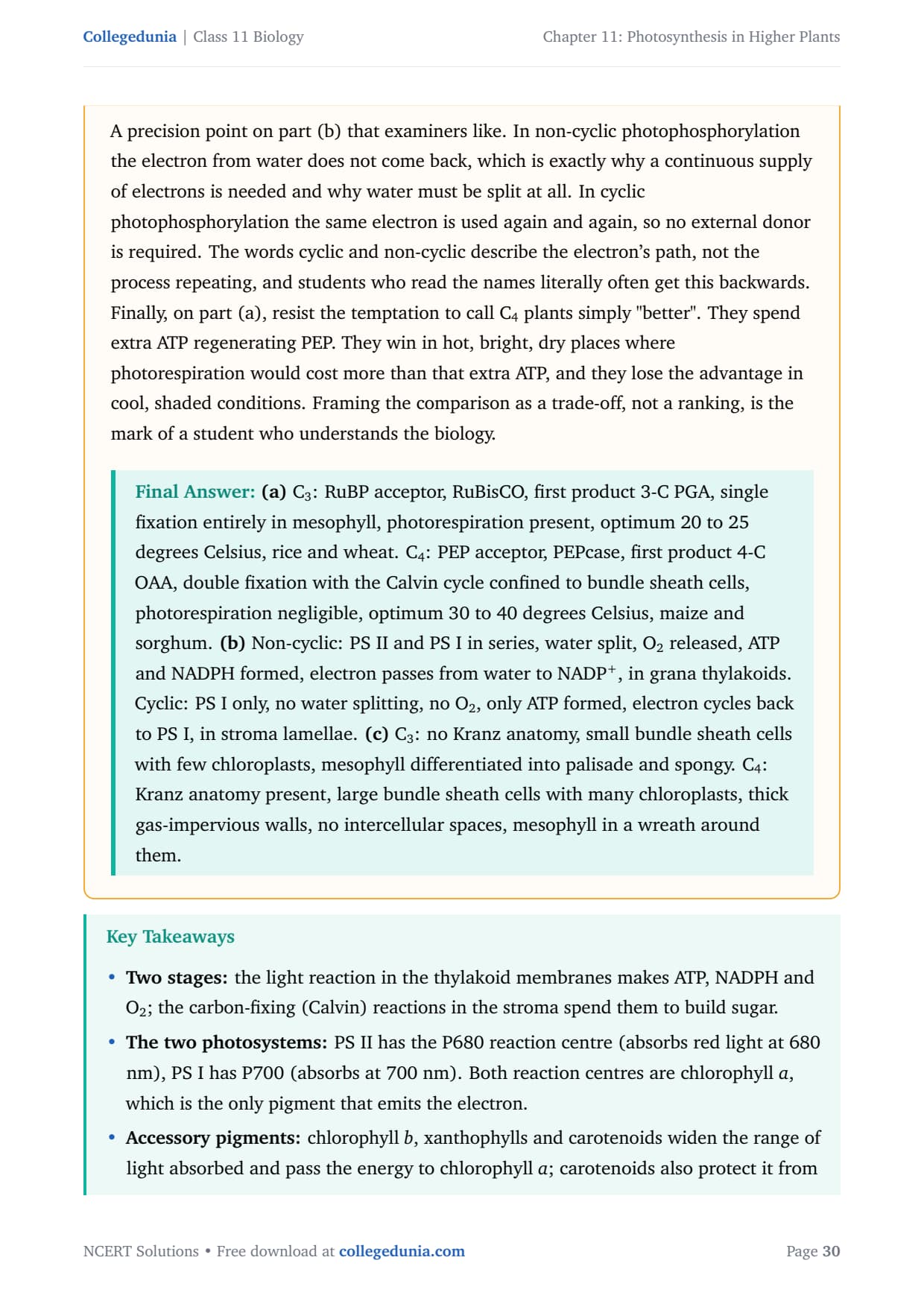
Question 9 is a three-part comparison that gathers the whole chapter into one answer, and it is the most marks-heavy question in the exercise. The table below sets out the C3 and C4 pathways and the two types of photophosphorylation side by side, which is exactly how students should reproduce it in the exam.
| Feature | C3 pathway | C4 pathway |
|---|---|---|
| Primary CO2 acceptor | RuBP (5-carbon) | PEP (3-carbon) |
| Fixing enzyme | RuBisCO | PEP carboxylase |
| First stable product | 3-carbon PGA | 4-carbon OAA |
| Number of fixations | One, all in mesophyll | Two, mesophyll then bundle sheath |
| Photorespiration | Present | Negligible |
| Optimum temperature | 20 to 25 °C (rice, wheat) | 30 to 40 °C (maize, sorghum) |
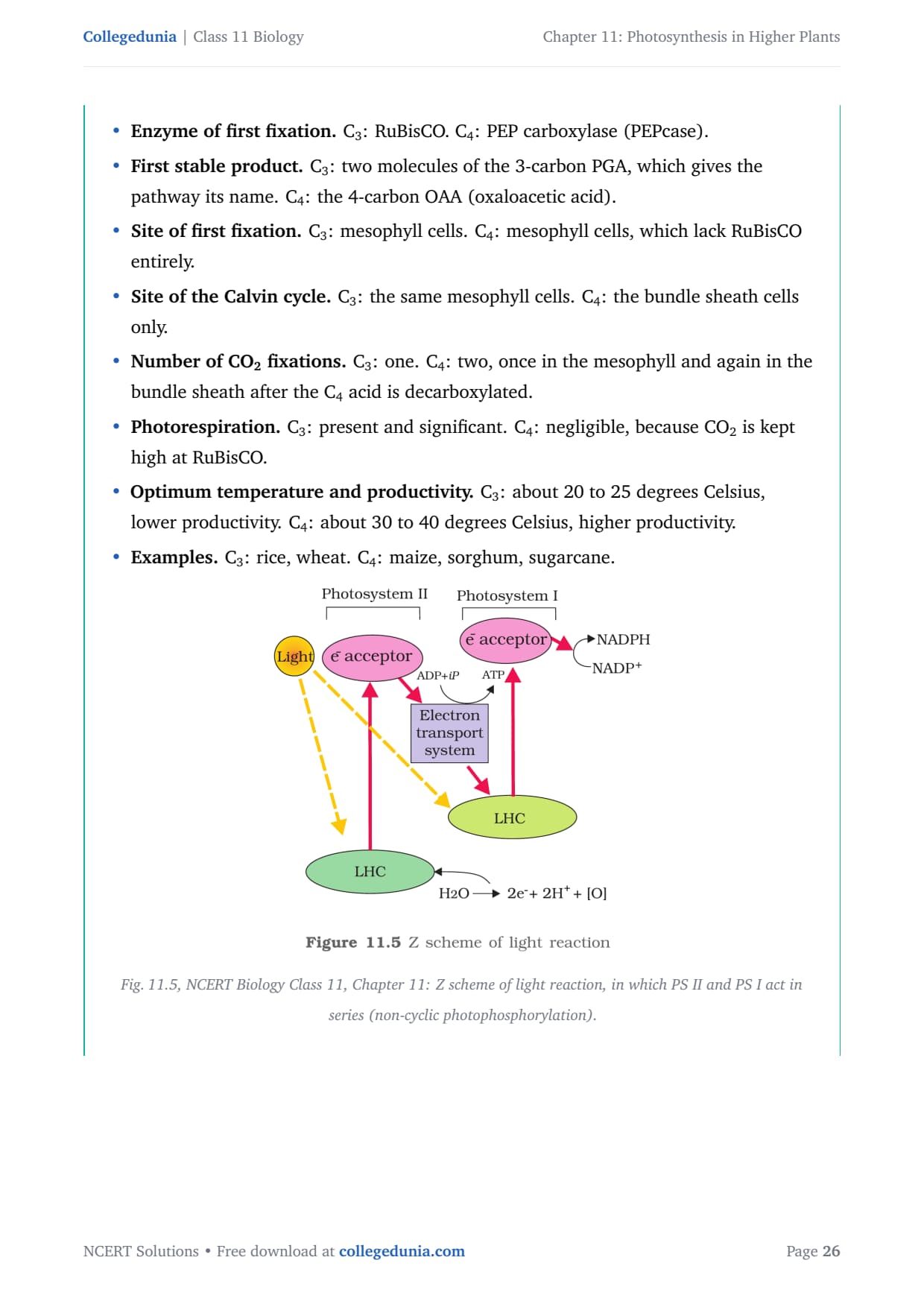
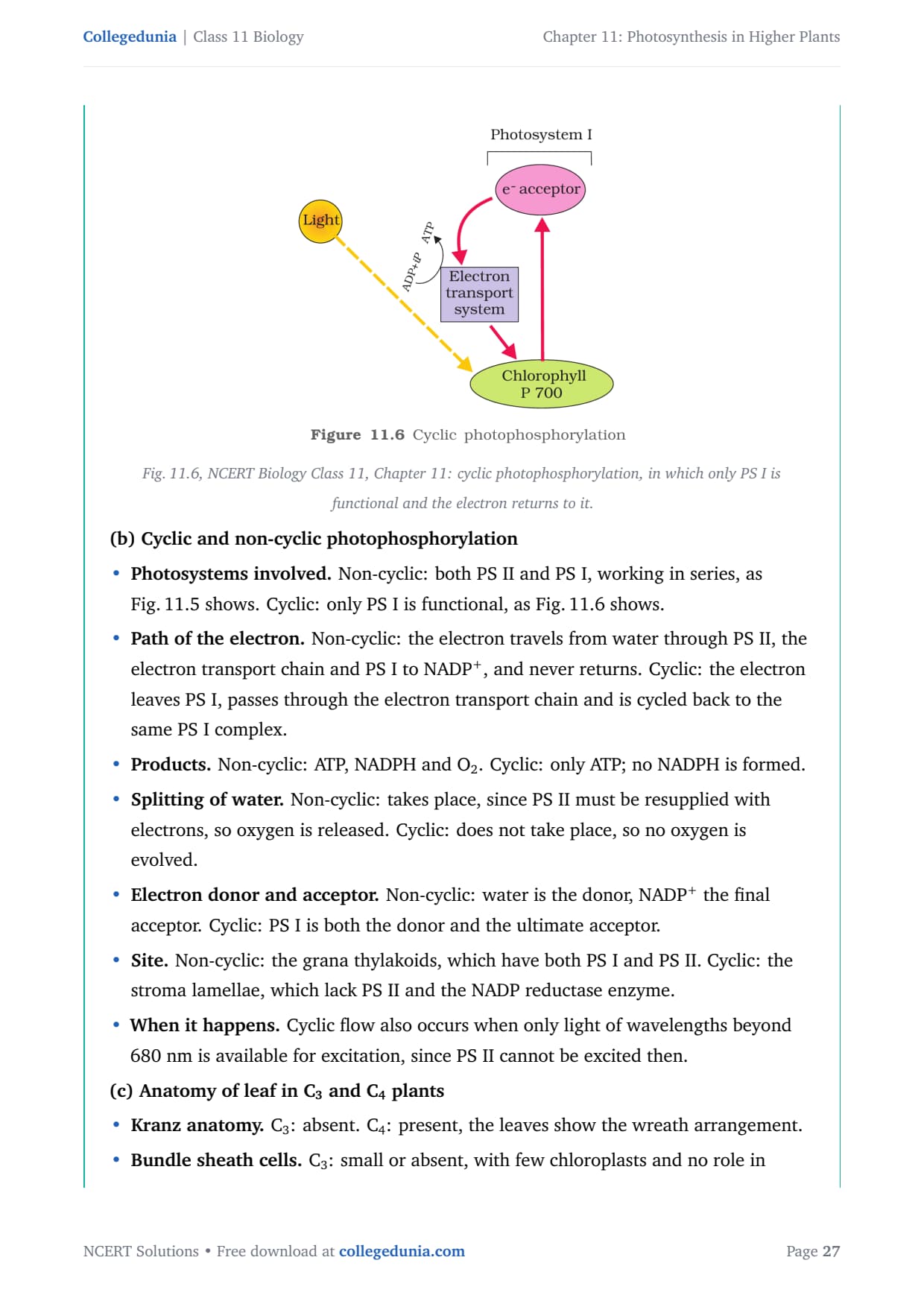
For photophosphorylation, non-cyclic uses Photosystem II and Photosystem I in series, splits water, and yields ATP, NADPH and O2, with the electron passing from water to NADP. Cyclic photophosphorylation uses only Photosystem I, the electron returning to the same photosystem, and makes only ATP with no NADPH and no O2. For leaf anatomy, C4 leaves show Kranz anatomy with a chloroplast-rich bundle sheath while C3 leaves do not. Presenting all three comparisons as tidy point-by-point tables is the surest way to secure every mark here. See Exercise Q9 for the fully worked comparison.
Photosynthesis in Higher Plants Exercise-wise Breakdown
The NCERT back exercise has 9 questions that move from applied reasoning to a graph and finish with a long comparison. The table below maps the question blocks to their topics so students can revise by theme and spot where the marks sit.
| Question block | What it tests |
|---|---|
| Q 1 to Q 2 | Whether external or internal features tell a C3 plant from a C4 plant, and the role of Kranz anatomy. |
| Q 3 to Q 4 | Why C4 plants are highly productive and why RuBisCO carries out more carboxylation in them. |
| Q 5 to Q 6 | The need for chlorophyll a and accessory pigments, and why dark-kept leaves turn yellow. |
| Q 7 | Why shade leaves are darker green than sun leaves. |
| Q 8 | Reading the light response graph and identifying limiting factors. |
| Q 9 | Comparing C3 and C4 pathways, cyclic and non-cyclic photophosphorylation, and leaf anatomy. |
The heaviest marks sit in Question 9 and in the productivity reasoning of Questions 3 and 4, so those deserve the most revision time. Learn the C3 versus C4 comparison as a table and the CO2 pump as a short story, and the rest of the chapter falls into place. Every question in the class 11 biology NCERT solutions chapter 11 Photosynthesis in Higher Plants PDF is solved with each step of reasoning shown, so students can compare their answers against the model working.
Practice the solved questions: Work through the full question bank with step-by-step answers and expert tips.
Photosynthesis in Higher Plants Class 11 Solved Practice Questions
Common Mistakes Students Make in Photosynthesis in Higher Plants
Most marks in this chapter are lost on mixing up the two pathways or misreading the graph, not on the hard biochemistry. Each mistake below costs 1 to 2 marks, so watch for it at the exact step.
Mistake 1: Saying a C4 plant can be told apart by its outward look. The difference is internal, biochemical and anatomical, so only a leaf section showing Kranz anatomy proves it.
Mistake 2: Swapping the acceptors or first products. C3 uses RuBP and makes 3-carbon PGA; C4 uses PEP and makes 4-carbon OAA. Reversing these loses easy marks.
Mistake 3: Claiming a plant with only chlorophyll b can photosynthesise. Without chlorophyll a there is no reaction centre, so no electron is emitted and no ATP or NADPH forms.
Mistake 4: Reading the flat part of the light graph as light-limited. On the plateau light is not limiting; the rate is set by CO2, temperature or water instead.
Student Feedback on Photosynthesis in Higher Plants Solutions
What 13,240 students told us about their Photosynthesis in Higher Plants preparation:
- 64% of students said the C4 pathway and Kranz anatomy were the hardest part to visualise before they saw a labelled leaf section.
- Most-skipped detail: naming CO2, temperature and water as the other limiting factors in region A of the light graph, missed by about 4 in 10 students.
- Students who learned the C3 versus C4 comparison as a table first said Question 9 became the easiest long answer in the paper.
Source: 2026-27 Class 11 Biology student poll. Sample of 13,240 students from CBSE schools across 16 states, conducted before the 2026 boards.
Other Photosynthesis in Higher Plants Class 11 Biology Resources
Pair these solutions with the revision notes, formula sheet and NCERT textbook PDF for the same chapter.
| Resource | Link |
|---|---|
| NCERT Notes | Photosynthesis in Higher Plants Class 11 Notes |
| Formula Sheet | Photosynthesis in Higher Plants Class 11 Formula Sheet |
| NCERT Book PDF | Photosynthesis in Higher Plants Class 11 Book PDF |
NCERT Solutions for Class 11 Biology: All Chapters
Jump to the step-by-step solutions for any other Class 11 Biology chapter below.
| Chapter | NCERT Solutions |
|---|---|
| Chapter 1 | The Living World |
| Chapter 2 | Biological Classification |
| Chapter 3 | Plant Kingdom |
| Chapter 4 | Animal Kingdom |
| Chapter 5 | Morphology of Flowering Plants |
| Chapter 6 | Anatomy of Flowering Plants |
| Chapter 7 | Structural Organisation in Animals |
| Chapter 8 | Cell: The Unit of Life |
| Chapter 9 | Biomolecules |
| Chapter 10 | Cell Cycle and Cell Division |
| Chapter 11 | Photosynthesis in Higher Plants |
| Chapter 12 | Respiration in Plants |
| Chapter 13 | Plant Growth and Development |
| Chapter 14 | Breathing and Exchange of Gases |
| Chapter 15 | Body Fluids and Circulation |
| Chapter 16 | Excretory Products and their Elimination |
| Chapter 17 | Locomotion and Movement |
| Chapter 18 | Neural Control and Coordination |
| Chapter 19 | Chemical Coordination and Integration |
FAQs on Photosynthesis in Higher Plants Class 11 NCERT Solutions
Photosynthesis in Higher Plants NCERT Solutions - Frequently Asked Questions
Ques. What do the class 11 biology NCERT solutions chapter 11 Photosynthesis in Higher Plants cover?
Ans. These solutions solve every back-exercise question, including how to tell a C3 plant from a C4 plant, why C4 plants are highly productive, why RuBisCO favours carboxylation in them, the role of chlorophyll a and accessory pigments, why dark-kept leaves turn yellow, why shade leaves are darker green, reading the light response graph, and the full comparison of the pathways and of cyclic and non-cyclic photophosphorylation. Every question is solved step by step.
Ques. How can you tell a C3 plant from a C4 plant?
Ans. External features such as leaf shape, colour and height are alike, so a plant cannot be identified as C3 or C4 by appearance. The difference is internal: a different CO2 acceptor, first product and enzyme, plus Kranz anatomy in C4 leaves. A vertical leaf section showing a wreath of large, chloroplast-rich bundle sheath cells means C4 (maize); its absence means C3 (rice).
Ques. Why does RuBisCO carry out more carboxylation in C4 plants?
Ans. In C4 plants RuBisCO is confined to the bundle sheath cells, which the C4 pathway loads with CO2. Decarboxylation of incoming C4 acids releases CO2 there, and the thick, gas-impervious walls with no intercellular spaces stop it escaping, so CO2 stays high and O2 relatively low. Since the relative concentrations decide the binding and RuBisCO prefers CO2, it acts almost purely as a carboxylase and photorespiration is negligible.
Ques. Why does a leaf kept in the dark turn yellow?
Ans. Chlorophyll is synthesised only in light and is broken down all the time, so in the dark replacement stops while breakdown continues and the chlorophyll content falls. The leaf turns pale green and then yellow because the carotenoids and xanthophylls, present all along but masked by the green chlorophyll, become visible. Carotenoids are the more stable pigment, as their synthesis does not need light and they resist degradation.
Ques. What is the difference between cyclic and non-cyclic photophosphorylation?
Ans. Non-cyclic photophosphorylation uses Photosystem II and Photosystem I in series, splits water, and produces ATP, NADPH and O2, with the electron passing from water to NADP. Cyclic photophosphorylation uses only Photosystem I, the electron returning to the same photosystem, so it makes only ATP with no NADPH and no oxygen release.
Ques. What is the weightage of Photosynthesis in Higher Plants in CBSE Class 11 Biology?
Ans. Photosynthesis in Higher Plants carries roughly 4 to 5 marks in the CBSE Class 11 Biology paper, usually through the C3 versus C4 comparison, the light and dark reactions and the factors affecting the rate. It is also a high-yield NEET chapter, where the pathways, photophosphorylation and limiting factors appear almost every year.



Comments